What to Say, How to Say It, and When to Say Nothing at All | Keep It Shut by Karen Ehman
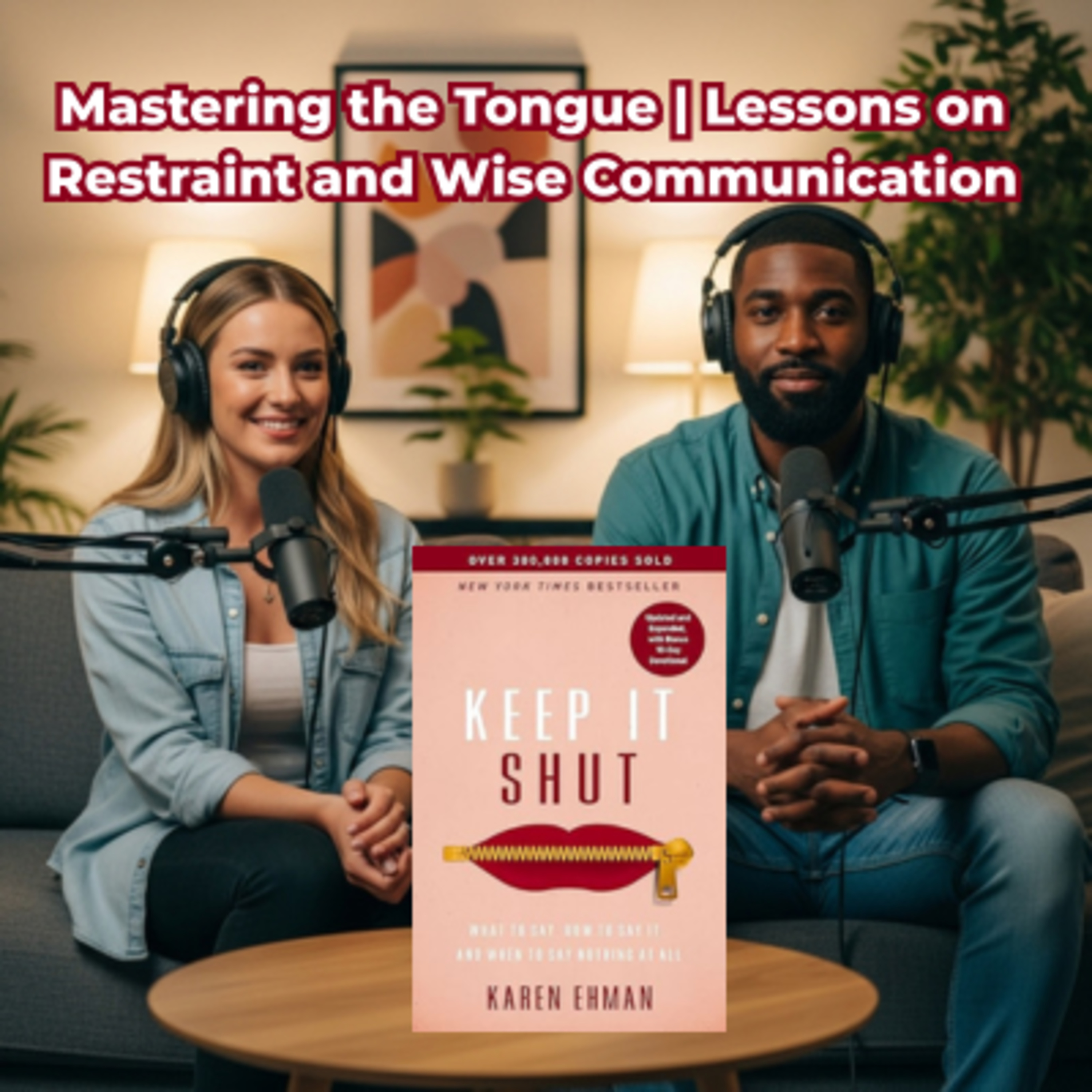
This episode provides a summary of Karen Ehman’s book, "Keep It Shut," which explores the immense power of human speech and the importance of verbal restraint. The author argues that words can either nurture relationships or cause destructive conflict, comparing careless remarks to a spreading fire. To improve communication, the source suggests practical habits such as pausing before responding, avoiding harmful assumptions, and evaluating one's underlying motives for speaking. It also warns against the dangers of online hostility and gossip disguised as concern, urging readers to prioritize honesty over people-pleasing. Ultimately, the material serves as a guide for anyone seeking to communicate with grace and use their words to uplift rather than harm others.
Gain practical insights into breaking habits of gossip, flattery, verbal retaliation, and people-pleasing in this encouraging and biblical resource on taming your tongue.
Got words? Oh yeah, you do! The average person speaks over 2.5 million per year--not to mention the ones they type online. In this fully updated and expanded edition of Keep It Shut, Karen Ehman--a woman whose words have often landed her in a heap of trouble (you'll find out more about that in chapter one)--shares the how's (and how-not-to's) of dealing with the tongue's enormous power.
Now with an all-important bonus chapter on how we talk to ourselves as well as a 10-day devotional on watching our words, including an explanation of a different biblical Greek or Hebrew word each day, Keep It Shut will teach you:
- The difference between gossip and properly processing with a trusted friend
- How to wisely use our digital tongues as we talk online or on social media
- How to pause before you pounce, attacking the problem but not the person
- How to avoid saying something permanently painful just because you are temporarily ticked off
- What the Bible teaches about making our speech laced with grace, as sweet as honey, and yet seasoned with salt
Using biblical examples as well as Karen's own personal (and sometimes painful!) stories, Keep It Shut will equip you to know what to say, how best to say it, and when you'd better just keep your lips zipped!#KeepItShut
#KarenEhman
#BookSummary
#BookPodcast
#PodcastRecommendations
#SelfImprovement
#PersonalGrowth
#CommunicationSkills
#EffectiveCommunication
#MindfulSpeaking
#ThinkBeforeYouSpeak
#WordsMatter
#PositiveCommunication
#EmotionalIntelligence
#RelationshipAdvice
#ConflictResolution
#LeadershipSkills
#CareerGrowth
#ProfessionalDevelopment
#BusinessBooks
#PersonalDevelopmentBooks
#FaithAndGrowth
#GraceFilledWords
#StopGossip
#HealthyRelationships
#PodcastClips
So picture this, you're sitting in a really high pressure meeting. Oh, we've all been there. Right. The fluorescent lights are buzzing, emotions are running super hot, and the stakes are just uncomfortably high. Yep. The tension is palpable. Exactly, and someone makes a comment that just rubs you the wrong way and before your brain can even like reach for the emergency brake you blurt out the exact wrong thing. Oh. Man, the worst feeling. You know it the second it leaves your mouth. Yeah, you feel that immediate sickening drop in your stomach.
Yeah, the temperature in the room just completely plummets. And suddenly you're looking down the barrel of weeks, I mean maybe even months of trying to fix the damage, and you're just desperately wishing that real life came with a Command Z undo shortcut. It is a universally agonizing experience, just that feeling of wanting to reach out and like, physically snatch the syllables out of the air before they hit the other person's ears. We have all been there, just staring at the wreckage of our own words.
Well, welcome to today's deep dive. It is Saturday, April 25, 2026, and our mission today is to shortcut those incredibly painful moments. That's a great. Mission You want to figure out how to master our words and honestly, more importantly, how to Mac draw our silence. Which is often the harder part. Oh, absolutely. So we're drawing from some really phenomenal insights in Karen Eamon's book, Keep It Shut. We're looking at how we can transform these potential relationship ruining disasters into real opportunities for connection.
Right, because since we don't have that rewind button, we have to figure out the preventative maintenance. So how do we stop needing that rewind button in the first place? That is the central question. And to understand that, we actually have to look at the mechanics of how a conversation spirals out of control. OK, we tend to think of arguments as these, you know, spontaneous explosions, but they actually follow a very predictable chemical reaction. Like a formula. Exactly. I mean, words are not like fire.
A well placed fire brings warmth, it brings clarity. It it lights up a room. But a? Careless Spark. A careless spark burns the whole house, right down to the foundation. OK, let's unpack this, because I really love the fire analogy. But a careless comment isn't just a metaphor, right? No, it's very real. It escalates so incredibly fast in reality, like dropping a match in a dry forest when someone throws A verbal jab. Our instinct isn't to sit back and observe it. Our instinct is to like, throw gasoline on it.
We want to fight back. Right, So how do we actually intervene before the forest burns down? What's fascinating here is the actual biology of a regretful comment. The antidote is what the source calls the power of the pause. The power of the pause. It sounds a little like a bumper sticker. It does, it totally does just pause. But we have to look at why it works on a neurological level. OK, I'm intrigued. When you are criticized or challenged, your brain's amygdala perceives it as a literal physical threat.
Wow, really? A physical threat. Yeah, it doesn't know the difference between a snarky Co worker and a predator in the wild, so it floods your system with cortisol and adrenaline. So that's why your heart rate spikes. Exactly. Your palm sweat, your heart races. You are in a state of biological hijack, totally preparing to fight or flee. So in that exact moment when you snap back at someone, it's not even really a rational decision, it's just a raw survival reflex. Precisely your prefrontal cortex, which is the logical, empathetic part of your brain.
It's temporarily offline. Oh wow it literally shuts. Down it goes dark. So when you force a pause, when you literally take a deep breath and wait, say, 6 seconds, yeah, you aren't just collecting your thoughts, you are giving your parasympathetic nervous system the necessary time to reboot. That is wild. You're putting out the biological fire so your rational brain can step back into the driver's seat. That makes so much sense. I mean, it's basically a physiological system override. That's a great way to put it.
Think about it. We all carry these ghost burns from arguments we had years ago, words someone threw at us in the heat of the moment that we still, you know, replay in the shower. Oh. Absolutely. The shower arguments are the worst. Right, that is the fire we are talking about. Think of a specific time someone said something hurtful to you during a fight. If that person had just taken a breath and stayed calm, their words could have actually addressed the underlying issue. Instead of just inflicting a new.
Wound. Exactly. A new wound that completely overshadows whatever the original problem even was. Yeah, the pause prevents the spark from becoming an inferno, but of course, the pause is just the emergency brake. Right, it stops the crash. It stops the immediate crash. But if we want to truly master our communication, we have to ask a much deeper question. Which is. Why are we walking around carrying books of matches in the 1st place like what is happening internally before the words even form on our tongues?
OK, so this gets into what the book calls the gap and our hidden motives. Yes, the gap is huge. AB points out that there is constantly a gap between what we know and what we don't know about other people's actions. Like if a friend cancels plans last minute with some vague excuse, there is a gap in our knowledge. We don't know the full story. Right, but I have to push back on this a little bit. The author frames this gap as inherently dangerous. Wait, isn't it just human nature to try and fill that gap?
Oh, it definitely is. Aren't my assumptions just my brains way of trying to protect me? You know, to solve the puzzle so I don't get blindsided or hurt. You're not wrong. It is absolutely an evolutionary survival mechanism to try and solve that puzzle. I mean, your brain despises a vacuum. It really does, but. Here is the critical flaw in that system. When you don't know someone's motive, your brain acts like the predictive text on your smartphone. Oh, I like that, the predictive text. Right. Think about how predictive text actually works.
It guesses your next word based on your past behavior. Yeah, if I'm always typing about being stressed, it suggests negative words. Exactly, your brain does the exact same thing with the gap. It auto fills the missing information based on your past traumas, your own insecurities, and your worst fears. Oh wow, so if your friend cancels, your brain's predictive text doesn't say oh, they must be tired from a long week. Right, it says they're secretly mad at you. They never liked you and you are going to end up entirely alone.
Wow it just auto fills with absolute garbage it. Auto fills with absolute garbage and then, and this is the tragic part, we react to the auto fill. We react to an invented reality. Yes, we start an argument based on a motive we completely made-up in our own heads, and that creates massive, unnecessary drama. So the strategy there is that instead of assuming the worst, we have to actively seek clarity. Cute clarity. Exactly. We have to ask questions to get the actual story rather than, you know, fighting a phantom.
Yes, you have to assume positive intent until proven otherwise, and that really requires checking your own internal dashboard. Checking your motives. You have to examine your motives before you speak. Like are you speaking to genuinely connect and understand or are you speaking out of jealousy? Or frustration. Right. Are you speaking out of a feeling of inadequacy and this is the hidden driver behind so many of our worst moments? Are you just speaking out of the selfish need to prove yourself right?
Oh man, that desire to be right is so intoxicating. It's a huge ego trip. It really is. If you can honestly audit yourself in the moment and say my intentions here are rooted in kindness, your words will naturally follow suit. Absolutely. Bowen pivot here because assumptions and bad motives are dangerous enough when we are sitting across the table from someone. But there is a specific environment where these internal triggers go completely off the rails. They become downright toxic. You're talking about the moments when we aren't looking someone in the eye.
Exactly. Here's where it gets really interesting. Let's talk about the danger of the screen. Oh, the digital Shields, yes. Our phones, our laptops, they act like this bizarre psychological invisibility cloak. That's a perfect description. They give us this wild illusion of anonymity and because we don't have to look at the person's face, we become incredibly careless. So. Careless, but the. Cruel irony is that while typing feels anonymous and fleeting in the moment, our digital words are actually the most permanent words of all.
Psychologists call this the online disinhibition effect, and it is the ultimate trap of modern communication. How so? Well, think about how empathy actually functions. Empathy requires a feedback loop. If we're talking face to face and I say something a little too sharp, I immediately see the micro expressions on your face. Right, you'd see my reaction. I see your eyes drop. I see your shoulder slump. And seeing that triggers something in you. Exactly. My mirror neurons fire. I literally feel a fraction of your discomfort and that biological feedback loop forces me to course correct.
You'd say, oh I'm so sorry that came out wrong. Yes, but when we communicate through a screen we strip away all the non verbal cues. There is no tone of voice, there's no facial expression. No immediate emotional feedback at. All, and without that feedback loop, empathy just plummets. We just hit send to get the frustration off our chest and it feels good for like about 3 seconds. Right, the immediate release. You type out that cold, passive aggressive e-mail to a colleague because you're annoyed, or you drop a sarcastic, hurtful comment on social media because you feel perfectly safe behind your keyboard.
You drop the match, but you don't stick around to watch the forest burn. Exactly, but the recipient still feels all the heat. The golden rule of communication in the 21st century really has to be this Online words are just as powerful as spoken ones, but they carry a much higher risk of collateral damage. That's a really important rule. You have to be just as careful writing on a screen as you are speaking to someone right in your living room. And that illusion of distance, that feeling of being insulated from the consequences of our words, it breeds another incredibly sneaky fire.
What's that gossip? Oh, yes. But the book highlights a very specific, insidious form of gossip. We aren't just talking about the cartoonish, whispering by the water cooler kind of gossip. Right, it's more subtle than that. We're talking about gossip disguised as concern. This is a fascinating behavioral quirk. It's when someone's personal life, their struggles, their private missteps are being dissected and broadcasted, but the person doing the broadcasting frames it under the pretext of care. Yes, in some social circles, the author points out, it's framed as a prayer request.
This one stings because it is so incredibly common. It is everywhere and it is so dangerous because the person spreading the gossip feels entirely justified. They feel morally superior, even. Easy. A man actually shares a visceral, personal anecdote about exactly this in the book. She recalls a situation where she was going through a really hard time and someone shared her private, vulnerable information publicly. Ouch, that's a massive betrayal. It really is now. The person doing the sharing genuinely seemed to think they were helping by spreading the word so people could support.
Her. But were they really helping? No, in reality they were just taking her deeply private life and turning it into public entertainment without her consent. It is such a profound violation of trust. Because if we really examine the motives going back to that internal dashboard we talked about, the motive wasn't actually about supporting her. Not at all. If you want to support someone, you call them privately, you bring them dinner. The hidden motive behind disguised gossip is actually the dopamine hit of sharing exclusive information.
It's the social currency. Exactly. Being the one holding the secrets makes you feel important. It makes you the center of attention in the group. It's social currency disguised as altruism. Yep, the rule here is incredibly simple, but very hard to practice. If it is not your story to share, the absolute best thing you can do is just keep to yourself. Period. Even if you think you are helping. Even then, just keep it shut. So what does this all mean? If we can't gossip and we can't lash out, what is the proactive strategy?
Right. What do we actually do? If we take away our digital Shields and we take away our fake concern and we recognize that our brains are constantly auto filling the gap with worst case scenarios, we are left totally exposed. We have to actually communicate genuinely. Exactly when the fire starts burning, what do we do? The antidote is a combination of creating space, whether through reflection or prayer, and making a radical commitment to honesty over people pleasing. OK. Let's talk about creating space First, there's this old children's rhyme the book references.
Prayer is the key, right? But the author applies it in a deeply practical way to our daily adult lives. She shares another experience where she was deeply, genuinely offended by someone. Which happens to all of us. And the immediate instinct, the fire, was to March over and confront this person, to just let them have it and frankly, to feel vindicated in doing so. The urge to strike the match and burn them down, right? But instead of reacting immediately, she forced the pause. She chose to hit pause and pray for wisdom first.
Which takes a lot of discipline. It really does. She's literally took a moment to ask for help so she wouldn't say the wrong things and permanently damage the relationship. And. What was the outcome? The result of that intentional space was that her eventual response was completely different. It was calm. It was compassionate and because of that she navigated a really difficult conversation and entirely avoided a massive conflict. If we connect this to the bigger picture, the mechanism here is universal.
How so? Whether you frame it as a quick prayer for wisdom, a moment of meditation, or simply taking a deep breath to center yourself, you are achieving the same critical goal. You are interrupting the cycle of reactivity. You're stopping the biological hijack. Exactly. When you are offended, your brain demands immediate action. Taking that moment to reflect lowers the alarm bells. It allows your higher reasoning to step in, so you can deliberately choose words that heal, rather than impulsively throwing words that hurt.
OK. I love the idea of creating space space. But this brings me to a part of the strategy that I really want to challenge you on. Bring it on. The final rule for mastering our words in the book is always choose honesty over people pleasing. Speak the truth gently, even when it's hard. Yes, radical honesty. But wait a minute, doesn't honesty sometimes start the exact fires we are trying to avoid? I can see why you'd think. That, let's be real for a second. If Gary from Accounting asks me if I like his agonizing 90 slide presentation and I absolutely hate it, isn't a small polite lie better?
You want to save Gary's feelings? Right Isn't saying looks great Gary a form of fire prevention? If I say no Gary this is a disaster I am starting a massive fire. Isn't people pleasing actually a communication tool to keep the peace? It absolutely feels like fire prevention in the short term, and that is exactly why we all do it. Because it's easier. But we have to look at the long term mechanics of a polite lie. Small lies do not extinguish fires, they just build up a massive cache of dry kindling for a much bigger explosion down the road.
Wait, how so? Let's use your example. If you lie to Gary to keep the peace, what happens? Gary keeps making 90 slide decks. Oh no, that's. True. You have to sit through them every single month. You start to resent Gary. You start venting to other coworkers about Gary's awful presentation. Which leads right back into the gossip we just talked about. Exactly. Oof, OK, that's entirely true. I didn't think about the ripple effect. When you tell a small lie to avoid hurting someone's feelings, or when you say yes to an obligation you genuinely don't want to do just to avoid the awkwardness of saying no, you are taking on a debt of authenticity.
A debt of authenticity. It builds resentment inside you and eventually people sense that lack of authenticity. It erodes the bedrock of trust between you and the other person. Because they know you aren't being real with them. Right. So who did that polite lie actually serve? It didn't serve Gary. No it didn't. It served your own desire to avoid a momentarily comfortable conversation I. Hate how much sense that makes. Yeah, we trade long term trust for like 30 seconds of short. Term comfort. Precisely.
The key insight we have to grasp is that honesty and kindness are not mutually exclusive concepts. We treat them like they are though. We treat them like complete opposites, but they aren't. You can be entirely truthful and entirely kind at the exact same time. So what do I say to Gary? You don't have to tell Gary his deck is a disaster. You can say, Gary, I love the data you've gathered, but I think we'd lose the audience's attention after slide 20. Let's condense it. That is gently sharing true thoughts.
Exactly. It will absolutely feel uncomfortable in the moment. Your heart rate might still spike, but that discomfort is just the friction of growth. Or friction of growth I like. That substituting a comfortable lie for uncomfortable honesty is always a bad trade. Over time, practicing kind honesty builds vastly stronger, far more genuine relationships. Because people learn that your yes actually means yes and your no actually means no. It builds a reputation of total integrity. So as we pull all of these threads together, the mission of this deep dive was to figure out how to stop needing the rewind button.
And it all boils down to an incredible shift in perspective. It's a checklist we can all use. We have to recognize the biological fires and force the pause. Step one. We have to stop letting our brains predictive text invent bad motives for the people around us. Don't assume the worst. We have to reflect and check our own motives. We need to strick away the invisibility cloak of our digital screens and remember the human on the other side. Be kind digitally. Avoid the disguised gossip and finally be brave enough to trade the cheap comfort of people pleasing for the deep value of kind honesty.
Choose words that heal. It's about recognizing that our words are active tools. They are the mechanisms we use to either build our relationships up or tear them down. This raises an important question, and it's the final thought I really want to leave with the listener today. Let's hear it. It builds perfectly on this entire idea of examining our motives and mastering the profound power of silence. OK. We spend so much of our lives reacting. We spend so much energy trying to defend ourselves, trying to win the debate, trying to prove that we were right and the other person was completely wrong.
It's exhausting. It is, but the next time you find yourself an in a heated moment, whether you are staring at a screen or sitting across the table. The next time you feel that urgent burning biological need to jump in and prove your point. Pause. Take a breath. Take a breath and ask yourself this one question. Are you trying to win an argument or are you trying to win the relationship? Because if your goal is truly to win the relationship, sometimes the most powerful, the most profound, and the most healing thing you can possibly say is absolutely nothing at all.
Winning the relationship over winning the argument that changes the entire paradigm of how we interact. Thank you so much for exploring this with us today. It was a pleasure. We hope you take these insights, these new tools for your internal dashboard into your week. The next time you find yourself in a high pressure meeting or drafting a really heated e-mail, remember the power of the pause. You won't ever have to wish for that rewind button again. Have an incredible weekend and we will catch you on the next deep dives.
 Apple Podcasts
 Castbox
 Castro
 Goodpods
 Moon FM
 Overcast
 Pocket Casts
 Podbean
 Podcast Addict
 Podcast Republic
 Spotify