The Power of Becoming a Divine Answer | Solution Driven Destiny by Rich Miller
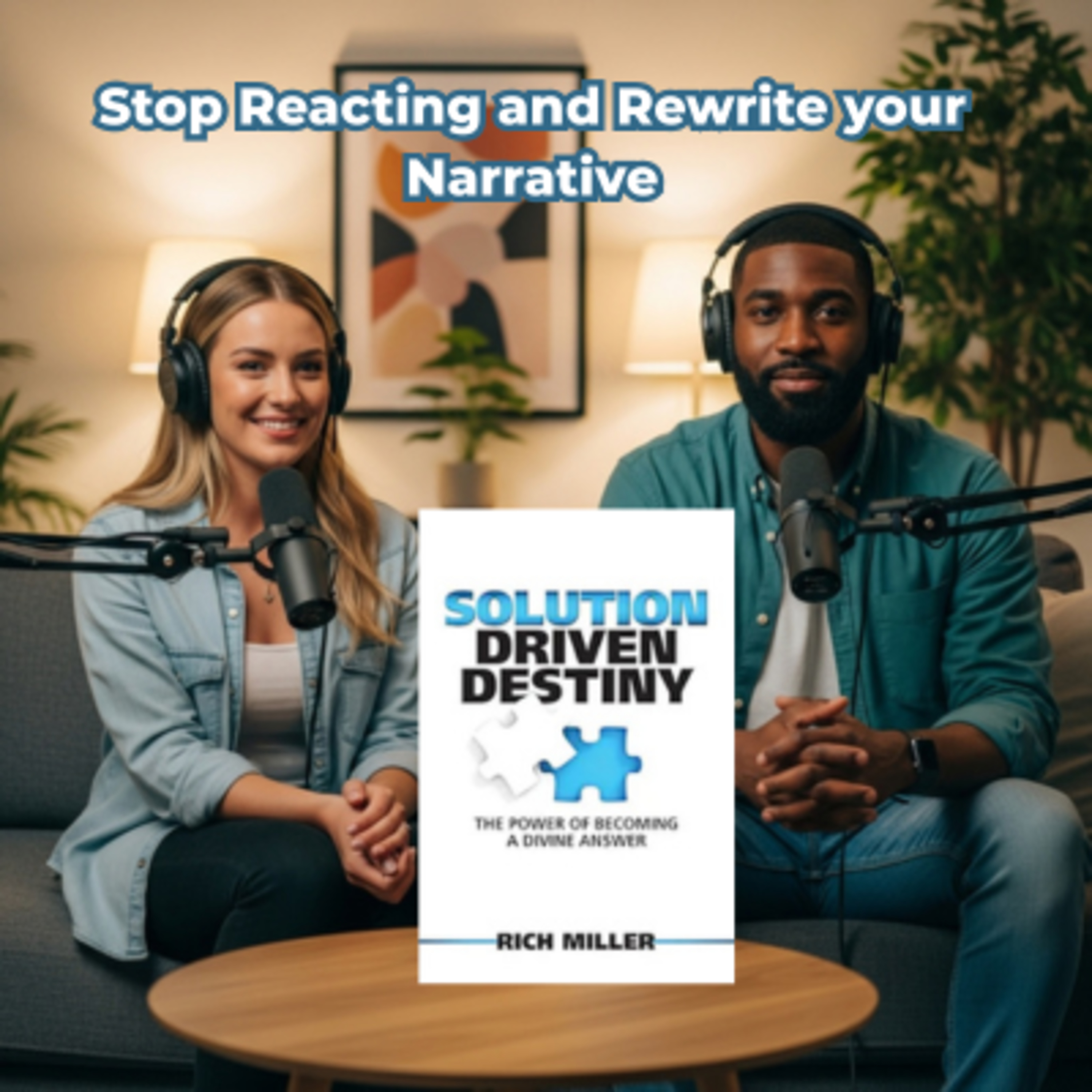
Your crisis did not take God by surprise—what if He sent you to transform the situation with anointed solutions to the world’s problems?Your destiny is so much more than personal fulfillment or living your dream. Your destiny is about bringing heaven to earth; it’s about advancing the kingdom of God, and about exercising dominion over creation. You are a divine answer! Rich Miller helps you assess and acknowledge the season you are in and view it from a fresh perspective. What are you trying to accomplish that is not productive in this season? What are you anointed to do in this season? When you surrender to your season, question your crisis, and submit to God’s positioning, an amazing thing happens—you begin to function inside your unique God-ordained assignment and walk in purpose like you have never before experienced! You are the extension of Christ in the earth. Isn’t it time you engaged with your SOLUTION DRIVEN destiny?
The episode outlines a transformative self-help framework from the book "Solution Driven Destiny," which encourages readers to transition from a victim mentality to a proactive mindset. Through an overview of various chapters, the sources explain how individuals can leverage personal strengths and shift perspectives to view life's obstacles as essential opportunities for growth and refinement. The material emphasizes the importance of embracing different seasons of life, letting go of outdated habits, and aligning personal actions with higher moral values. Key strategies include critically analyzing crises to find hidden advantages and maintaining flexibility when faced with unexpected calls to action. Ultimately, the text serves as a guide for taking control of one's future by recognizing the purposeful role that both success and struggle play in reaching a greater destiny.
#productivityhacks #personaldevelopment #successstrategies #businessinsights #leadershipskills #leadership #ambitiousprofessionals #businesstips #self help #scaling business #businesstactics #professionaldevelopment #startupgrowth #entrepreneurship #businessmindset #growthstrategies
Have you ever felt like you're, I don't know, just blindly reacting to life's plot twists instead of actually writing the script yourself? Oh yeah. I think everyone knows that exact feeling. Right, you wake up, you have this totally solid plan for the week, and suddenly you're handed a storyline you absolutely did not ask for. Like a massive set back at work or a sudden financial hurdle out of nowhere. Exactly. Or even just a bizarre relationship conflict. And in those moments, it genuinely feels like you're just a background extra in your own movie, just getting tossed around by the whims of some unseen director.
It's an incredibly common feeling, yeah. And honestly, well, it's how most of us are wired to operate by default. We tend to think of our circumstances as things that just happened to us. Like we're just innocent bystanders. Yeah, exactly. We view our environment as something fixed and ourselves is simply reacting to. But that passive approach is, I mean, it's dangerous. It leaves us entirely at the mercy of whatever random obstacle pops up next. Totally, and that is exactly what we're tackling today in this deep dive.
We're looking at the core concepts from the book Mastering Your Narrative, The Solution Driven Destiny Guide by Rich Miller and Wendy K Walters. It's a fascinating text. It really is. And the mission for you, the listener, is simple today. But it's massive. We are going to extract the exact blueprint for turning your biggest, most frustrating obstacles into incredible opportunities for growth. And we really need to establish right away that this material isn't about, you know, wishful thinking. We aren't talking about manifesting good vibes or just putting on a forced smile.
Right, no toxic positivity here. None at all. The framework we're exploring today is highly practical. It's about understanding the actual mechanics of the situations you find yourself in, analyzing your challenges objectively, and fundamentally shifting the way you operate in the world. OK, let's unpack this. Because before you can rewrite your narrative, you have to acknowledge who is actually holding the pen and, well, you also have to honestly assess the current chapter you're in. Which is often the hardest part.
Yeah, the material argues in chapter one that the very first step is outright rejecting the victim mentality. Instead of seeing ourselves as powerless, we have to shift our mindset to see ourselves as a proactive part of the solution. Which is without a doubt the hardest step for most people, and there's a real psychological reason for that. Walk me through that. Why is it so hard? Well, playing the victim isn't necessarily a conscious choice, right? It's often a defense mechanism. If you aren't responsible for the problem, your brain tells you that you aren't responsible for the solution.
Which saves cognitive energy. Exactly. It feels safer, It's lazy, but it's safe. But taking control means accepting responsibility, not necessarily for the cause of the problem, but for your response to it. Right. True empowerment comes from acting rather than reacting. Yeah, it means looking at the obstacle, assessing it, and actively seeking solutions by leveraging your unique strengths. And that leads right into Chapter 2, this whole concept of surrendering to the season you're in. The book heavily references Kevin D Johnson here, pointing out that every season has a specific purpose.
Whether it's a period of stability, a period of massive growth or, you know, a really difficult grinding struggle. Yeah, you have to actively interact with your situation rather than fighting the fact that you're in it. It actually makes me think of Agps navigation system. I like that. How so? Well, you can program in the most amazing, beautiful destination in the world, right? But the system absolutely cannot route you there unless it can ping the satellite and lock in your current exact location.
That is a perfect mechanism to visualize it, right? If you lie to the GPS about where you're starting from, or if you just block the signal entirely, the algorithm just spins. You're never going to get those step by step directions out of there. You literally cannot calculate a route out of a difficult season if you refuse to transmit your actual coordinates. Accepting where you are allows you to stop wasting energy fighting the existence of the problem. Because it's already there. Exactly. You redirect that energy toward navigating it, which requires an immense amount of patience.
But the sources get incredibly specific about these locations in Chapter 3. They categorize the settings we find ourselves in as palaces of prosperity, prisons of limitation, and pits of despair. The three PS Yeah. Now I have to push back on this a little bit because it's incredibly easy to actively interact with the Palace of Prosperity. Everyone wants to be in the palace. Naturally, yeah. But how do you actively interact with the pit of despair without just wallowing in it? I mean, when you fall into a pit, your nervous system's instinct isn't to sit down and look for a life lesson.
No, not at all. Your instinct is to panic, scream for help, and just claw the dirt. What's fascinating here is that we often misinterpret what these difficult environments actually are. Pits and prisons aren't meant to be punishments in this framework, they're actually viewed as. Incubators. Incubators like like for premature babies. Exactly like that. Think about it. An incubator is a highly controlled, often isolated environment designed to force development that couldn't happen out in the regular world.
Oh wow. OK. A pit of despair or a prison of limitation operates the exact same way. It's an environment specifically designed to teach you resilience and adaptability by basically stripping away your usual comforts. So it's forcing you to adapt, right? If we connect this back to being the solution, you can't leverage your strengths to climb out of the pit if you're burning all your oxygen screaming about how unfair it is that the pit exists. Because you're wasting energy. Exactly. Acknowledging your setting allows you to look at the walls objectively and say, all right, what's the structural integrity of this jerk?
What tools do I have in my pocket to dig? You stop fighting reality and start manipulating. It OK, so you've locked in your GPS location, you've accepted that you're currently sitting at the bottom of a damp, dark pit and you're taking responsibility for the climb out, right? The next logical question from chapter 6 is how do you strategically handle that crisis to find your way out? And the text argues that you shouldn't just react to a problem, but critically analyze it. You have to question your crisis.
Which goes right back to overriding that panic response you mentioned earlier. When a crisis hits, the instinct is to be overwhelmed by the pure emotion of it. Of course. But we're urged to objectively examine the circumstance, asking questions like what exactly caused this mechanical failure, or how is this specifically affecting my resources right now? Gathering data, essentially. Yeah, what data can I gather from this? And they pair this with the concept in Chapter 4 that there's always another side, that there's a solution for every challenge and a silver lining to every set back.
Now here's where it gets really interesting. OK, because I can hear you, the listener right now, just rolling your eyes. Finding a silver lining sounds fantastic on a motivational poster in a corporate break room. Oh, absolutely. But when you are in the thick of a genuine crisis, say your business just went under, or you know you're facing a serious health scare, a forced optimistic outlook doesn't just feel impossible, it feels insulting. Yeah, it really does. Like if I'm bleeding in a pit and someone yells down to me to find the silver lining, I am throwing a rock at them.
Which is a completely justified reaction. And that's exactly why we need to clearly distinguish between what this framework is suggesting and what we call toxic positivity. Right, because they are not the same thing. Not at all. Questioning the crisis is absolutely not about slapping a fake smile on a terrible situation or pretending it doesn't hurt. It is purely about data collection. Data collection. Walk me through how that actually works in the brain when you're, you know, panicking. Sure. So when you panic, your brain's amygdala is essentially running the show.
It's all emotion, all fight or flight. Right, survival mode. Exactly. You physically cannot problem solve in that state, but by forcing yourself to ask specific analysis political questions about the crisis, you're requiring blood flow to move to your prefrontal cortex. Oh, the logical part of the brain. The logical problem solving part of your brain? Yeah, every set back has a mechanical reality, A process failed, a market shift at a communication broke down. So when you look for the other side, you aren't looking for a reason to be happy.
No, you are objectively examining the mechanics of the failure. So you're basically treating your own disaster like a crime scene investigator. Precisely. You're looking at the wreckage and asking, what can I learn from these structural weak points? Identifying that lesson naturally reveals the hidden opportunities for advancement. I see. The silver lining is just the newly created space for improvement that didn't exist before the collapse. It forces you to be adaptable to the new possibilities that have arisen because of the difficult situation, not in spite of it.
OK, I actually really like that distinction. It's less about feeling warm and fuzzy about the crisis and more about coldly mining it for useful intelligence. Exactly. It's highly pragmatic. You're saying this is agonizing, but what valuable data can I pull from the rubble to make sure it never happens again? Makes a ton of sense, but mastering your internal mindset and dissecting your own crisis is really only half the battle. Right, because you don't live in a vacuum. Exactly. You still have to step out your front door and deal with the external world, and the external world is largely made-up of frustrating people and stubborn, outdated systems.
It really is the ultimate stress test of this entire mindset shift. You can be perfectly centered, fully proactive, mining all your crises for data, but you still have to interact with an environment that might be entirely reactive and chaotic. Colleagues, family members, institutions, all of it. Yeah. And the sources offer two incredibly useful frameworks for navigating all this external clutter. The first, from Chapter 7 revolves around the idea that children will be children. It tackles the reality that people frequently act in ways that directly correspond to their developmental stage.
Basically, you have to manage your expectations when people fall short of your standards and just exercise profound patience. Because if you expect everyone around you to operate at your exact level of understanding, maturity, or, you know, proactivity, you're going to spend your entire life bitterly disappointed. Yeah, you'll just be angry all the time. People are constantly in flux. They're always changing in growing at different rates. The solution driven approach here isn't to react with anger when someone drops the ball.
It's to understand their current capacity. Right, and offer guidance instead of judgement. It's basically treating them like they're in their own specific season and adjusting your GPS to meet them there. Exactly. You provide constructive feedback, recognizing that everyone's learning curve looks different. But then we hit the second external hurdle, which is much trickier, and that's the systems themselves. Chapter 8 introduces this concept of tabernacles. Yes, the Tabernacles. A Tabernacle in this context, is an antiquated institution, a company policy, or a societal custom that people cling to simply because they're used to it.
Right. It no longer serves any useful purpose, but it's treated as sacred. And the mechanism behind this right is that human beings are essentially prediction machines. We inherently crave the familiar because our brains want to conserve energy. We will hold on to outdated structures because the known, even if it's wildly inefficient or detrimental, feels neurologically safer than the unknown. But the text is uncompromising on this. These outdated methods actively hinder your growth. You have to evaluate and discard these antiquated structures to make room for fresh development.
You know, it makes me think of like keeping a bulky old VCR taking up space in your living room. Oh. That's a great comparison. Right. You don't own any VHS tapes anymore, but you keep it plugged in just because you know how the buttons work. Or it's corporate phantom limb syndrome. Phantom limb syndrome. I like that. Yeah, you see this in big companies all the time. The entire organization is bending over backwards, wasting hours of time and thousands of dollars to accommodate a department or a reporting process that effectively died five years ago.
They still feel the pain of it, they still try to use it, but it's just empty the air. Exactly. It's taking up valuable real estate. But here's my question for you. How do you know the difference between a tradition that is just a useless Tabernacle phantom limb and a tradition that is actually a valuable load bearing foundation that you need to keep? If we connect this to the bigger picture, adaptability is your ultimate filter. OK, how so? The way you evaluate a practice or structure is by holding it up against your current specific goals.
Does this custom, this weekly meeting, this institutional habit, actively support the exact place you were trying to go? So you measure it against the destination. Right. If it's hindering your current trajectory, or if the only justification for keeping it is, well, that's just how we've always done it it. It's a Tabernacle. And there's a brilliant parallel to draw here between these two external factors we just discussed. Oh really? What is it? The sources are essentially teaching us to have immense patience, tolerance and empathy for people who are still growing and making mistakes.
Right, the children will be children concept. Exactly, but we are told to be entirely ruthless when it comes to discarding outdated systems and practices. Protect the people, but destroy the Tabernacle. Wow. Protect the people, destroy the tabernacles. I love the clarity of that rule. It really clears away so much of the daily friction. It really does. And once you've done that, once you've aggressively cleared away those outdated systems and you've appropriately adjusted your expectations of the people around you, the path is suddenly completely clear for you to step into what the text calls your actual unique calls.
Which brings us to chapters 9 and 10 and this concept of peculiar positioning. Peculiar positioning, yeah. This is the idea that every individual has specific, unique traits that make them stand out. The framework strongly encourages us to deeply value and leverage our weirdest viewpoints and strengths. Especially the ones that appear unconventional or out of the ordinary. Right? Exactly. So what does this all mean in practice? To me it sounds like having a highly specific kind of weird superpower.
That's a good way to look. At it. Imagine spending your whole life trying to sand down your rough edges, trying to hide this peculiar trait just so you can fit in with the corporate culture or societal expectations. Which is what most people do, right? Only to finally realize that the this exact weird trait is the specific tool required for your ultimate mission. That's exactly how it works mechanically. Think about it, Conventional traits are already automated. They are crowded out by everyone else doing the exact same thing.
Right. The market is saturated with conventional yes. But when you encounter novel situations, rapid changes, or unforeseen challenges, which is what the concept adapt to the call in Chapter 10 is all about, the conventional approaches fail. Because there's no playbook for it. Exactly. The peculiar trait is the only thing that works. Your peculiar positioning gives you a unique vantage point, and your flexibility allows you to rapidly execute on it. You assess the bizarre new situation, and because you aren't bogged down by those tabernacles, you can adjust your approach at lightning speed.
This raises an important question though, for anyone engaging with this material, what is the ultimate point of taking charge of your destiny? Is it just to be a hyper efficient, adaptable CEO? Right. What's the end game of all this self mastery? Because it sounds very self focused at first. The end game, which they refer to in chapter 5 as Living after God's Heart, is that this shouldn't merely be for selfish interests or personal gain. The ultimate goal is to align your life and your choices with ideals that represent a higher, constructive calling.
When you combine your weirdest, most unconventional traits with your newly trained ability to adapt and problem solve, you are uniquely equipped to serve a greater purpose. It transforms this entire journey, doesn't it? Completely. It takes it from basic ego driven self improvement into a mission to make a vital impact on the world. You're building trust, acting with profound integrity, and achieving a level of fulfillment that a purely selfish pursuit could never provide. It's a complete paradigm shift from where we started.
I mean, we've covered so much ground today, and the journey you take through this framework is intensely practical. It's a very logical progression. It is. You start by looking at your exact GPS location, whether it's a season of growth or a literal pit of despair, and you own your role as the proactive solution. You stop letting the amygdala panic during a crisis and start forcing the prefrontal cortex to extract the data. You learn to extend deep developmental empathy to the people around you while simultaneously being absolutely ruthless about dismantling the outdated Tabernacle systems that slow you down.
Protect the people, destroy the Tabernacle. Exactly. And finally, you embrace your weird, unconventional superpowers to answer a calling that transcends your own self-interest. It's a highly robust blueprint. The underlying mechanism from start to finish is moving from passive reception to active participation. You are no longer just letting the movie play. You are the one evaluating the scene, adjusting the lighting, and moving the plot forward with purpose. Every challenge truly is just raw material for you to build with.
Now don't just sit there letting this information fade away. Take what you've learned today and start applying it. Look at the biggest obstacle in your life right now through this new analytical lens. Your destiny is quite literally in your hands. But before we leave you, we want to offer one final lingering thought that builds on what we've discussed today. Something to really chew on. Yeah, we spent a lot of time today talking about ruthlessly dismantling those outdated tabernacles in our workplaces and our communities.
But consider this what if the biggest, most stubborn Tabernacle holding you back isn't an external institution at all? Oh, that's an interesting thought. What if the prison of limitation you were sitting in right now was actually built by your own outdated expectations of who you were supposed to be 10 years ago? It's entirely possible that the most restrictive system you need to tear down is the narrative you've been telling yourself about yourself. Thank you for joining us on this deep dive. Keep learning, keep questioning the mechanics of everything around you, and keep master your own narrative because you shouldn't just be reacting to the plot twists.
It's time you start writing the script yourself.
 Apple Podcasts
 Castbox
 Castro
 Goodpods
 Moon FM
 Overcast
 Pocket Casts
 Podbean
 Podcast Addict
 Podcast Republic
 Spotify