Victory Through Organization by Ulrich | Why the War for Talent is Failing Your Company and What You Can Do About It
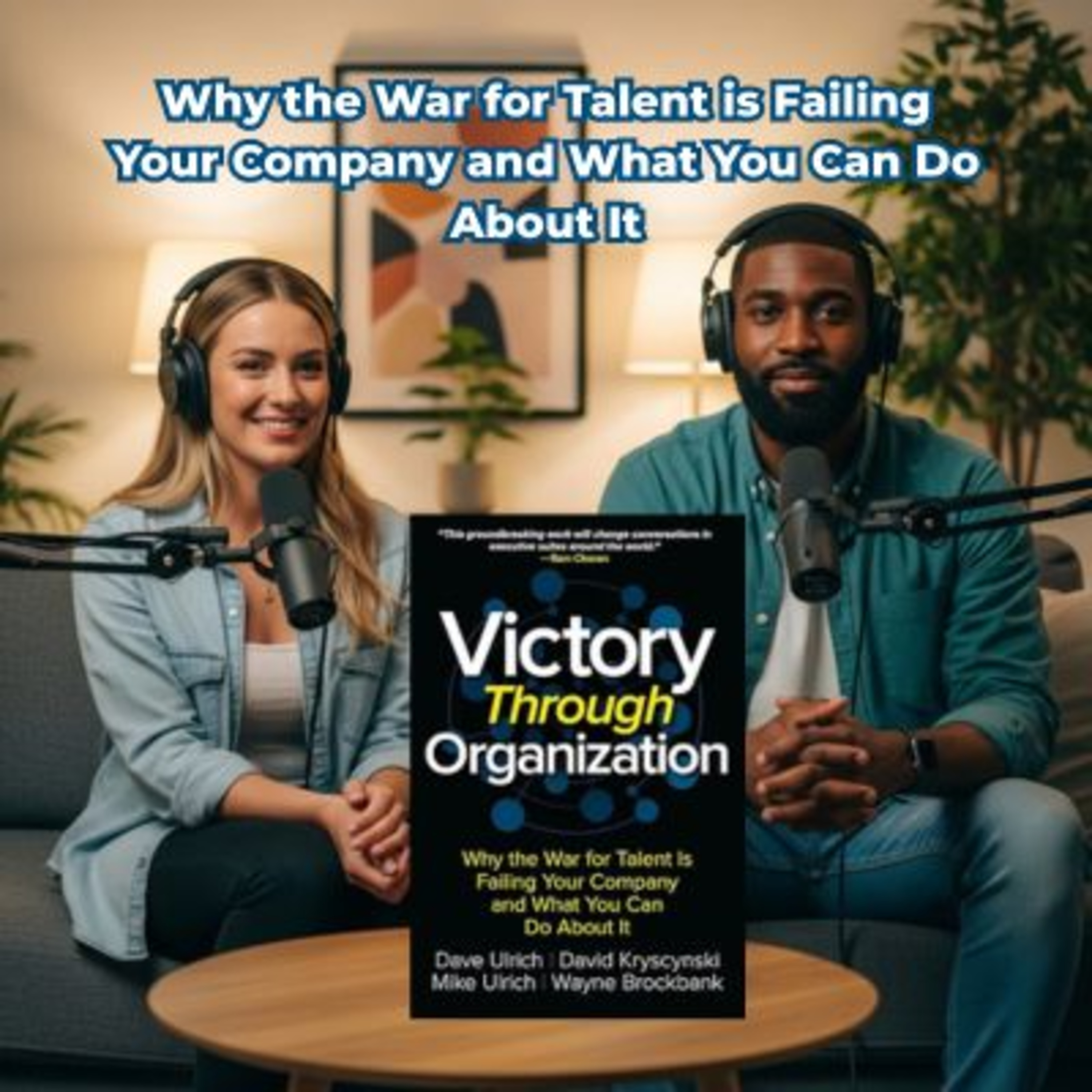
“HR is not about HR. HR begins and ends with the business.”
The RBL Group and the Ross School of Business at the University of Michigan have shaped much of the HR profession for 30 years through the Human Resource Competency Study (HRCS). With this latest (7th) round of research, Dave Ulrich, David Kryscynski, Mike Ulrich and Wayne Brockbank call for us to pivot from fighting the “war for talent”―to creating victory through organization.
Sure to be an HR classic, Victory Through Organization provides the rationale for shifting your focus from how to help individuals prosper to the organization. Filled with fact-based insights and field-tested strategies, it demonstrates that organizational success isn’t just about the talent you have―it’s about how the collective organization makes the individual talent better. To this end, HR professionals and business leaders will learn:
• How they can ensure that organization creates greater value than the sum of individual talent parts.
• How to create more integrated HR solutions for business results across multiple stakeholders
• How HR departments can better create a comprehensive information advantage
• How HR professions can master the competencies that have greatest impact on their personal effectiveness, key inside and outside stakeholders, and business results
Victory Through Organization offers tools business leaders and HR professionals need to better respond to emerging opportunities, and it provides expert advice for building HR departments to deliver measurable business value. You will learn how to build organization capabilities, strengthen systems, and empower human capital―for longer lasting success.
Building and retaining a solid, talented workforce is a great thing. Creating the competitive organization that wins is even more important for business results.
This episode provides a summary of Victory Through Organization, a book that argues for shifting the focus of human resources from individual talent to organizational capability. The authors suggest that a company’s internal systems and structures are more vital for success than the brilliance of a single employee. By integrating HR strategies with business analytics, departments can move beyond administrative tasks to become proactive strategic partners in a company's growth. The source highlights that creating a supportive corporate culture ensures that high-performing workers are given the environment necessary to thrive. Ultimately, the text illustrates that data-driven decision-making and cohesive teamwork are the primary drivers of sustainable competitive advantage.
#Leadership #HRStrategy #BusinessStrategy #OrganizationalCulture #FutureOfWork #Management #TeamPerformance #BusinessLeadership #WorkplaceCulture #HumanResources #CorporateStrategy #LeadershipDevelopment #BusinessPodcast #BookSummary #OrganizationalSuccess
You know that incredibly specific, deeply frustrating feeling of finally hiring a true rock star? Oh yeah, the absolute relief. Right. You know the type. Someone who just completely blows you away in the interview. They have the perfect resume. They seem like the exact missing puzzle piece for your team. You bring them on board. You breathe this huge sigh of relief, and then you just watch them walk out the door. Six months later, it's. Devastating. It really is. It's this universal pain point. Like whether you are managing a small scrappy team or you know, scaling a massive tech startup, or even just trying to survive the latest corporate restructure, the sheer exhaustion of struggling to attract and keep truly outstanding employees is very real.
Oh, completely. And I think the worst part is the traditional sort of old school personnel management approaches, the ones companies have relied on for literally decades, they are completely failing us today. They just do not work anymore. They are failing spectacularly. I mean, it's a systemic failure. And that is exactly what brings us to our focus for this deep dive today. We are looking at a brilliant road map for this highly specific problem, and we're drawing this from the book Victoria Through Organization by Dave Ulrich, David Krasinski, Wayne Brockbank and Michael Rich.
Which is a fantastic resource. It really is. And the mission for our discussion today isn't just to, you know, summarize a business book. It's to really dissect their core insights and uncover the actual mechanical blueprint for building an organization where talent doesn't just survive the onboarding process, but actively thrives. Right. We want them to thrive. Exactly. We are moving entirely past gut feelings and guesswork, and we are going to look under the hood at the hidden mechanics of successful companies.
OK, well let's unpack this because this is not going to be some dry theoretical business lecture. Definitely not. This is really about realizing that we have probably been looking at the whole concept of quote UN quote talent completely backwards. The authors start with a concept that, honestly, it stopped me in my tracks because it runs counter to, well, pretty much everything we are taught in corporate culture. It really does. They argue that individual brilliance, that Rockstar quality we all obsess over and frankly pay top dollar for, is actually significantly less important than the organization itself.
What's fascinating here is just how profound a shift in perspective that actually is because I mean, we are so culturally conditioned to worship the superstar employee. Oh yeah, the lone genius. Right. We love that narrative of the lone genius who is going to swoop in, disrupt the whole industry and just save the quarter all by themselves. The superhero complex. Exactly. But the authors present a hypothetical scenario that perfectly dismantles why this is basically a myth. So they introduce us to an employee named Sarah.
OK, now Sarah is the ultimate dream hire. She is astute, she is highly agile in her thinking, and she is exceptionally skilled in her specific. Field, so she has it all. She possesses all the raw aptitude you could possibly ever want on your payroll. She is the candidate you absolutely fight your competitors to hire. Like you're offering huge signing bonuses just to get her in the door. Right. And let's say you win that fight. But here is the critical variable. Sarah goes to work for your company, an your company is fundamentally disorganized.
Oh no, the internal communication pipeline's are a complete mess. Middle management is totally unequipped to support the staff and the daily procedures are just chaotic. Yeah, we've all been there. So what happens? Sarah's immense, undeniable talent is completely neutralized. Wow. The book makes it abundantly clear that the organization's mechanism is the ultimate decider of whether she succeeds or fails. Her individual aptitude simply cannot outperform A structurally broken system. OK, so let me push back on this a little bit, or at least try to ground it.
Are we saying individual talent is just useless? Well, no, not useless. Should we just stop trying to hire the best people and settle for mediocrity because the system is all that matters? Because that feels like a massive overcorrection. It would be. Yeah, the way I'm picturing this dynamic and tell me if this tracks, it's like buying a world class multimillion dollar Formula One engine. I like where this is going. Right. That engine represents Sarah. It is brilliant. It is powerful. It is a literal marvel of engineering.
OK, but if you take that Formula One engine and you drop it into a rusty, broken down tractor with flat tires and a busted transmission, the engine is still brilliant. But the machine as a whole is going to fail. You aren't going to win any races. I'd actually take that analogy even further, because it perfectly captures the underlying mechanics at play here. Oh really? Yeah, because that Formula One engine cannot operate in a vacuum. It requires a highly specific chassis, finely tuned aerodynamics, and a transmission capable of translating all that raw power into actual forward momentum.
Right. In a business context, your transmission is your internal communication structure. The chassis is your operational workflow. OK, that makes. Sense if the chassis is rusted out, like if teams are siloed, if approvals take three weeks, if goals are unclear, that brilliant engine just vibrates itself to pieces. Oh wow, vibrates itself to pieces. Exactly. And that vibration is what we call employee burnout. Oh, that's such a good way to put it. So why does the organization trump the individual?
Because an organization is a complex system of interconnected parts, and if those parts are misaligned, they create friction. Friction destroys momentum absolutely, regardless of how much raw horsepower you apply. To it. So instead of just obsessing over buying the most expensive engine, we have to look at the whole vehicle. We have to make sure the wheels are actually connected to the steering wheel. Yes, the focus has to fundamentally shift toward creating the strong structures. We are talking about transparent communication pipelines, supportive management frameworks and procedures that enable everyone to succeed collaboratively rather than, you know, competitively, right?
The authors point out that while individual stars are fantastic, a cohesive team operating within a well oiled machine is practically invincible. Let's look at another example they provide which you see constantly today. Go managing a tech startup. Oh, startups are the classic breeding ground for this exact problem. You have a bunch of brilliant people moving way too fast and breaking things. Exactly. So imagine you recruit the absolute most talented software developers in the world. They are literal coding prodigies.
The Dream Team. But you drop them into a startup environment that lacks a solid project management system and well defined strategic objectives, they will struggle instantly. Because they don't know what to build. Right, because there is no workflow. They will be writing brilliant, elegant code for features that the customers don't even want. Or they will be accidentally duplicating each other's work because they have no mechanism for communicating their daily progress. The total waste of talent.
But the moment you implement clear procedures, say a defined agile workflow where dependencies are mapped out, those exact same developers can suddenly work efficiently, they interact seamlessly with the rest of the team, and they actually drive the expansion of the business instead of just generating disjointed lines of code. Because you finally build the transmission that connects their engine to the wheels, you elevated the entire squad, not just the standout players. The talent doesn't have to fight the system just to get their job done anymore.
The system actually carries the talent forward. And when you have the proper setup, talent naturally pours into the organization because high performers want to work where they can actually be effective, and more importantly, they stay. The collective output just rises exponentially. OK, so if the machine, the organization itself, is what guarantees this success, it begs a pretty massive, unavoidable question, which is who is actually responsible for designing and maintaining that machine? Yes. And this leads us to a major revelation, the source material, one that completely redefines the role of human resources.
If we connect this to the bigger picture, this requires a major mindset shift for a lot of companies. Historically, and even in a lot of modern corporations today, HR is viewed as a strictly administrative function. Yeah, they are compliance officers. They are the paper pusher. I mean, let's be honest, you go to them when you need to sign your tax forms, when you need to update your direct deposit or unfortunately, when someone is getting fired and you need someone to handle the legal paperwork.
Right Recruiting, dismissing, and mitigating liability? Exactly. But the authors argue that to deliver true corporate value, HR strategies must be deeply integrated into the business model itself. Every single aspect of HR procedures, from the initial hiring process and onboarding to ongoing performance views and leadership development, has to function as 1 cohesive unit. You really cannot treat them as isolated administrative tasks. Look, I hear what you're saying about integrated HR, but let's be real for a second.
Every HR professional in LinkedIn says they need to seat at the table and that they are strategic partners. Sure, but most founders and CEO's view HR as a cost center. They view them as overhead. Yes they do. If I'm ACEO driving a fast-paced startup, my engineers are building the product, my sales team is bringing in the revenue, How do you convince me that HR isn't just going to slow down my agile company with a bunch of corporate red tape? Well, I'd actually argue that viewing HR as a cost center is a symptom of structural blindness.
Oh, interesting. That red tape you're talking about is what happens when HR is forced to be purely reactive. The authors use a brilliant metaphor here. Well, let's hear it. They say traditional HR is just there to patch the sail when it rips in the middle of a storm, but a strategic HR department is there to help navigate the entire vessel. To do that, they have to deeply understand the company score mechanics. They need to know exactly what generates revenue, what the major operational bottlenecks are, and what the five year objectives are.
Let's look at the company expansion example the authors provide because it perfectly illustrates the financial difference between reactive and proactive HR. Here is where it gets really interesting because this is where the rubber meets the road for a lot of leaders. Exactly. So the old reactive way looks like this. The executive team decides to massively expand the business. They map out the new markets, They secure the venture funding. And then at the very last minute they knock on HR's door and say, hey, we need you to hire 50 new engineers by next month.
Oh my God, an HR nightmare. It is a frantic, chaotic scramble. HR is entirely on the back foot. Which means they're just trying to fill seats. They aren't looking for cultural fits. They are probably inflating salaries just to lure people away from competitors quickly and they are essentially panic buying talent. And that panic buying destroys your margins and your culture right now. Contrast that with the integrated strategic approach. In this model, hour is involved from day one. When the expansion is just a vague ID on a whiteboard.
HR is in the room A. Seat at the table. Yes. And they aren't just taking orders, they are connecting capacity analysis. They are looking at the middle managers and saying look, if this manager with five direct reports suddenly has 15, they will burn out in three months. Wow. So they are looking ahead. Exactly. So six months before the expansion even happens, HR is building a leadership training pipeline. They are forecasting specific talent requirements and prepping the company culture to scale smoothly.
By the time the expansion hits, the ship has been navigated safely into new waters. That is fascinating. They aren't just hiring people, they are actively stress testing the chassis of the vehicle before they drop 50 new F1 engines into it. Precisely. So if HR is sitting at the strategic table acting as the ship's navigators, what exact destination are they steering toward? Like what does this fully optimized machine actually look like on a random Tuesday afternoon? Good question. The source material describes this as cultivating a talent driven ecosystem, and the most important point they make here is that hiring exceptional people isn't the finish line.
No, hiring them is merely the starting line, and a surprisingly high number of companies get this wrong. Yeah, they really do. A truly talent driven organization goes far beyond simply acquiring great individuals. The core concept is that you have to deliberately foster an atmosphere in which those individuals can actually flourish. You are establishing procedures, cultivating psychological safety, and building systems that actively support your staff in reaching their highest potential. It's like taking that Formula One engine, but instead of just dropping it into a decent car and hoping for the best, you're building an entire high performance racing ecosystem around it.
Yes, you've got the secialized pit crew, the aerodynamic engineers analyzing the data, the optimal fuel strategy. You're creating an environment designed entirely for peak performance. And the source material grounds this in a very practical example involving a tech company. Think about the standard old school approach. You hire a group of talented developers, you show them to their desks, you hand them a log into the code base and a list of tasks, and you basically leave them to fend for themselves.
The classic sink or swim mentality, which frankly usually leads to a lot of sinking, massive imposter syndrome and eventual burnout. But a talent driven organization takes a completely different path in instead of abandonment masquerading as autonomy, they build a structure rigorous onboarding procedure. They don't just show them the code, they integrate them into the company's overarching mission. They establish mentorship programs. They provide chances for ongoing development. And crucially, they foster a culture driven by continuous constructive feedback rather than just, you know, those dreaded annual reviews.
And the result of that isn't just that the developers write better code. The source points out something much deeper. By building this ecosystem, by giving them mentors and a clear path to success, the developers actually feel a sense of ownership. They become deeply invested in the company's success. You get better performance, yes, but you also get significantly lower attrition and massively increased employee engagement. They stay because the environment acts as a multiplier for their talent.
Exactly that when workers are driven, when they have clear workflows and they genuinely feel their growth is supported, the company's overarching results inevitably improve. OK, this all sounds amazing in theory. I think anyone listening would want to work in an ecosystem like that or build one for their team. But I have to ask the skeptical question here. OK, lay it on me. How do we actually know if this ecosystem is working and not just a nice idea on a whiteboard? Because if the answer is sending out a 50 question employee engagement survey once a year, count me out.
Everyone hates those people. Just check the middle boxes to get it over with and they rarely tell you anything useful. How do you measure something as abstract as support or culture without relying on corporate buzzwords? This raises an important question and it is the exact hurdle where so many well-intentioned companies stumble. They try to build a great culture based purely on vibes, good intentions, and you know, maybe a ping pong table in the break. Room, right? The infamous startup ping pong table.
But a truly invincible organization requires hard proof. You cannot just cross your fingers and hope the culture is working. And that brings us to the final crucial mechanism the authors discuss, which is HR analytics. So we are moving from vibes to data. We are taking the guesswork out of the equation entirely. To maintain and optimize this massive organizational machine, leaders must move away from gut instincts and anecdotal evidence. Analytics in human resources is about relying on actual data to drive choices regarding hiring, performance and overall organizational health.
It's less like trying to read a crystal ball and much more like plugging a diagnostic tool into the dashboard of your car. Yes, it doesn't magically predict the future, but it tells you exactly which cylinder is misfiring before the whole engine blows up on the highway. That is the perfect way to look at it. It gives you visibility into your operational blind spots. The source material emphasizes tracking highly specific metrics. Like what? Like cross referencing staff attrition rates with performance trends, analyzing promotion velocity, and tracking highly granular engagement levels.
OK, when you gather and analyze this data, you start to see the hidden causality in your organization. You can forecast requirements before they become emergencies and you spot systemic problems incredibly early. Let's walk through this specific example they give about the sales staff because I think this perfectly illustrates the power of moving from, you know, gut instinct to data-driven diagnostics. Imagine your company is experiencing A severely high rate of churn within the sales department.
People are quitting almost as fast as you can recruit them. Not a good sign. No. Now, if leadership is relying purely on gut instinct, what is the usual narrative you hear in the boardroom? Oh, the narrative almost always blames the individuals. The managers will say, oh, people just don't want to work hard anymore, or we're just hiring bad salespeople who can't close, or this younger generation just likes to job hop. You immediately assume the problem is the talent itself. But then you bring in HR analytics, you delve into the actual data, and what you discover completely shatters that lazy narrative.
What is? The data show. The data reveals that the individuals aren't the problem at all. When you segment the attrition, you find that the highest turnover rate is specifically concentrated among new hires who did not receive a structured one-on-one with their manager during their first 14 days wait. Really just a one-on-one in the first two weeks. Yep, just that. Wow, so it wasn't the engine at all. The data proves it was the fact that the engine was never properly installed into the machine in the first place.
Exactly. The high turnover is just a lagging symptom. The root cause is a highly specific systemic failure in the onboarding procedure. That's incredible. And armed with this knowledge, you don't need to fire your recruiting team, and you don't need to overhaul your entire compensation package. You just need to mandate and track early managerial check insurance. When you fix that specific onboarding process, guided by what the data shows, you immediately lower the attrition rate. Because you identify the actual friction point before it becomes a catastrophe, you adjust your tactics based somewhat the numbers prove is failing, and you raise productivity across the board.
All comes back to making thoughtful, informed decisions instead of just crossing your fingers and following your instincts. It is the final mechanism that keeps the organizational machine running smoothly. Analytics ensures that all the complex structures and communication pipelines you built to support your talent are actually doing their job day in and day out. So let's pull all of these threads together. Let's do it. If you are listening to this right now, whether you are trying to scale a tiny startup out of a garage, or manage a mid size team, or navigate a massive, sluggish corporate environment, understanding these levers gives you a massive unfair advantage.
We've learned that organizational health fundamentally Trump's isolated individual brilliance. You simply cannot drop a Formula One engine into a rusty tractor and expect to win the race. We've seen that HR can no longer be relegated to pushing paper and managing compliance. They must be proactive, strategic navigators, stress testing the ship. We've explored the necessity of cultivating an ecosystem where talent is actively supported through structured feedback, not just left to sink or swim. And finally, we've seen that utilizing dashboard diagnostics through HR analytics is the ultimate key to continuous optimization.
You don't have to guess why things are breaking the data. Gives you the exact blueprint to fix it. It is a comprehensive, highly actionable blueprint for collective success. But as we wrap up, it leaves us with a massive looming question, something that pushes the boundaries of everything we've just discussed about creating strong physical structures and workflows. We know now that an organization's systems, its management support, and its communication pipelines are the true predictors of a top talent success.
But what happens when the very definition of an organization fundamentally changes? What do you mean? As we move rapidly toward a world of fully remote, globally decentralized teams where there is no physical office space, no water cooler to gather around, and no physical proximity to passively hold a culture together, how do you build an invincible tractor in the cloud? Oh well. How do you ensure that Sarah's brilliance isn't neutralized by a chaotic system when the system is entirely virtual and spread across 5 different time zones?
That is the next frontier of organizational design, and it is something to think very deeply about the next time you log into a virtual meeting. How do you build an invincible tractor in the cloud? That really is the question of the decade. A massive thank you for joining us on this Dee dive. Kee asking those big questions. Kee looking at the data and we will see you next time.
 Apple Podcasts
 Castbox
 Castro
 Goodpods
 Moon FM
 Overcast
 Pocket Casts
 Podbean
 Podcast Addict
 Podcast Republic
 Spotify