The_Five_Strategic_Moves_For_Success | Your Next Five Moves by Patrick Bet-David
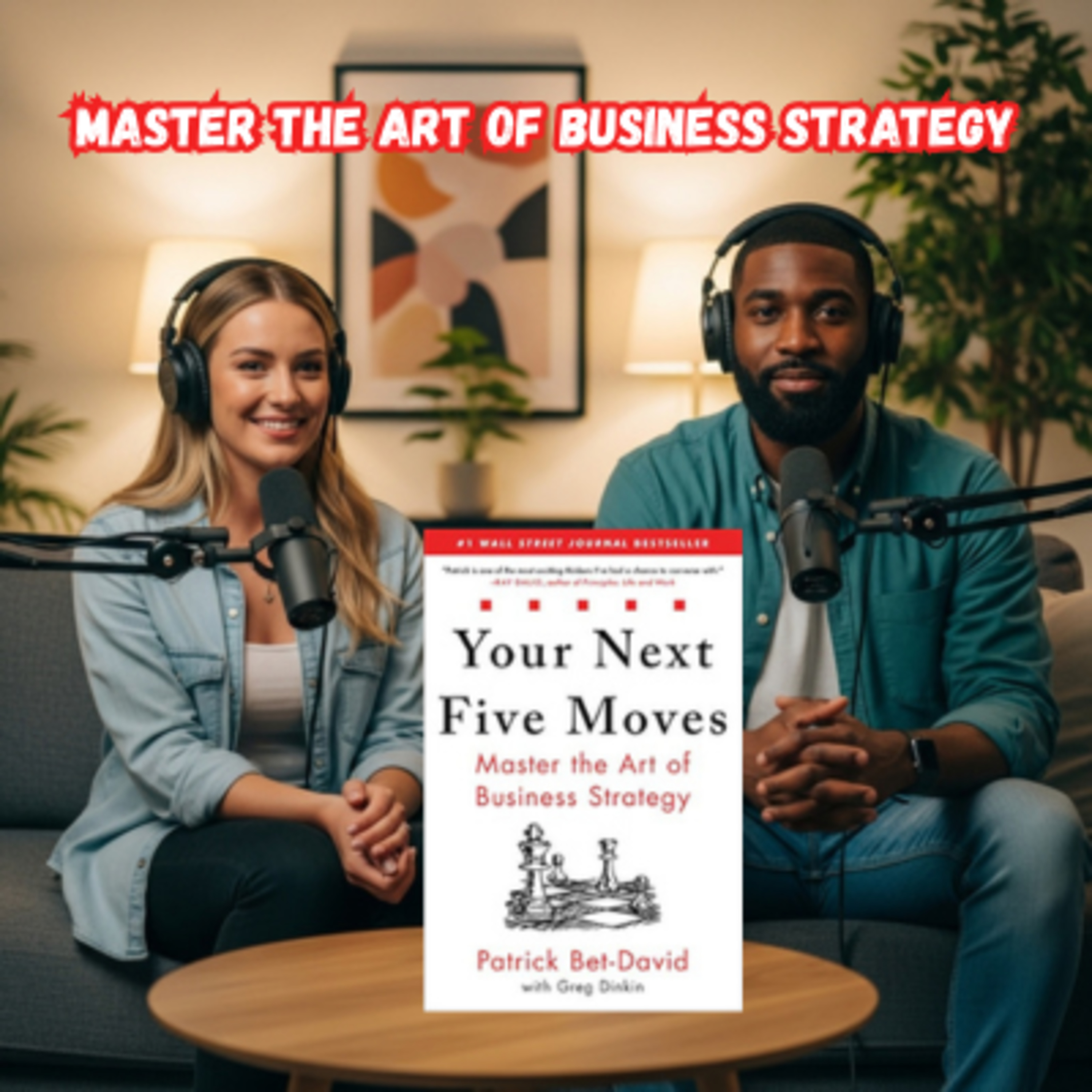
This summarizes Patrick Bet-David’s business book, "Your Next Five Moves," providing a strategic roadmap for entrepreneurs to avoid failure and achieve growth. The first steps focus on developing deep self-awareness and mastering the art of root-cause problem-solving rather than just addressing symptoms. The guide then transitions into external growth, emphasizing the importance of assembling a complementary team and scaling operations without losing the company’s core identity. Finally, it explores strategic power plays, teaching readers how to outmaneuver competitors through innovation and calculated negotiations. Ultimately, the source serves as a practical manual for transforming personal strengths into sustainable professional success.
productivity hacks, personal development, success strategies, business insights, leadership skills, leadership, ambitious professionals, business tips, self help, scaling business, business tactics, professional development, startup growth, entrepreneurship, business mindset, growth strategies
So nearly seven out of every 10 startups, they just hit a dead end. That's the statistic you always hear, right? It's a really sobering reality. It just triggers so much anxiety for, well, for anyone trying to launch something ambitious. Oh, absolutely. It's the fear of becoming one of those statistics that, you know, it paralyzes so many of us, right? But what if that doubt? What if it wasn't a stop sign? What if it was just preparation? You like that? The framework we're diving into today, Patrick Bette, David's whole philosophy in your next 5 moves.
It suggests that the key to resilience is is radical preparation. Exactly. And that's really our mission with this deep dive to distill that what is it, 272 page road map. A dense one, yeah, And just. Boil it down into the most actionable strategic Nuggets for you. We're trying to turn a philosophy into a clear, structured blueprint, right? So think of it as your essential strategic upgrade, whether you're, I don't know, launching a Unicorn tech company or just trying to get a big promotion. And we're not just offering a superficial summary here.
We're going to walk you through how these five moves, these five decisions, they don't exist in a vacuum. They build on each other. They create this, this sustainable path for growth. We start with the micro, you know, understanding yourself, and we end with the macro, mastering the battlefield, so to speak. OK, let's unpack this. Let's jump straight into that very first move because it's so fundamental that I think a lot of leaders, they just skip right over. It they really. Do they're focused on market share before they even have a handle on their own self-awareness?
Exactly. So move number one, it's all about discovering the absolute foundation of success. Understand yourself. Our business culture just screams at us to look outward all the time. Copy your competitor. Chase the latest trend. You know, chase the fast, honey. But this framework, it challenges that right away. It tells you put the external stuff on hold for a minute. And that's probably the most counterintuitive part of the whole book, but it's it's arguably the most powerful. It frames success not as something you acquire externally, but as an internal alignment.
OK. And getting to that level of self knowledge, I mean it's not a weekend retreat, it's a strategic process. It requires you to audit yourself, almost like you would accompany. So what does that internal audit actually look like? It's not just, you know, listing 5 fun facts about yourself. Right. No, It's methodical. The philosophy suggests identifying your authentic strengths and weaknesses. Authentic meaning not the ones you wish you had, but the ones proven by your actual past behavior. And crucially, you have to identify your core personal values.
The book even has this really interesting exercise where you track your 96 hour week. That's your time outside of sleep to see where your effort actually goes. Versus where you say it goes? Exactly. It's a cold reality check. That's fascinating. So if you claim oh, family is my top priority, but your calendar shows 80 hours at work and zero with family, there's a gap. And that gap, that's what defines the critical principle here, the alignment principle, your strategy, your whole business plan, it has to mirror who you are at your core.
If there's a misalignment between your goals and your values, that's a strategic weakness A. Huge one. But wait, hang on, isn't there a risk here? I mean, sometimes you have to make tough choices, unfulfilling choices to hit a necessary goal. Absolutely tough choices are a given, but the risk of long term misalignment is burnout. It's frustration. It's a lack of conviction when things get hard. I see if you build a multimillion dollar business that requires you to, I don't know, compromise your core value of integrity, that success is going to feel empty.
It's unsustainable. That cognitive dissonance eventually leads to strategic paralysis. So you need to know you're non negotiables. You have to, because when a strategy forces you to violate them, the framework says you pivot immediately, no matter the cost. So the foundation isn't market analysis, it's making sure the person running the plan is internally sound, internally aligned. It's combining who you are today with where you need to go tomorrow. That's the bedrock. OK, so once we have that self knowledge from move one, then we can step into the arena.
You can face resistance, right? Move number 2 is about turning problems from these paralyzing roadblocks into well into real strategic opportunities. Solve problems effectively. This is where strategic thinking becomes like strategic detective work. Detective work. I like that. Yeah, because when problems hit, and they always always do, the first response shouldn't be panic. We're just throwing money at. It exactly. Don't just throw resources at the symptoms. The book guides you to tackle challenges by breaking them down, by analyzing them deeply.
This is isn't about a temporary bandage, it's about triage. Let's let's run with that classic small business scenario. Imagine you're running a boutique. Everything is going great, and then boom, a 20% drop in sales over three months. The immediate panicky reaction for most people would be double down on promotions. Spend a fortune on some flashy new marketing campaign. And that is precisely what the framework warns you against. That's a reactive move. You're treating the symptom low revenue, not the disease.
So what's the strategic move? Before you spend a single dollar on advertising, you look deeper. You use a diagnostic tool, something like the Five wise analysis. OK. So why are sales down? Because customer retention is low. OK, why is retention low? Because our customer service ratings dropped. Why did they drop? Because we hired 2 new untrained employees who are totally overwhelmed. So the problem isn't the market, it's not a lack of ads, it's an internal failure in training and onboarding. Precisely.
And if you'd only focused on marketing, you would have just been spending money to drive new customers into a broken system. That's just inefficiency masking failure. Exactly. By mastering this deeper analytical approach, you build long term resilience. You're curing the disease and you stopped that same problem from just popping up again in six months in a different disguise. It's the difference between being reactive and being strategically anti fragile. That makes perfect sense, and once you get a handle on problem solving, you realize pretty quickly you can't cure every disease on your own.
No. Way which? Brings us right into move 3 build winning team. The foundational truth here is well, greatness is never achieved in isolation. This step shifts the focus. It moves from individual capability to collective capacity. The chapter really emphasizes that a team's strength isn't just about the talent of the individuals. It's about their alignment. Their alignment with the mission, Yes. It's all about creating synergy, That idea where the whole is greater than the sum of its parts. And this confuses people a lot.
I think they assume building a winning team means hiring 10 clones of yourself, right? Or just, you know, hiring those expensive, highly credentialed person you can find. And that's a huge strategic pitfall. If you hire 10 people who are all amazing at sales but but they're all terrible at operations, you have a weak team, not a winning one. The framework talks about complimentary weaknesses. Let's go back to your cafe example. You are an amazing barista. The coffee's perfect. You're the heart of the brand, but you absolutely dread managing inventory.
Or negotiating with suppliers. Yeah, that's me. My impulse, and I think a lot of people's impulse, is to just try and force myself to learn spreadsheets and social media because I feel like I should be doing it all. But the strategic move, the winning move, is finding someone who thrives in those exact areas. The goal is to build a team where your skills fill each other's gaps. And it all goes back to move one. It takes humility to admit your limitations, and then it takes vision to identify the complementary skills you need.
A winning team isn't just a collection of employees, it's a strategically designed structure. All built to execute that shared vision. Exactly. And when everyone is aligned on that mission, the best coffee experience in the city, that cafe stops being just a local business. It becomes a destination, yeah, all because of that synergy. That's it. OK, so the foundation is set. We're analyzing problems, the team is aligned, we're ready to grow. Which brings us to move #4 strategize to scale up. And this is the difference between just growing and growing smart, right?
Scaling is where your strategic planning, your resource allocation, it all becomes absolutely critical. And scaling is so misunderstood people think it's just replication. Like a copy paste job. Yeah, but the framework clarifies that sustainable growth means expanding your reach without losing the core essence, the unique value that made you successful in the first place. OK, let's use the local bakery. Every example you've perfected your sourdough, there are lines out the door and now you want to open a second, a third, a fourth location.
How do you scale that without the new places feeling, I don't know, sterile corporate? This is where you test your understanding of your core values from move one. Scaling means thinking about adapting your supply chain. Sure, maybe you need new baking tack or a central dough facility, but you have to ensure that each new location feels integrated into its own community while still maintaining the heart and soul of that original sourdough recipe the moment you compromise quality control for speed.
You haven't scaled smart. You've just expanded your mediocrity. And what about when the market changes, say a new competitor moves in and they specialize in online delivery? Scaling demands flexibility. It requires constant adaptation. It might mean exploring online sales or developing new efficiencies you didn't need before. The core insight here is that you have to continuously evolve your strategy, not just your size. Which reinforces that mantra from the book. Bigger isn't always better. Better is better.
Yes. Strategic scaling is about quality, not quantity. You have to constantly improve and adapt, not just multiply. Their focus on quality, it prevents the kind of growth that just burns out the team and dilutes the brand. And that careful, sustainable growth lets you finally tackle the really bold, high stakes challenges in Move 5. Can't go to power plays? This is where the game shifts from execution to maneuver. Power plays are these strategic decisions, They're often unexpected or disruptive that let you seize opportunities, influence the landscape.
And stay ahead of the game. Exactly. It's about understanding the dynamics of power, of negotiation, of, of leverage within your specific industry. The natural assumption though, is that power plays are only for the giants. You know, the behemoths who can just buy up their competition, right? So how does a small player like that tech startup from the sources? How do they execute a real power play against a Google or an Amazon? Well, the book argues you don't fight them on their terms. A power play isn't about matching their multibillion dollar budget.
It's about rewriting the rules of the game so their size actually becomes a liability. OK, Now this is where you leverage your agility, your speed, the deep market understanding you're gained in moves to and four. Can you get us a concrete example of that kind of disruption? Sure, think about a startup launching some niche social platform. The giant competitor has massive resources, but it's slow, it's bureaucratic. The startups power play isn't to try and out advertise them. So what is it? It's launching hyper specific, rapid feature updates based on real time user feedback, Something the big competitor takes six months to even approve.
Oh, I see. Or maybe they form a strategic partnership with an unexpected group of influencers. They instantly gain credibility and reach that the incumbent completely miss. So they turn their limitation, their small size, into a strength. They use agility and surprise. They don't just compete, they make the giant irrelevant to a new specific part of the market. Precisely the whole goal of mastering power plays is to achieve a unique and dominant market position. It takes courage to challenge the status quo and to view negotiation and influence not as optional skills but as the final, crucial levers of growth.
Being bold, innovative and always a step ahead. That's the game. Wow, what a journey. We started with the internal Understanding yourself and we ended with external mastery mastering power plays. We've covered the five moves designed to build resilience and confidence. Start with self knowledge. Learn to solve problems by finding root causes. Build a winning team on complementary skills, strategize to scale up smartly, and then finish by mastering power place. And if you look at the whole arc of this philosophy, the entire journey really depends on the strength of move one informing how you execute move 5, right?
You started by defining your core values, and you ended by challenging external rules. So this raises a really potent final question for you, the listener to think about. We all operate under rules in our lives, right? Rules about what's possible, what's acceptable. But what assumption or rule in your current journey is built just on external expectation or tradition or the industry status quo, rather than on your own core values for move one? And if you can isolate that externally imposed limit, that rule you've just been blindly following, what bold, unexpected move, what true power play would suddenly become possible for you if you decided to challenge it, if you were guided only by your authentic self knowledge, that connection between who you are and what you dare to change, That is the enduring lesson here.
That is definitely something worth thinking about all week. Thank you for diving deep with us into strategic mastery. The journey to mastering your next 5 moves has truly just begun.
 Apple Podcasts
 Castbox
 Castro
 Goodpods
 Moon FM
 Overcast
 Pocket Casts
 Podbean
 Podcast Addict
 Podcast Republic
 Spotify