The Wealthy Barber by David Chilton
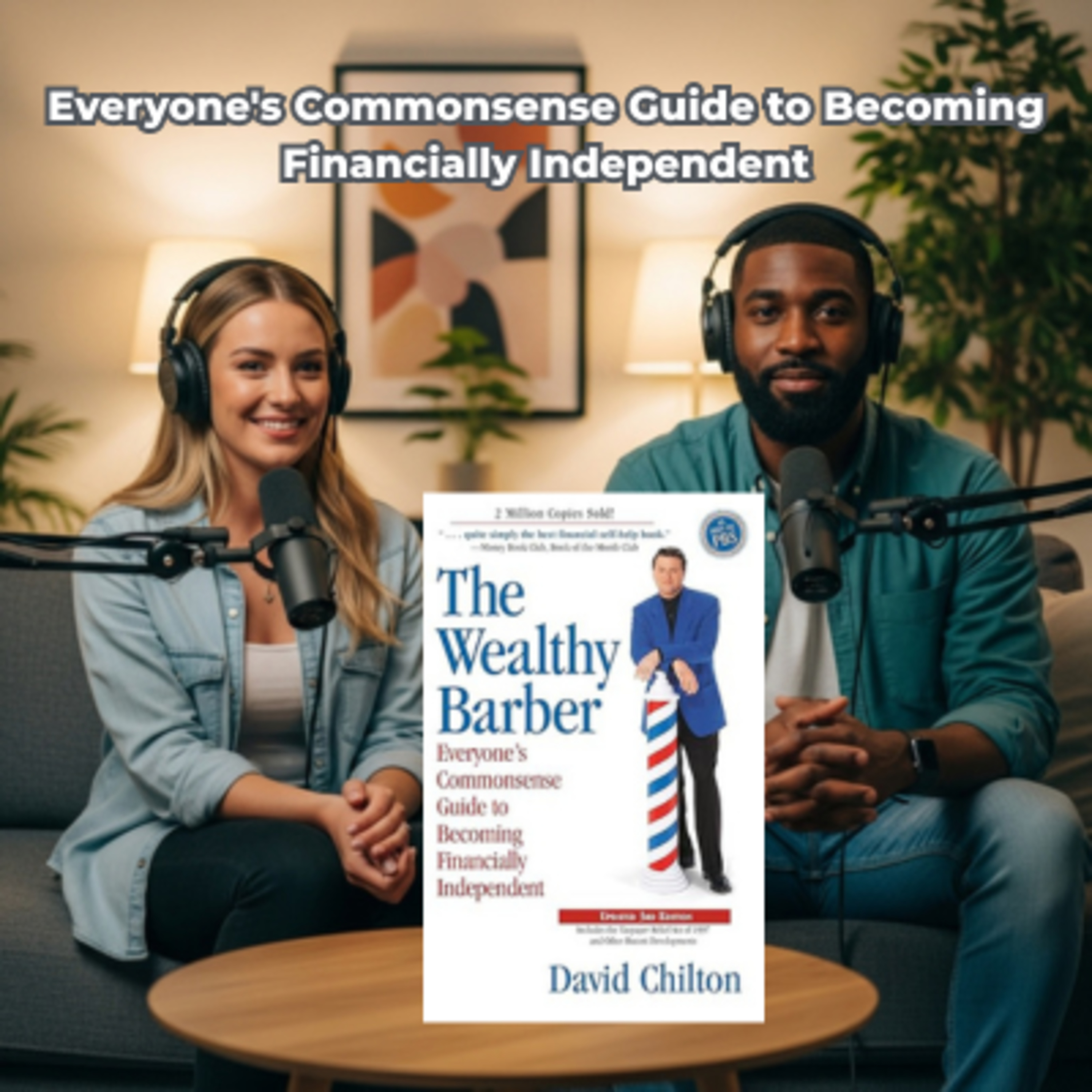
This episode outlines the core financial principles from David Chilton’s book, The Wealthy Barber, which uses a fictional barber to deliver practical money management advice. The primary lesson is to prioritise savings by automatically setting aside at least ten per cent of one's earnings before addressing any expenses. It further advocates for living below your means and leveraging the power of compound interest by beginning to invest as early as possible. Additionally, the source stresses the importance of financial security through stable investments, life insurance, and prudent retirement planning. By maintaining consistent habits and avoiding high-risk ventures, individuals can gradually build significant wealth regardless of their starting salary. Ultimately, the text illustrates that financial freedom is achieved through discipline and simple, long-term strategies rather than complex schemes.“One of the most effective tools for teaching personal finance basics.”—Arthur Andersen
In this updated edition of one of the biggest-selling financial-planning books ever, David Chilton simplifies the complex puzzles of personal finance and helps you achieve financial independence. With the help of his fictional barber, Roy, and a large dose of humor, Chilton shows you how you can take control of your financial future—slowly, steadily, and with sure success. Chilton’s plan (detailed in an entertaining story) is no get-rich-quick scheme, but it does make financial independence possible on nothing more than an average salary. Even if you consider yourself a financial “basket case,” Chilton explains how you can easily put an effective financial plan into action.#TheWealthyBarber #DavidChilton #PersonalFinance #FinancialFreedom #WealthBuilding #MoneyManagement #FinancialLiteracy #InvestingBasics #FinancialIndependence #WealthMindset #BookSummary #MoneyTips #FinancialEducation #SmartMoney #BuildWealth
Imagine you are walking into your local barbershop, right? But you're just sitting down in the chair and you're expecting the usual small talk. You know, like the weather, maybe some sports, maybe just a quick trim. Just the standard barbershop chat. Exactly, but instead of just cutting your hair, the Barber leans in and starts handing you life changing financial advice. Which is, I mean, it sounds a bit crazy, right? It sounds totally crazy, but well, that is exactly the premise behind the source material.
For today's Deep Dive, we are looking at David Shelton's classic, The Wealthy Barber. Such a great. Book it really is, and I got to tell you our mission today is to extract the practical, like highly accessible wealth building habits taught by this fictional character. Right, Roy the Barber. Yes, Roy, we want to show you how to take control of your money, regardless of you know where you're starting from right now. Yeah. And what immediately stands out about this approach, and I think this is so important, is the absolute rejection of financial jargon.
Oh, thank goodness for that. Right. I mean, we are looking at some dry, overwhelming textbook here. Yeah, you don't need an economics degree to figure this out. Exactly, you don't need to decipher anything. This is really just a guide to taking control of your financial destiny using incredibly simple everyday habits. Which is so refreshing. It is, and it's crucial to understand right from the start that Roy, the titular wealthy Barber, he wasn't wealthy because he had some like massive multimillion dollar salary.
Right, he wasn't Aceo. Not at all. He built his wealth through systems, through discipline and, you know, consistency over time. Systems and consistency. Yeah, that is a vital distinction for anyone listening today. You really don't need to be an executive with a massive stock package to build meaningful wealth. Right. It completely shatters that pervasive myth. You know, the one that says financial security requires like getting rich quick or hitting the crypto lottery? Or starting out with a massive 6 figure salary right out of college.
Exactly. It just requires smart, repeatable habits. So our goal for this deep dive is to distill the essential habits from Roy's eight lessons. The core philosophy. Yeah, and we want to look at the actionable steps you can actually apply to your life right now, but before we can even begin to talk about growing wealth. We got to talk about capturing it first. Right, we have to talk about how to capture the money you already make. We have to look at controlling the inflow. Because I mean, if you can't control what comes in, the rest of the financial machinery simply has no fuel to run on.
No fuel at all. Right. And the absolute foundation of this entire philosophy, like the bedrock of it, is paying yourself first. Ah. Paying yourself first. This is the golden rule here. The idea is that you must save at least 10% of your income before you pay for anything else. Before anything. Anything that means before any bills, before the rent, before groceries, literally before anything. If you make $500, you immediately put 50 away. OK, let's unpack this because, you know saying pay yourself first sounds great in a vacuum.
Sure does like think of paying yourself for like treating your future self as the most important VIP bill collector you have, right? I love that framing. Your future self is standing at the absolute front of the line, even ahead of the power company. Yep, the VIP. But I got to push back on behalf of anyone listening right now who is dealing with the realities of today's economy. Which is very tough right now. It is if our listeners rent just went up and like groceries are double what they were last year.
Where is this magical 10% actually coming from? It's a very fair question. I mean, saving before paying the electric bill sounds totally counterintuitive, and honestly, to someone living paycheck to paycheck it sounds a bit reckless. How does that actually work in reality? Well, this raises an important question, right? And it it is where the psychology of prioritization really comes into play. The psychology of it, yeah. It feels counterintuitive because society teaches us to do the exact opposite, right?
Pay everything first. Exactly. We are taught to pay all our bills, buy our necessities, maybe buy a few treats, and then save whatever is miraculously leftover at the end of the month. If there is anything leftover. Right. And that's the fundamental problem, human nature. There is rarely anything leftover. So true. Because this is driven by Parkinson's law, which basically states that our expenses will always rise to meet our income. So if I make more, I just spend more. Basically, yeah. If you have $1000 in your checking account, your brain will subconsciously find a way to justify $1000 worth of needs.
We suddenly need a lot of. Exactly. We confuse wants with needs because the cash is visually available to us right there. Oh, I get that. We see a balance in our checking account and our brain instantly says great, I have a survival buffer. I can absolutely afford that new jacket. Or, you know, that expensive dinner out. Precisely, You see the money, you spend the money. So by automating that 10% transfer, the absolute moment of paycheck hits your account. Like routing it completely out of sight.
Yeah, routing it to an entirely separate institution if possible. By doing that, you are enforcing A strict artificial boundary. Artificial scarcity? Exactly. You are artificially restricting your supply of spendable cash. So if you earn $3000 a month and you automate a $300 transfer out on. Payday You're forcing yourself to live on 2700. Right. You just adapt to the scarcity. The money isn't there. You just, well, you figure it out. Because you have to. You skip the takeout. You negotiate a lower Internet bill.
You find a way. Hiding that money from yourself removes the temptation of wants that so cleverly disguise themselves as needs. Man, that makes a lot of sense. It's like putting an unbreakable firewall between your current impulses and your future security. A firewall is a great way to put. It you literally just don't see the money so you can't mentally spend it. Right, it's out of sight, out of mind. So OK, you've safely trapped this money behind a firewall, but with inflation, putting those captured dollars into a basic checking account or like, stuffing them under a mattress means your money is actually losing purchasing power every single year.
Oh, absolutely. It's shrinking if it's just sitting there. Right. So we have to put those dollars to work. We need to explore how this philosophy suggests growing that money. And this completely challenges the whole, you know, go to the moon investing mentality we see everywhere online today. Oh, it really does. The growth engine we were talking about here is built entirely on time. Time, not risk. Exactly time rather than high specs risk. The core mechanism at work here is the immense, undeniable power of compound interest.
Magic of compounding. Yeah, time is actually your biggest financial asset, which means starting early is far more important than starting with a lot of money. You're leveraging decades rather than leveraging high risk capital. Now here's where it gets really interesting though. If we look at the numbers in the source tax, there's a scenario here that honestly made me do a double take. The $20 example, yes. It suggests that starting to save just $20.00 a month at age 25 will yield significantly more by age 65 than waiting until you're 40 and saving a much larger amount each month.
The math is wild, isn't it? It is. I hear you on the math, but I have to play devil's advocate here for a second. Go for it. Is $20.00 a month really enough to matter? Like it feels like a drop in the ocean? It's barely $10,000 of your own money contributed over 40 years. Right, logically it feels too small. Even with compounding, how is a drop in the ocean like that going to fund a decades long retirement? Especially when a single sudden medical bill or, you know, a leaky roof can cost $5000 in one afternoon.
Well, what's fascinating here is how the mechanics of compound interest completely defy our natural linear intuition. Defy it How? We tend to think of saving as stacking bricks 1 by 1, right? Yeah. Put a dollar in, you have a dollar. Right, but Combat Interest isn't stacking bricks, it's breeding them. Breeding bricks. That's quite an image. Think of your initial $20 contribution as an employee you just hired. OK, I hired a $20 employee. Right after a year of being invested in the market, that employee recruits a few interns.
The interest? Exactly. That is the interest you earned. Then the year after that, your original employee recruits more interns, but now last year's interns are full time employees and they're recruiting their own interns. Wait, so the money you earned is now earning its own money? Yes, Completely independent of your original contribution, Yes. It is a total snowball effect. By the time you were 65, you have a massive corporate workforce generating capital for you, all stemming from those original $20 hires.
That is wild to think about. And if you wait until you are 40 to start, you miss out on 15 years of that generational hiring process. You miss the interns of the interns. Exactly. You miss out on the interns of the interns of the interns, and you cannot buy back lost compounding time no matter how much cash you inject later. Because they need time to multiply. Right. And of course, $20 is just the mathematical baseline to prove the concept. If you apply that same mechanism to $200 a month, or you know, $2000 a month, the final number becomes astronomical.
OK, that makes the time aspect incredibly clear. But time only does the heavy lifting if you actually get your money into the right kind of market. Right, the vehicle matters. Because the urge for a lot of people is to find the next big tech stock, throw all their money at it, and just hope it triples in a year. Which is exactly what this approach warns against. Oh, really? Yes, the strategy relies on avoiding high risk investments entirely. I mean if you gamble your money on a single risky stock and the company goes bankrupt.
You lose it all. Your money goes to 0, your entire compounding engine is destroyed, all those employees are fired, and you basically have to start over from scratch. That's a terrifying thought. It is instead, the focus is on slow, steady growth through vehicles like mutual funds or index funds. OK, so for someone who might not live and breathe finance, how does a mutual fund protect you from that kind of wipeout? Well, think of investing in a single stock like betting your life savings on one horse in a race.
Very risky. Very risky. If that horse trips, you lose everything. A mutual fund, on the other hand, is like owning a tiny fraction of every single horse on the track. Oh wow. OK. Yeah, you weren't going to get a massive life changing payout from 1 lucky winner, but you are mathematically guaranteed to capture the overall growth and momentum of the entire race. Because at least some of them are going to finish strong. Exactly. It severely reduces your volatility. It is boring. Yes, very. Boring. But boring provides the steady, predictable stability needed for compound interest to do its job uninterrupted.
Uninterrupted is the keyword there. Yes, and if you pair that with tax advantage retirement accounts like an IRA or a four O 1K and you capture any matching funds your employer offers. Which is literally free money. Literally free money. You accelerate the entire process safely. Boring is the secret ingredient to the growth engine. I love that. It really is. But let's look at the broader picture here, because growing your wealth with these boring, steady investments is really only half the battle.
We need to play defense. Exactly. We have to shift gears and look at the defensive strategy. We need to look at how to protect this wealth from sudden life events or major financial missteps, things that could literally wipe out decades of this steady growth. Because, as we know, life rarely goes according to a neat, predictable spreadsheet. Yeah, defensive strategy is the perfect term. You can do everything right on the offensive side, right? You can capture your 10%. You can automate it. You can invest in mutual funds starting at age 25.
All the right moves. But if you leave yourself exposed to massive, uncalculated risks in your personal life, all that compounding wealth can vanish overnight. It really can. And a major area where people expose themselves to this kind of risk, which surprised me in the text, is homeownership. Yes, which is fascinating because home ownership is always pitched as the ultimate American Dream, right? Right, the pinnacle of financial stability. It's usually seen as a foolproof investment, not a risk, but the philosophy here warns against rushing into it because of all the hidden, unrecoverable costs.
It's not just about affording the monthly mortgage payment. Not at all. People often view a mortgage as a forced savings account, assuming every dollar they pay is basically building equity. Right, paying yourself. But they ignore the unrecoverable costs. If you stretch your budget to the absolute maximum limit just to get approved for a mortgage, you are leaving yourself 0 margin for error. Zero breathing room. Right, You have to account for property taxes which go up. You have to account for insurance premiums and most importantly, you have to account for.
Maintenance, Maintenance. Maintenance is the silent killer of wealth. I really like how we can frame this. Buying a house without budgeting a massive buffer for the hidden costs is kind of like buying a high end sports car but forgetting you have to pay for premium gas, specialized tires, and, you know, really expensive oil changes. Oh, that analogy perfectly captures the trap. It looks incredible parked in your driveway, but it's going to bankrupt you to actually operate at day-to-day. Exactly.
Imagine you are house poor, barely making the mortgage and then you have a sudden leaky roof. Where the HVAC system dies in the middle of winter, Yes. You suddenly need 5 to $10,000 in cash right now. If you aren't prepared, you end up putting that on a high interest credit card. And the whole plan falls apart. Right. Suddenly, your house has flipped from being an asset into a crushing financial burden, and that derails your ability to save that 10% we talked about in Part 1, man. And Speaking of unexpected disasters, there is another major defensive strategy emphasized here that really surprised me.
The estate planning. Yes, there is a heavy focus on having a will and securing life insurance. People hate talking about that. They really do. It feels a bit morbid to focus on. I mean, when you're already scraping together that 10% to invest, paying a monthly premium for life insurance feels like an unnecessary drain on your wealth engine. It feels like throwing money away. Right. We usually associate wealth building with stock portfolios and real estate empires. Not, you know, estate planning.
Well, it feels morbid because it forces us to confront our own mortality, which is deeply uncomfortable for most people. Very uncomfortable. Or we dismiss it thinking wills and life insurance are complicated legal tools and only for the ultra rich with these complex estates. Right, like I don't need a will, I just have a checking account in a Honda? Exactly. But the brilliant reframing here is viewing these tools not as a legal chore, but as an act of love and responsibility. An act of love. I'd argue it's also about preserving the machine you spent your whole life building completely.
If you don't have these protections, you aren't just leaving a tragic personal situation, you're leaving a massive financial catastrophe. That is the core of the defensive mindset right there. Wealth isn't strictly about accumulation, it is fundamentally about security. Security for your people. Yeah, if you have dependence, a spouse, children, anyone who relies on your income, a basic term life insurance policy ensures they are financially secure if the absolute worst happens to you. Which is priceless Peace of Mind.
It is, and a simple will outlines exactly who gets what, cutting through the chaos so your family knows exactly what to do. And how to pay for immediate expenses during an incredibly painful time. Right, because a family tragedy without a financial safety net is the quickest way to force your loved ones to liquidate those long term investments we just talked about. Oh, and usually at a massive loss because they need the cash tomorrow. Exactly. Life insurance and a will are basically the insurance policies on the wealth building machine itself.
OK, so we've got the theory down. Now we have our offensive strategy capturing 10% right off the top through artificial scarcity, utilizing the exponential snowball of time and playing it safe with boring broad market mutual funds. Solid offense. And we have our defensive strategy, maintaining a wide margin of error for the hidden costs of home ownership and protecting our loved ones with a will and life insurance. The perfect defense. But now we have to talk about the real world, the hard, the hard part.
We have to talk about execution. How do we actually do this for 40 years without failing when real chaotic life inevitably gets in the way? Well, moving from theory into execution hinges almost entirely on one word consistency. Consistency. Financial success is not an event, it is a process. It is about making smart, steady, often unglamorous decisions over a very long period of time. Decades. Really. Decades. It requires actively managing your money habits, tracking your monthly income and expenses, and just, you know, recognizing where your resources are actually flowing.
But I have to ask a very grounding question here. If the blueprint is genuinely this simple, literally just automate 10%, wait a few decades and don't take silly risks. Why isn't everyone wealthy? Right. Why isn't it universal? The math is undeniable, the stacks are super easy to understand. What is the disconnect between knowing this stuff and actually doing it? If we connect this to the bigger picture, we see that the real challenge isn't a lack of financial literacy. The real challenge is human behavior.
Human behavior. We are operating in a modern world that is aggressively optimized to separate us from our money. Oh man, is it ever. Everything around us, from targeted social media adds to frictionless one click. Purchasing is designed to trigger instant gratification. Buy now, pay later. Exactly. We aren't just fighting our own internal impulses. We are fighting billion dollar marketing algorithms designed to make us feel inadequate if we don't buy the newest phone or the nicer car or take the luxury vacation today.
It's a constant daily battle between the present self who you know wants the dopamine hit of a fancy dinner out tonight, and that VIP future self who needs the compound interest. And it is exhausting to constantly say no. It's so exhausting. It is exhausting, which is exactly why automation is so critical. You have to remove willpower from the equation as much as possible. Just take the choice away, right? Sticking to a budget and intentionally fighting the urge for instant gratification are incredibly difficult psychological battles, but you have to remember that every single small decision changes your trajectory.
Every. $20 choice, yes. It is choosing to invest that $20 instead of spending it on impulse take out day by day. It really doesn't feel like you are building an empire. The progress is basically invisible. Completely invisible. But decade by decade, the compounding results are absolutely undeniable. So what does this all mean? When we take a step back and look at the entirety of this philosophy, it points to 1 incredibly empowering conclusion. Building real, lasting wealth is accessible to almost anyone.
Anyone can do this? You don't need massive 6 figure income to start. You don't need to understand complex derivatives or gamble on individual tech stocks. Please don't do that. Yeah, please don't. You just need the discipline to enforce boundaries on your spending and pay yourself that 10%. 1st the firewall. You need the patience to let a small army of dollars compound and multiply over decades. You need the wisdom to embrace boring, diversified investments. And importantly, you need the foresight to protect the people you love with a solid defensive plan.
True financial freedom is built on the foundation of everyday habits. It is a slow, steady March, completely ignoring the noise of dramatic windfalls and overnight success stories. It is the ultimate marathon. Which leads me to a final thought I want to leave you with today. Let's hear it. We talked a lot about the friction of instant gratification. So next time you are standing in a store or maybe browsing late at night online and you're about to make an impulse buy that you haven't budgeted for, I want you to visualize that transaction differently.
Ask yourself, are you actively robbing your future self to pay your present self? Is that brief hit of instant gratification really worth firing one of those employees working in your Compounding wealth engine? Oof. That is the exact perspective shift required. Every dollar spent on an unneeded want today is actually that dollar, plus all of its future compounding potential permanently taken from your security tomorrow. Permanently. So, you know, don't wait for someday when you magically have more money.
Take at least one small step today to force the issue. Just one step. Go set up that automatic transfer for your next paycheck, even if it's just a small amount to start. Log in and capture that employer match on your 401K. Or just sit down tonight and honestly track your expenses for the last 30 days to see where your money is actually escaping. You'd be surprised what you find. Start building that better financial future right now, because as the old saying goes, the best time to plant a tree or start a compounding interest account was 20 years ago.
The second best time is today. We hope you enjoyed this deep dive and maybe the next time you sit down for a haircut, you'll be the one handing out the life changing financial advice.
 Apple Podcasts
 Castbox
 Castro
 Goodpods
 Moon FM
 Overcast
 Pocket Casts
 Podbean
 Podcast Addict
 Podcast Republic
 Spotify