The Tipping Point by Malcolm Gladwell | Summary of The_Three_Rules_of_The_ Tipping_Point
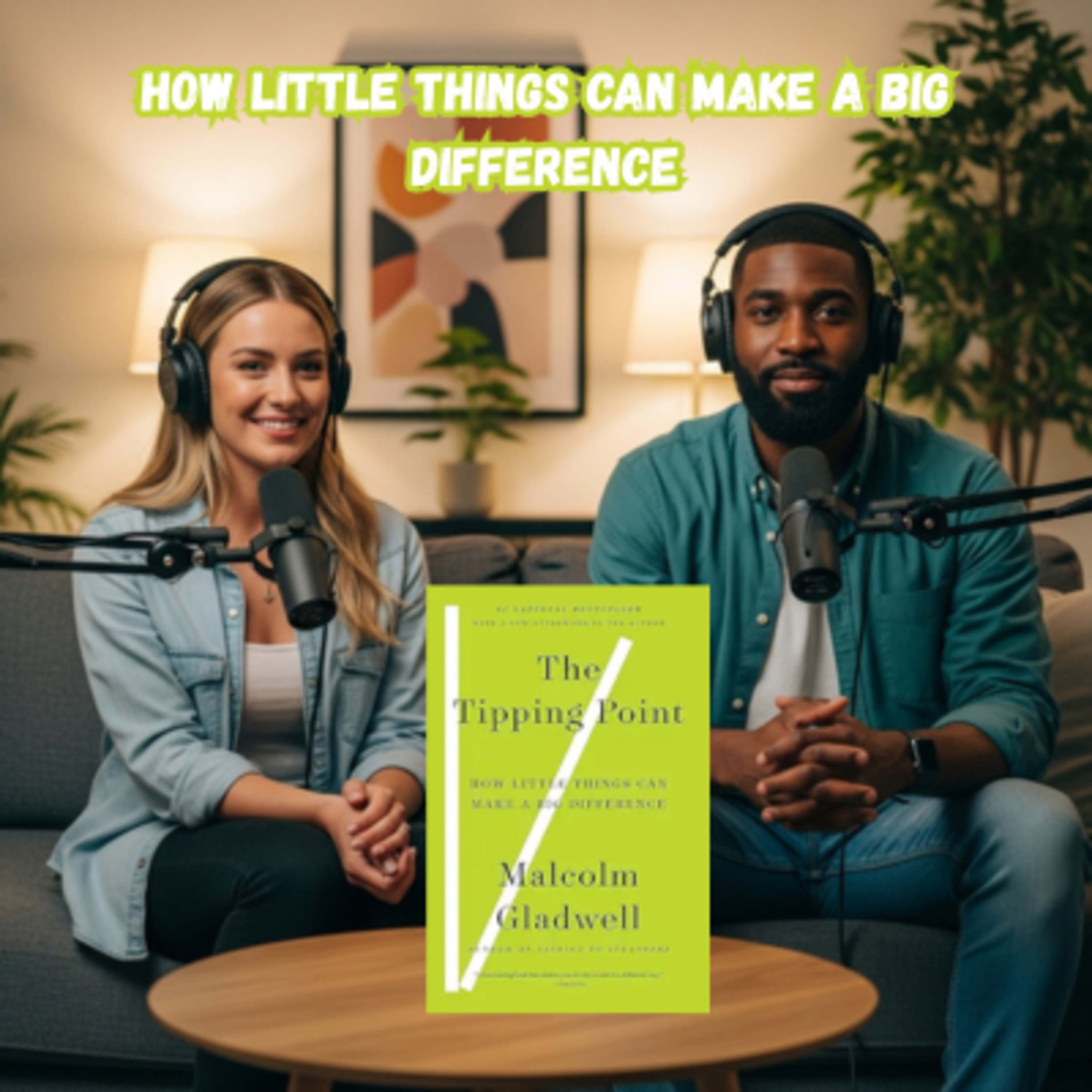
This Episode outlines the core principles of Malcolm Gladwell's book, The Tipping Point, which examines how minor actions can trigger massive social shifts. It details three primary drivers of change: the Law of the Few, which identifies influential individuals; the Stickiness Factor, which ensures messages are memorable; and the Power of Context, which emphasizes the impact of the environment. Through various case studies, the summary explains how Connectors, Mavens, and Salesmen collaborate to spread ideas efficiently across networks. The text also highlights the Rule of 150 as a limit for group cohesion and explores how social influence can make even harmful behaviors contagious. Ultimately, the source serves as a guide for recognizing and creating tipping points by focusing on specific details and testing new strategies. Success in any field requires the belief that small, targeted efforts can eventually lead to a global impact.
Uncover the captivating science behind viral trends in business, marketing, and human behavior in the breakthrough debut — named one of the best books of the decade by The A.V. Club and The Guardian — by Malcolm Gladwell, the bestselling author of The Bomber Mafia.
The tipping point is that magic moment when an idea, trend, or social behavior crosses a threshold, tips, and spreads like wildfire. Just as a single sick person can start an epidemic of the flu, so too can a small but precisely targeted push cause a fashion trend, the popularity of a new product, or a drop in the crime rate. This widely acclaimed bestseller, in which Malcolm Gladwell explores and brilliantly illuminates the tipping point phenomenon, is already changing the way people throughout the world think about selling products and disseminating ideas.
“A wonderful page-turner about a fascinating idea that should affect the way every thinking person looks at the world.” —Michael Lewis#productivityhacks #personaldevelopment #successstrategies #businessinsights #leadershipskills #leadership #ambitiousprofessionals #businesstips #self help #scaling business #businesstactics #professionaldevelopment #startupgrowth #entrepreneurship #businessmindset #growthstrategies
Welcome back to the Deep Dive. Today we are taking a a really fascinating look at 1 core question. How do small things become big things? Yeah. How does that happen? We're talking about those, you know, those social epidemics, the moment a niche fashion trend just explodes overnight, or when like a tiny behavioral change in one community suddenly ripples out and changes a whole city. And for this, we've got a comprehensive guide on Malcolm Gladwell's The Tipping Point, which really provides the definitive frame work for for understanding this whole mechanism.
It's all about how ideas and products and even behaviors move from being totally obscure to, well, wildly popular in what feels like an instant. Exactly. So our mission today is to quickly pull out the core engine of this process. We're going to unpack the three fundamental rules that Ladwell identifies. And this should give you, the listener, a completely new operating system really for thinking about influence and and mass adoption. A new way to see the world. Absolutely. The tipping point itself is It's defined as that critical level, that one specific moment when an idea or trend flips.
It goes from this slow limited growth to boom exponential acceleration. And Gladwell's whole point is that this isn't random. It's not magic. No, not at all, he says. It's driven by three predictable and, importantly, controllable forces. That's what's so compelling. He gives us these intentional levers for change. We don't have to just sit back and watch these tipping points happen. They can actually try to create them. OK, so let's get into this foundational framework. He calls them the three rules of epidemics.
That's our road map. And they are first, the law of the few, second is the stickiness factor, and 3rd, the power of context. And you really need all three of these to align for a social epidemic to, you know, to really take off. I think the biggest initial take away for you listening is just realizing that if you want to achieve something massive, I mean launching a product, driving a community initiative, whatever, you don't have to convince everybody, not at all. You just have to focus on optimizing these three specific areas, the right people, the right message, and of course, the right environment.
Precisely. And that that all starts with the first pillar, the law of the few, right? This rule, it basically challenges our intuition that trends spread, you know, democratically. Like everyone has an equal say. Yeah, but he says no. Instead, a very small number of exceptional people are disproportionately responsible for driving the trends, initial launch and and its eventual adoption. It's about convincing the right 20%, not the whole 100%. Which in this age of social media where we're told everyone's an influencer, that idea can feel a little, I don't know, counterintuitive.
It really can. But Gladwell argues that true impact boils down to three very distinct, very specialized roles that these few people play. OK, So what are they? Right. So knowing these roles is key to targeting your efforts. First, you have the connectors. These are the incredibly sociable people, the the bridge builders, They just seem to know everyone and they collect people from all these different social circles. They have these unusually large networks. And you've got the mavens. The mavens.
They're the information specialists. They don't necessarily know more people, but they know more about things. They love to learn. They devour data and people trust them for advice. O if you need a really informed recommendation, you go to a Maven. Exactly. And finally, you have the salesman. OK, these are the persuasive people, the charming ones. They're just incredibly skilled at convincing others to, you know, try new things or change their minds. They're masters of non verbal cues and sincerity.
What's so fascinating is that it's rare to find someone who's all three of those things. Very rare. And that's what makes the whole system work. You need the connector to bridge the world's, the maven to give it credibility, and then the salesman to sort of close the deal on the new idea and. We can see these rules perfectly in one of the book's most famous examples. Yeah, the revival of Hush Puppy shoes. This was in the mid 90s. I mean, this is a brand that was completely defunct. They were selling barely 30,000 pairs a year.
They had like 0 marketing budget. So how did they suddenly have this massive, completely unexpected tipping point? Well, it started with a really small initial action. Just a handful of what Gladwell calls fashion forward. Kids in downtown Manhattan started wearing them, kind of ironically. OK, so just a few people. Just a few. They picked up pairs from these dusty old shops and they acted as the initial connectors. Interesting seeing this forgotten shoe into their influential, you know, niche circles.
So it starts small, but then you have this, this rapid acceleration. And this is where he introduces the idea of the power of translation, right? Exactly. The revival wasn't just about those few kids. It became a nationwide thing because fashion influencers and celebrities, the next level of connectors and salesman. They saw this little niche signal and they acted as translators. Translators. How so? They took this kind of counterculture ironic trend of wearing dusty old shoes, and they presented it in a way that appealed to the mainstream.
They made the shoes broadly desirable. They made them cool. So they translated a new signal into mass market language. That's it. The relevance for you listening is pretty straightforward. Then, if you're trying to launch something, you should focus all your energy on finding your connectors, your mavens, and your salesman. They're your exponential force multiplier. But you know, once you have those influential people, you still have to give them something worthwhile to talk about. Something to spread.
And that brings us right to the second rule, the stickiness factor. Right. An idea has to be more than just interesting, It has to be memorable, engaging, and I think critically easy for people to hold onto and internalize. And tiny little tweaks to the message can have a massive impact on that stickiness. I love the example he uses for this educational television. Oh yeah, it's a great one. Before the 1970s, educational TV was, let's be honest, pretty dry. Kind of boring. Very didactic, yeah. And then along comes Sesame Street.
And it was a revolution because its creators, they rigorously tested every single segment. They didn't just ask, is this educational? No, they asked, is this entertaining enough that a kid won't just change the channel? They put entertainment first to grab the attention, which is what made the lessons actually stick. They engineered the message to fight distraction. And then you have shows like Blue's Clues in the 90s which took that idea even further. They went all in on repetition, extreme repetition and really simple, clear formats.
They would ask kids again and again to find the clues. And the structure encouraged you to participate, to yell at the screen, yes. They weren't just showing a lesson once, they were drilling down on the stickiness until learning became durable. They knew exactly how many times a young child needed to see something to really get it. It's such an important lesson that applies everywhere, whether you're, I don't know, writing a corporate memo or a public health warning. The focus should be less on the amount of information.
And more on engineering that information to just lodge itself in someone's memory. Exactly. And that leads us to the third and final rule, which is the power of context. This is the idea that our immediate surroundings, our environment, fundamentally influences our behavior. More than our personality sometimes. Often more than our personality or moral compass, Yeah. This concept has two major parts and the first one deals directly with the physical environment through the the famous Broken Windows theory.
Right. This theory argues that visible signs of disorder, like a single unfixed broken window or graffiti or litter, it signals a breakdown of community standards. It sends a message. It sends a very powerful message. When people see that no one seems to care about the small things, they start to assume they can get away with the bigger things. So. One small sign of decay doesn't just show disorder, it actually licenses more disorder. The environment itself gives people permission to shift their behavior in a negative way.
And the book gives this powerful counterexample of New York City in the 1990's. The city saw this huge, rapid drop in crime rates. And it was often attributed to the decision to, you know, aggressively clean up subway graffiti and crack down on minor stuff like people jumping the turnstiles. Which seemed like tiny, almost insignificant changes compared to solving violent crime. Right. But by restoring order in those small ways, they shifted the entire context. They created this palpable sense of accountability and control, and that small, positive change in the environment led to a massive, widespread behavioral shift across millions of people.
That's a perfect context based tipping point. And the second part of context isn't just about our physical surroundings, but our social structure, specifically group size. The magic #150. The magic #150. The rule of 150. This comes from the anthropologist Robin Dunbar, and his finding is that we humans can only really maintain stable, meaningful social relationships with about 150 people. And by meaningful, he means you know who everyone is and you know their relationship to everyone else in the group.
Right. And beyond that number, communication just starts to breakdown. Trust erodes. And smart organizations have actually learned to use this. Take the company Gore Tex, the one that makes specialized fabrics. They consciously limit their factory teams to around 150 employees. And why that specific hard limit? To foster cooperation when everyone knows each other, communication is just it's more efficient, trust is high, and idea spread easily through the group's mavens and connectors without needing, you know, layers of bureaucracy.
You see the same thing in armies, right? They've traditionally organized soldiers into units of about 150. It's the sweet spot for cohesive teamwork, for having soldiers who trust each other implicitly, which is, I mean, absolutely vital in a high stakes environment. So the deep insight here for you, the listener, is that organizational design, just how many people you put on a team or in a club is a huge part of the context. A critical part. If you want an idea to achieve maximum stickiness and spread effectively, you have to keep the group small enough for real relationships to form.
We've mostly been focused on positive change, but we do have to talk about how this framework also explains the darker side of tipping points. Right. How suggestion and peer influence can drive negative behaviors, sometimes contagiously. This is where we see the power of context and the law of the few kind of working in reverse. Gladwell talks about the Werther effect. Which was named after a character in a novel whose suicide triggered this wave of copycat acts across Europe. It's this idea that publicized suicides can have a ripple effect.
Making the ACT seem tragic but also weirdly normalized or even contagious within a certain community. And we see this in tragic real world examples like the suicide epidemic in Micronesia that he talks about. And you can link this right back to our rules. The behavior spreads because highly influential peers, the law of the few, adopt or publicize it. And the social environment, the power of context, makes it feel like an acceptable, though tragic, response to a problem. A less devastating but equally clear example is teen smoking.
Oh yeah, the data really suggests that the behavior is driven less by nicotine addiction, at least at 1st, and much more by the social environment. It's about the cool image, you know, the desire to fit in with your peers. The desire to be accepted by the right 150 people. Precisely. Teenagers are drawn to smoking because they're connectors and mavens do it, and the social context makes the ACT seem rebellious or, you know, desirable. And understanding that the environment and social influence are the initial drivers is so crucial if we ever want to successfully reverse or prevent these negative social trends.
Exactly. So we've broken down the architecture of change. What does this mean for you, the individual, the professional who wants to actually make a difference? The last chapter gives some really practical advice. It does. It says you can in fact create your own tipping points. And that advice boils down to three actionable steps, focus, test, and belief. OK, focus. That means you have to be strategic. You can't just scatter your energy. You have to focus on identifying your high leverage points.
Where are the connectors? How sticky is my message really? Am I operating in the right context? Then test. This means you have to take a scientific approach, you can't just assume it's going to work. You have to try different things, test your messages and then adjust your approach based on what you see based on the feedback. Keep experimenting until you find that exact combination that sparks a exponential growth. And finally, believe you have to have faith in this framework. You have to believe that fixing 1 broken window, or convincing 1 trusted maven, or making one tiny change to the stickiness of your message that it really can lead to these huge widespread results that almost feel miraculous.
But we've seen the three powerful levers for change the law of the few find the right people, the. Stickiness factor. Craft the right memorable message. And the power of context set up the right environment. We've talked about how suggestion and peer influence can cause widespread social contagion, leading to everything from the rise of a forgotten shoe brand to tragic epidemics of negative behavior. So this raises a really important final question for you to think about. If small, focused actions can trigger these widespread negative changes through peer pressure and context, what essential positive changes are we currently failing to achieve simply because we haven't successfully identified and leveraged the specific connectors, mavens and salesman in our own communities?
What positive trend are you going to try to make stick? Thank you for joining us for this deep dive into the mechanics of social epidemics. See you. Next time.
 Apple Podcasts
 Castbox
 Castro
 Goodpods
 Moon FM
 Overcast
 Pocket Casts
 Podbean
 Podcast Addict
 Podcast Republic
 Spotify