The Small Changes That Change Everything | Tiny Habits by BJ Fogg
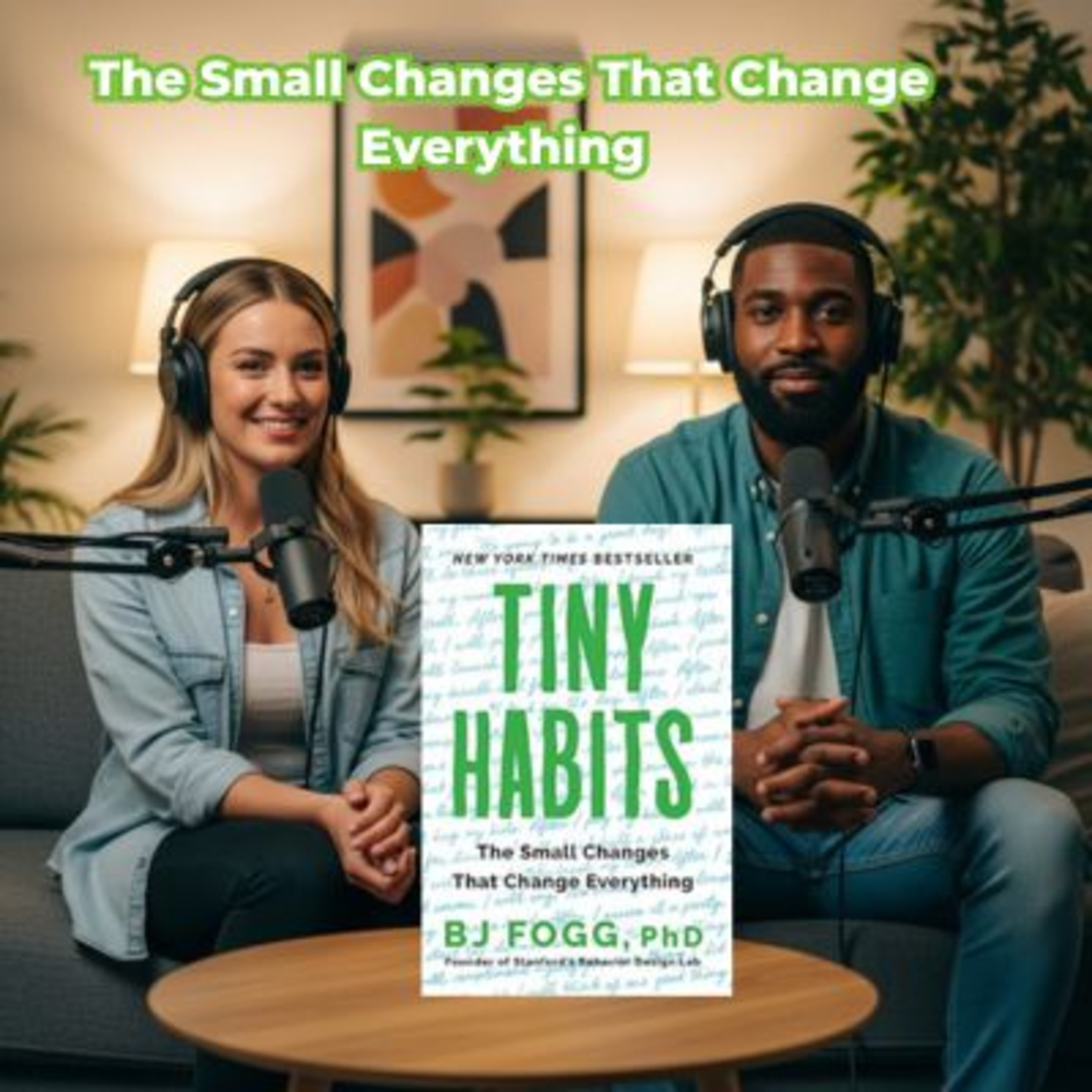
“There are many great books on the topic [of habits]: The Power of Habit, Atomic Habits, but this offers the most comprehensive, practical, simple, and compassionate method I've ever come across.” —John Stepper, Goodreads user
BJ FOGG is here to change your life—and revolutionize how we think about human behavior. Based on twenty years of research and Fogg’s experience coaching more than 40,000 people, Tiny Habits cracks the code of habit formation. With breakthrough discoveries in every chapter, you’ll learn the simplest proven ways to transform your life. Fogg shows you how to feel good about your successes instead of bad about your failures.
This proven guide for personal transformation will help you design habits and make them stick through positive emotion and celebrating small successes. Whether you want to lose weight, de-stress, sleep better, or be more productive each day, Tiny Habits makes it easy to achieve—by starting small.
Inside this practical self-help guide, you’ll discover the keys to lasting behavior change:
- The B=MAP Framework: Learn the simple but powerful model from Stanford behavior scientist BJ Fogg that cracks the code of all human behavior.
- Actionable Strategies: Go beyond theory with proven, step-by-step techniques to build good habits and untangle bad ones.
- Start Tiny: Discover why starting small is the secret to achieving your biggest goals, whether you want to lose weight, increase productivity, or reduce stress.
- Celebrate Success: Master the art of self-reinforcement to wire in new habits fast by feeling good about your progress, not bad about your failures.
This episode summarizes BJ Fogg’s behavior model, which posits that lasting transformation occurs through manageable, microscopic adjustments rather than drastic life overhauls. Central to this philosophy is the B=MAP formula, asserting that any action requires a combination of motivation, ability, and a prompt to occur. By focusing on simplicity and reducing effort, individuals can bypass the instability of willpower to make new routines automatic and effortless. The source emphasizes that positive emotions and immediate celebration are vital for reinforcing these behaviors and wiring them into the brain. Additionally, it outlines strategies for habit stacking, untangling negative patterns, and utilizing social support to sustain long-term growth. Ultimately, the text illustrates how tiny, consistent steps evolve into significant personal achievements over time.
#TinyHabits #AtomicHabits #HabitBuilding #SelfImprovement #ProductivityHacks #PersonalGrowth #BehaviorChange #MindsetShift #DailyHabits #SuccessHabits #HabitTracker #MotivationDaily #SelfDiscipline #BookSummary #GrowthMindset
Imagine you are staring at a blank calendar. Oh yeah, we've all been there. Right. And you've decided this is the month you were going to completely overhaul your life. The classic blank slate. Exactly. You tell yourself you're going to wake up at 5:00 AM every single day. You're going to run 5 miles. You're going to eat like nothing but kale and lean protein. Sounds exhausting already. It really does. But in that moment, sitting at your desk, you have this intense, burning desire to change. You feel totally unstoppable.
Motivation is high. Right. But Fast forward two weeks. The alarm goes off at 5:00 AM. It's pouring rain outside. The kale has gone completely bad in the fridge and while you were right back where you started feeling completely defeated. Yeah, and that cycle of intense ambition followed by inevitable burnout is something almost everyone experiences. Which is exactly why we're here. Welcome to this personalized deep dive tailored specifically for you. Yeah. Today, our mission is decoding the actual science of habit formation.
But crucially, we're doing it entirely without that overwhelming pressure of massive life overhauls. Yes, exactly. So if you're listening to this right now and you want to learn the most efficient way to upgrade your daily routines without drowning in information overload or just, you know, exhausting yourself, consider this your shortcut. It's a tremendous relief, isn't it, to finally let go of that suffocating pressure. It really is. We are going to look at how tiny, almost effortless tweaks can lead to massive transformations.
No more exhausting reliance on sheer willpower. Because we're unpacking behavioral scientist BJ Fogg's brilliant framework. Tiny Habits, the small changes that change everything. OK. Let's unpack this. Right, so to really grasp how to permanently change our behavior, we first have to understand the fundamental mechanics of why those past ambitious attempts have usually. Failed the 5:00 AM runs. Exactly. The core issue is that our entire culture has taught us to essentially worship at the altar of motivation like.
If you just want it bad enough, you'll succeed. Yes, but biologically and psychologically, that is a deeply flawed strategy. Instead, FOG introduces A framework that actually respects how human neurology works. And this is the Bmap formula, right? So B equals MAP behavior equals motivation plus ability plus prompt. Precisely. For absolutely any behavior to happen, whether it's running a marathon or literally just biting your nails, all three of those elements must converge at the exact same moment.
Motivation, ability, and a prompt. Yes, if even 1 is missing or inadequate, the behavior simply does not happen. OK, break those down for us. Best sure. Motivation is your baseline desire to do the thing. The ability is your capacity to execute it. You know how easy or hard it is. And the prompt is the cue, the specific trigger that tells your brain do this action right now. Got it. The fatal flaw in our cultural obsession with self improvement is that we over index on motivation, which Fog points out is incredibly fickle.
It really is. I mean, relying on motivation is like trying to sail across the ocean and relying entirely on the wind. That's a great way to put. It it's completely outside of your direct control. Some days you get a massive Gale, your sails are full and you feel like you can conquer the world. But other days the water is dead calm. You're stuck in the doldrums and you don't even want to get out of bed. You cannot schedule the wind. Exactly. You can't plan a daily routine around something that unpredictable.
But wait, I have to push back on this a little bit. Sure. Go for. It isn't intense, unyielding motivation exactly what gets Olympic athletes to the gold medal. I mean, they have that burning, fiery Dr. that pushes them through the pain. Why shouldn't we aim for that elite level of motivation? Well, if we connect this to the bigger picture, what you are seeing with an elite athlete on competition day or even during a grueling training session is the result of years of optimized systems. Systems, not just drive.
Right, they haven't just relied on raw motivation to get them out of bed, they have entirely mastered the ability and prompt sides of the equation. Oh I see. Their entire lived environment is engineered for their habits. Coaches, schedules, customized nutrition. Everything is designed to reduce friction. So they've practically automated the difficult parts. Exactly. For everyday people trying to build a new routine from scratch, Fog shows that your motivation needs to match the difficulty of the habit.
OK, so if it's hard, you need a lot of motivation. Yes, even if you are highly motivated on January 1st, if a new habit requires a massive amount of effort, you will eventually fail the moment that motivation naturally dips. Because the brain is lazy. Well, the brain is an energy conservation machine. It will always look for the path of least resistance. Makes sense. But if the habit is incredibly easy, it matches whatever low level of motivation you might have on a random rainy Tuesday morning.
So lowering the barrier to entry is a far more reliable lever to pull than waiting around for a motivational storm to hit. You hit the nail on the head. Since we've established that motivation is basically an unreliable weather system, it makes total sense to shift our focus to the variable we actually can control on a daily basis, which is ability. Right, and this is where we get into the concept of making your new habits what fog calls stupidly easy. Stupidly easy. I love that phrasing. It's very intentional.
He argues that if you want a behavior to stick, you need to shrink the required action down so small that it feels absurd to say no to it. You're bypassing the resistance. You are deliberately bypassing the brain's natural resistance to change. The examples he uses to illustrate this are wild. Like if you want to start a consistent exercise routine, the habit isn't go to the gym for an hour after work. No, definitely not. The habit is dropping to the floor and doing one single push up. Just one.
Or if your goal is to drastically improve your dental hygiene, the habit you start with is flossing exactly 1 tooth. Just one. And a massive part of making this work involves altering your environment to reduce the friction even further. Environmental Design. Yes, environmental design is arguably the most powerful tool for increasing your ability. It's about manipulating the physical space around you, so the right choices are the easiest choices. Give me an example of that. If you want to work out in the morning, you don't just plan to do it.
You put your workout clothes on the floor right next to your bed so you literally trip over them when you wake up. You. Can't avoid them, right? If you want a meditate, you don't just mentally commit to finding time. You set a 5 minute timer app to open automatically on your phone screen at 8:00 AM. The easier the physical execution the task, the higher your ability. Exactly, and then you pair that frictionless task with a prompt. The trigger, the thing that actually initiates the behavior. Exactly.
The prompt is the spark. Now, it could be a digital notification, but relying on screens can be distracting. Very true. Fog suggests it's vastly more effective when the prompt is an existing behavior, an anchor. Like tying it to something you already do. Yes. For example, the prompt for flossing that one tooth isn't an alarm, it's the physical action of putting your toothbrush back into the holder. Because you already do that every night. Right the sequence. Toothbrush down, floss. One tooth eventually actually becomes an automatic unbroken chain.
So what does this all mean? I mean, I have to ask the obvious question here, especially for anyone listening who wants real, tangible results. Go ahead. Does doing a single push up or flossing just one tooth actually achieve anything health wise? Or is this entirely A psychological trick to fool our brains? That's a very common question. Because physically speaking, one push up is not building A6 pack and flossing one tooth is not preventing a cavity on the other side of your mouth. It's a very fair question, but it's important to understand that it is not a trick.
It is about establishing the baseline neurology of the behavior. The. Baseline neurology, yes. You cannot optimize a habit that does not exist. The goal in the beginning isn't the physical output of 1 push up. The goal is wiring the neural pathway of the routine itself. So. It's about frequency over volume. Precisely, you have to establish the consistency first to prove to your brain that you are the type of person who does this activity daily. Making it an identity thing. Right. Once the habit of dropping to the floor every single morning is hardwired into your basal ganglia, the part of the brain that handles automatic behaviors, then you can naturally and slowly adjust the difficulty.
Because the habit is already there. Exactly. You eventually strike a balance where the habit is challenging enough to be physically beneficial but easy enough to do consistently. But you can't reach that optimization phase until you establish the baseline through tiny manageable steps. OK, so the hurdle is set incredibly low. Yeah, you are barely stepping over. It very low. But once you do step over it day after day, how do you make sure you don't just get completely bored and walk away because 1 push up gets a monotonous.
It does. This is where we transition from the pure logic of prompts and ability into the much more complex realm of human emotion. And this transition is arguably the linchpin of the whole system. Behavioral science has clearly shown that repetition alone does not create habits. Really. What about the whole 21 days thing? We've all been told it takes 21 days or 60 days of repeating a task to form a habit, but that's a myth. Emotions create habits. Emotions. Yes, when we experience a positive emotion while doing something, the behavior sticks rapidly.
And FOG specifically mandates celebrating these small wins immediately. Like he says, if you floss that one tooth, you need to give yourself a literal physical cheer. A tiny celebration, yes. Or you make the habit inherently fun by blasting your favorite high energy music while you do your one single push up. Exactly. But I have to admit to you and into the listener the idea of standing alone in my bathroom, looking in the mirror at 11:00 PM, flossing a single tooth and then giving myself a fist pump and a woo.
Hoo, it feels silly it. Feels completely ridiculous. It feels incredibly fake. Is this forced artificial positivity really scientifically necessary for the habit to form? What's fascinating here is the deep neurological reality behind that seemingly ridiculous cheer. OK, tell me the science then. It isn't just about being goofy or forcing a smile. When you deliberately celebrate a tiny success in that exact moment, you are instantly generating positive emotions that link with the physical action you just took.
You're hacking your brain. You are triggering your brain to release a hit of dopamine. Now dopamine is often called the pleasure chemical, but it's really the molecule of learning and reward prediction. It acts like a save button in your brain. So you are basically artificially flavoring the habit with a chemical reward to force the brain to save the file. That is a perfect way to put it. You are consciously creating a reinforcing cycle. Your brain logs the data. Flossing one tooth resulted in a sudden spike of dopamine and a feeling of success.
And he wants more of that. Because the brain fundamentally wants more dopamine, it starts to subconsciously want to repeat the behavior that caused it. You are effectively hacking your own reward system so you don't have to rely on conscious willpower later. That's brilliant. The BMA formula. Behavior, motivation ability prompt is the mechanical engine, but the positive emotion, that burst of dopamine is the oil that actually allows the gears to turn smoothly and permanently lock the habit into place.
OK, I will buy that. If doing a goofy fist bump in the bathroom genuinely hacks my dopamine pathways and saves me from thousands of dollars in dental bills down the road, I'll do it. It's good trade off. So we have this foundation of joyous tiny habits established. The neural pathways are getting paved. How do we start leveling them up? That's the next step. And maybe more importantly for most of us, how do we deal with the deeply ingrained bad habits that are already taking up all the real estate in our lives?
This is where we get into the practical architecture of growth. First, there's the concept of habit. Stacking habit stacking. This is how these tiny, seemingly insignificant habits become deeply transformative overtime. You take that tiny habit you've mastered, and you systematically stack it onto a routine your brain already executes without thinking. Attaching it to an anchor. Yes, in neuroscience there's a principle called heavy and learning. Neurons that fire together wire together, right? Think about something you already do on autopilot every single morning, like brewing a pot of coffee.
Perfect example. That is a deeply ingrained automatic habit. So you stack a new tiny habit onto it. The exact moment you push the brew button you do a a quick one minute stretching routine. Exactly. You are using the established neural network of making coffee as the prompt for the new flexibility habit. Exactly. It makes the new behavior feel incredibly natural because it's piggybacking on established neurological momentum. It's so efficient. You don't need a new trigger, you just attach a new car to a train that's already moving down the tracks.
But then, as you mentioned, we have to address the bad habits, the hard part. And Fog uses a really brilliant clarifying analogy here. He compares A chronic bad habit to a tightly knotted ball of yarn. Yeah, you can't just take a pair of scissors and aggressively slice the yarn in half. It just ruins the yarn. Exactly. Yeah. You can't just forcefully eliminate a deeply ingrained behavior like doom scrolling on your phone for two hours every night through sheer brute force willpower. It requires methodical patience to slowly untangle.
And to untangle it we use the framework of the habit loop, Q routine and reward. Q Routine reward. Every single habit, good or bad, fundamentally follows this loop. If you want untangle A destructive habit, you have to dissect it first. Figure out what the cure trigger is, right? What's starting it? Then look objectively at the routine you were executing, and finally identify the specific underlying reward your brain is actually seeking. And the strategy for untangling is swapping, yes. Instead of just trying to abruptly stop a bad habit, which almost never works, you swap the negative routine for a tiny positive.
1 exactly. For example, if you constantly procrastinate when faced with a hard task, you swap the procrastination with one minute of deep breathing. Right. But here's where it gets really interesting, and honestly, where I get a little skeptical about how this works in the real world. Let's hear the skepticism. If my bad habit loop is snacking on junk food late at night because I'm incredibly stressed out from work, the reward I'm seeking is the intense immediate comfort of sugar and salt. Naturally.
Is doing one minute of deep breathing or stretching really going to provide a satisfying enough neurochemical reward to replace a massive bowl of ice cream? It's a fantastic observation, and the strictly by logical answer is no, a minute of stretching will not immediately replicate the massive immediate topamine spike of refined sugar. So why? Do it. But untangling a habit is a systematic journey, not a magic trick. The goal of the tiny swap in the very beginning isn't to provide equal, immediate sensory pleasure.
The goal is to successfully hijack the cue and introduce a moment of conscious agency. Hijack the cue. Break that down for me. When the stress hits, that's the cue your brains immediately. The Fear and stress center is highly active, right? You're in fight or flight. It automatically commands you to reach for the ice cream, the routine to soothe the stress. By inserting a tiny, ridiculously easy positive habit at the exact moment of the queue, you are engaging your prefrontal cortex, the logical part of your brain.
You're waking up the logic. Exactly. You are creating a conscious fork in the road. You acknowledge the stress, but you choose a routine that is so small you can't possibly fail at it, like drinking a glass of water or doing one stretch. Just to disrupt the autopilot. Yes. Overtime, as you deliberately celebrate that tiny victory, the new loop gains structural strength in the brain. It eventually grows to replace the old destructive loop because it provides A fundamentally different depper kind of reward.
What kind of reward? The profound psychological feeling of being in control of your own actions rather than being a slave to your impulses. That makes a ton of sense, yeah. You aren't replacing the sensory pleasure of the ice cream. You are replacing the feeling of helplessness with a feeling of agency. Exactly. The dopamine of empowerment eventually outweighs the dopamine of sugar. Well said. Now, even with the perfect behavioral formula, doing all of this internal rewiring in total isolation feels like playing life on hard mode.
We are social creatures. We certainly are. So the final piece of the puzzle Fog gives us is about the environment around us, specifically the people we surround ourselves with. This is a crucial element. We cannot ignore that our social environment fundamentally shapes our behavior. Humans have a deeply ingrained evolutionary drive for social conformity. We want to fit in. Right. Our mirror neurons are constantly firing, mimicking the behaviors of those around us. Trying to radically change your habits while surrounded by people who constantly reinforce your old destructive habits requires an unsustainable amount of cognitive load and willpower.
It's exactly like drafting and competitive cycling. That's a good analogy. If you are riding a bike entirely alone against a strong headwind, you are doing 100% of the physical work. It's utterly exhausting. Very true. But if you ride in a peloton tucked closely behind a group of other cyclists who are moving at the speed you want to go, they break the wind resistance for you. They do the hard work. You just let the momentum of the group carry you forward so you don't have to pedal nearly as hard.
The strategy here is deliberately creating habit groups with friends, family or colleagues for accountability, encouragement and positive peer pressure. This raises an important question. It invites us to deeply examine our current environments. FOG highlights the incredible power of positive peer pressure. Seeing others consistently succeed inspires us to keep going. It's cadigious. A dedicated habit group provides A structured, supportive system to help troubleshoot challenges when you inevitably get stuck, rather than an environment that subtly encourages you to give up.
So we change together. We leverage the social wiring of our brains for good. I absolutely love that. It's very powerful. To bring this all together for you, the listener, let's look at the ultimate takeaways from Fogg's decades of research. First, drop the exhausting reliance on motivation. It's too unpredictable to build a life on. 2nd, embrace the BVP formula. Behavior requires motivation, ability, and a prompt to all align. Third, focus on ability by making the action ridiculously, stupidly easy.
Lower the friction until you can't say no Keep. Tiny. 4th Celebrate the tiny wins immediately to lock in the habit with positive emotion and dopamine. 5th Stack your new habits onto existing routines to build momentum. The habit stacking. 6th Treat your deeply ingrained bad habits like a knotted ball of yarn. Untangle them slowly by hijacking the queue and swapping in tiny positive routines. And finally, lean on your community to break the wind resistance. It is a comprehensive, scientifically backed system that completely redefines how we approach personal growth and lasting change.
And the absolute best part is the direct, immediate application. Transforming your daily life does not require drastic, exhausting measures that you have to wait until January 1st to begin. You can literally start today. Right after this deep dive ends, you can drop to the floor and do a single push up or walk into the bathroom, floss one single tooth and give yourself a genuine you have the actual neurological tools now. We've spent this time talking entirely about deliberately creating intentional prompts and triggers to build the exact life you want.
But if our behaviors and neurological pathways are so easily, seamlessly shaped by tiny environmental cues and social pressures, what hidden prompts in your home or within your closest friend group are secretly dictating your daily routines right now without you even realizing it? Wow. I'm going to be looking at my living room and my phone completely differently tonight. We will leave you with that to think about. Thank you so much for joining us on this Dee dive into the science of tiny habits.
Kee stepping over those low hurdles and we'll catch you next time.
 Apple Podcasts
 Castbox
 Castro
 Goodpods
 Moon FM
 Overcast
 Pocket Casts
 Podbean
 Podcast Addict
 Podcast Republic
 Spotify