How to Think Smarter About Problems | Think Like a Freak by Steven D. Levitt &Stephen J. Dubner
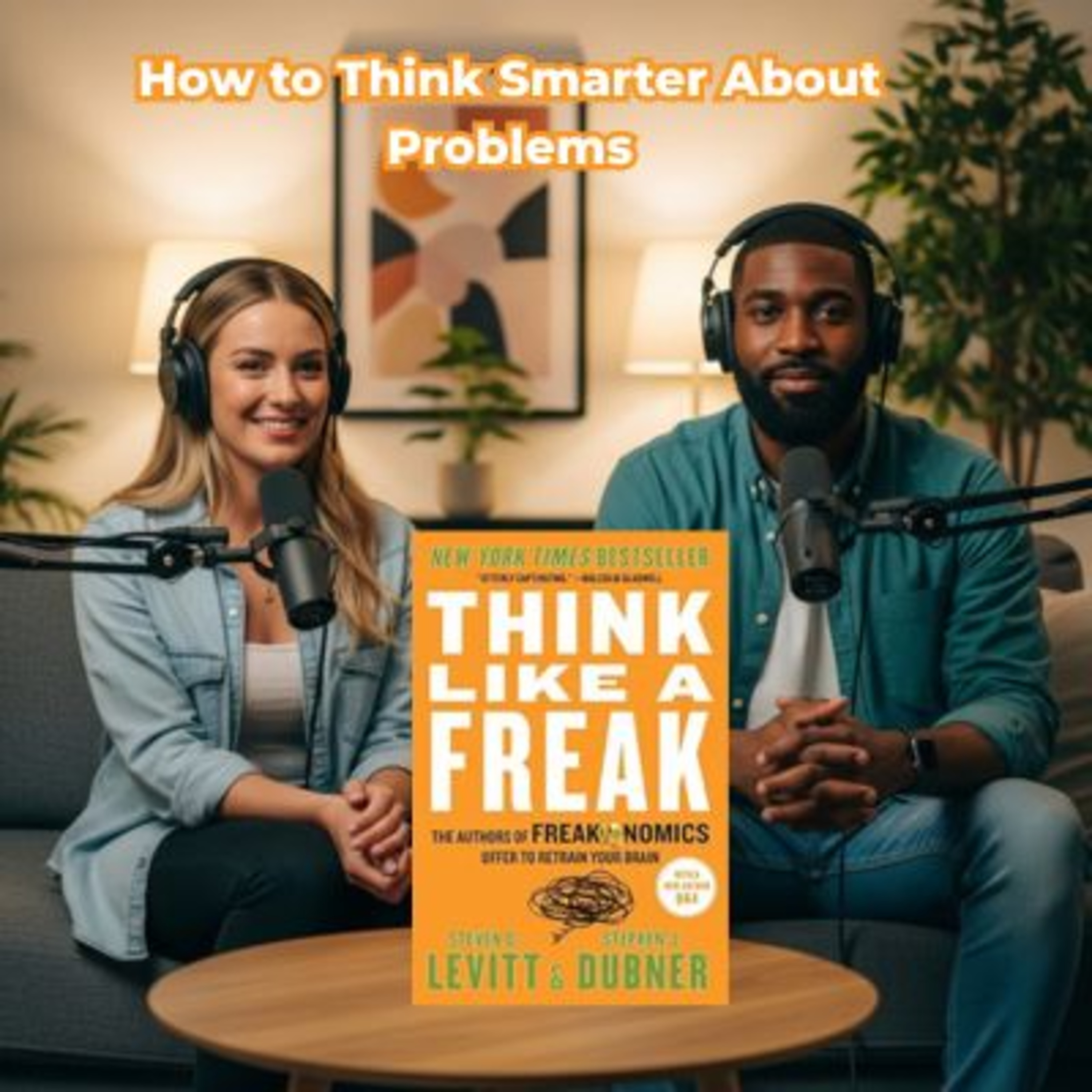
Now, with Think Like a Freak, Steven D. Levitt and Stephen J. Dubner have written their most revolutionary book yet. With their trademark blend of captivating storytelling and unconventional analysis, they take us inside their thought process and teach us all to think a bit more productively, more creatively, more rationally—to think, that is, like a Freak.
Levitt and Dubner offer a blueprint for an entirely new way to solve problems, whether your interest lies in minor lifehacks or major global reforms. As always, no topic is off-limits. They range from business to philanthropy to sports to politics, all with the goal of retraining your brain. Along the way, you’ll learn the secrets of a Japanese hot-dog-eating champion, the reason an Australian doctor swallowed a batch of dangerous bacteria, and why Nigerian e-mail scammers make a point of saying they’re from Nigeria.
Some of the steps toward thinking like a Freak:
- First, put away your moral compass—because it’s hard to see a problem clearly if you’ve already decided what to do about it.
- Learn to say “I don’t know”—for until you can admit what you don’t yet know, it’s virtually impossible to learn what you need to.
- Think like a child—because you’ll come up with better ideas and ask better questions.
- Take a master class in incentives—because for better or worse, incentives rule our world.
- Learn to persuade people who don’t want to be persuaded—because being right is rarely enough to carry the day.
- Learn to appreciate the upside of quitting—because you can’t solve tomorrow’s problem if you aren’t willing to abandon today’s dud.
Levitt and Dubner plainly see the world like no one else. Now you can too. Never before have such iconoclastic thinkers been so revealing—and so much fun to read.
This summary of "Think Like a Freak" explores unconventional strategies for problem-solving and critical thinking. Authors Steven Levitt and Stephen Dubner encourage readers to discard traditional assumptions, admit to ignorance, and maintain a childlike curiosity to uncover root causes rather than surface symptoms. The text outlines practical methods for influencing others, understanding human incentives, and recognising when strategic quitting is the most productive path forward. By reframing challenges and seeking data-driven insights, individuals can develop a more creative and effective mindset. Ultimately, these chapters serve as a guide to navigating complex issues by thinking differently and embracing a more analytical, open-minded perspective.
#ThinkLikeAFreak #Freakonomics #CriticalThinking #ProblemSolving #DecisionMaking #BehavioralEconomics #MindsetShift #SelfImprovement #Psychology #BusinessThinking #MentalModels #BookSummary #ProductivityHacks #CreativeThinking #PersonalGrowth
You know, usually when we talk about solving a problem, there's this, this underlying expectation of straightforward mechanics. Oh. Absolutely. I mean, think about fixing a car, you hear a weird rattle, you take it into the shop, they replace a spark plug and the mechanic just points and says hey, there's your issue, you're good to go. Right, because it's a straight line cause and effect. It's highly visible and honestly, incredibly comforting. We desperately want our challenges to be easily categorized into a neat little box so we can just apply the standard fix.
But then you step into the real world, you step into your career, your personal life or like a massive organizational crisis, and suddenly that mechanics toolbox is completely useless. Yeah. Totally useless we're. Looking at a landscape of challenges that is honestly just a tangled mess of human behavior and hidden variables. So welcome to the deep dive everyone. I'm your host. And I'm your resident expert, glad to be here for this one. Today we are setting the stage for a complete mental rewiring.
The mission here is to transform you into a master problem solver, the kind of person who can spot hidden solutions and generate crazy good ideas when everyone else is just, you know, staring at a brick wall. Exactly. We are trying to help you look at the world through an entirely different, highly unconventional lens. It's really about learning to rebel against standard operating procedures. And to do that, we are diving into an incredible source today. It's excerpts from a summary guide titled The Master Problem Solver, which distills the core wisdom of Steven Levitt and Steven Dubner's famous book, Think Like a Freak.
It's such a great text. It really is, and our goal today is to extract the absolute essence of this material so you can tackle your personal challenges, improve your work strategies and avoid information overload, all while respecting your time. Right, getting straight to the good stuff. OK, let's unpack this. Before we can actually solve anything, our source makes it clear that we have to fundamentally change our baseline approach to knowledge itself. Because you simply can't fill a cup that's already full.
Yes, exactly. That is the perfect way to frame it. I mean, the very first step to adopting this mindset is actively tearing down the ego, right? You have to approach problems with an open mind, question conventional wisdom, and take take the kinds of intellectual risks that actually lead to breakthroughs. You basically have to stop accepting the excuse. Well, that's just the way it's always been done. But tearing down that ego brings up an immediate, deeply uncomfortable reality, right? You have to actually say the words out loud.
You have to admit you are ignorant. Oh. People hate doing that. They really do. The text is huge on this. Owning up to the three hardest words in the English language, which are. I don't know, just thinking about this and admitting ignorance is a lot like clearing the cache on your web browser. Oh. I like that. Right when you do it, it feels like you're losing valuable data, but it actually frees up the processing memory you need to take in new information instead of like constantly relying on outdated cookies that are slowing you down.
That's a great analogy, because holding on to that outdated information takes up massive cognitive load. Embracing humility is arguably the most crucial step in this entire framework. The text points out that at meeting when you don't know something isn't a weakness, it is a strategic strength. But I have to push back here. Isn't it terrifying to say, I don't know, in a professional setting where you're expected to be the expert? I mean, if you are the manager, the leader, the person getting paid to have the answers, doesn't clearing that cash and admitting ignorance just destroy your credibility?
What's fascinating here is that the exact opposite is usually true. Really. Yeah, pretending to know everything actually isolates you. Think about the mechanics of a typical boardroom. If the leader pretends to understand a complex new market dynamic just to save face, they are forced to defend a position they haven't fully thought. Out Oh, I've seen that happen. Right. This naturally leads to terrible uninformed decision making and worse groupthink, because nobody wants to contradict the boss who claims to have the answer.
So the fake expertise actually creates a bottleneck. Exactly. But the text highlights that by admitting what you don't know, you actively build psychological safety. You are signaling to the room that truth is more important than ego. Right, which opens everything up. Exactly. When you drop the facade of the all knowing expert, you remove the friction in the room. People suddenly feel safe to be in there by verse specialized expertise to the table. You create a culture of lifelong learning rather than a culture of hiding mistakes.
That makes a lot of sense. Once you clear that cache and admit you don't have all the answers, you were actually ready to download the right information. Precisely. But that leads to the next major hurdle, like how should you actually look at the obstacle in front of you? The source emphasizes the vital importance of accurately diagnosing the real problem before you even think about jumping to solutions. This is where we have to constantly ask why gather real data and stay flexible enough to revise our definition of the problem as new information comes in.
Because if you don't do it. If you don't do that, you end up treating symptoms instead the disease. The source uses this fantastic metaphor of a bad dye job, saying the truth is always in the roots. It's so true. If I can add to that, it's like treating a relentless weed in your garden by just running a lawn mower over it instead of getting your hands dirty and pulling it out by the root. Yeah, out of sight, out of mind. Exactly, sure your lawn looks fine for a weekend, but the root system is completely intact and the weed is just going to grow back stronger next week.
So what does this all mean for our listener when they face a crisis at work? Well, you have to resist the overwhelming temptation to apply a quick fix. The text warns us about how a hasty study or rushed analysis leads to incorrect conclusions and, you know, massively wasted resources. Give me an example of that. Let's ground this in a real world scenario. Imagine a company where sales has suddenly plummeted by 20%. OK, so the symptom is low revenue and the knee jerk lawn mower solution is usually to like fire the sales manager or run a massive discount campaign, right?
You panic and you treat the symptom. But if you continuously ask why and dig into the roots, you might triangulate the actual cause. Like what? Maybe the sales team is fine, but the product quality dropped because procurement quietly switched to a cheaper supplier 6 months ago. Oh wow. Yeah, or maybe the market demographic has fundamentally shifted and your product is suddenly obsolete. If you just fire the sales manager, you've wasted money, ruined a career, and your sales will still drop because you didn't fix the supply chain issue.
So you're just mowing the weed? Exactly. Effective solutions, the ones with actual long term impact, only happen when you target the source. Anything else is just mowing the weed. OK, so let's say you've done the hard work. You cleared your ego, you ask why a dozen times, and you successfully grabbed that weed by the root. Good step one. Now, how do you solve the issue without falling back into the exact same conventional traps that created the problem in the first place? Right. This is where the text gets into the toolkit for unconventional solutions, and it hinges on this concept of thinking like a child.
It sounds counterintuitive for high level problem solving, but the authors urge us to develop an inquisitive mindset, to embrace, wonder, ask what if, experiment freely, and this is a big one, not take yourself too seriously. I love how the source illustrates this. I mean, I have to marvel at the specific stories they use here to explain this mindset, specifically the juxtaposition of the biblical King Solomon and David Lee Roth, the lead singer of the rock band Van Halen. It's quite the pairing.
On the surface that is insane comparison, but they both use childlike, unconventional reframing to solve massive problems. Can we actually break down what David Lee Roth did? Because it's brilliant. It really is if we connect this to the bigger picture of finding hidden information. The David Lee Roth story is a master class OK set. The scene for us? So back in the 1980s, Van Halen was pioneering these massive stadium level rock shows. They were hauling unprecedented amounts of heavy gear, lighting rigs and pyrotechnics into relatively small, outdated arenas.
So things could go wrong fast. Exactly. The risk of a stage collapsing and killing people was very real. So they had this incredibly dense 50 page technical contract that promoters had to follow to the letter just to ensure basic safety. Right, but David Lee Roth had a problem. How do you quickly find out if the local promoter actually read the 50 page technical writer or if they just skimmed it? Right. His solution was famously buried deep in the middle of the contract. He demanded a bowl of M&M's backstage but with a strict non negotiable clause.
Absolutely no Brown M&M's. Which, for decades the media spun, is the ultimate example of a diva rock star on a power trip. But it wasn't a power trip at all, was it? Not at all. It was a diagnostic tool. It was a Canary in the coal mine. How so? When David Lee Roth walked into the dressing room, if he saw a single brown M&M in that bowl, he immediately knew the promoter hadn't read the contract carefully. Well, that's more. And if they missed the clause about the candy, what were the chances they properly reinforced the steel girders holding up 10,000 lbs of lighting equipment?
Wow. Yeah. So he knew instantly to check the safety rigs. Exactly. It was a fast, cheap, completely unconventional way to reveal hidden information about safety compliance. And then the text connects that exact same logic to King Solomon. Two women come to him, both claiming to be the mother of the same baby. It's an impossible, he said, she said. Scenario A. Classic problem. The conventional adult approach would be the interview witnesses or ask a million questions. But Solomon does something totally bizarre.
He says fine, we'll cut the baby in half and you each get a piece, which is. Horrifying on the surface, but brilliant in terms of game theory. Solon didn't actually want to harm the child, he wanted to force the real mother to reveal herself. Because a real mother would never let that happen. Exactly. The true mother immediately begged him to spare the child and give it to the other woman, while the fake mother agreed to the split by introducing a completely unexpected extreme variable, he manipulated the situation so that the truth naturally rose to the surface.
I imagine solving problems this way requires stepping completely outside the adult obsession with the rules. Oh definitely. Kids are great at this. They just test limits without assuming something is impossible or unprofessional. That's what it means to think like a child here, right? Does that mean we are supposed to throw out our hard earned professional expertise or just our assumptions? Just our assumptions. A child doesn't know what the rules are, so they aren't constrained by them. As adults, our expertise is valuable, but it blinds us.
It makes us rigid. Yes, the text is telling us to keep the adult knowledge but adopt the child's willingness to experiment. By challenging norms like David Lee Roth or King Solomon, you can reframe a problem entirely and find data that a purely adult mindset would completely miss. OK, so you've got this brilliant, unconventional David Lee Roth style solution, but here is the reality check. A great idea means absolutely nothing if you can't get other people to buy into it. So true. If human psychology is wired to resist change, your idea is dead on arrival.
How do we bypass that psychological firewall? Well, this brings us to the art of motivation and persuasion. You have to understand human psychology to motivate conduct. The authors stress the importance of mixing intrinsic rewards with extrinsic rewards, all while staying focused on long term goals. Here's where it gets really interesting. The authors of Think Like a Freak play a very deliberate, highly ironic trick on the reader here. Yes. I love this part. They put all of their brilliant advice on how to persuade people into a chapter titled The Upside of Quitting, and they put all their advice on how to quit into a chapter about persuasion.
Yeah, it's a deliberate subversion of our expectations. Maybe they were just testing to see if we were paying attention, but rolling with it, looking at the actual mechanics of persuasion they outline. How do we combine these rewards to win over doubters? Like what is mixing intrinsic and extrinsic rewards actually look like in the real world? Think about it like trying to install a necessary software update on a computer that's aggressively running a firewall. If you just walk into a room and drop a massive spreadsheet proving your unconventional ideas right, people will naturally get defensive.
They shut down. Exactly. The data is blocked by their emotional firewall. You have to use incentives as the security key to bypass it. Like giving candy to a baby, as the chapter suggests. Right. Intrinsic rewards are the tangible things like a year end cash bonus or a promotion that gets them in the door and appeals to their baseline needs. But the cash alone doesn't change their mindset. Right. That is where intrinsic rewards come in. Intrinsic rewards appeal to their internal desires. You know, giving someone autonomy to lead a new initiative or public recognition that makes them feel valued.
You need the extrinsic cash to get their attention, but the intrinsic ownership is what stops them from fighting your new idea. And the text pairs those incentives with the power of storytelling. Instead of shouting data at them from across the river or fighting their firewall, stories seem to slip right past their defenses. Because stories build trust. From a psychological standpoint, stories bypass the amygdala threat response. Wait, really? The brain sees data as a threat. Oh absolutely. When you tell someone, hey, your current process is wrong, their brain literally registers it as a threat.
But when you tell a story or use an analogy, you engage their emotions and allow them to arrive at the conclusion themselves. That is so powerful. It is. You are addressing their objections proactively through a narrative they can relate to. It's not manipulation, it's aligning your solution with the way human brains actually process information. That makes a ton of sense, Yeah, but I have to ask the bleak question. Go for it. What happens when, despite your absolute best reframing, despite your perfectly tailored intrinsic and extrinsic incentives and your brilliant storytelling, yeah, the endeavor is simply failing?
Well, that is the hardest pill to swallow for a high achiever and it leads to the final strategy, which is the art of walking away. Which, playing on that deliberate irony from the authors again, is housed under the lesson of how to persuade people who don't want to be persuaded. The lesson is sometimes you just give up, knowing when to cut losses, evaluating costs and benefits, and strategic quitting. But I have to push back hard on this. For our listener, it makes logical sense on paper. But letting go of that conditioning is tough.
We are practically hardwired from birth to believe the old saying winners never quit and quitters never win. Isn't giving up the ultimate failure for a problem solver? This raises an important question, and it's one that the freak mindset completely turns on its head because it forces us to confront a major psychological blind spot, which is the sunk cost fallacy. Explain how that works. Well, the human brain is evolutionarily wired for loss aversion. Studies show that losing $100 feels roughly twice as painful as the joy of finding $100.
Wow, twice as painful, Yeah. Because of this, when we invest a ton of time, money, or emotion into a project, say pouring venture capital into a failing startup or staying in a terrible college major just because you've already spent two years on it. We pain. We become terrified of cementing that loss. We blindly persist in a failing endeavor just because of pride or a fear of being a quitter. We double down on bad bets to avoid the pain of the sunk cost. Even though the time and money are already gone and you can never get them back.
Exactly. And by obsessing over the sunk cost, we completely ignore the opportunity cost. The cost of what you could be doing instead. Precisely every hour, every dollar, every ounce of mental energy you pour into a dead end project is a vital resource stolen from a potentially brilliant alternative. That is a harsh reality. It is, but the text points out that strategic quitting isn't a failure at all. It is a highly calculated intelligent strike. An act of choice. Yes. By evaluating the trajectory and choosing to cut your losses, you stop the bleeding.
You free up those resources. You learn from the failure, absolutely. But you don't chain yourself to a sinking ship. You pivot. Exactly. Quitting strategically allows you to pivot and pursue alternative paths with far greater potential for success. True problem solvers don't just bash their heads against the wall trying to solve the problem in front of them. They have the clarity to know which problems are actually worth solving in the first place. It takes a lot of active on learning, but that shift in perspective changes everything.
It really does. So let's bring this all together. Look at the journey we've taken through this material today. We started by clearing the cache, embracing the humility of I don't know which tears down the ego, removes the boardroom bottleneck, and actively invites collaboration. A. Crucial first step. Then we learn to ignore the bad dye job, to stop mowing the symptoms and start digging for the true root causes of our problems. And once we found those roots, we applied a childlike wonder to our solutions.
We stripped away our rigid adult assumptions and used unconventional tools like a bowl of Brown M&M's to reveal hidden information. We figured out how to bring resistant people along for the ride by hacking their psychological firewalls, blending the extrinsic and intrinsic rewards with the disarming power of storytelling. Because nobody likes having data shouted at them. Right. And finally, we gave ourselves permission to do the unthinkable, to conquer the sunk cost fallacy and strategically quit when an endeavor is failing so we can redirect our energy towards something with real potential.
It is a phenomenal comprehensive toolkit. It takes the tangled messiness of real world problems and gives you a completely different framework for navigating them. So to you, our listener, here is our challenge for the week. Take just one of these lenses and apply it to a roadblock you are facing right now, whether it's at work or in your personal life. Just one is all it takes to start. Exactly. Maybe it's finally admitting, I don't know, in your next meeting to build some psychological safety.
Or maybe it's asking what if, like a kid when you look at a stalled project, try it and see how the landscape shifts. It really only takes one small shift in perspective to start seeing the hidden solutions. It really does. But before we go, I want to leave you with one final, unaddressed idea to Mull over. Sorry, I'm ready. If the absolute core of thinking like a freak is rebelling against conventional wisdom to find better solutions, what happens if this book works perfectly and everyone adopts this mindset?
That's a paradox right there. Right. If everyone starts thinking like a freak, does this unconventional boundary pushing approach just become the new boring conventional wisdom? And if so, what kind of freak will we need to break those rules? Keep questioning everything we'll catch on the next deep dive.
 Apple Podcasts
 Castbox
 Castro
 Goodpods
 Moon FM
 Overcast
 Pocket Casts
 Podbean
 Podcast Addict
 Podcast Republic
 Spotify