The Responsibility Ethic by Adam Kreek | 12 Strategies Exceptional People Use to Do the Work and Make Success Happen
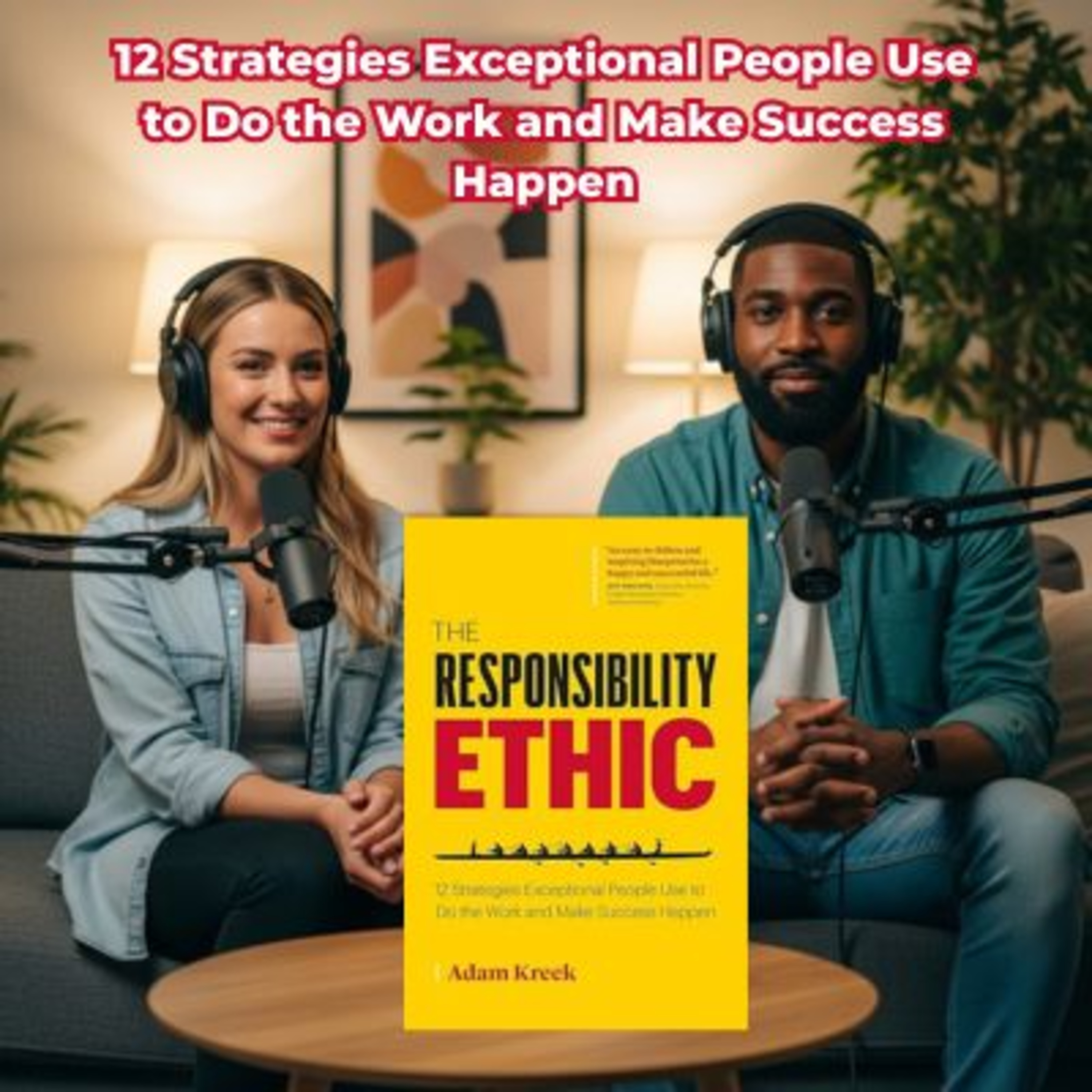
In his book The Responsibility Ethic, Adam Kreek argues that personal accountability is the fundamental catalyst for achieving extraordinary success and overcoming stagnation. The text outlines how individuals can reclaim power by owning their choices and reactions rather than blaming external circumstances for their failures. Practical strategies are provided for managing stress, refining professionalism, and setting disciplined goals through small, consistent actions. Furthermore, the material emphasizes that true leadership involves empowering others and sharing authority to foster innovation and collective growth. By mastering this mindset, one can build resilience and maintain the momentum necessary to navigate complex professional and personal challenges. Ultimately, the source serves as a motivational guide to unlocking human potential through radical self-responsibility.Built from Olympic training and executive coaching, this book is a field-tested guide taking ownership, unlocking resilience, and achieve more with less stress.
Discipline ― build habits that make execution automatic (in work and life)
Resilience ― recover from setbacks faster and stay steady under pressure
Leadership ― lead yourself first, then earn trust and influence with others
Performance ― apply Olympic-level principles to pursue goals with focus and consistency
Action ― replace excuses with a simple, repeatable execution: do the work
Together, these principles give you the clarity and drive to finally break through plateaus and achieve results that last.
Stop drifting. Start leading. Scroll up to get your copy of The Responsibility Ethic today. Take control of your success, starting now.
#ResponsibilityEthic #SelfDiscipline #Leadership #PersonalDevelopment #Resilience #MindsetShift #SuccessMindset #HighPerformance #Accountability #MentalToughness #SelfImprovement #GoalSetting #DisciplineEqualsFreedom #BookSummary #GrowthMindset
What if right now, the single biggest threat to your company's survival, it isn't actually the rise of artificial intelligence or, you know, sudden market crash or even a new competitor, right? What if the real danger is simply that the 25 year old marketing coordinator and the 60 year old sales director literally cannot communicate? Yeah. That's the real threat. Welcome to the deep dive. I want you to picture a scenario that, I mean, you have almost certainly lived through recently. You are sitting in a conference room.
Or maybe you know, you're just staring at a grid of faces on a Zoom call. We've all been there. Right. And you are watching this like slow motion collision on one side of the virtual table. You have the veteran colleagues and they seem, well, entirely disconnected from the younger staff, like completely baffled by their work habits. Totally baffled. And then on the other side, the younger staff are looking at those veteran employees like they just arrived from the place to see an era. You can practically feel the eye rolls happening off camera.
Oh, and the private Slack messages. Exactly. The resentment brewing in those silent Slack channels, and you're just sitting there wondering, is this just like a hopeless culture clash that every workplace is doomed to endure? Or, you know, is there an untapped goldmine of potential hiding inside all this friction? Yeah. And it's a dynamic that plays out in nearly every organization, I mean, every single day. And the default corporate reaction is almost always just, well, it's damage control. Yeah.
We treat generational friction as a liability, like a toxic spill that needs to be contained. Management tries to minimize it, usually by just ignoring it completely. Right sweeping under the road. Exactly. But the reality is that when you actually harness it, that exact friction can become an organization's most potent competitive advantage. And that is exactly the mission for our deep dive today. We're going to transform that generational friction you see at work into what your biggest personal asset.
We're going to shortcut your way to being the ultimate bridge builder in your career. Because that's the person who wins. Exactly. The person who can translate between these polarized groups is the person who becomes completely indispensable to a company's future. And we are pulling all of this from an incredible set of sources today, anchored by a book called Intelligence Strategies for a Multi Generational Workplace. It's a great read. It really is. It's by Brandon Fogle, Josephine Nachemson Ekwall, and Megan Gerhart, And they argue that having a massive age spread on your staff isn't, you know, some HR headache to solve.
It is a strategic resource to leverage. So OK, let's unpack this. Let's do it. Before we can fix the friction in our own offices, we really need to figure out where these rigid, conflicting generational boxes even came from in the first place. Right, because nobody arrives in the workforce with like a barcode on their forehead dictating how they're going to behave. Yeah, that'd be weird. It would, But to understand the tension, we have to look at the origin story of what the author's term the Generation Wars.
And a massive piece of that puzzle is, well, media amplification. The media plays an enormous role in distorting our reality by just, you know, flattening out human complexity. The book points to a highly influential moment. There was this 60 Minutes piece by Morley Safer. Oh, right, I think I remember hearing about that. Yeah, he effectively introduced millennials to the broader corporate consciousness, and the broadcast relied heavily on these incredibly broad, sensational generalizations. Like what?
Well, he painted a picture of a generation that demanded participation trophies, required safe spaces in the office, and just fundamentally refused to pay their dues. Man, it's like they drew a like a caricature of what a younger worker looked like broadcasted to millions of homes and suddenly everyone was just expected to fit into that specific cartoon outline. That's exactly what happened it. Honestly reminds me of horoscopes. You know, you read your horoscope in the morning, it tells you that you're like a fiery Leo who's going to be impatient today.
And suddenly, every time you tap your foot waiting for an elevator, you think. Typical Leo. Right, it's a self fulfilling prophecy. Yeah, people start acting like these generational stereotypes simply because the media repeats them so relentlessly. Wait, let me push back a little. Is this really just media programming? Are we just playing the character the media happened to assign to us? Or I mean, are these stereotypes rooted in actual lived experiences that just happened to fit the narrative? Well, what's fascinating here is that the foundation is absolutely legitimate, even if the media exaggerates the edges.
OK. So it's not just made-up. No, not at all. The book makes it clear that generational identities are very real phenomena. They're shaped by shared historical occurrences, major cultural shifts, and especially massive technical developments. So the stereotypes are just, you know, distorted reflections of those real foundations. OK, so it's not made-up out of thin air. Walk me through the mechanics of that then. Like why does a baby boomer inherently value face to face interaction so much more than, say, a millennial or Gen.
Z employee? It really comes down to the verifiable metrics of trust that were available during their formative professional years. Metrics of trust. Yeah, for a baby boomer or even older Gen. X workers, they built their careers in an era before instant digital communication. So in that environment, physical presence, you know, being at your desk early, staying late, looking someone in the eye during a meeting, that was the only reliable, verifiable metric of dedication and reliability. That makes sense.
Right. That is how you proved your worth. But millennials and Gen. Z, conversely, they grew up entirely immersed in the Internet age. Yeah. Digital natives. Exactly. For them, speed, access and digital responsiveness are the metrics of reliability. So a younger worker naturally prioritizes prompt digital communication because of that is the environment they learn to navigate. Because for a millennial delivering a flawless project file via Slack at like 11:00 PM on a Sunday, that proves dedication, whereas for a boomer doing that without ever coming into the office all week might scan as what?
Aloof or disconnected? That is the core of it, yeah. The logic holds up perfectly when you look at the historical conditions they actually experienced. And the authors stress that self-awareness of our own generational identity is like the mandatory first step here. You cannot understand someone else's baseline until you recognize that your own way of working is not some undeniable objective truth. It is just a product of the era you happen to enter the workforce in man. That's powerful. So if we've all deeply internalized these identities and they're colliding out in the real world, how does this actually manifest?
Because it doesn't just stay as interesting sociology, right? It turns into those very real daily obstacles that make us want to pull our hair out. Oh, absolutely. Out in the wild, the authors identify two major barriers creating this friction. You've got conflicting communication patterns and the perceived resistance to change. OK, give me an example. Well, these are the daily flashpoints. Consider a project team made-up of, say, Gen. Z and Gen. X employees. Gen. X spent 20 years mastering a specific workflow, maybe a complex e-mail filing system or a particular way of running quarterly reviews.
Right. They know it inside and out. Exactly. But when Gen. Z comes in and immediately suggests blowing up that process in favor of a new, highly automated platform, Gen. Z views Gen. X's hesitation as being overly rigid or terrified of technology. I see where this is going. Meanwhile, Gen. X is incredibly irritated by what they perceive as Gen. Z's total lack of patience and their refusal to understand why the old system was built that way in the first place. It's like 2 entirely different operating systems trying to share data without an API to translate the code.
Like, the hardware is fine, but the systems are fundamentally incompatible out-of-the-box. That's a perfect analogy. But let me push back on this idea of, you know, resistance to change. Isn't resisting change just a universal human trait as we age? Like do we really pin that specifically on Gen. X or Baby Boomers as a unique generational flaw? Won't Gen. Z violently reject whatever I don't know? Telepathic neural link technology replaces smartphones in 40 years. Oh, they absolutely will. You're right.
Resistance to change is a fundamental part of the human condition. Right. But the the book's crucial insight is that the context of the change is what triggers the generational friction. It's context. Yeah. When an older generation resists a new procedure or technology, it isn't usually born from a desire to just be stubborn. It is a defense of their hard earned competence. Oh wow, they have spent decades building expertise in a specific tool set. So when a younger employee casually suggests throwing that tool set away, the older employee subconsciously hears your expertise is no longer valuable.
Ouch, that would sting. Exactly. Recognizing that this resistance is a natural defense mechanism makes navigating it much easier. You stop seeing it as malice and start seeing it as a need for reassurance. That reframes everything. You aren't attacking their willingness to work, you're asking them to abandon the very framework that made them successful in the 1st place. Yes. So if resistance to change is actually just a defense of confidence, how do we systematically disarm that defense without insulting anyone?
One, I mean, this is where the authors introduce their solution, right? The thing they call gentelligence. Yes, exactly. The Gentelligence framework revolves around everyday leadership, specifically leveraging 2 essential behaviors, empathy and flexibility. Empathy and flexibility, OK. Now, empathy in the corporate world often gets, you know, watered down into just being nice. But in this context, it means actively investigating the why behind a diverse viewpoint. Digging deeper. Right. It is moving from why is my older colleague doing this wrong?
To what historical context makes this approach logical to them? I love that. And flexibility is I guess the physical execution of that empathy. It's modifying your communication styles and actively offering multiple channel for collaboration. Exactly. But let's look at the actual mechanics of this in the real world, specifically for the toughest job in the corporate hierarchy, the mid level manager. Here's where it gets really interesting. If you are in middle management, you are essentially the middle child of the corporate family.
That is so true. Right. You are forced to act as this endless diplomat between the demanding older sibling, the executives, and the chaotic, energetic younger sibling, the junior staff. The mid level manager is entirely in the crossfire. The book explains that they have to master 2 distinct forms of translation leading up and leading down. Leading up and leading down. Right upward leadership means taking a raw idea and tailoring the pitch to fit the priorities, the expectations, and the communication styles of the senior executives.
So let's say your Gen. Z team wants to use TikTok for internal company announcements. If your boomer boss values risk mitigation, long term strategic alignment, and face to face updates, you don't just send them a Slack message saying hey, let's do TikTok. It's viral, yeah. Definitely not. You schedule a sit down meeting and you frame the idea not as a fun disruption, but as a low cost tool for asynchronous knowledge retention that will, you know, help build the company's legacy. You translate the code.
That is a perfect example of upward leadership. Yeah. You preserved the core idea, but you formatted it for the receivers operating system. Yeah. And simultaneously, that same manager is executing downward leadership. This means providing feedback suited to the work styles of junior team members. Right, the energetic younger sibling. Yeah. If you have Gen. Z staff who expect rapid iteration, transparency and immediate impact, you cannot make them wait for a formal 6 month annual review to tell them how they are doing.
You adapt to a high frequency, low formality feedback loop. But wait, if I am that manager and I am constantly translating my upward communication to appease my boss and then completely reformatting my downward communication to motivate my staff, yeah, don't I risk losing my own authentic leadership voice? Like, am I just becoming a corporate chameleon who mirrors whoever is in the room? It's a fair concern, but if we connect this to the bigger picture of organizational behavior, true leadership has never really been about rigid self-expression.
It is about effectiveness. Effectiveness. OK, by adjusting your style, you aren't being inauthentic, you are just being highly competent. The historical corporate model dictated that younger generations simply had to assimilate entirely to the older generation's rules. Right, it was a one way St. Exactly. Gentiligence flips that paradigm. It demands mutual adaptation. By changing your frequency to match the listener, you aren't erasing your voice, you are guaranteeing that your voice is actually heard.
Changing the frequency, not the message. But I mean relying on individual diplomacy expecting one stressed out middle manager to constantly translate. That's a recipe for massive burnout. Oh absolutely. It is not a sustainable business strategy. To truly eliminate the generation wars, these practices have to be scaled up. They need to be hard coded into a company's HR strategy and its structural culture. Yes, scaling gentiligence means moving from individual behavioral tweaks to massive structural systems.
A gentiligent people strategy acknowledges that diverse strengths need to be structurally combined, not siloed. So not just putting all the young people on one team. Exactly. Younger generations naturally bring tech savvy, disruption and fresh frameworks to the table, while older generations hold the deep rooted institutional knowledge and industry relationships. A successful culture physically builds bridges between those assets. The sources emphasize that this requires totally reimagining career development.
Companies have to abandon those rigid one-size-fits-all training modules. They do, and it extends deeply into career pathing, which is a major logistical shift for HR departments. How so? Well, the book points out that millennials and Gen. Z heavily value rapid skill development. They want micro certifications, rotational projects and swift advancement. Baby boomers, conversely, are often much more focused on building a legacy, sharing their institutional knowledge and taking on advisory or mentorship roles.
So different end goals. Yeah, a intelligent company actually builds distinct formal pathways that cater to those wildly different goals. It's like an A la carte menu instead of a forced multi course meal. Or you know, taking a high performance car and tuning the suspension completely differently depending on the track. Exactly. You wouldn't use the same setup for a Dirt Rally that you'd use for a paved track. Even though it's the exact same vehicle. You tune it to maximize performance in that specific environment.
That's a great way to think about. IT, but if I'm an HR director, how do I actually implement diverse career tracks without blowing up my budget or having half the staff scream about favoritism? Like if I give the 26 year old a fast track tour of duty rotational program and ask the 58 year old to join an Advisory Board, isn't someone going to claim unfair treatment? Well, the defense against claims of unfairness and the key to keeping the budget intact, honestly, is establishing radically transparent shared team goals.
Transparency is key. Always. If the entire organization is crystal clear on what the ultimate objective is, the methods of getting there can vary wildly without causing resentment. Oh, I see. Furthermore, HR departments often find that creating these tailored tracks is significantly cheaper than the alternative, which is the constant expensive turnover of burned out employees who feel misunderstood. Good point. Turnover is so expensive. Exactly. Equity in a modern workplace doesn't mean giving everyone the exact same tools.
It means giving everyone exactly what they need to succeed and contribute to that shared objective. The culture simply requires open avenues for feedback so that everyone understands why different paths exist. Equity over equality. You give everyone the tools that actually work for their specific operating system. And getting this inclusive, tailored culture right today isn't just about making the office a warm and fuzzy place to be. It is a strict, non negotiable requirement for surviving the massive disruptions barreling toward us.
Which brings us to future proofing the workplace. The book dedicates substantial focus to this because the stakes are incredibly high. Companies have to leverage intelligence to navigate the enormous shifts on the horizon. Like what specifically? The permanence of remote labor networks and the relentless March of artificial intelligence and automation. Adaptability is the master. Key. Organizations that are flexible across generations are the ones that absorb technological shocks without fracturing.
The sources highlight two very specific essential skills for surviving the future of work, digital literacy and emotional intelligence. And the mandate here is that opportunities to develop these two skills must be provided for all generations. Like, you cannot just train the young people on digital tools and the older people on emotional intelligence, right? Everyone needs both. So what does this all mean for you? Listening right now? This is essentially your personal survival guide. Let's look at a concrete scenario.
As AI workflow adoption fundamentally changes your industry, how does this actually play out? Consider how AI will be adopted. A baby boomer might use an AI tool to rapidly summarize 40 years of client notes to identify long term market trends. That's combining their deep industry knowledge with high digital literacy. Very smart. A Gen. Z employee might use that same AI to automate a daily check in process, freeing up time to actually sit down and actively mentor a new intern. That's combining their native digital fluency with high emotional intelligence.
Oh, that. You can no longer afford to just be the tech person or the people person when AI can write the code and draft the emails. Emotional intelligence and the ability to navigate complex human relationships, those become your primary differentiators. You need both to survive what's coming. But wait, let's follow that to its logical conclusion. If the ultimate goal of an intelligent company is that literally everyone from the 22 year old intern to the 65 year old executive learns high level digital literacy and high level emotional intelligence, don't the generational differences eventually just vanish?
Like if we all master the exact same 2 future proof skills, won't we all just become one homogeneous, highly effective BLOB of a workforce? This raises an important question, and it really gets to the philosophical core of the author's research. Is the goal of Gentiligence to erase our differences, or is it simply to remove the friction between them? Oh. It's a good distinction. Based on the premise of the book, the differences will not disappear because our foundational coming of age experiences will always inform how we apply those new skills.
OK, so they use them differently. Exactly. The baby boomer with high digital literacy is still going to leverage it to enhance long term legacy building relationships. The Gen. Z employee with high emotional intelligence is still going to use it to advocate for rapid empathetic shifts in work life balance and systemic transparency. I see the diversity of thought remains entirely intact. It is only the communication barriers that get dismantled. O The generational differences are still there, they just stop being weapons we use to undermine each other and they start being specialized tools we use to build the company together.
Erfectly said a truly successful workplace is ultimately 1 where everyone, regardless of the year, printed on their birth certificate feels appreciated, heard and aligned with a shared mission. And that brings us full circle. We started by looking at that tense, awkward conference room with the hidden eye rolls and the unspoken frustrations. It's a slow motion. Exactly. The major take away from all the source material is that you do not have to just sit there and endure that culture clash. You can take these specific tools Active Empathy.
To discover the why, conscious flexibility to change your frequency and tailored communication to format your pitch. An you can become the translator in your own office starting tomorrow. You really can. You can be the individual who turns that generational standoff into a massive strategic advantage for your career. It fundamentally requires the willingness to step out of your own generational perspective for just a moment, recognize that your way isn't the only objective truth, and validate the logic of someone else's operating system.
But. I want to leave you with a final, slightly provocative thought to Mull over as you go back to your day. We have talked extensively about how generational identities are formed by major technological and cultural shifts, right. Historically, we think of a generation as spanning roughly 15 to 20 years. But look at the world today. Technology is not advancing linearly. It is advancing at an unprecedented exponential rate. Oh. It's so fast now. Right, The cultural and digital landscape shifts completely every few years.
Now. The Internet a 20 year old grew up with is vastly different from the Internet a 25 year old grew up with. So is the traditional 15 to 20 year generation dead? Will we soon be dealing with micro generations entering the workforce every three to five years? And if the gaps between operating systems keep getting smaller and more frequent, does that mean we will require constant, non-stop intelligence just to keep our offices from completely falling apart? It is a fascinating prospect. As the pace of technological change continues to accelerate, our capacity for mutual adaptation is going to be tested more frequently than ever before it.
Really is. So the next time you were in that meeting and the generational friction starts sparking, remember you now have the blueprint to fix it. Thanks for joining us for this deep dive. Keep asking questions, keep translating, and we will catch you on the next one.
 Apple Podcasts
 Castbox
 Castro
 Goodpods
 Moon FM
 Overcast
 Pocket Casts
 Podbean
 Podcast Addict
 Podcast Republic
 Spotify