The Little Book of Gold by Erik Hanberg | Fundraising for Small (and Very Small) Nonprofits
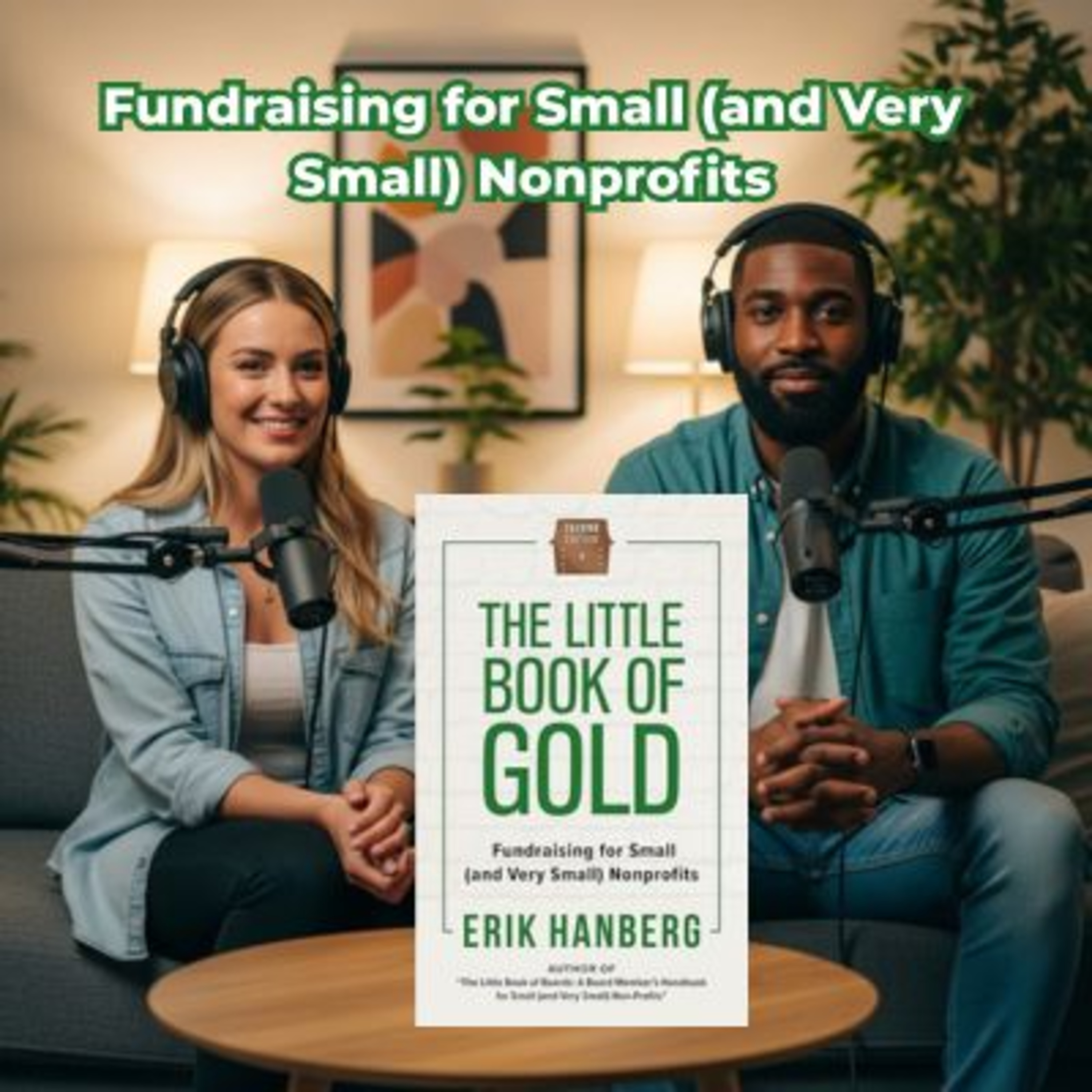
Erik Hanberg’s fundraising strategies focus on helping small organizations build sustainable financial support without exhausting their limited resources. The process begins by requiring financial commitments from board members to establish internal credibility and a solid foundation for growth. Instead of chasing corporate sponsorships, non-profits should prioritize cultivating personal relationships with individual donors who provide consistent, long-term backing. To prevent burnout, organizations are encouraged to reduce the number of labor-intensive events and focus on direct, meaningful engagement. Success is further achieved by having the courage to make specific, large-scale requests to donors who have the capacity to fund major projects. Finally, the text advises charities to expand their capacity gradually, ensuring they master basic management before attempting complex institutional grants.
The Little Book of Gold is dedicated to helping small (and very small) non-profits unlock their fundraising potential. Avoid common pitfalls and get tips on proven methods that work. This short guide helps new Executive Directors, active board chairs, and other key staff in charge of fundraising to learn the basics of professional and sustainable fundraising. Geared specifically for non-profits with small and very small budgets (a few hundred thousand dollars a year down to the smallest budgets).
What's New in the Second Edition
Updated for Modern Fundraising
This edition includes comprehensive guidance on online donations, recurring gifts, mobile payments, and email campaigns—all integrated seamlessly with the book's proven low-cost approach.
Enhanced Digital Strategy
Learn how to set up donation forms that actually convert, use QR codes for easy giving, and leverage email for cultivation without overwhelming your donors. Plus updated guidance on donor databases and payment processing for today's digital-first world.
Deeper Implementation Guidance
The core strategies remain the same, but now with more detailed timelines, troubleshooting tips, and step-by-step checklists. Follow along as "Linda" at the Smallville Historical Society implements each strategy with even more specific guidance on execution.
Expanded Coverage of Major Topics
- More comprehensive event planning information
- Enhanced donor cultivation and stewardship strategies
- More guidance on when and how to hire development staff
- Expanded section on grant writing and foundation research
- New coverage of planned giving and capital campaigns
Still the Same Practical Approach
Despite the updates, this remains the same focused, actionable guide that tens of thousands of small nonprofits have used to transform their fundraising. The "little book" philosophy stays intact—just better equipped for 2025 and beyond.
#littlebookofgold #ErikHanberg #productivityhacks #personaldevelopment #successstrategies #businessinsights #leadershipskills #leadership #ambitiousprofessionals #businesstips #self help #scaling business #businesstactics #professionaldevelopment #startupgrowth #entrepreneurship #businessmindset #growthstrategies
If you are trying to keep a struggling community organization afloat, the absolute worst thing you can do to raise money, and I mean the absolute worst, is hold a public fundraiser. I know it sounds completely backwards, right? But it really is one of the most consistent traps that small organizations fall into. Think about it. Have you ever, you know, found yourself standing in the middle of a blazing hot parking lot on a Saturday afternoon, holding a soapy sponge, desperately trying to flag down cars for a charity wash?
Or maybe you've been the one up at midnight, furiously wrapping cellophane around mediocre gift baskets for a silent auction. The classic silent auction we've all been. There, right? You put in all this exhausting work, you rally your volunteers. You spend weeks stressing over the logistics and at the end of the day you look at the little cashbox and realize you have barely made a dent in the actual financial goals of the organization. It is a very specific, deeply demoralizing type of exhaustion, honestly, because you are running on pure, unadulterated passion for your cause.
But, you know, passion doesn't pay for the community center's heating bill, and it certainly doesn't fund a new outreach program. No it doesn't. So that's severe disconnect between the massive effort you exert and the tiny financial outcome you achieve. Well, that's where so many small nonprofits simply collapse. OK, let's unpack this because today we are doing a deep dive into excerpts from Eric Hamburg's The Little Book of Gold Fundraising Strategies, and our mission is to extract the exact tactics that allow tiny grassroots organizations to raise real, sustainable money.
Right without completely burning out their volunteers and their staff. Yes, exactly. We are looking at at how to break that cycle of exhaustion. Which honestly requires a complete shift in perspective. As we work through the source material, it becomes clear that sustainable fundraising isn't really an accounting problem. Yeah, we are talking about human psychology. We are looking at how we allocate our most precious resources and most importantly, we're looking at the actual mechanics of relationship building.
I love that. The money on the balance sheet is almost just a byproduct of getting those underlying human elements right. And getting those elements right starts in a place that feels, honestly, totally counterintuitive. I mean, you would naturally think the very first step in fundraising is to go out into the world with a megaphone, tell your story, and ask the public for help. Right, the natural instinct. But the text says no. Before you ask a single neighbor for a dollar, you have to start from the inside out.
You have to start with your board of directors. It. Fundamentally begins at the foundation of the organization. Because think about it, you cannot logically ask the outside world to invest their hard earned money in building a house if the people who actually designed and managed that house haven't bought into it themselves. Yeah, that makes sense. The premise here is that the very first people to open their wallets must be the board members. And the book suggests bringing this up as a strict, non negotiable requirement at your next board meeting.
And to be clear, it doesn't have to be some massive, intimidating figure that bankrupts your team. No, not at all. It suggests setting a modest collective goal, like, say, raising exactly $1000 for the first time, generated entirely from the board members themselves. And achieving that specific baseline is absolutely critical for when you eventually do go to the outside world. The text points out exactly how this plays out in a real world conversation. Walk us through that. Sure. Imagine you are finally sitting across from a prospective major donor in your community.
They are considering writing a substantial check, but they naturally want to know if this is a credible operation. Of course they want to know their money is safe. Exactly. So they pause and ask you. So who is already supporting this organization because you did the internal work first. You can look them directly in the eye and state proudly. All of our board members have contributed. Wow, that is such a powerful dynamic shift. I mean, it's basically skin in the game. It's like a chef eating at their own restaurant.
It immediately conveys ultimate dedication to the outsider. It really does. But wait, I do have to challenge this premise just a bit. OK, go for it. If you have a tiny, scrappy local charity, your board members are likely already giving up their weekends, their evenings, skipping their kids soccer games to volunteer for you. Oh. Absolutely, they are doing the heavy lifting. Right, so isn't it a bit greedy, or at least tone deaf to look at those exhausted volunteers and demand their money too? That is exactly the friction every small organization faces.
We naturally tend to view time and money as completely interchangeable currencies of support. Yeah, like I gave my time, so I'm good. Right. We think, well, Dave put in 40 hours this month organizing the pantry, so he's paid his dues. But what's fascinating here is that the source text isn't actually focusing on the monetary value of that initial $1000. It's not. No, it is focusing on a fundamental psychological shift that has to happen within the board members themselves. You mean how they perceive their own role?
Precisely when a board member only donates time, their brain often remains in the mindset of a passive advisor or a helper. They give advice. They help with logistics. They move boxes. OK, I'm tracking. But the moment they write a personal check out of their own account, no matter how small the amount, their psychological relationship to the organization permanently changes. Right, because if I'm just donating my Saturday to set up folding chairs, I'm a volunteer. But the second I write a check for, say, 50 bucks, my brain subconsciously demands a return on that investment.
You become an owner. Yes, I'm suddenly scrutinizing the budget. I care deeply about whether that $50 is being wasted or utilized efficiently. Exactly. You become a financially committed investor. That financial commitment turns passive advisors into active, deeply invested advocates who will fiercely protect the organization. That makes total sense. It sets a powerful precedent for the internal culture before you ever face the public. They literally have a personal stake in the balance sheet now.
All right, so the internal foundation is set. The board has written their checks. The psychology has shifted. Yep. Step one is done. So where does this tiny organization look next? Because my instinct, and clearly the instinct of almost every small NGO out there, is to immediately launch into a flurry of activity like we want to host a dozen different public fundraisers to get our name out there. And this is exactly where the source material throws up a giant flashing stop sign. Really. Yes, the man here is to stop relying so heavily on exhausting events and pivot your entire focus towards specific individual donors.
The text is brutally clear on this distinction. It specifically calls out the classic trio that every small charity attempts the sprawling dinner fundraiser, the chaotic silent auction and the local 5K fun. Run. Oh, the 5K fun run. Right, it describes scenario where a passionate team attempts to pull off all three of these in a single year, and by the end of December everyone is completely worn out. And broke. Yeah, the actual profit raise barely covers the cost of the event spaces, the catering and the promotional T-shirts is the.
Ultimate false economy. Small nonprofits fall into this chap because events offer the illusion of productivity. Oh, illusion of of productivity. I like that phrase. It feels like you are doing something highly visible and tangible. You have a checklist, you are booking a venue, you're printing Flyers. It satisfies the urge to be active. But activity does not equal achievement. It's like running on a treadmill, right? Lots of sweat, but you don't actually go anywhere. Or like a retail store selling products below cost just to keep the cash register ringing.
You are generating massive amounts of motion, but mathematically you are going backward. That's a perfect analogy. If we connect this to the bigger picture of organizational survival, we have to recognize what a tiny nonprofits most scarce resource actually is. It's not money. No, it is not capital. It is the time and energy of its core people. When you pour hundreds of hours into the logistics of organizing a fun run, navigating city permits, renting porta potties, coordinating 50 volunteers, dealing with weather contingencies, you are draining your most precious resource for a very low, highly transactional return.
Wow, when you put it like that. But wait, aren't bake sales and local fun ones the traditional lifeblood of community charities? Are we really saying they are a trap? For tiny organizations, yes, they often are. The text strongly advocates for redirecting that massive expenditure of energy away from event logistics and instead pouring it into treating specific donors like genuine friends. OK, the book gives us a really concrete example of how different this looks in practice. It introduces us to a hypothetical individual donor named Sarah.
Right Sarah. Now the old model would be to harass Sarah into buying a $20 ticket to a chaotic spaghetti dinner where she sits in a loud room, eats mediocre food and leaves. That's exhausting. Exactly. But the new model completely ignores the dinner. Instead, the organization just focuses on staying in meaningful contact with her. They sent her regular updates that feature a personal, highly specific story of someone who directly benefited from our previous gift. Let's analyze the mechanism of engagement there, because the difference is profound.
A fun run or a spaghetti dinner is purely transactional. You pay an entry fee. You receive an experience or a plate of food. The donor's brain categorizes it as a purchase. Exactly. But the update sent to Sarah is deeply relational. When Sarah reads a specific narrative about how her $50 bought winter coats for a local family, she feels a profound sense of inclusion. She actually sees the mechanism of her own generosity working in the real world. Yes, she can directly relate to the impact of her money.
That psychological connection, that feeling of being an appreciated partner rather than just a customer at a bake sale, is what inspires her to become a recurring long term giver. That's beautiful, really. It is. You're building a sustainable pipeline of support rather than constantly trying to catch rainwater in a leaky bucket. So the book isn't arguing that humans shouldn't gather, or that you should never host an event ever again. It's arguing for strategic focus. Yeah, it says to ditch the exhausting trio of low yield events.
Instead, if you must gather, host one single, highly focused, significant annual gala, tie it intimately to the core mission, make it an unforgettable experience, and then spend the other 364 days of the year focused on building those direct, one-on-one relationships with people like Sarah. It is entirely about return on investment. Redirecting your staff's energy from managing A chaotic car wash in July to having three meaningful, quiet coffees with donors yields an exponentially higher financial return.
And probably saves everyone's sanity too. Oh. Absolutely, and more importantly, it creates a reliable safety net of loyal supporters that transactional events simply cannot provide. OK, so let's follow the logical progression here. We've cut out the endless bake sales. We've recovered all this lost time and energy. We've utilized that time to build genuine trusting relationships with individual donors like Sarah Era. What do we do with that trust? How does a charity actually convert goodwill into the capital it needs to survive?
That is the $1,000,000 question. According to the text, the next step requires something that makes most people incredibly uncomfortable. Having the courage to make a massive ask. Yes. Why is that so hard for us? It is a massive hurdle for well meaning organizations. They build the friendships, but they freeze up when it comes time to fund the mission. The rule here is clear. Do not be afraid to ask for large amounts of money from specific individuals to fund entire programs or scale your operations.
The book walks us through the mechanics of this with a donor named Tom. Good old Tom. Right. Tom is a consistent, long time benefactor. He's always been around, he believes in the cause and he always writes a modest check at the end of the year, but he has never actually been pushed to do more, mostly because of the staff is too timid to ask. You don't want to bother him. Exactly. So the text lays out a specific strategy. You set up a private, dedicated meeting with Tom. You don't walk in and offer a vague plea for general support.
No vague pleas. Right. Instead, you explain a brand new, specific initiative that will mathematically increase the charity's reach by 50%. You lay out the vision and then you look him in the eye and you ask him specifically for $10,000 to make that exact vision happen. And Tom says yes. He does. The mechanics of why he says yes are crucial here, he agrees, because the request is not an abstract concept, it is highly detailed, it is intimate, and it is tied directly to a transformative, measurable vision.
You are demonstrating to Tom the exact, undeniable impact his specific contribution will generate. Precisely. Here's where it gets really interesting to me, because it reminds me of pitching a startup to an Angel investor in Silicon Valley. Oh, that's a great comparison. Right. If a tech founder walks into a venture capital firm, they don't ask for a few 100 bucks to buy. Office applies. They sell a vision of a disrupted industry and they ask for $3,000,000 to build the infrastructure. And the investor doesn't feel insulted.
They feel they are being offered an exclusive opportunity. Exactly. But in the nonprofit world, we act completely differently. If we know Tom likes us, and we know Tom has a financial capacity, why are charity directors naturally so terrified to ask for a large sum from him? I mean, why does asking for $10,000 feel like such an emotional burden to the person asking it? Comes down to how we socially condition ourselves to view the concept of charity. In normal life, asking someone for money implies that you are taking something away from them to benefit yourself.
Oh right, like borrowing 20 bucks from a friend. Exactly. We mistakenly map that same interpersonal dynamic onto philanthropy. We view a big ask is placing a heavy burden on the donor. We feel like we are imposing or begging or depleting their resources. But the psychology of high level philanthropy works entirely differently, right? Completely differently. How does the donor view it then? When you present a clear, goal oriented, massive ask to someone who already cares deeply about the mission, you are not burdening them at all.
You are empowering. Them you are giving them a way to make an impact. Yes, you are offering them a vehicle to achieve their own desires for the community. You are giving them agency. Exactly. You are giving them a rare and profound opportunity to personally drive a significant, tangible difference in a world that often feels chaotic and out of their control. That is a huge perspective shift. It shifts the power dynamic entirely. Tom isn't just dropping coins in a bucket, he is acting as the sole catalyst for a 50% increase in your organization's capability.
People deeply want their lives and their resources to have meaning. And a highly specific, large ask provides that meaning on a silver platter. And from a a purely logistical standpoint for the charity, it means you need far fewer of these successful meetings to fully fund your annual goals, saving even more time. That makes so much sense. OK, so let's say the strategy is working beautifully. You have a board that has invested their own money. You've trade the endless fun runs for a network of loyal individual friends.
Things are looking up. Yeah, you are sitting down and successfully making these empowering $10,000 asks. The capital is finally flowing in. You would think you could finally relax, but the text highlights a completely new danger. The danger is actually drowning in your own success. This is where so many organizations snatch defeat from the jaws of victory. The question becomes, how do you scale the organization to handle this new influx of capital without the whole operation collapsing under its own weight?
The final major concept we are pulling from the text is all about prioritizing the fundamentals and gradually, methodically increasing your internal capacity. The author explicitly warns against the temptation to immediately jump into massive capital drives or highly complex multi layered grant applications just because you have a little bit of positive momentum. The philosophy here is that you must build the plumbing before you build the Spire. The plumbing before the Spire, I like that. And the source provides A wonderfully unglamorous, humble starting point for this internal infrastructure.
The spreadsheet, yes. The almighty spreadsheet. The text says quite literally just use basic spreadsheet. Before you go out and buy massive, expensive enterprise software, establish a simple, manageable donation tracking system. Record the incoming donations, log the contact details accurately, and most importantly, keep detailed notes on the interpersonal relationships and conversations. Master this basic spreadsheet first. Use it to create a simple fundraising strategy with precise, achievable objectives and hard due dates.
The argument is that only after you have built this verified performance history internally do you even think about applying for the massive outside grants. It is entirely about proving your operational competence to yourself on a small scale before you attempt to prove it to a massive institutional foundation. So what does this all mean? Because I have to play devil advocate here. All right, let's hear it. If I am running a charity and I know there is a $100,000 state government grant sitting out there right now just waiting to be claimed, telling me to ignore it so I can practice managing a spreadsheet of local donors feels like terrible advice.
Aren't we just leaving critical life saving money on the table out of an abundance of caution? This raises an important question about the hidden mechanics of institutional funding. Let's explore what actually happens when you win one of those massive grants. OK, let's say you ignore the spreadsheet advice. You swing for the fences. You write the complex application, and miraculously, the government awards you $100,000. Suddenly, a massive sum of money drops into your organization's bank account.
Which solves all the problems, right? You can hire staff, you can expand the programs. We're rich. Except institutional grants do not function like a check from Tom. Massive grants come with massive, legally binding reporting requirements. All the fine print. Exactly. They require strict forensic auditing. They require you to track complex metrics to prove the efficacy of the funds. The money is often highly restricted, meaning you can only spend it on very specific line items, and you have to prove you didn't accidentally spend a dollar of it on the wrong category.
And if your team is currently struggling to track $50 checks on a spreadsheet? Exactly. If you do not have the basic operational infrastructure, if your team hasn't mastered the simple discipline of data entry and tracking individual donor interactions, that massive grant will physically crush your staff. The administrative burden of compliance will consume every waking hour. Securing huge funding without the internal capacity to manage the reporting is a fast track to severe staff burnout, accidental financial mismanagement and ultimately the complete failure of the organization.
It's the equivalent of giving a teenager the keys to an 18 Wheeler before they've learned how to drive a sedan. That's a great way to put it. The vehicle is incredibly powerful, but without the underlying skills to control it, it's just going to cause a catastrophic wreck. Growing slowly and deliberately builds the required operational muscle. It streamlines your internal processes. It ensures that when you finally do apply for and receive that massive institutional grant, your team is completely prepared to deploy it effectively.
And track it accurately. Right and report on it Florida State all without burning themselves out. It protects the mental health of your staff just as much as it protects the integrity of the donors investments. So if we step back and look at the whole picture, the logic running through this entire framework is remarkably consistent. Very consistent. It is all about pursuing energy and deploying it where it actually generates a return. It starts by looking inside, requiring the board to put their own money on the table, forcing that psychological shift from passive helper to invested owner.
Step one. Then you step off the chaotic event circuit. You trade the exhausting trio of dinners, auctions and fun runs for quiet, deep individual relationships with people like Sarah, showing them exactly how their money works. Right, quality over quantity. Exactly once that trust is firmly established, you overcome the fear of the ask, you sit down with your Toms, and you make highly specific $10,000 requests by selling them an empowering vision of what they can achieve. And you empower them to make real change.
And finally, you manage all of this new success humbly on a basic spreadsheet, building your operational muscles slowly before you ever try to navigate the complex world of massive institutional grounds. And you know what makes this framework so valuable is its universal applicability regarding human bandwidth. How so? Well, avoiding burnout through this kind of strategic relational focus is critical no matter what specific scale you are operating at. Whether you're literally trying to save a tiny struggling non governmental organization, or you've just been roped into joining your local school board, or you're trying to organize a neighborhood community garden.
Right, it applies everywhere. Exactly. The underlying mechanics of time, energy, and human connection remain exactly the same. You have to stop doing the things that look like work and start doing the things that actually build capacity. Which leaves us with a really fascinating final thought to ponder. We've spent this entire deep dive talking about community centers, charities and nonprofits. But think about your own life for a second. Think about the mechanics of how you navigate your own professional world.
Oh, that's interesting. If these principles if ditching high effort, low yield events in favor of deep one-on-one relationships and finding the courage to make highly specific big asks, if that framework works so perfectly to save a dying organization, how might you apply this exact same little book of gold strategy to your own career trajectory? I love that. Are you currently exhausting yourself by attending dozens of low value chaotic networking mixers, handing out business cards that go straight into the trash when you should really just be having one quiet coffee with a mentor and making a clear, bold ask for the exact opportunity you want?
Maybe it is time to stop confusing frantic activity with actual progress. Press, leave the soaky sponge in the car wash behind and start treating your own goals with a strategic focus they actually deserve.
 Apple Podcasts
 Castbox
 Castro
 Goodpods
 Moon FM
 Overcast
 Pocket Casts
 Podbean
 Podcast Addict
 Podcast Republic
 Spotify