Supporting the Art and Science of Teaching | Effective Supervision by Robert J. Marzano, Tony Frontier, and David Livingston
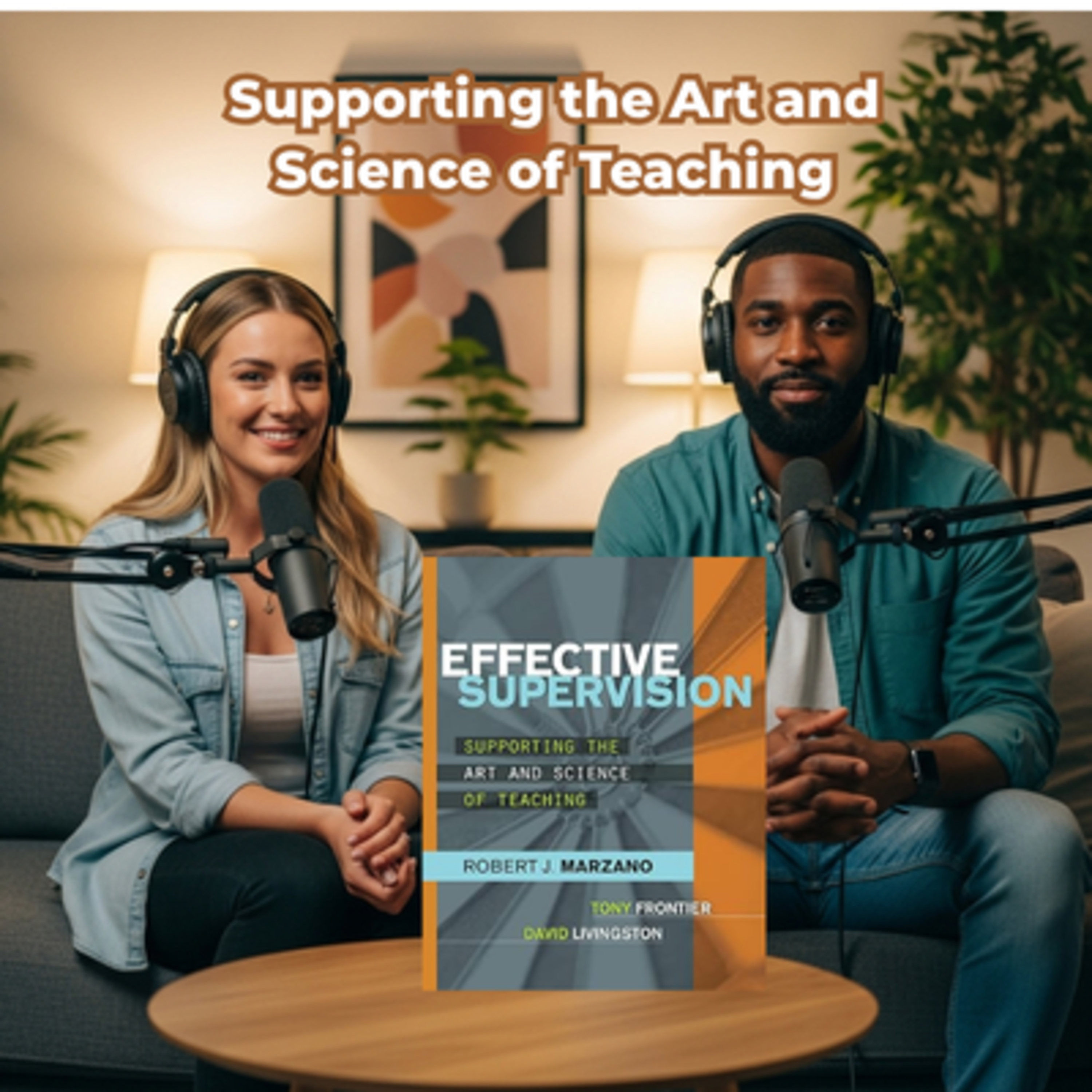
This EPISODE outlines the fundamental principles of effective instructional supervision, emphasizing that the primary goal of oversight should be professional growth rather than mere evaluation. It traces the historical evolution of these practices, advocating for a shift from rigid, top-down monitoring to collaborative and supportive relationships. Key strategies discussed include the necessity of a shared knowledge base, the delivery of actionable feedback, and the importance of peer observations. By establishing clear success criteria and structured development plans, supervisors can help educators refine their craft and reach their full potential. Furthermore, the text highlights the value of identifying and leveraging expertise within a school to foster a culture of continuous improvement. This comprehensive approach ensures that teachers receive the specialized guidance they need to enhance student engagement and learning outcomes.
In Effective Supervision, Robert J. Marzano, Tony Frontier, and David Livingston show school and district-level administrators how to set the priorities and support the practices that will help all teachers become expert teachers. Their five-part framework is based on what research tells us about how expertise develops. When these five conditions are attended to in a systematic way, teachers do improve their skills:
* A well-articulated knowledge base for teaching
* Opportunities for teachers to practice specific strategies or behaviors and to receive feedback
* Opportunities for teachers to observe and discuss expertise
* Clear criteria for success and help constructing professional growth and development plans
* Recognition of the different stages of development progressing toward expertise.
The focus is on developing a collegial atmosphere in which teachers can freely share effective practices with each other, observe one another's classrooms, and receive focused feedback on their teaching strategies. The constructive dynamics of this approach always keep in sight the aim of enhancing students' well-being and achievement. As the authors note, "The ultimate criterion for expert performance in the classroom is student achievement. Anything else misses the point."
#productivityhacks #personaldevelopment #successstrategies #businessinsights #leadershipskills #leadership #ambitiousprofessionals #businesstips #self help #scaling business #businesstactics #professionaldevelopment #startupgrowth #entrepreneurship #businessmindset #growthstrategies
Welcome back to the Deep Dive. Our mission is always the same. We take the dense source material you send our way, the books, the research, and we pull out the essential, actionable knowledge. And today we're really cutting to the chase on professional expertise, specifically within education. That's right, we are going deep on the principles of what's called instructional supervision, and we're leaning heavily on the work of Marzano, Frontier and Livingston. And for you listening, think of this as a shortcut, a way to understand a really critical shift that's been happening.
We're not talking about supervision as some kind of checklist, no bread at all. The whole scope here is about how modern, effective supervision can actually accelerate a teacher's development. It's about moving past simple rating systems. Right, the high stakes stuff. Exactly. The goal here is to build a learning atmosphere. High support, high challenge. A place where educators actually feel empowered to get better all the time. OK, so let's jump right in, because this starts with a philosophy that completely changes the supervisor's job description.
The source is called Supervision that Develops Expertise. It's a total paradigm flip. It really is. So what's the core idea? Chapter 1 lays it out perfectly. Effective supervision has to, and I mean has to, prioritize assistance above evaluation. Assistance above evaluation. Yes, and that's not just a preference, it's a strategy. Think about it, if your boss's main job is to judge you to grade you. You're going to put on a show. You'll only do the things you know you can't fail at. Precisely, you close the door.
But if their primary role is to help, to assist, that creates safety. And safety is, you know, the absolute prerequisite for taking risks and actually improving. That makes so much sense, but I imagine that assistance can't just be a free for all, right? It needs some kind of focus. It does, and that's where stated objectives come in. They're essential. Without clear defined goals that everyone's agreed on, the teachers efforts are just scattered. And the supervisors guidance is probably pretty useless.
Right, an objective like improve classroom management is just it's too vague, it means nothing. A stated objective would be something like by next month, Sarah will use three specific non verbal cues to cut down transition time by 15%. And that's something you can actually measure. It is, and we see this with the case study of Sarah. She was really struggling with student attention. Her classroom felt, well, a little chaotic. So the old model of supervision would have just been a note in her file, right?
Needs to improve engagement. Exactly. Which helps no one. But with this model, the supervisor collaborated with her. They watched a video of her teaching together. That's the assistant, and they pinpointed the exact moment things went off the rails. During the transitions between activity. That was it. So the strategies became targeted. Use a visual timer. Stand near this group of students. Use the specific phrase. It turns a vague judgment into collaborative, practical problem solving. OK, but this brings up a huge point.
For a supervisor to do that, they have to know what they're talking about. They have to be an expert too. That's the engine of the whole model from chapter 3, the knowledge base for teaching. You can't give that kind of granular help if you don't have that deep knowledge yourself. You really can't. The argument is that supervisors need what they call a strong foundational knowledge. And that's not just knowing the curriculum. It's understanding instructional methods, the science of how kids learn, student needs.
Without it, the feedback is just gut feelings. It's. Generic, and frankly, it's useless to a teacher who's trying to get better. So how does this play out in the real world? I mean, think about a high school supervisor. How can they have foundational knowledge for AP physics and 3rd grade reading? Oh, that's a great question. The sources say it's about synthesizing principles, not just memorizing facts. OK, what does that look? Like, well, take the case of Tom. He's a teacher trying to improve his lesson plans.
A supervisor just doing a compliance check with, you know, just take a box. Plan submitted, done. But a supervisor with that foundational knowledge knows what an effective plan looks like for any subject. It needs specific goals. It needs interesting activities. And critically, it needs efficient ways to check for understanding. So they don't have to be able to teach the physics lesson, no, but they have to be able to spot the elements of a well designed lesson, no matter the content. Exactly, they can guide Tom by asking the right questions.
Are your goals clear? How does this connect to what they learned yesterday? Is this evaluation method the best use of your time? It connects the principles of learning to Tom's specific content. That's a great transition into the mechanics of all this. Here's where it gets, I think, really interesting. Let's talk about focus, feedback, and practice. This is chapter 4, and it's so important because it explains why most feedback in professional life just fails. It just doesn't stick. Right. And the reason is it's not focused.
The sources call for specified feedback. It has to be be incredibly clear and targeted if you tell a teacher to fix 5 things. They'll fix 0 things. Zero. You have to pick one, maybe two things that will make the biggest difference in the very next lesson. And crucially, it has to include actionable advice. It can't be an observation, it has to be a recommendation. They can use tomorrow. Yes, the example of Emily is perfect. Her supervisor noticed. She was great at correcting students, but not so great at praising them when they did the right thing.
So instead of saying, be more positive, which is useless. That feedback was incredibly specific. In your next math lesson, I want you to make 5 explicit positive statements right after students follow an instruction. That's a directive you can actually follow. Yeah, but let me push back on that. Doesn't that feel a bit like micromanaging? Like you're telling a professional how to talk. That's a fantastic point, and the distinction the sources make is that this is a shared experiment, not a command.
An experiment. Yeah, the supervisor is saying let's try this just for a week and see what happens. Let's measure the result. The goal isn't to Force One style of teaching, it's to test a specific lever for change and see if it works. And then they follow up. Of course, they review the results. If it works, great, Emily now owns that new skill. If not, they figure out why and they adjust. That kind of shared experiment needs a road map, though, which I think brings us to Chapter 6, Clear criteria and a plan for success.
It does. If you want growth to be measurable, you need precise standards. And that's hard in teaching because so much of it feels like an art. But the criteria have to be clear enough for teachers to know exactly what the target is, what success looks like. Yes, when the expectations are fuzzy it just kills morale. And then once you have the criteria, you need a real organized plan, not just a one off report that gets filed away. It needs phases, deadlines, resources, all of it. Think about Alex the teacher.
He wanted to get better at 4:00 formative evaluations. He's already good, but he wanted to be great. So his supervisor didn't just give him a book to read. No. First they define what mastery even looked like. It meant prompt feedback. It meant the evaluation perfectly matched the learning goal, and it meant the data from today actually changed what you taught tomorrow. So those standards become the blueprint. Exactly. And then they built the plan. Phase one, here are some digital tools to speed things up.
Phase two, let's Co plan a unit and analyze the data together. Phase three, let's have you watch another teacher who's a master at this. It's a whole developmental system. That structure really shows how far supervision has come, which I think is a good time to step back and look at the history here. Chapter 2 gives us this brief history of supervision and evaluation. And you have to understand the history to understand why so many teachers are still, you know, a bit wary of the whole process. It explains the distrust.
It really does. The history shows this massive historical evolution. Early supervision was very top down. It was about compliance, about making sure you followed the rules. The. Supervisor was more like an inspector. 100% the main tools were the checklist and the surprise visit. The goal was accountability to the administration, not development for the teacher. That's where all the anxiety comes from. So the idea of learning from the past is to see why that old model failed. It created fear. It's stifled creativity.
Absolutely. So a modern supervisor, maybe someone new to the role like Alex, the supervisor in the book, they can use that history. They know that their very first job is to build trust, to show everyone, hey, I'm here to help you grow, not to catch you messing up. That changes the entire culture. From day one. And Speaking of culture, a huge part of this new model is realizing the best expertise isn't always in the supervisor's office. It's in classroom next door. Charter 5 is all about creating opportunities to observe and discuss expertise.
Peer observations. It's one of the most powerful and honestly cheapest tools there is. When a teacher watches another teacher, it's relevant, it's real, and it's way less intimidating than a formal observation. And the magic isn't just in the watching, is it? No, it's in the conversation afterwards, the collaborative discussion. That's where they can breakdown what they saw and figure out how to apply it. The feedback comes from a peer who gets it, who lives the same daily reality. Let's talk about Laura's case.
She was struggling with using technology to keep students engaged. Right, and the solution wasn't some generic online course. She went and watched a colleague who was amazing at it, who used the simple gamified system. And she saw it in action with real students. She saw the exact steps, but more importantly, in their discussion afterward, they talked about the timing. Not just what tool to use, but when to use it for the biggest impact. Laura tried it in her very next class and saw a huge difference.
You just. Can't replicate that kind of immediate transfer of skill you. Can't. And that leads us to the final piece of the puzzle from Chapter 7, which is maybe the most important identifying expertise this is. Where the whole system shifts from just fixing problems. To actively finding and celebrating what's going right, you have to intentionally identify strengths. Recognizing what your best people do well isn't just a nice thing to do, it's a strategic move. It professionalizes the whole environment.
It does. And then once you found that expertise, you have to leverage expertise. You institutionalized it. You have those expert teachers mentor others, lead workshops and share what? Works. That's how you raise the standard for everyone. And the example of Mia just nails this. She's a master of project based learning, so recognizing her skill isn't just about giving her a good evaluation. It's about making her the school's internal consultant on project based learning. That's it. She leads the training.
She coaches her colleagues. The school's professional development is now powered by its own staff, which is so much more relevant and effective than bringing in some outsider. What a fantastic framework. So to sum it all up, by focusing on targeted assistance, using clear criteria, and really leaning into collaborative learning, especially by leveraging the experts you already have, you build this engine for constant improvement. You shift the entire dynamic. It stops being about top down judgement and becomes a true professional partnership.
And I think that transformation is really the key take away for you, our listener. The history here is clear. We're moving away from rigid judgement and toward using our collective experience. Which leaves us with a really provocative thought to chew on if we're getting better at identifying and sharing excellence. If Mia's expertise becomes the new default training tool, how might that fundamentally redefine the foundational knowledge of teaching itself for the next generation? Meaning today's cutting out of practices could become tomorrow's baseline expectation.
Exactly what does that do to the pace of improvement? It's something to Mull over. A powerful thought and a great place to end this deep dive. Think about how these principles could apply in your own field. That's all the time we have. Thanks for joining us and we'll see you next time.
 Apple Podcasts
 Castbox
 Castro
 Goodpods
 Moon FM
 Overcast
 Pocket Casts
 Podbean
 Podcast Addict
 Podcast Republic
 Spotify