Stubborn Attachments by Tyler Cowen | A Vision for a Society of Free, Prosperous, and Responsible Individuals
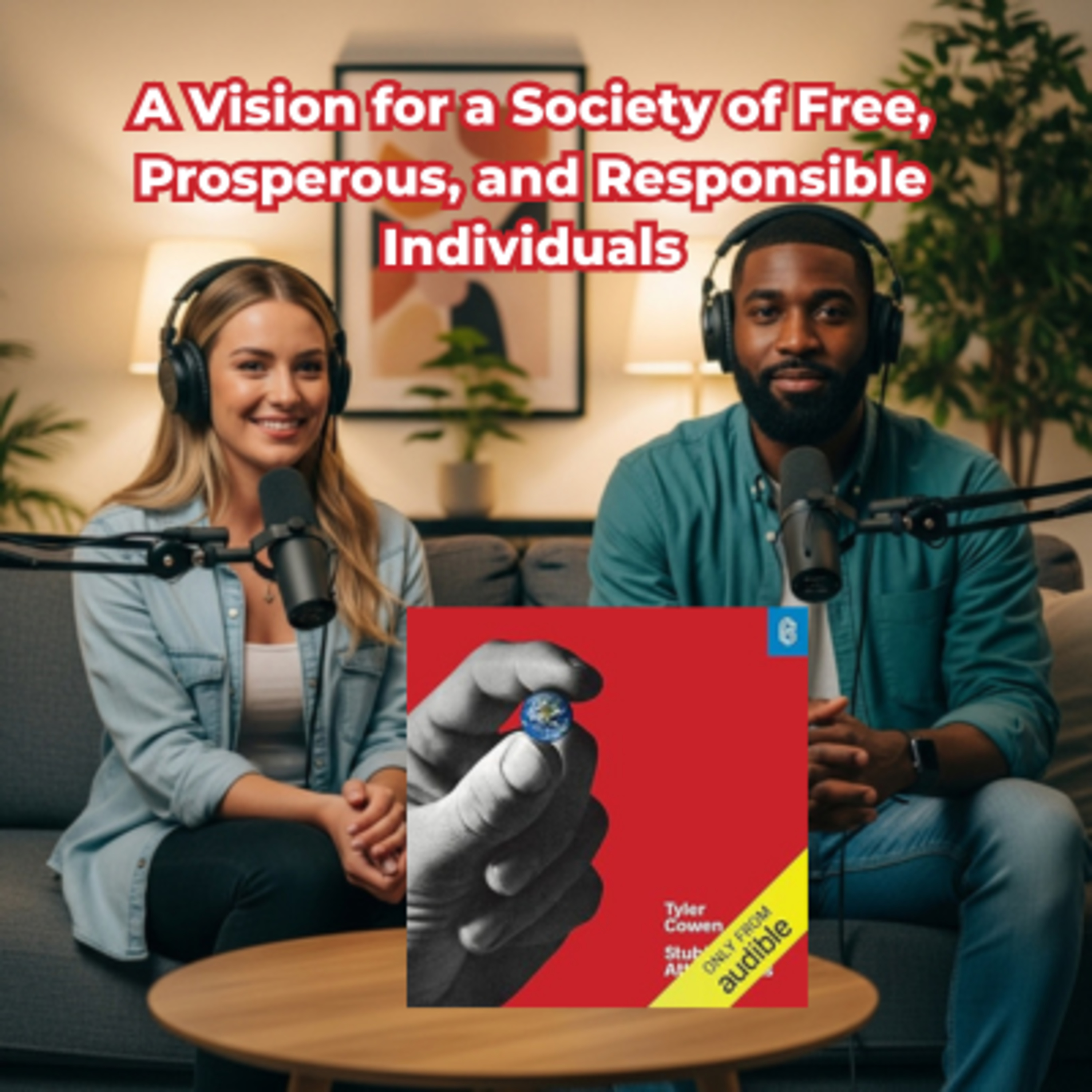
Growth is good. Through history, economic growth, in particular, has alleviated human misery, improved human happiness and opportunity, and lengthened human lives. Wealthier societies are more stable, offer better living standards, produce better medicines, and ensure greater autonomy, greater fulfillment, and more sources of fun. If we want to continue on our trends of growth and the overwhelmingly positive outcomes for societies that come with it, every individual must become more concerned with the welfare of those around us and in the world at large and most of all, our descendants in the future. So, how do we proceed?
Tyler Cowen, in a culmination of 20 years of thinking and research, provides a road map for moving forward. In this new audiobook, Stubborn Attachments: A Vision for a Society of Free, Prosperous, and Responsible Individuals, Cowen argues that our reason and common sense can help free us of the faulty ideas that hold us back as people and as a society. Stubborn Attachments, at its heart, makes the contemporary moral case for economic growth and delivers a great dose of inspiration and optimism about our future possibilities.
The episode summarises Tyler Cowen’s book, which argues that a great society is built upon the pillars of economic growth, individual liberty, and long-term accountability. Cowen suggests that prioritising wealth creation and innovation is the most effective way to eradicate poverty and enhance global living standards over time. The author advocates for a moral framework that values the well-being of future generations just as much as our own, requiring us to look beyond immediate gratification. Furthermore, the text explores how to navigate social disagreements, the limitations of wealth redistribution, and the necessity of making firm decisions despite future uncertainty. Ultimately, the work encourages readers to adopt a sustainable perspective to ensure a prosperous and ethical future for all.
#stubbornattachments #TylerCowen #productivityhacks #personaldevelopment #successstrategies #businessinsights #leadershipskills #leadership #ambitiousprofessionals #businesstips #self help #scaling business #businesstactics #professionaldevelopment #startupgrowth #entrepreneurship #businessmindset #growthstrategies
So think about a massive historical engineering marvel, something like the Roman aqueducts, or, you know, the great cathedrals of Europe. Oh, sure. The people who actually hauled those stones and poured that early concrete, they knew with absolute certainty that they were building something that would outlast them by centuries. Right. They were operating on a time scale that, well, it extended far beyond their own life spans. Exactly. But contrast that with how our world operates today. I mean, a company's success is often judged by what, a three month quarterly earnings report?
Yeah, or political strategies that barely look past the very next election cycle. Right. We have somehow completely strunk our timeline. And when you notice that, it forces you to ask this ultimate human puzzle like what exactly makes a society great? What are the actual fundamental ingredients that guarantee a prosperous, thriving future for everyone? It's arguably the most important question we can ask, and to tackle it in this deep dive, we are going to look at the framework laid out by the philosopher Tyler Cowen.
Such an intelligent guy. Oh, absolutely brilliant. We're looking at excerpts from his book Stubborn Attachments, Building a Prosperous and Moral Future. Cowan is trying to define the exact formula for societal greatness, and his core argument is that establishing an environment where everyone is free, successful and accountable, it requires a massive shift in how we understand our obligations to the future. And what we are doing today, our mission for this deep dive, is basically extracting A blueprint from his work because look, we are taking some incredibly complex concepts here, morality, mathematics of wealth, our psychological relationship with time.
She's a big. 1A. Huge one, and we want to simplify them for you. We want to show you how our present choices, even the seemingly small everyday ones you make, directly engineer a wealthy and law abiding society for the future. Right. My goal today is to bridge the gap between this high level abstract philosophy and your everyday reality. We're going to connect the dots. We want to show you how Cowen's theories aren't just academic thought experiments. They are practical lenses to evaluate your own decisions, your career, and your actual impact on the world.
OK, let's unpack this. Because to build anything that lasts, you need a bedrock foundation, and Cowen starts in a place that honestly, it completely caught me off guard. Yeah, he doesn't start with taxes or laws. Right. He starts with the human brain's perception of time and how that hidden bias completely dictates our moral choices. He. Redefines the entire concept of what it means to act morally. I mean, if you ask the average person to define moral conduct, they usually default to basic compliance.
Like don't steal. Yeah, don't steal, don't harm others. Follow the laws of your community. But Cowan argues that this baseline is totally insufficient. It's just step one. Exactly. True moral conduct, in his view, fundamentally requires taking unborn future generations into account. It's about actively making decisions that build trust and cooperation for a civilization we will never actually live to see. He introduces this phrase and I stared at the page for a good minute when I read it. He asks, is time a moral illusion?
It's a heavy question. It really is because human beings, we naturally view time as this very rigid, linear hierarchy. Today feels vastly more important than tomorrow, and tomorrow feels more important than a decade from now, just because today is happening to us right now. The present is loud, you know. Well, evolutionary biology hardwired us that way. Our ancestors survived by focusing on the immediate threat, the predator in the bushes today, not a hypothetical drought 10 years down the line.
But Cowan points out that this linear hierarchy of time causes us to continuously prioritize short term benefits over long term prosperity. Think about distance in terms of geography. Most of us agree that a human being suffering 10,000 miles away has the exact same moral value as a human being suffering right next door, right? Distance in space doesn't erase human value. Exactly. And Cowan argues that distance in time shouldn't diminish the value of human life either. Someone thriving or suffering 100 years from now carries the exact same moral weight as someone today.
Time as a barrier to empathy is an illusion. To make this concrete, there's this brilliant analogy in the source material regarding the planting of an oak tree. We all fundamentally understand how a massive tree grows, right? You put tiny acorn into the dirt and it takes decades to mature. Yeah, has to weather countless storms. But the person who digs the hole and plants the seed, they are almost certainly never going to sit under its full shape. No, probably not. But planting it right now is the literal only way to guarantee that future generations get to enjoy its beauty and its shelter.
That is the ultimate act of overriding our short term biology, and Cowan uses that concept to emphasize that a society must give priority to initiatives that support compounding long term growth. Because quick remedies might sound amazing to voters today, but they routinely result in structural collapse later on. I want to bring up the hypothetical the text uses just to show how hard this is. Imagine you're a city planner and you are debating whether to fund a massive project. This project will provide immediate financial relief to the current generation right now.
Jobs today. Payouts today. Very tempting. Super tempting, but the data shows that doing so actively endangers the next generation. Now, if you have that rigid hierarchy of time mindset, your brain screams at you to fund the project anyway. You prioritize the people standing right in front of you. But if you adopt what Cowan calls a flexible view of time, the math changes completely. You realize the future danger outweighs the quick remedy. And implementing that shift in perspective is what cultivates deep trust.
When institutions prove they are protecting the future, it lowers panic in the present. Look, I hear the logic in that, but I have to push back hard on the day-to-day practicality of this. Let's ground this in reality for a second. If I am struggling today, like if I literally cannot pay my rent and I'm paralyzed by the anxiety of feeding my family this week, it is nearly impossible to care about a hypothetical oak tree 100 years from now. Absolutely. Survival instincts take the wheel, right? So how does adopting a flexible view of time actually change how we navigate our immediate moral choices when the present is just so demanding?
Well, what's fascinating here is that Cowan doesn't dismiss the brutal reality of immediate human suffering. He isn't suggesting you should let yourself starve today just so a hypothetical citizen can eat tomorrow. OK, good. What he is doing is shifting the framework of how a society as a collective designs its systems. Thinking beyond the here and now is required for true moral reasoning. So it's a macro perspective. Exactly. When a society adopts this flexible view of time at a macro level, it shifts from a reactive mindset where we are constantly triaging emergencies to a responsible long term perspective.
The moral choice isn't just a handout life preservers, it's to build ships that don't sink. Wow. OK, so if the ultimate goal is this prosperous, deeply resilient future, if that's the mature oak tree we're trying to grow, then what is the actual water and sunlight? Because you can't just wish a Great Society into existence. No, you definitely can't. And according to Cowan, the literal engine that drives this entire moral framework is continuous economic growth. Yes, he argues that wealth makes the world go round.
And he means that in a very structural, mathematical sense. Eradicating disease, raising global living standards. It absolutely depends on consistent compounding economic growth. Wealth can sometimes feel like a dirty word, you know? Yeah, we're just talking about billionaires hoarding gold in a vault. Right. But Cowan frames it as capability. Consistent economic growth is the greatest method humanity has ever discovered to help people escape absolute poverty and radically improve public services.
Take the modern smartphone as an analogy. When you look at the invention of the smartphone, on the surface it's just a slick glass rectangle for texting, right? It looks like a pure consumer convenience, a luxury item. Dive into the mechanics of what the cash generated by the IT industry actually did. It didn't just stay in Silicon Valley. It funded massive innovations in completely different sectors. Totally like the demand for tiny cell phone cameras drove down the cost of optical sensors, which revolutionized medical imaging and healthcare.
And education, too. Exactly. It's an economic engine that produces wealth that aggressively spills over. That spillover effect is the invisible magic of compounding growth. Everyone ultimately gains from an expanding economy, it boosts tax revenues for public infrastructure, and it drives technological leaps. This is why Cowan insists that focusing on growth is a moral imperative. Now, before we go further, I want to do a quick neutrality check here because Chapter 5 brings up wealth redistribution, taking money from the rich to give to the poor to address inequality.
Very heated topic. Extremely. And I want to make it explicitly clear to you, the listener, that in this deep dive, we are absolutely not taking a political side on this left wing, right wing. We are leaving all of that at the door. Right, we are purely examining Cowen's philosophical framework based on the text. Exactly. So, setting partisan politics aside, how does Cowen view redistribution strictly through the lens of long term economic growth? He looks at redistribution strictly as a matter of systemic trajectory, so redistribution might handle urgent needs.
It acts like a Band-Aid OK, but it doesn't guarantee long term growth because simply shuffling existing wealth from one side of the Ledger to the other doesn't address the underlying mechanics of value creation. So if we look at a society's wealth like a pie. Oh, I love this analogy. Right. Cowan is saying we shouldn't spend all our political capital and intellectual energy arguing over how to slice up the current pie perfectly equally right now because eventually the pie is eaten. It's gone. It's gone.
Instead, we should be investing all our energy into building a massive, state-of-the-art bakery that can produce enough pies for everyone indefinitely. That perfectly captures his view. Cowan advocates for focusing on opportunity instead of just redistribution. We need investments in infrastructure, education and laws. Advanced development. You permanently alter the environment so resources are constantly generated. Which is such an eliminating way to audit our own daily lives. Yeah. I'd ask you listening to this right now to reflect on your own industry or your career.
Are you spending the majority of your time trying to redistribute existing budgets for clients within your company, or are you investing in the kind of R&D and innovation that raises the living standards for everyone? It's a demanding way to measure your daily impact. It really is. It's OK building this massive bakery of economic growth, planting this multi generational oak tree. It all sounds incredibly elegant on paper. On paper, sure. But human beings are messy. We constantly disagree. We form factions and the future is fundamentally unpredictable.
So how do we actually achieve this when we are bottlenecked by human conflict? This brings us to Chapter 3, Overcoming Disagreement, and Cowan's approach is refreshing because he rejects the notion that divergent views are a flaw in the system. Wait, he thinks they're good. Yes, he views them as a normal, highly useful part of society. Think about the corporate group project analogy. You are assigned to a team and there are immediate, sharp differences in how to approach the task. Our natural instinct is to dig our heels in and fight.
Right. We view opposing sides as a threat, But Cowan points out that a society without friction is blind to its own blind spots. In that group project. Rather than fighting, collies can avoid groupthink by combining the best features of each perspective. But they have to be focused on a common goal. Exactly. The friction is only productive if it's tethered to a shared objective. And operating that way requires a lot of comfort with ambiguity, which transitions us to Chapter 6, The paralyzing effect of ambiguity, because the future is entirely opaque.
Let's relate this to starting a totally new business from scratch. You pour your life savings into a new venture, but the future return on investment is unpredictable. The economy could dip. A competitor could emerge. It's. Terrifying. But if you let that dread deter you, you never launch. You just immobilize yourself instead. You have to manage the hazards. Cowan emphasizes that we must accept uncertainty as a driving force. You use it to acquire data and make defensible decisions rather than avoiding risks entirely.
Here's where it gets really interesting to me. If uncertainty is unavoidable, is Cowan actually suggesting that uncertainty isn't just an obstacle we have to deal with, but the exact friction required to force us to innovate in the first place? Yes, that's the ultimate synthesis here. If we connect this back to the bigger picture, a prosperous society doesn't eliminate risk or disagreement, It uses them as tools to prevent stagnation. Wow. Disagreement and uncertainty are the grinding stones that sharpen a civilization's edge.
So to summarize this deep dive for you, Cowan's Blueprint for a Great Society requires 3 things. A long term moral perspective, an unyielding focus on economic growth and opportunity, and the courage to embrace both disagreement and uncertainty. And as Cowan says, little actions today might result in significant transformations tomorrow. I encourage you to look at your own choices through this flexible view of time. I want to leave you with a final, somewhat provocative thought to Mull over. One argues that we must act ethically for the benefit of generations we will never meet.
Right, right. But if time truly is a moral illusion and the future holds equal weight to the present, does that mean the people of the future are already, right now, holding you accountable for the choices you made today? Keep questioning, keep learning, and we will catch you on the next deep dive.
 Apple Podcasts
 Castbox
 Castro
 Goodpods
 Moon FM
 Overcast
 Pocket Casts
 Podbean
 Podcast Addict
 Podcast Republic
 Spotify