Strategic Advantage: The Essentials of Outsourcing Wisdom
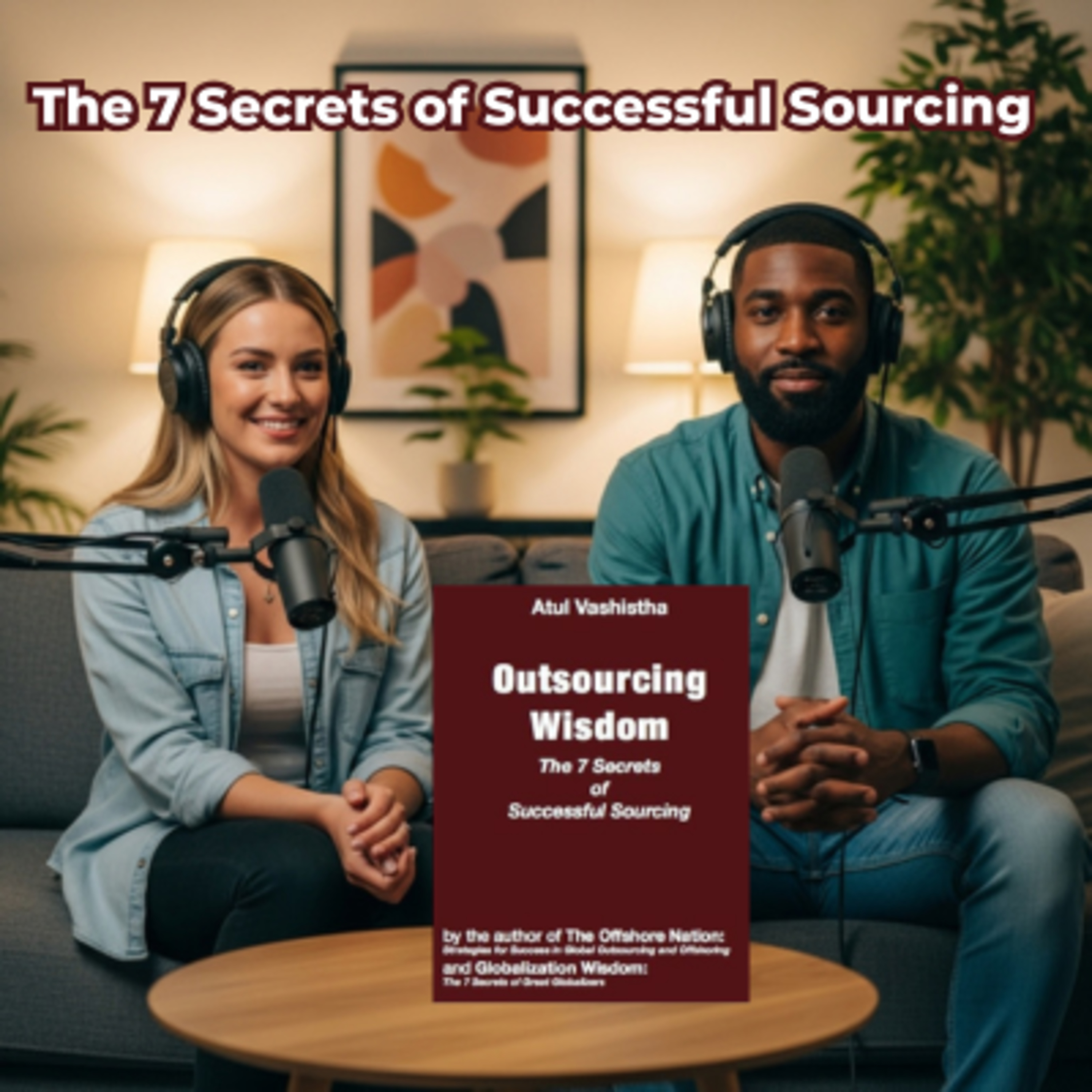
This source details the core principles of effective outsourcing as defined in Atul Vashistha’s strategic guide. It shifts the focus from simple cost-cutting to achieving a competitive advantage by allowing leaders to concentrate on their primary business strengths. The text advocates for a lifecycle approach, emphasizing that success requires continuous management, clear goal alignment, and internal governance rather than just signing a contract. By treating external partners as strategic assets, companies can drive innovation and adapt more fluidly to market changes. Ultimately, the material serves as a practical roadmap for entrepreneurs to transform their operational models through expert collaboration.
The “Good to Great” For Outsourcing
Not surprisingly, the companies and leaders that are successful outsourcers engage in similar practices—key practices that other companies regardless of size can emulate. In my two decades of consulting to major corporations on global sourcing and outsourcing, I’ve seen similar trends and patterns among firms that have succeeded in outsourcing and have summarized them as seven best practices in successful outsourcing. This book is about sharing those practices, these seven secrets.
The seven chapters on the seven secrets that follow expound the key attitudes and behaviors that successful outsourcers share—and offer concrete guides for replicating their success within your own organization. I’ve paired what I know from my work with Neo Advisory (Formerly neoIT), as an advisor to firms looking to outsource, with sage advice and stories from executives at organizations that are successful outsourcers, many of whom were among the first to outsource, including Applied Materials, Lenovo, Virgin, Cisco, FedEx and Plantronics. The end result is a book designed specifically for C-level executives and practitioners at organizations positioned at all stages of outsourcing maturity.#outsourcingwisdom #AtulVashistha #productivityhacks #personaldevelopment #successstrategies #businessinsights #leadershipskills #leadership #ambitiousprofessionals #businesstips #self help #scaling business #businesstactics #professionaldevelopment #startupgrowth #entrepreneurship #businessmindset #growthstrategies
Imagine you're the lead singer of a rock band. You are like moments away from walking out onto this massive stage. OK. Setting the scene. Right. The crowd of 10,000 people is screaming your name, but instead of, you know, warming up your vocals or getting into the zone, you are on your hands and knees. Oh no, Yeah, you're crawling underneath the drum kit, sweating profusely as you try to solder a broken microphone cable. I mean it is a completely absurd image. You have this one incredible talent, like the whole reason everyone bought a ticket and you were just wasting it doing technical maintenance.
Exactly. Maintenance that someone else could honestly do in their sleep. Right. It sounds ridiculous when you picture a rock start doing it, but that is exactly what thousands of business owners, managers and entrepreneurs do every single day. Yeah, they really do. So welcome to another custom deep dive specifically tailored for you. We have a really fascinating stack of notes in front of us today, rooted in a tool, Vashista's Concepts on outsourcing wisdom. It's a great source. It really is. And our mission today is to sort of strip away the corporate fluff, bypass the jargon and figure out how to actually keep you on that stage singing instead of, you know, crawling under the drums.
I love that and it is a really compelling set of insights because it takes a concept that is so heavily discussed and honestly like so heavily misunderstood in business circles and completely re evaluates its actual utility. Oh, absolutely. We are fundamentally redefining what outsourcing actually means here. Right, because let's be honest for a second, if you are listening to this right now, when you hear the word outsourcing, your immediate reaction is probably a massive eye roll. Oh yeah, totally.
You hear that word and you instantly think of some dry corporate cost cutting measure. You picture like a boardroom full of executives trying to find cheap labor overseas just to shave a few cents off the quarterly budget. Right. It's got this reputation of being just a race to the bottom, like a total sacrifice of quality for savings. Yes. But the insights we are unpacking today, they completely flip that script. I mean, it is not about keeping out at all. No, not at all. That is the perfect way to look at the big picture here.
The true value of these sources is that they frame outsourcing not as a compromise, but as a massive strategic advantage. A strategic advantage, OK. Think of this as a road map for anyone who is just feeling overpowered by the incredibly fast-paced, complex business world we operate in today. Which is pretty much everyone, right? The core argument is that outsourcing is not just about spending less money. It's about making astute, highly calculated choices that actually give you a competitive edge.
It is a tool for leverage, you know, not just a tool for savings. OK, let's unpack this because if we look at the insights we gathered, they really hit this idea hard. Treating outsourcing as a strategic advantage allows you to actively Dr. change in your organization, right? Think about a bakery. Let's say you start a bakery because you are absolutely amazing at baking cakes. That is your gift. Your cakes are literally works of art. Sounds delicious. Right, but to run a modern business you need a website.
So you spend 4 hours every single night banging your head against the wall trying to learn web design. Oh, the worst. You're fighting with domain hosts and coding shopping carts. And inevitably, your cake start to suffer because your cognitive resources are entirely drained by something you absolutely hate doing. Exactly, you are wiring the microphones instead of singing. Instead of struggling, you just hire an expert to build the site. Yeah, you let them do what? They're good. At and you focus entirely on making the tastiest cakes in town, and they handle the technology.
You didn't just save time, you protected your superpower. What's fascinating here is how that exact logic scales up from a small neighborhood bakery to massive corporate entities. It is all about resource allocation. Like where you put your energy? Specifically, where you spend your mental energy. Yes, you think about ACEO at a modest tech startup. You have a fantastic product concept. Investors love it. The market is hungry for. It OK, things are going great. But suddenly you realize you need a completely new IT infrastructure from the ground up to support your growing staff, right?
If you tried to build that yourself, you are suddenly not a visionary product leader anymore. You are a stressed out IT administrator trying to figure out server compliance and cybersecurity protocols. And the momentum of the actual product just completely stalls out. Precisely, by contracting a professional company to handle those IT demands, you bypass the need to hire a whole internal department. You skip the massive financial investments of building servers yourself. Exactly. You get the materials and the knowledge you require without those permanent overhead costs.
And the mechanism here is crucial. You are acquiring elite specialized talent without making long term commitments. It gives the business an incredible amount of agility then. Yeah, you don't have to worry about technological bottlenecks, which means you can bring your product to market infinitely faster and actually grow the company. And that speed to market is the actual competitive advantage. It's not that the outsourced IT team was necessarily the cheapest option on the planet. It's that they were the fastest, most elite option that allowed the CEO to stay in their zone of genius.
And this connects directly to how outsourcing fundamentally alters a company. It physically changes the company's DNA. Wait, really changes its DNA? Yeah, consider a traditional manufacturing business. Yeah, let's imagine they make high end furniture and historically they've always managed their own logistics internally. OK, so they have their own warehouse, their own trucks, their own drivers, right? Over time, as the company grows, that logistics arm takes up more and more bandwidth. The internal executive team becomes totally overworked, constantly fighting fires just to get the chairs and tables on the trucks.
They're just moving boxes around instead of designing better furniture. Exactly. The focus has completely shifted away from their core competency, but when that manufacturer decides to use a third party provider specifically for logistics, they free up all those internal resources. Oh, I see. The company's very DNA shifts from we make things and we ship things to we make incredible things and our trusted elite partner handles the shipping. That's a huge mindset shift. It is. It frees the core team to concentrate on raising customer happiness and product quality.
The logistics rofessionals just take care of moving the goods. You know, if you are listening and you've ever started a side hustle, you know this exact feeling. Oh for sure. We looked at this example of an Internet clothing company owner. They designed amazing clothes but they are spending like 80% of their week in their garage printing out shipping. Labels the glamorous side of fashion. Right, just finding the right size cardboard boxes and keeping track of inventory. That is time stolen directly from creative work.
Yeah, and by contracting out the fulfillment, the physical storage and the shipping to a dedicated logistical business, the owner completely reclaims their time. They can develop new product lines. They can actually promote the brand. So the great victory here is not just saving time. You are fundamentally changing how the company operates from the inside out, right? You're giving your most important people the bandwidth to pivot to what actually matters, growth, innovation and the customer experience.
You are relieving them of routine responsibility so they can drive the business forward. OK, so we have established that outsourcing, when done right, is basically a way to give your business superpowers. Definitely. It drives complete transformation and lets you focus on your absolute strengths. But, and this is a big bet, and handing over the keys to your entire IT infrastructure or your entire shipping department to a total stranger, it's scary. That sounds terrifying. If they crash the system or lose all your inventory, it is your business on the line, not theirs.
How do you prevent absolute chaos? It is a massive risk, if poorly managed. The transition from realizing the theoretical benefit of outsourcing to actually executing it safely is where most businesses stumble, and they fall hard. Here's. Where it gets really interesting though, because I think a lot of entrepreneurs view signing that outsourcing contract as the finish. Line. Oh, they totally do. Like great, the paperwork is signed, the invoice is paid, the shipping problem is permanently off my desk.
Why doesn't that work? Like why is it so incredibly hard for businesses to accept that outsourcing requires the exact same level of care as hiring a full time in house employee? If we connect this to the bigger picture, it comes down to a fundamental misunderstanding of what a contract actually does. An entrepreneur signs the paper and thinks they have purchased a vending machine. You know, put the money in, ush the button, get the exact desired result every single time without thinking about it.
Oh. That's a great way to put it, but the. Reality is completely different. The whole set it and forget it mentality is incredibly dangerous. Outsourcing is not a vending machine, it is a marriage. A marriage. Yes, it requires A comprehensive life cycle approach. A marriage, not a vending machine. I like that a lot. We were looking at this brilliant road trip analogy earlier that explains this perfectly. Yeah, the road trip. If you and a friend are on a road trip in their car heading to the exact same destination, everything is great.
You are making good time. Right, enjoying the ride. But if one of you stops communicating and suddenly turns off the route without telling the other, you lose your way entirely. You might still be driving fast, but you are heading in the complete wrong direction. That analogy perfectly illustrates the danger of ignoring the life cycle of the relationship. So what does that life cycle actually look like in practice? Let's say I'm that entrepreneur. I just signed the contract. What am I supposed to be doing?
Well, it involves rigorous planning, choosing the ideal partner, establishing expectations, actively managing the relationship and continuously assessing it to make changes. OK, that sounds like a lot. It is. Let's look at a customer support call center as an example. Say your business is growing way too fast and you contract out your customer support to an external agency. Pretty common scenario. Very common, but the day you sign that contract is not the end of your involvement, it is literally day one.
Day one. You have to continually check in. You set clear expectations from the start regarding how you want your customers spoken to. You monitor their performance metrics. You eriodically assess how the interactions are actually going by like listening to the calls. O you cannot just hand them a script at them on the back and disappear into the ether. Exactly. If you treat this like recruiting a new staff member, you do not just hire them, point to an empty desk and walk away forever. Right. That would be a terrible management strategy.
You provide ongoing training. You monitor their development, you offer constructive feedback. You ensure they are growing along with the changing needs of your business. Make sure they're. Adapting the insights we're reviewing insist that outsourcing requires this exact same level of care from the very first day of the contract until Year 5 and beyond. Wow, Year 5. Actively managing the relationship over time is the only way to maintain control over quality assurance. It prevents massive issues before they arise and it guarantees you actually get a return on your investment rather than a massive brand damaging surprise down the road.
That makes a lot of sense. It is the ongoing daily maintenance of the relationship. But there is another layer to this road trip idea that really stood out to me. Aligning goals with success. Yes, because finding a partner who can technically complete a task is actually way less important than finding a partner whose work fundamentally aligns with your larger business goals. This is perhaps the most critical nuance in this entire discussion. Goal alignment is everything. Let's use a marketing firm to really visualize this.
OK, imagine you manage a growing company and your core annual objective, your big strategic goal for the year is to increase your brand, social media following and build a tight knit community. Got it? You decide to outsource the creation of your daily content. Now you could very easily find a team online that produces high quality, cheap, incredibly fast content. Right, they promise you like 5 visually stunning posts a week for a flat rate. Sounds like a steal. It sounds like a steal, but here is the catch.
Goal alignment You have to make absolutely sure that outsourced team deeply comprehends your unique brand voice and your long term community building objectives. Because if they just want to hit their quota of five posts. If their only goal is hitting that quota, they will create content that is totally inconsistent with your strategy. The post might be grammatically perfect, the graphics might be gorgeous, but if it sounds like a generic corporate robot wrote it instead of capturing your quirky specific brand voice, it will not build community.
And it definitely won't increase your following, no. It becomes totally useless work, no matter how cheap or efficient it was to produce. Those issues are avoided with clear, explicit alignment from the outset. So they need to know the why. Exactly, when you're outsourcing partner shares your goals and fully understands why you're doing the work, they can actually assist you in reaching those milestones. It lessens misunderstandings and improves outcomes all around. It goes right back to that road trip it does.
If your goal is to get to the beach to relax, but your partner thinks the goal is just to drive the car as fast as humanly possible, you might end up stranded in the snowy mountains. Totally wrong destination. You were moving. You were making great time, but you are completely lost. Exactly. But here is the thing. A shared vision, perfect goal alignment and a rigorous life cycle plan. Those are all fantastic on paper. They are essential, but they mean absolutely nothing without a captain on the ground to actually steer the ship day in and day out.
Which brings us to the final piece of the puzzle today, the concept of applying strong internal governance and continuous improvement. The necessity of internal governance. It's where the rubber meets the road, and we're so many well-intentioned outsourcing plans fall apart. So what does this all mean? The analogy we have for this is so vivid. Picture a fantastic high end restaurant. OK, I'm picturing it. The external suppliers might drop off the most amazing ingredients in the world, the freshest organic vegetables, the finest cuts of imported meat.
The best of the best. But the chef is the one who actually stands in the kitchen overseas. The line cooks, manages the temperature and ensures everything is prepared to perfection and plated beautifully for the customer, right? If that chef is not standing there managing those raw ingredients, everything goes wrong. The meat burns, the vegetables get soggy. Total kitchen nightmare. Exactly. But I have to jump in here with reality check. Wait, hold up. What's the catch? If the whole point of outsourcing is to free up my time and save my company's resources, like the tech CEO or the clothing store owner we just talked about, doesn't keeping an in house manager on the payroll just to watch the outsourced team defeat the entire purpose?
Oh, I hear this all the time. Aren't I just paying twice for the exact same work? Like I pay the external agency and then I pay a guy to watch the external agency. This raises an important question, and honestly, it is the exact trap that catches so many incredibly smart entrepreneurs completely off guard. It really feels counterintuitive. It feels completely counterintuitive at first glance. You think I outsource this so I wouldn't have to hire someone? Yes, but we have to clarify a very crucial distinction here.
You are not paying your internal person to do the work, you are paying them to manage the partnership. Manage the partnership. Right. You are paying them to translate and those are two vastly different skill sets. Let's look at the IT support example again to really ground this. OK. Let's do it. You outsource your IT support to a brilliant elite external partner, but you absolutely must have a manager in house who comprehends the requirements of your specific organization and the realities of information technology.
Translating what exactly? Like what are they bridging? They are bridging the gap between external expertise and internal culture. Imagine it's a Friday afternoon. Your sales team is trying to close a multimillion dollar deal, but they hit a bizarre software glitch in your internal system. Oh. Classic Friday panic. Yes, they submit a ticket to your elite outsourced IT team now to the external IT team. This looks like a standard low priority software bug affecting only like 3 users. They log it and plan to look at it on Monday.
Oh wow, and the sales team is panicking because the deal dies if they don't get the contract out by 5:00 PM. Exactly. The outsourced IT team, no matter how elite they are, does not know your company's daily operational quirks. Right, they don't live in your office. They do not know the unwritten rules of your office culture or how this specific glitch uniquely impacts your most important client on a Friday afternoon that makes. Total. Sense if you do not have an internal cometent project manager acting as that bridge, someone who can ick U the phone, call the lead at the outsource IT firm and translate the business urgency to escalate that ticket immediately, you get absolute disaster.
You lose. The deal? You get misunderstandings, you get missed deadlines and worst of all, you lose massive deals. So without the internal chef, the ingredients just rot on the counter. Perfectly said. The suppliers did their job. They delivered the food based on the standard schedule, but there was no one in the kitchen to combine it into a meal when the dinner rush it. Precisely. Governance is not redundant labor. It is a protective shield that guarantees effectiveness. It's an investment in making the other investment work.
Right. It reduces versus hazards, maintains focus, it ensures there are fewer surprises and results in significantly better work. And I imagine it builds a better relationship with a partner too. Oh. Definitely. It builds stronger bonds with your outsource partners because they have a clear point of contact who understands their language. If you just toss a complex project over the fence to an outsourced team and close your eyes hoping for the best, you are abandoning governance. You're just wishing on a star at that point.
Pretty much the internal manager ensures that the life cycle we talked about earlier, the constant checking in, the goal alignment, the quality assurance actually happens in reality, not just on a spreadsheet. They're the ones steering the car on the road trip. Making sure everyone stays on the same route, checking the map when there is a detour. So really it is about accountability. You cannot outsource accountability. You can outsource the physical task, you can outsource the manual labor, you can even outsource the strategic execution.
But the ultimate responsibility for whether it serves the business and protects the brand still has to live inside your own walls. That is the perfect distillation of the entire concept, the strategic advantage, the superpower we talked about, the very beginning only materializes when internal governance is holding the reins. This has been incredibly eye opening if you are listening right now and you run a team or a business or even just manage your own side projects. Let's take a moment to recap this journey we have been on today.
And a big one. We started by tearing down the old tired corporate idea of what outsourcing means. It is not a surrender. It is not a cheap shortcut to save a few pennies at the expense of quality. Not at all. According to the deep insights we've unpacked, it is a highly effective strategic weapon. It is a tool that allows you to acts like the lead singer of your band, focusing entirely on your unique strengths, your visionary ideas and your core superpowers, while elite professionals handle the heavy lifting behind the scenes.
Yeah, staying on the stage. But to actually wield that weapon safely, it demands A rigorous hands on lifecycle approach. You have to treat it like a marriage, not a vending machine. Communication is key. It relies on perfectly aligned goals from day one to Year 5 and most importantly, it requires A skilled internal chef, a strong governance leader to manage the ingredients, bridge the gap between external talent and internal culture, and ensure everything comes out perfectly. Now that you understand the true mechanics of how this works, consider your own daily routine.
Yeah, think about your own day. Look at the. Tasks that drain your cognitive resources. If you could outsource 1 task tomorrow to completely transform your focus and give yourself a massive strategic advantage, what would it be? And more importantly, who on your internal team is actually ready to step up, take the reins and manage that new partnership? That is the perfect question to leave you with. Thank you so much for joining us on this deep dive. Keep learning, keep exploring, and we will catch you on the next one.
 Apple Podcasts
 Castbox
 Castro
 Goodpods
 Moon FM
 Overcast
 Pocket Casts
 Podbean
 Podcast Addict
 Podcast Republic
 Spotify