Your Body Is an Instrument, Not an Ornament | More Than A Body by Lexie Kite & Lindsay Kite
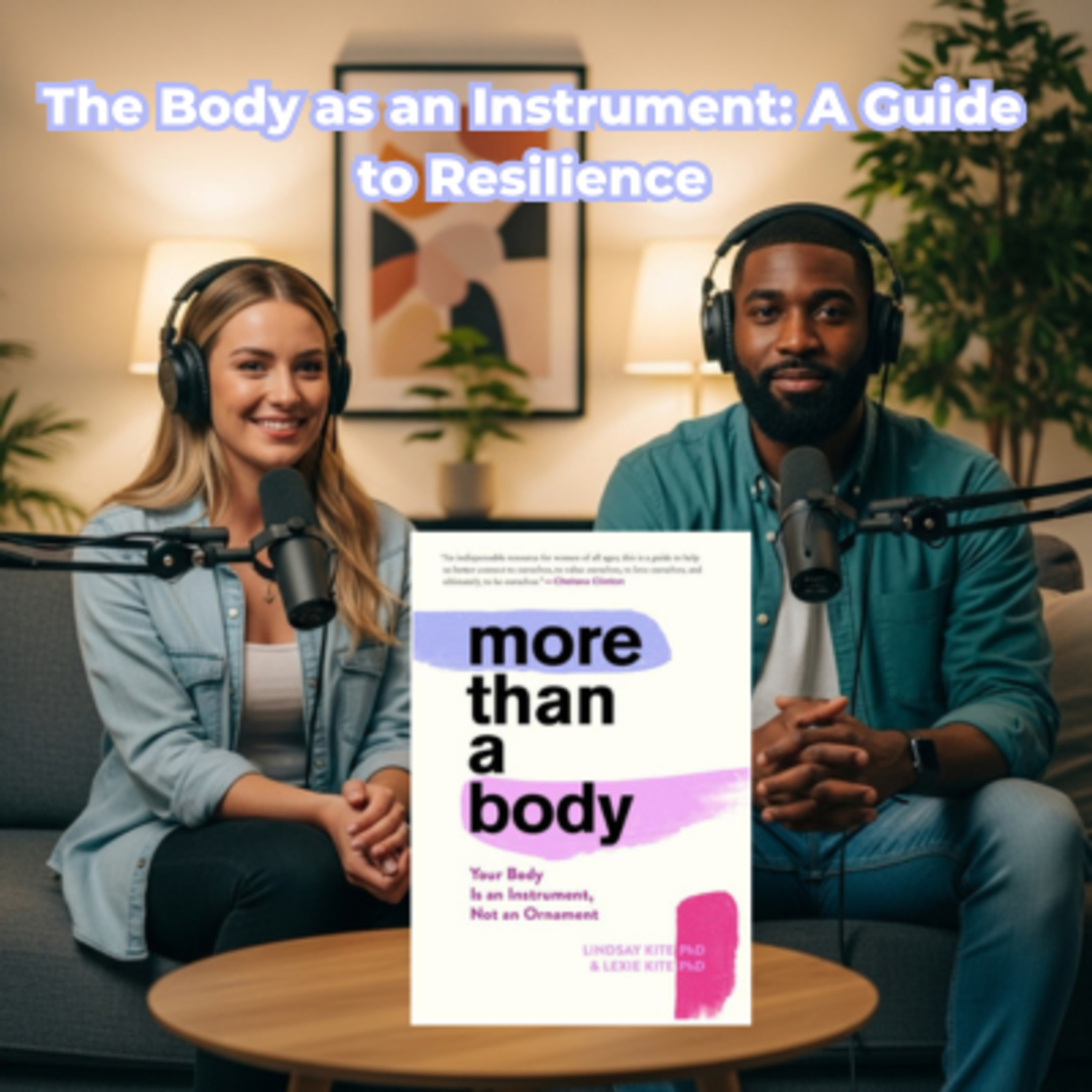
This episode summarises the core principles of Lindsay and Lexie Kite’s book, which advocates for viewing the human body as a functional instrument rather than a decorative object. By cultivating body image resilience, individuals can learn to navigate societal pressures and media-driven beauty standards that often lead to harmful self-objectification. The chapters outline practical strategies for curating media consumption, fostering female solidarity, and reclaiming fitness as a pursuit of personal well-being instead of aesthetic perfection. Ultimately, the source encourages a profound psychological shift where self-worth is rooted in physical capability and internal health rather than outward appearance. This perspective aims to empower readers to build a supportive community and celebrate their bodies for the lived experiences they enable.An indispensable resource for women of all ages, this is a guide to help us better connect to ourselves, to value ourselves, to love ourselves, and ultimately, to be ourselves."
—Chelsea Clinton
Positive body image isn’t believing your body looks good; it is knowing your body is good, regardless of how it looks.
- How do you feel about your body?
- Have you ever stayed home from a social activity or other opportunity because of concern about how you looked?
- Have you ever passed judgment on someone because of how they looked or dressed?
- Have you ever had difficulty concentrating on a task because you were self-conscious about your appearance?
Our beauty-obsessed world perpetuates the idea that happiness, health, and ability to be loved are dependent on how we look, but authors Lindsay and Lexie Kite offer an alternative vision for building a positive body image. With insights drawn from their extensive body image research, Lindsay and Lexie―PhDs and founders of the nonprofit Beauty Redefined (and also twin sisters!)―lay out an action plan that arms you with the skills you need to reconnect with your whole self and free yourself from the constraints of self-objectification.
From media consumption to health and fitness to self-reflection and self-compassion, Lindsay and Lexie share powerful and practical advice that goes beyond simple "body positivity" to help readers develop body image resilience―all while cutting through the empty promises sold by media, advertisers, and the beauty and weight-loss industries. In the process, they show how facing your feelings of body shame or embarrassment can become a catalyst for personal growth.#MoreThanABody #LexieKite #productivityhacks #personaldevelopment #successstrategies #businessinsights #leadershipskills #leadership #ambitiousprofessionals #businesstips #self help #scaling business #businesstactics #professionaldevelopment #startupgrowth #entrepreneurship #businessmindset #growthstrategies
OK, so let's just jump right in and unpack this. Imagine, just for a second, that you own this absolutely incredible high performance sports car. Oh, like a top of the line machine? Exactly. We are talking a master class in engineering, right? Capable of taking you literally anywhere you want to go at thrilling speeds. You have the keys to this absolute marvel of mobility. Yeah, the kind of car built for the Autobahn, like it's built to be pushed to its limits and actually, you know, used. Right.
But now imagine that instead of ever actually driving this car, like instead of feeling the engine rumble or testing the suspension on a winding road, or just taking it out on the open highway, you just park it on your front lawn. Wait, just just leave it there. Just. Leave it there strictly as a lawn ornament, and you spend all your time out there with a little microfiber cloth just polishing the hood, stressing over some microscopic scratch on the bumper. That sounds exhausting. Right. And you're constantly looking over your shoulder to see if the neighbors approve of the paint job.
It's, I mean, it's completely absurd when you frame it that way. You're totally ignoring the primary function of the machine in favor of like its aesthetic value to bystanders. Well, here is the really wild part of today's deep dive. Aren't we doing exactly that to our own bodies? Oh wow, yeah, I see where you're going with this. Yeah, so today we are exploring some core concepts from the book More Than a Body by Lindsay and Lexie Kite, and the entire premise rests on this single massive paradigm shift, treating your body as an instrument for your own experience rather than an ornament for others to evaluate.
And that shift, I mean, it's incredibly difficult because we don't operate in a vacuum, right? Our environment actively trains us from a very young age to self objectify. Yeah, to view ourselves from the outside in. Exactly. We we are conditioned to start measuring our worth by anticipating how other people perceive our physical form, which fundamentally rewires how we navigate the world. I really want to look at the mechanics of how that rewiring actually happens, because I think the most common trap we all fall into is the mirror.
Oh, the mirror is a big one. Right. So imagine you're getting ready for a significant occasion, like a wedding or a major date. You go into the bathroom feeling perfectly fine, maybe even excited. You're anticipating a good time. Exactly. You put on your outfit, you look in the mirror and suddenly bam you start adjusting A seam here, pulling at a hem there and like 5 minutes later you are spiraling into full blown anxiety. Yeah, what's happening in your brain during that spiral is actually fascinating.
You're taking a dynamic 3 dimensional Organism, a body that is literally about to carry you to an event where you will laugh and converse and dance, right? And you are reducing it to a static 2 dimensional image. Your brain shifts its entire evaluative criteria from what am I about to experience to how closely do I match an idealized visual standard. And we never match it. No, never. And when you inevitably find that discrepancy between your reflection and that impossible standard, your nervous system actually registers it as a threat.
With a threat like a physical danger. A social threat, actually. Which our primitive brains process very similarly to physical danger. Oh, interesting. Yeah, evolutionarily, our survival depended on social acceptance within a small tribe. If you perceive that you didn't measure up to the tribe standards, that signaled a massive risk of ostracization. You'd be kicked out of The Cave. Exactly. So that anxiety you feel in front of the mirror, it isn't just vanity, it's literally a biological alarm bell going off because your brain thinks your social standing is in jeopardy.
Wow that makes so much sense of the physical reaction we get, Like the tight chest, the sudden drop in mood. But OK, if the bathroom mirror triggers that, the digital mirror we carry in our pockets must be like an absolute biological nightmare. Well, it's an evolutionary bottleneck. I mean, think about human history. For hundreds of thousands of years we lived in groups of maybe 150 people, right? You only ever compared yourself to the people in your immediate vicinity. Now you open social media and within 5 minutes you are bombarded with thousands of images of the most genetically anomalous, highly edited and perfectly lit humans on the.
Planet. But logically. I mean, I know those images are manipulated. I know about AI filters, I know about Photoshop, I know about angles. So why doesn't my logical knowledge just override the feeling of inadequacy? Because your visual cortex processes imagery in milliseconds. Yeah, long before your prefrontal cortex, which is the logical part of your brain, can step in and say, hey, hold on, that's just a filter. So the emotional reaction beats the logic. Exactly. The visual cortex sees a hyper attractive competitor and the amygdala instantly fires off that social threat response we just talked about.
Your brain simply hasn't evolved to intuitively differentiate between a glowing 2D pixel arrangement on a screen and a physical human standing in your tribe. Your nervous system reacts to the pixels as reality. So we are essentially hacking our own threat detection systems multiple times a day just by scrolling. Yeah, pretty much. So if the algorithmic feed is intentionally feeding us our insecurities to keep us engaged, how do we actually combat that? I mean, the common advice out there is to curate your feed, right?
Unfollow the fitness models. Follow diverse, authentic accounts. Right, that's the standard advice. But honestly, let me play devil's advocate here. Isn't that just burying your head in the sand? We can't put an authenticity filter on billboards or movies or just people walking down the street. Well, you can't sanitize the entire world, no. And attempting to do so is a losing battle, right? But curating your digital environment is. It's like necessary triage. It stops the immediate bleeding by reducing the frequency of those amygdala hijacks.
OK, so it helps, but it's not a full fix. Exactly. You're right, it's not a cure. The cure requires a much deeper internal shift. If your foundational metric for human value is still appearance based, the real world will eventually trigger you. You have to actively build what the authors call body image resilience. Body image resilience, which means changing the metric of success entirely. If we aren't judging the ornament, we have to start evaluating the instrument. That's the shift. And I really want to take this concept out of the bathroom and into environments where our capabilities should logically be the absolute center of attention, like say a high stakes professional setting.
Oh, the boardroom is actually one of the most vivid examples of how self objectification sabotages us. Yeah, I was reading through the notes on this, and the cognitive mechanics are just wild. Let's say you're walking to the front of a conference room to give a major presentation. You know the data, you built the slide deck. You are the expert in the room. But as you stand up, your brain suddenly pivots. You start wondering if your shirt is wrinkled, or if your posture looks weird from the side, or if the overhead lighting is highlighting a breakout.
Yeah, you've just triggered a third person perspective on yourself. You are no longer the subject acting in the room, You're trying to view yourself as an object being perceived by the room. And doing that literally makes you worse at your job in that moment. It's it's like having a heavy app running in the background of your phone. That's a great analogy. You're trying to open your e-mail, but the phone is lagging and freezing because this invisible app is draining all the RAM. When you are monitoring your own appearance, you are stealing working memory, actual cognitive bandwidth away from your ability to recall data, read the room and speak eloquently.
Yeah. Dual tasking in cognitive psychology tells us that human beings cannot process 2 highly demanding tasks simultaneously without a drop in performance. We just can't do it. No. Monitoring your aesthetic presentation while simultaneously trying to deliver complex information. It splits your cognitive load. Self objectification doesn't just make you feel insecure, it actively makes you less competent in the moment. Because you're so distracted by yourself, right? The bandwidth required to be the observer of yourself leaves very little bandwidth to actually be yourself.
That is a staggering realization it. Really is. So if we can fix this mental split in the boardroom by focusing entirely on the action and the contribution, what the psychological framework calls self actualization, what happens when we step into a physical space? Because historically the gym is like the ultimate alter of self objectification. Oh, absolutely. Fitness culture is largely built on an extrinsic motivation model. Everything is external. Yeah, the messaging is almost entirely aesthetic.
Shrink this tone that. Get ready for swimsuit season. When you start a workout routine with the goal of altering your physical appearance to meet a societal standard, your motivation is entirely dependent on an external locus of control. And the goal post is constantly moving. You lose the weight, but now you aren't toned enough. You get toned, but now your proportions are wrong according to like this year's trend. Exactly. The business model of the aesthetic fitness industry relies on you never actually reaching the finish line.
Wow. Yeah, they need you to keep paying. Right. But if your goal is to feel strong, or to run a mile without stopping, or to improve your cardiovascular health so you can keep up with your kids, that is intrinsic motivation. It comes from inside. Yes, you get an immediate neurological reward, a dopamine release from the accomplishment, and the endorsements from the movement itself. So you are doing it for the feeling it gives you on the inside. You're shifting from being the painting on the wall passively, hoping the critics in the gallery appreciate the brush strokes, to being the artist holding the brush.
You care about the act of creating the motion, the capability. Beautifully put. The focus moves from How does my body look while I do this to what is my body capable of achieving. It's the difference between doing a squat while staring intensely in the mirror at your glutes versus doing a squat and focusing on the mechanical power of your legs pushing the floor away. 1 reinforces the ornament, the other celebrates the instrument. I really love the mechanics of that shift, but I have to challenge this premise just a bit.
OK, go for. It. We can adopt this empowering artist mindset all we want, right? We can focus on intrinsic goals and our internal metrics of success, but we still live in a society that objectively rewards the painting. That's true. We know that the Halo effect exists. People who fit conventional beauty standards are often unconsciously perceived as more competent. They get hired more easily. They're treated better by strangers. So how do we balance our internal self actualization with a world that visually judges us before we even open our mouths?
It's a vital question, and it's a tough one. Acknowledging body image resilience does not mean ignoring the reality of pretty privilege or the harsh truths of societal bias. So we aren't just pretending it doesn't happen. No, the framework doesn't ask you to pretend the world is fair. It asks you to carefully choose where you deploy your limited energy. If you spend your life trying to manipulate society's initial superficial gaze by constantly altering yourself, you will be exhausted and your sense of worth will forever be held hostage by the opinions of strangers.
Because we simply cannot control the external gaze, no matter what we do. We can't, but we have absolute control over our response to it. And crucially, we have control over the micro cultures we choose to participate in. OK. What do you mean by micro cultures? Well, we don't have to tackle the macro societal biases alone. This is where the concept moves beyond just individual cognitive behavioral tricks and steps into the realm of sociology. The power of the collective, because trying to maintain this instrument mindset alone while surrounded by people obsessed with the ornament sounds like a complete recipe for burnout.
Exactly. Which brings us to the social dynamics, particularly the ways cultural constraints push people. Very often women though it affects everyone into these subtle competitions. Oh, you mean the social ritual of bonding over insecurities? Yes, exactly that. I think everyone has experienced this, whether it's in a locker room, at a brunch, or just standing around at a party. Someone throws out a self deprecating comment like I feel so bloated today I hate my arms in this shirt. And the immediate social expected response isn't to reassure them.
The expected response is to counter with your own flaw. Are you kidding? Your arms look great, but look at my stomach. I need to lose 10 lbs. Yeah, we use self deprecation as a form of social currency. It's essentially an evolutionary appeasement. Strategy. How? So by degrading your own physical form you are signaling to the group, hey I am not a threat to the social hierarchy. You are lowering your own status to make others feel comfortable. Man, it's like a financial market where everyone is collectively shorting their own stock.
That is a perfect way to describe it. You think you are building a connection, but you are literally artificially deflating the value of the entire group. You are all collectively agreeing that your bodies are objects to be aggressively critiqued and that your flaws are the most interesting things about you. That analogy hits the nail on the head. You are reinforcing the exact systemic standard that is making all of you miserable in the 1st place. You're doing the culture's policing work for it.
Just keeps the cycle going. Yeah, bonding over negative body image actively reinforces polarization and undermines the collective power of the group. If your shared foundation is mutual self objectification, you cannot build a resilient community. So how do we actually disrupt that market? Like practically speaking, if someone throws out that self deprecating comment at a party, how do you change the culture of that room without sounding like some preachy self help guru? You disrupted by simply refusing to participate in the ritual.
You don't have to give a big speech. You just change the currency, OK? If someone criticizes their own body, you pivot the focus to their capabilities or their character. So you say I don't know about any of that, but I do know the presentation you gave yesterday was brilliant. Oh, I like that. Or when discussing your own body, you normalize neutrality or functional appreciation. Like, I'm just glad my legs let me finish that hike today. You literally starve the comparison engine when you intentionally change the conversation from aesthetic comparison to functional celebration.
You dismantle the standard in real time. But I mean, even with a supportive community and all this cognitive awareness, we have to talk about the reality of the relapse because the bounce back is never a perfectly linear trajectory. Oh, of course not. Setbacks are guaranteed. The cultural conditioning is just too deeply ingrained and the media environment is too loud to ever expect perfection. Right, because you do all this internal work. You clear the RAM in your brain, You start exercising for the endorphins, You disrupt the toxic locker room talk, and you feel great for months.
And then one day you try on a pair of pants from last year and they don't button. Or a family member makes an offhand critical comment about your weight at dinner, and in a split second, that amygdala hijacks your brain again. It comes rushing back. The anxiety floods back and you feel like an absolute fraud, like all that resilience just vanished. But see, that is a misunderstanding of what resilience actually is. Resilience is not Teflon, right? It's a muscle that tears and repairs. Resilience isn't the absence of a set back, it is measured entirely by the speed of your recovery.
Oh, that's a crucial distinction, the speed of recovery. Right. A year ago that pair of pants might have ruined your week, caused you to crash diet, and sent you into a spiral of self loathing. Today it might ruin your afternoon, but by the evening you've deployed your cognitive toolkit. And what exactly is in that toolkit when the amygdala is screaming at you? The first step is just acknowledging the biological reality of what is happening. Without judgement. You practice radical self compassion.
Just giving yourself some grace. Yeah, you say. Of course. I feel terrible right now. My brain just perceived a social threat because of a piece of fabric. You externalize the problem. The problem isn't your body. The problem is the cultural standard that gave the piece of fabric so much power. You pull the lens back. You reconnect with why you started viewing your body as an instrument in the first place. And you celebrate the micro victories. Recognizing that you interrupted the downward spiral faster than you used to is a massive win.
You have to actively reinforce the new neural pathways that say my value is not determined by my dimensions. It is a profound shift in how we navigate the physical world. We've mapped out some really complex territory today. I mean, we started by looking at how the brain processes our reflections both in the physical mirror and the digital 1. Yeah, and why our nervous systems react to those 2D pixels as real world competition. Right. And then we moved into the boardroom, identifying how self objectification literally drains our cognitive bandwidth, making us less effective when we are hyper focused on the external gaze.
And we looked at how to reclaim our physical spaces, shifting from that exhausting treadmill of extrinsic aesthetic goals to the deeply rewarding pursuit of intrinsic functional capability. You're the artist, not the canvas. Exactly and ultimately we examine the sociology of our relationships, why we use self deprecation as social currency to appease the group, and how refusing to short our own stock is the first step to building genuine, resilient communities. I love that. Listen, your body is the only permanent home you will ever know.
It is a wildly complex, fiercely capable instrument designed to let you experience the friction, the joy and the texture of the world. It really is. It processes the taste of a great meal, the physical exertion of a steep climb, the warmth of the sun, and the embrace of the people you care about. When we leave it parked on the lawn just to be polished and judged, we miss out on the drive entirely. It is the vehicle of your existence, not the Billboard of your worth. Absolutely. So before we wrap up this deep dive, we want to leave you with a thought experiment to test this framework in your own mind.
We've talked extensively about the visual gaze and how heavily we weigh it. Right. So imagine if tomorrow humanity entirely lost the ability to perceive physical appearance. If, in a visual sense, you were suddenly invisible to everyone else, and they were completely invisible to you, what specific skills, actions, or sensations would instantly become the most valuable and cherished things your body could do for you?
 Apple Podcasts
 Castbox
 Castro
 Goodpods
 Moon FM
 Overcast
 Pocket Casts
 Podbean
 Podcast Addict
 Podcast Republic
 Spotify