Stop Overthinking by Nick Trenton | The Now Practical Strategies to Relieve Stress
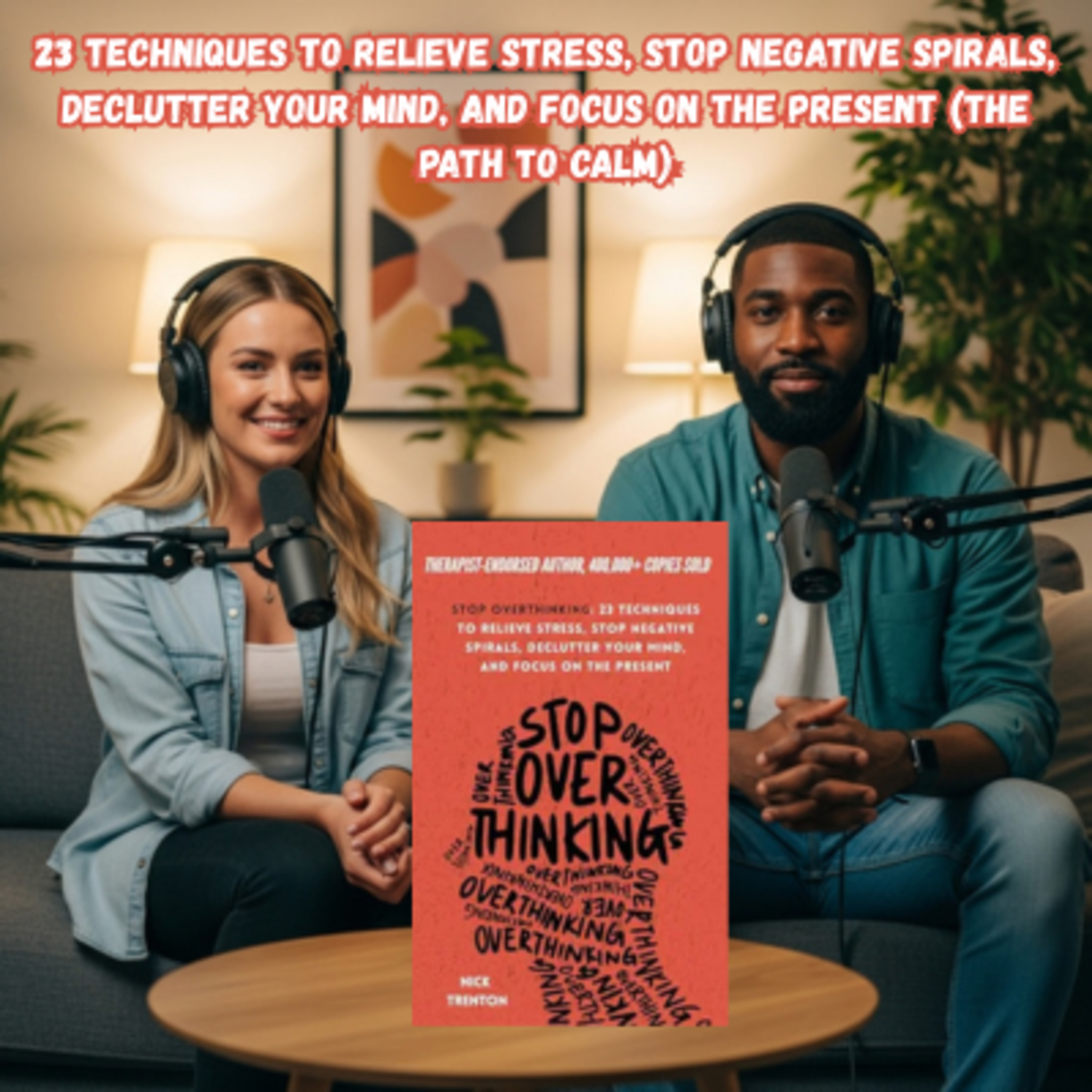
This summarizes Nick Trenton’s book, which provides a comprehensive guide for individuals seeking to dismantle the habit of persistent overthinking. The author moves beyond simple definitions to explore the underlying triggers, environmental influences, and cognitive distortions that fuel mental exhaustion. Readers are introduced to practical frameworks like the "De Stress Formula" and time management strategies designed to restore a sense of personal control. Furthermore, the material outlines grounding techniques and cognitive behavioral methods to help rewire negative thought patterns into more productive attitudes. By emphasizing emotional regulation and present-moment awareness, the source serves as a roadmap for achieving mental clarity and long-term psychological resilience.
Overcome negative thought patterns, reduce stress, and live a worry-free life.Overthinking is the biggest cause of unhappiness. Don't get stuck in a never-ending thought loop. Stay present and keep your mind off things that don't matter, and never will.
Break free of your self-imposed mental prison.Stop Overthinking is a book that understands where you’ve been through,the exhausting situation you’ve put yourself into, and how you lose your mind in the trap of anxiety and stress. Acclaimed author Nick Trenton will walk you through the obstacles with detailed and proven techniques to help you rewire your brain, control your thoughts, and change your mental habits.What’s more, the book will provide you scientific approaches to completely change the way you think and feel about yourself by ending the vicious thought patterns.
Stop agonizing over the past and trying to predict the future.Nick Trenton grew up in rural Illinois and is quite literally a farm boy. His best friend growing up was his trusty companion Leonard the dachshund. RIP Leonard. Eventually, he made it off the farm and obtained a BS in Economics, followed by an MA in Behavioral Psychology.
Powerful ways to stop ruminating and dwelling on negative thoughts.-How to be aware of your negative spiral triggers-Identify and recognize your inner anxieties-How to keep the focus on relaxation and action-Proven methods to overcome stress attacks-Learn to declutter your mind and find focus.
Unleash your unlimited potential and start living.No more self-deprecating talk. No more sleepless nights with racing thoughts. Free your mind from overthinking and achieve more, feel better, and unleash your potential. Finally be able to live in the present moment.
Do you ever get that feeling that that agonizing grinding loop where your mind is just stuck on repeat? Oh, absolutely. Not really solving anything, just rehearsing worries, anxieties, you know, past mistakes. It is so mentally exhausting. It is. It really is the mental equivalent of running 1000 background processes that are just constantly draining your battery. That's a great way to put. It you feel busy, but you're not actually productive, you're just generating heat. And look, that feeling is universal.
But our goal today isn't just to talk about it, it's to find the actual levers, the tools to stop it. And that's our mission for this deep dive. We are digging into the strategies from Nick Trenton's book, Stop Overthinking. We're pulling out the most practical, actionable methods, the real Nuggets for relaxing your mind and hopefully achieving some genuine peace. Think of this as your shortcut, a way to clear out that mental clutter. We're moving past the why we worry and getting straight into the how to manage it.
There's the road map. Well, we'll follow Trenton's framework. It's really designed for lasting change. We start with the root causes, then we jump into some immediate relief techniques. After that, we'll cover time management, external controls, and finally how to rewire those stubborn thought atterns for good. OK, let's unack that right from the start. Charter One hits you with this really crucial insight, one that kind of flips the script. It says overthinking isn't about overthinking. Right. And at first that sounds like a contradiction.
It does. But what's fascinating is that the problem is bigger than just, you know, thinking too much. Trenton argues that if you want real long term change, you have to see that the overthinking is usually a symptom. It's not the disease itself. A symptom of one thing. Of deeper underlying causes. You can't just stop the mental tape recorder if you don't know what's powering it, and so often that power source is a a misplaced attempt at control. A misplaced waste attempt to control. Wow, that resonates.
It's like our brains think if we just worry hard enough, we can somehow calculate away an uncertain future. Precisely. And the source material breaks these power sources down into two big areas. First, you have the internal factors. OK, These are our mental models, the deep seated beliefs we have about ourselves in the world. For a lot of overthinkers, this looks like crippling perfectionism or a really intense fear of inadequacy. So they overanalyze because they're terrified of not being perfect.
Exactly. And then you have the external factors. Your environment, your surroundings can either perpetuate or, you know, help alleviate these habits. If you're constantly bombarded by notifications, chaotic workspaces, or just tons of pressure, your environment is basically feeding that anxious brain fresh material. You can see that so clearly in the example of Sarah, the college student. Yes, the book uses her as a perfect example. She's constantly fretting over exams. Her internal model is demanding.
She thinks anything less than an A is a total failure. That's the perfectionism kicking in. Right. And then the external pressures, the huge volume of material, the competition, it all just forces her to spend hours replaying scenarios and worrying about every little detail. And that whole high stakes loop creates so much stress that it actually starts to sabotage her. The overthinking that was meant to prevent failure ends up causing it. Which brings us to the first really essential lesson from the book awareness and recognition.
Before you do anything else, you have to recognize the pattern. You have to see that you are overthinking and identify the consequences. So it's about acknowledging the cognitive inertia, that feeling of being locked in. Exactly. Until you see the full picture, those internal drivers meeting all that external chaos, you can't really make a targeted change. OK, so if awareness is the foundation, where do we go from there? Because just knowing you're drowning is only step one. We need some immediate tactical support.
And that's where we shift from diagnosis to action. We're talking about methods that offer instant relief, which Tretton calls the De Stress Formula and Instant Zen concepts. A proactive stance. I like that. It's a key mental shift. Instead of being a passive recipient of stress, you realize you have four major choices. He calls them the 4A's. OK, walk us through those 4A's. This feels like where the action starts. Absolutely. So the first A is avoid. You choose to simply avoid unnecessary stressors.
If a specific news feed always makes you anxious, you just cut it out. Simple enough. What's the second? The second is alter. You alter your environment or your approach to the stressor. If a colleague always derails your meetings, you change the structure of the meeting itself. That takes some real self-awareness, though. And the other two. The third is adapt. If you can't avoid or alter it, you adapt to the challenge. You change your perspective or develop new coping skills. And finally, the last A is accept.
You just accept things that are completely beyond your control. Like the weather or the global economy? Exactly. The overthinking stops when you realize it's pointless to try and control the uncontrollable. The big challenge, I think, is figuring out which A to use. How do you know if you should avoid something or if you need to adapt to it? And that's where a tool like journaling comes in, keeping a stress diary. It really helps you build that self-awareness. It helps people like John, the project manager from the book, who's facing these tight deadlines.
Right, he's totally overwhelmed. So how does a diary help him apply this destress formula? Well, John's Journal might show him that his biggest anxiety spike isn't at the final deadline. It's every Tuesday morning, 10 minutes before the big status meeting. So it's not the whole project, it's that one specific moment. Exactly. The trigger isn't the workload itself, it's his fear of being seen as unprepared during that very visible high pressure check in. So he can't avoid the meeting, but he can alter his preparation.
How? So? Instead of just rolling in, he starts setting aside 30 minutes on Monday afternoon just to draft some bullet points. By altering his routine, he reduces that internal stress, which immediately cuts down the need to overthink his whole project all afternoon. So the Journal turns this vague, huge anxiety into a specific, actionable decision. That's the power of it. But what about those moments when the anxiety hits hard before you've had a chance to journal? For that we need instant tools.
Instant Zen. Right. And these are crucial because they stop that runaway train in its tracks. The first one is the 54321 grounding technique. I love this one, it's so practical. It really is. It forces your mind out of that abstract worry and back into concrete sensory reality. It's so simple. You just list 5 things you can see, 4 things you can touch, three things you can hear, two you smell, and one you can taste. It's like a hard reset button for your brain. It is, and alongside that Trenton recommends methods that use the mind body connection.
Things like autogenic training, which is basically using self suggestions like my arm is heavy to relax your body. Then there's guided imagery and progressive muscle relaxation. And the connection here is that by consciously paying attention to your body tensing and releasing muscles, you break that feedback loop. Yes, the mental anxiety creates physical tension, and then that physical tension just feeds right back into the anxiety. You break the physical part of the loop and you give your mind a chance to rest.
I also really appreciate the concept of worry postponement. I think this is so helpful for someone like Alex, the marketing exec whose mind is always jumping from yesterday's missed opportunity to tomorrow's crisis. Worry postponement is essentially radical compartmentalization. Instead of letting worries hijack your whole day, you set aside a specific limited time for them, say 5.0 to 5.15 PM, and you just. Park the worry until then. You capture the thought, you acknowledge it and you tell yourself, I will deal with this at 500.
But I have to ask, doesn't that just feel like avoidance? How do you make sure you actually deal with it later and it doesn't just, you know, come back stronger? That's a fair question. The key difference is intentionality. You have to honor that worry time. When 5.00 PM hits, you actually sit down and review the concerns and what you often find is by then the problem seems a lot smaller. Or maybe a solution has already popped up? So the goal isn't to eliminate worry, but to control when and where it happens.
Exactly so it stops leaching energy from the rest of your day. That makes a lot of sense. OK, so let's shift to managing the external world. Because sometimes overthinking isn't just an internal thing, it's a direct result of being overwhelmed by everything coming at you. For sure, this part is all about controlling your external inputs and your time, which you know reduces the opportunity for overthinking. If your day is structured and your environment is calm, there are just fewer gaps for that anxiety loop to start spinning.
This is the exact struggle of Emily, the freelance graphic designer. In the book. She overthinks everything, worries about deadlines, and she can't say no. It's a vicious cycle. The lack of control fuels this intense overthinking about quality and client satisfaction. So what's the fix? The book focuses heavily on practical workflow strategies. First and foremost, efficient time management. Just by organizing your tasks and allocating time, you create a clear container for your work, which immediately reduces the urge to overthink.
And the key to that, according to Trenton, is prioritization, specifically using Eisenhower's method and setting SMART goals. Yes, the Eisenhower method is so powerful because it forces you to categorize tasks by urgency, an imortance. You split everything into four boxes, Urgent and important. What you do now, Important but not urgent. What you schedule. Urgent but not. Important you delegate that, and not urgent, not important, you just eliminate it. So how would Emily the designer use this? Well, Emily might be spending hours on a low value task like say, rearranging her font library.
It feels urgent because she hasn't done it in months, but it's not important for her clients Big project. Meanwhile, she's putting off the actual core design work. The thing that's important but not yet urgent and she's stressing because she's mixing up. The two. Exactly. The matrix forces her to schedule time for that important, not urgent work, which is where real progress and less anxiety happens. And using SMART goals helps too. Vague goals incurred. Overthinking SMART goals give you a clear path.
And of course, a huge part of controlling the external world is just minimizing distractions. Absolutely. We so often overlook our environment. Just managing your emails, your notifications, it makes a huge difference. Every interruption forces you back into that state of anxious catch up, which is a perfect breeding ground for overthinking. So we've covered the foundation, immediate fixes and external management. Now we're getting to the deepest level, rewiring the cognitive processes themselves.
This is where we get into some serious behavioral change tools. Right. To really address overthinking long term, you have to recognize your cognitive distortions. These are the illogical thought patterns we all adopt, often without even realizing. It like catastrophizing, assuming the worst case scenario is the only outcome. That's a huge one, and it's what keeps someone like Lillian from the book stuck. She dwells on past failures and worries way too much about the future because of these distortions.
They're basically lies, our brain tells us. And we just accept them as. We do, but the great news is we have tools for this. The source material really emphasizes using cognitive behavioral therapy or CBT techniques. These are active tools you can use to challenge and reframe those negative thoughts. Can you break that down for us? How does someone listening actually do that? The foundational technique is often called the three C's. First, you catch the automatic negative thought. Second, you check the evidence for that thought, Lillian thinks.
I failed that last presentation, so I'm going to fail every single one in the future. So you. Check it? Was it a total failure? What went well? Exactly. You challenge the logic, What evidence do you have that you can't improve? And the final step, change it. You change the thought. You replace the distortion, the lie, with a balanced realistic 1. Instead of I'm a failure, Lillian replaces it with that. Presentation was tough, but I learned XY and Z and I'll apply that next time. That shifts the whole focus from failure to learning, which ties right into build building a better inner narrative through self talk.
Precisely. You're essentially training a new, healthier voice inside your head, one that's focused on progress and self compassion, not judgement and fear. Which leads us to the final piece, Attitude correction and emotional regulation for long term resilience. What kind of attitudes are we talking about? It all comes down to accepting the reality of limited control. For someone like David, the sales manager who's always worried about market trends or what competitors are doing, the key is to adopt attitudes that prioritize actions within his control.
So he can't control if a client signs today. But he can control how many high quality outreach calls he makes. He shifts his focus from the outcome, which fuels the anxiety, to the process, which he can actually manage. That simple shift drastically reduces the space for overthinking. And finally, emotional regulation. It's a return to basics but applied consistently. Things like deep breathing and mindfulness. These are not soft skills. They are powerful tools. They empower you to manage stress effectively.
And ultimately the goal is what the book calls mindful living. Just practicing present centered awareness. You're retraining your mind to exist now instead of constantly replaying the past or trying to predict the future. Wow. We've covered a massive toolkit today, from the immediate relief of the 54321 technique, to the boundary setting of worry postponement, all the way to the deep cognitive work of CBT. It really shows that overthinking is common. But these are genuine, trainable skills. You can absolutely get a handle on it.
And remember, the most valuable knowledge is knowledge that you actually apply. We've given you the map. We really encourage you to think about what specific area of your life. Maybe it's your morning routine, maybe it's your inner self talk. You can reclaim control over using just one of these strategies. So here's the final thought. We'll leave with building on that crucial idea of urgent versus important if clarity reduces overthinking and knowledge is meant to be applied. Which specific task in your workload right now currently sitting in that urgent but not important box?
Will you successfully? Eliminate or delegate this week using the mental clarity you've gained. Go. Implement that change today.
 Apple Podcasts
 Castbox
 Castro
 Goodpods
 Moon FM
 Overcast
 Pocket Casts
 Podbean
 Podcast Addict
 Podcast Republic
 Spotify