Purpose Driven People by Alize Hofmeester | The_Seven_Pillars_of_Sustainable_Purpose
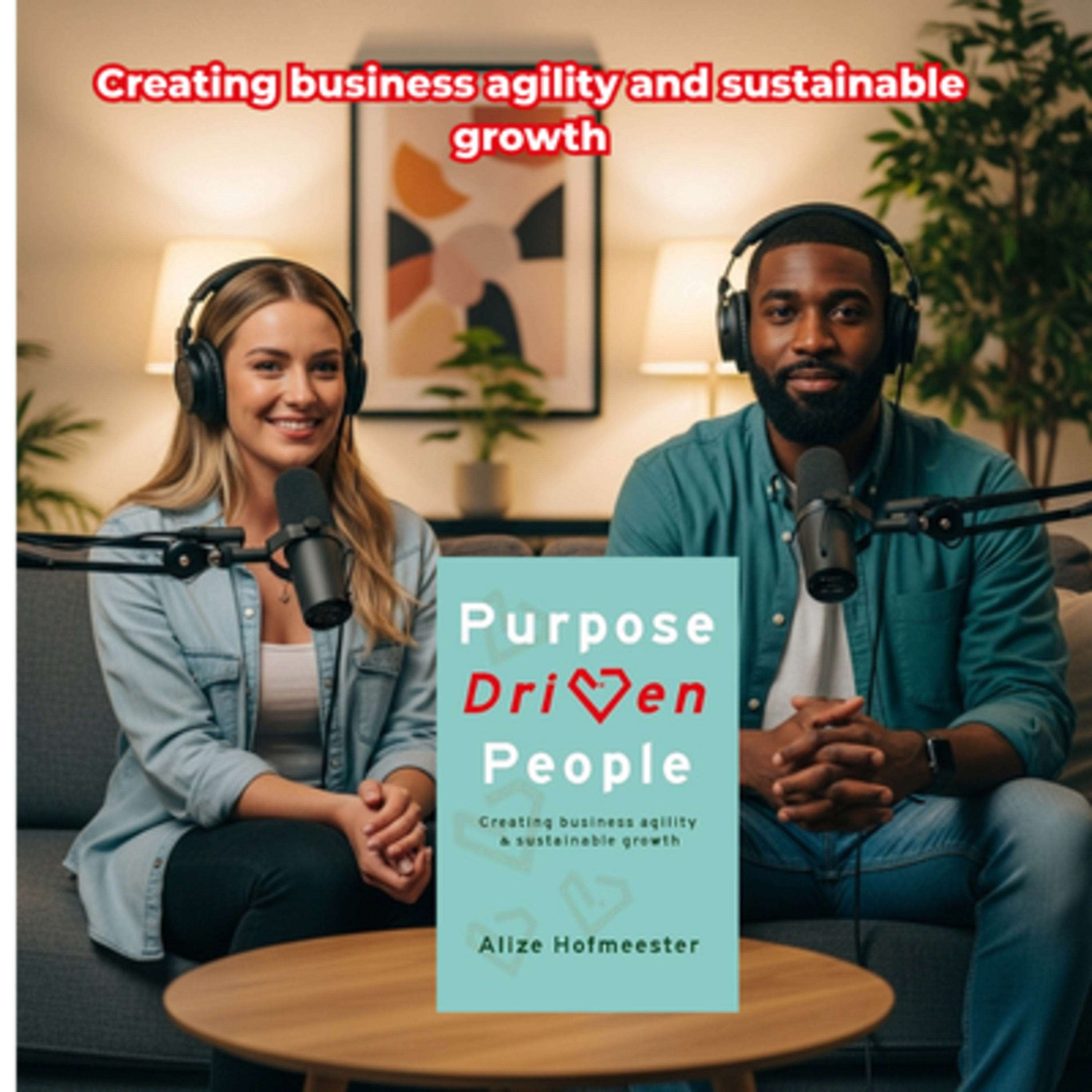
This text outlines the core principles of Alize Hofmeester’s book, which explores how to build resilient, purpose-driven organizations. The author emphasizes that a clear mission is the foundation for employee motivation and strong professional relationships. Success is further supported by transparent, two-way communication and the proactive identification of operational constraints. Leadership must evolve from simple management to role modeling, where managers inspire others by demonstrating core values. Additionally, the source highlights the power of collective intelligence through diverse communities and a persistent culture of learning. Ultimately, businesses are encouraged to view themselves as part of a larger ecosystem that balances profitability with long-term sustainability.
Agility is no longer a buzz word. Business agility within organisations is sorely needed. Reacting more quickly to volatile market conditions, customer and employee demands, value creation, being relevant and meaningful have become a necessity. Implementing agile models and methodologies is one thing. Being truly agile from the heart of the organisation is often a struggle. Impossible? Definitely not. But how…?The WHY, WHAT and HOW to create business agility and sustainable growth, all combined into one book. A refreshing and unique approach where people form the heart of future organisations and agile networks. Together they actively shape the future of work together. In this book, fiction is intertwined with non-fiction and supported by data, research, practical experiments, tooling and cases from experts, which you can try out directly. The elements of the People Journey Circle have been forged over years of intense experimenting, learning and improving during large and successful agile transformations. The choices the People Journey Circle offers you, will help you discover, how and where to embark on your unique journey toward business agility within your organisation.#productivityhacks #personaldevelopment #successstrategies #businessinsights #leadershipskills #leadership #ambitiousprofessionals #businesstips #self help #scaling business #businesstactics #professionaldevelopment #startupgrowth #entrepreneurship #businessmindset #growthstrategies
Welcome to the deep dive. This is where we we take a whole stack of research articles and key concepts. And we really just try to boil it all down. Exactly. Boil it down to the essential insights you need to get, you know, right up to speed. Today we're deep diving into something really fundamental for any organization. It's this question of how do you stop chasing those short term winds and actually build a business that's, well, that's a meaningful, adaptable and really designed for sustainable success.
We've got a fantastic source for this. Today we're focusing mostly on a lice Hofmeister's book, Purpose Driven People, and her work. It just lays out such a clear path for companies to kind of shift their DNA. It's not just about tweaking processes, it's about refining the whole culture so that purpose, not pressure, is what drives the results. And that's really our mission for you today. We're aiming to give you the ultimate shortcut here, distilling 7 core themes, 7 pillars really, that Hofmeister argues can move a company from just, you know, operating and surviving to truly thriving and sustaining that success.
It's a complex strategy, but made simple. Basically OK. Let's unpack this. We're going from a simple mission statement to a a proven competitive advantage in seven essential steps. Let's start right at the core, right the why? So Hofmieser starts exactly where all real organizational change has to begin. The Foundation. The foundation with pillar one, the distinct mission. And this isn't just, you know, painting a slogan on the office wall. She argues that knowing why you're doing the work, the actual impact is just as crucial as the work itself.
Right. That's the engine for employee connection for fulfillment. And the detail that really brings us to life for me is that story of tests, the one that gives the chapter its name. I mean, we've all been there, right? Yeah. You just clocking in, focus on the salary, going through the motions. You feel disengaged. But the source describes this, this powerful shift, once she gets clarity on her mission, her specific role in that something greater. And her drive just skyrockets. Totally. She suddenly finds enjoyment in tasks that were just chores before.
And what's so fascinating is the dual effect of that clarity. First, of course it solves the motivation problem. Purpose fuels happiness. People get invested. But second, it acts as this incredible organizational lubricant. It just strengthens all those work relationships because, well, if everyone agrees on the core mission. Then the little things don't matter as. Much exactly. The friction around day-to-day stuff, minor disagreements, it just sort of melts away. You have this non negotiable common ground.
That is such a great point because, you know, a lot of people think of purpose. Is this this soft metric, right. It's. Nice to have. Exactly. But it's not. It's a hard alignment mechanism. It cuts down on unproductive debates, but OK, once that purpose is clear, how do you make sure it actually sticks? And that, I guess, brings us right to Pillar too. Role modeling. Absolutely. Role modeling is the gear that turns that abstract mission into daily behavior. And Hofmeister makes a really important distinction here between managing and leading.
Managing, she says, is transactional. It's tasks first. But leading? Leading is about putting people and purpose first. It's about empowering them, instilling that mission. We just talked. About the source actually has a term for this, doesn't it? It's distributed leadership. It is, and that requires a huge amount of trust. It has to. It's about pushing decision making authority down to the people closest to the information. So leaders have to trust that their teams will use that mission as their guide instead of needing constant oversight.
It's a huge mental shift for a lot of traditional managers. And the example of the team with the new work schedule illustrates this perfectly. The change was hard. A traditional manager would have just enforced the rules, right? Do this. Yeah, do this. But in this case, the leader showed the behavior they wanted to see. They adopted the new system patiently. They actively helped others who were struggling. They sucked the example, right? The leader didn't just issue a decree, they became a cultural architect.
Their actions spoke so much louder than words. And because of that, the group followed their lead and well, they ended up thriving. So we've got the internal corset, the why, the mission, and the cultural engine, which is role modeling. Now we can move to the operational how, which starts with Pillar 3 awareness and communication, because all that great leadership is you know it's wasted if the mission and the decisions aren't understood by everyone. This is where Hofmeister talks about building an organizational bridge.
If the company's going through a big transition like a totally new strategic plan and the communication is weak or just one way. People get disconnected. They get disconnected, confused, and ultimately resistant. The goal is to get clarity through 2 really crucial types of communication. OK, so the first is purposeful communication, which is sharing the reasoning behind the decisions, right? Not just saying here's the new plan, but. But here's why this new plan is necessary. You have to tie it back to that distinct mission.
You give people context, not just instructions. That makes sense. Exactly. But the second piece, and this is the one that's so often forgotten, is two way communication. Leadership has to broadcast the message, yes, but they also have to listen. They have to take input. Take input, address the concerns, use the feedback. If you're only broadcasting, you're not building a bridge, you're just shouting from the executive suite and eventually people will just tune you out. That clarity, that alignment, it allows you to then see the roadblocks.
Which brings us right to Pillar 4, identifying constraints. Yes, Hofmeister defines these as the bottlenecks, right? The things that get in the way of efficient operations and limited agility to, like flashing lights telling you where the system needs to change. And finding them is the absolute first step to becoming truly adaptive. The classic example from the book is the business trying to implement an agile workflow right, but they keep hitting delays because their hiring process, the very first step, is old fashioned and just agonizingly slow.
The hiring process is the constraint, it's the bottleneck. You fix that one thing and the responsiveness of the entire organization just it proves instantly. And here's where it gets really interesting, especially for any organization that's trying to be faster. The source has this big warning about something it calls the agility contradiction. It's such a paradox, isn't it? It is Organizations say they want agility, but then they accidentally put more restrictions on themselves by overcomplicating everything.
They layer on more approvals, more bureaucracy, all because they're afraid of losing control. They think they're protecting the business, but they're actually just hamstringing it. So if agility is the goal, why do they do that? Is it just fear of failure or old systems no one wants to touch? It's often that comfort of control, I think, mixed with just process inertia. Hoffmeister's point is that identifying constraints often just means finding where you've built too much complexity. The extra approval steps, The thick policy manuals.
All of it. And then you have to actively reduce it. And you don't just, you know, play organizational whack a mole. You have to target the constraint that's actually getting in the way of customer value or the mission. That's how you unlock real progress. OK, so reducing that internal complexity clears the path for true adaptation and that leads us straight into the pillars about resilience. So Pillar 5 is community building, which is about shifting from just efficiency to collective creativity.
Yeah, and. Building a healthy community is so much more strategic than just like planning office parties. It's about creating an environment that actively fosters diversity, cooperation, and most importantly, what she calls collective intelligence. So the idea that the group is smarter than any one person in it. Essentially yes, that the knowledge and judgement of the group when you actually use it properly will always surpass what any single individual or you know a small all closed off leadership team could ever come up with on its own.
There's a great example of this in the source, a business that's hit a major creativity block. They keep running the same brainstorming sessions with the same people. The usual suspects. The usual suspects and they're getting nowhere. But then when they deliberately bring in people from different departments, different backgrounds, boom, they're suddenly inundated with creative alternatives. They broke the silo. And that example just perfectly highlights the key ingredient of this pillar. Diversity matters.
A community that's too homogeneous just becomes an echo chamber. You're just recycling the same old ideas. Exactly, you're just confirming your own biases. Diversity of thought, of background, of experience, That is the only real guarantee that fresh ideas will actually surface. But, and this is crucial, it requires psychological safety. You. Can't be afraid to speak up. Right. You can put a bunch of diverse people in a room, but if the culture doesn't allow for dissent, those great ideas will just stay hidden.
And all that innovation you get from a diverse community is useless if the organization can't capitalize on it. Which brings us to Pillar 6, the learning organization. This is about making learning a continuous process, not just a one time event. Exactly. It has to become just part of the daily culture. It's about cultivating curiosity and resilience. Think about the business and the source that was stuck in its old ways for years. And then suddenly found itself way behind its competitors. Right, because the rivals had embraced new tech and their solution wasn't someone off training seminar, it was investing in an educational culture where people were actually encouraged to take on new tasks and importantly, grow from setbacks.
I think the power here lies in two connected ideas. First, you have the learning culture, which you have to promote from the top. You fund it, you reward. It you make time for it. You make time for it, but second, and maybe more profoundly, is instilling a growth mindset across the whole organization. That mindset shift is everything. It's about viewing obstacles and failure, not as things to be punished. Or blamed on someone. Right. But as essential teaching moments, when an experiment fails, the organization shouldn't ask who messed up.
It should ask what did we learn and how do we apply that lesson next time? And removing that fear of failure, that's what truly allows a business to take smart risks and regain its edge. So we spent most of our time building up the inside of the organization, right? The purpose, the leadership, the agility, the resilience. Right, all the internal stuff. And now for the final critical piece of the puzzle, we have to look outside the walls. Pillar 7 is the ecosystem. This is all about looking outward and recognizing that no business, no matter how perfectly optimized it is inside, exists in a vacuum.
Success means adapting to what's going on externally. Interconnectedness is the keyword here. The example given is a tech company developing a new product. Instead of trying to do every single part of the process themselves, which is slow and super expensive, they partner up. They partner up consciously with a whole variety of external players, specialized manufacturers, freelance designers, other tech companies that complement what they do. And by using that external ecosystem, they can innovate faster, cut costs.
And me customer needs much better than they ever could alone. It's really an admission that you know the best talent and the fastest ideas aren't always going to be under your own roof. It's about being humble in a way. It is, and this external focus is what ultimately ensures long term survival. It all ties back to two core observations for this pillar. First, interconnectedness. Your success depends on how you interact with that larger ecology of partners and customers, OK. And 2nd, and maybe this is the most defining part of sustainable success, is sustainability itself.
A truly robust ecosystem is one that consciously balances making a profit with social and environmental responsibility. So success isn't just about the bottom line. Not in the long run. Success, according to Hofmeister, isn't just internal financial gain. It's about being a healthy, adaptable and responsible part of the world around you. So after all that, what does this all mean If we put all seven of these pillars together from, you know, test finding her personal mission all the way to understanding the global ecosystem, the message from Hoffmeister seems incredibly clear.
It is. A successful sustainable business is built by focusing on a clear mission, by giving people freedom, empowering them, reducing constraints, and by developing this rock solid, learning focused culture that is constantly looking outward. The core recipe really for long term adaptability is that seamless integration of internal purpose with external awareness. You need both. You absolutely need both. You have to have that internal drive of tests fueled by her mission, but you also have to be so aware of the linkages outside your walls to make sure you're adapting to the world, not just optimizing your own little internal bubble.
It's such a powerful framework. It's about moving businesses away from just constantly reacting to the market and toward building the kind of internal structure that can proactively meet the market wherever it goes next. Which leads us perfectly to the final provocative thought. We want to leave you with something for you to Mull over. We talked about Pillar 4, right? Identifying and removing those internal constraints, the slow hiring process, the old procedures, right? So if those are so critical for internal agility, we want to leave you with this question.
What is the greatest unseen constraint your organization is facing right now in the larger ecosystem? The one you're not looking. At the one, you're not looking at what external linkage, what unrecognized partner, or what sustainability pressure is limiting your long term potential as we speak, even if it hasn't become a visible bottleneck inside your walls yet. Something critical to ponder. That is all the time we have for this deep dive. We hope these insights help you build not just a profitable business, but a truly purposeful an resilient one.
Until next time, keep exploring how to alley these powerful insights.
 Apple Podcasts
 Castbox
 Castro
 Goodpods
 Moon FM
 Overcast
 Pocket Casts
 Podbean
 Podcast Addict
 Podcast Republic
 Spotify