Belonging At Work by Rhodes Perry | Diversity_Equity_Belonging_Action_Plan
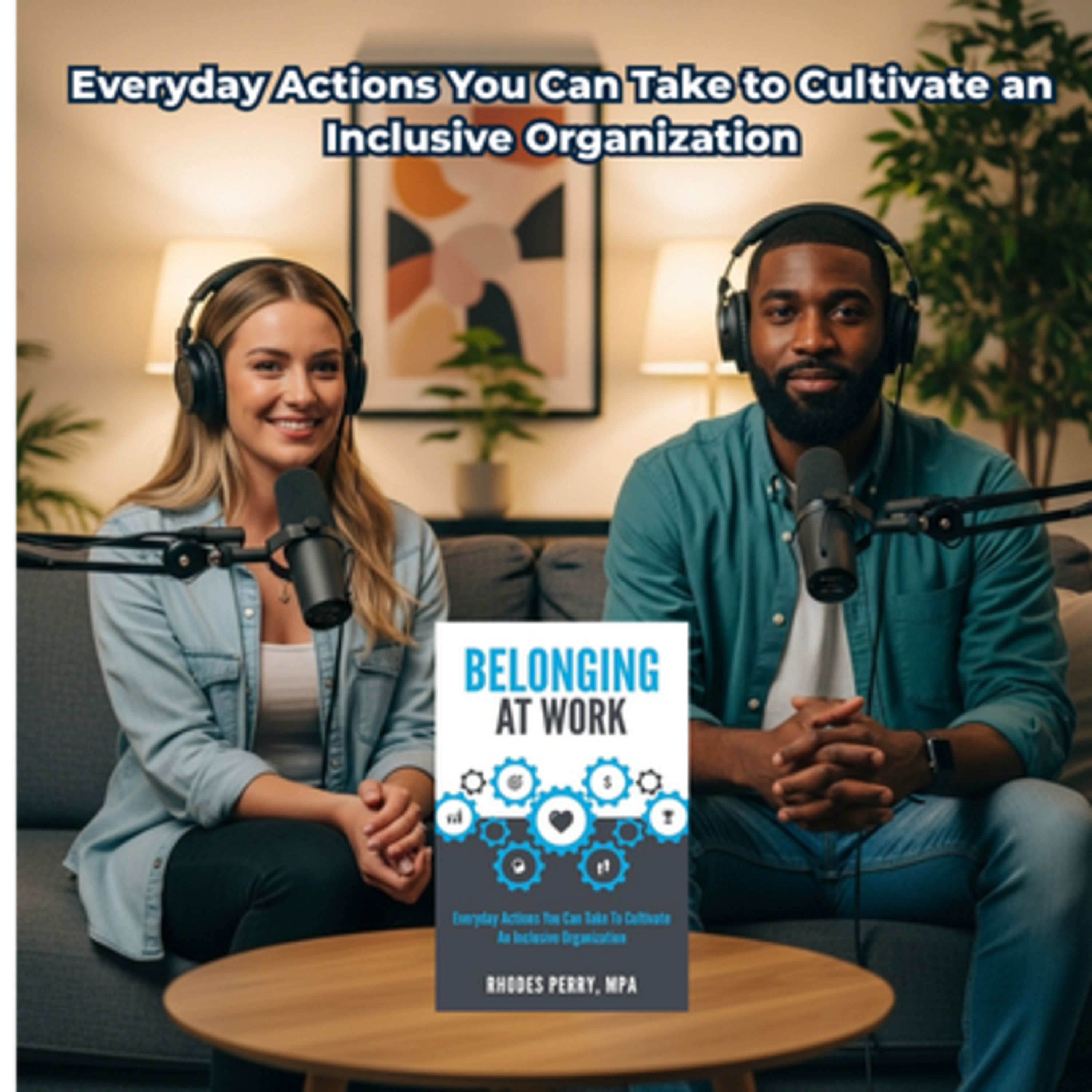
This episode explores Rhodes Perry’s book, Belonging at Work, which serves as a practical guide for fostering inclusive professional environments. The text defines essential concepts like diversity, equity, and inclusion while emphasizing that a sense of community is a fundamental human requirement for productivity and mental well-being. By highlighting the business case for belonging, the author demonstrates how valued employees contribute to higher retention rates, innovation, and overall company success. The chapters outline specific strategies for empathetic leadership and individual actions that promote open communication and mutual respect. Ultimately, the source encourages both managers and staff to align their core values with actionable goals to navigate the evolving, flexible future of the modern workplace.
“It’s virtually impossible to be successful in one’s work in any kind of group – be it a corporation, a deep-sea fishing crew, or a rock and roll band – without feeling a sense of belonging. Most of us have had the experience of working where we didn’t really fit in, and sure, we can pull in that paycheck for a while, make do, hang in there, but how long do those jobs ever last, especially if we want to be honest with ourselves or have a healthy work-life balance? It’s easy to say, 'No job is ever perfect. You’re not supposed to like it; that’s why they call it work!' But why settle for barely adequate productivity, creativity, or new hire return on investment when you can harness the synergy of belonging? Leaders and aspiring leaders who want to succeed should look to Rhodes Perry for inspiration and guidance. Belonging at Work really does matter” - Jamison Green, Ph.D., Author, Educator, Community Leader, and Corporate Executive
Belonging at Work empowers business leaders, change agents, visionaries, and those on their way to joining them with the knowledge, skills, and confidence to build inclusive organizations. The personal stories, case studies, and practical strategies featured in the book offer everything you need to cultivate workplace cultures where all of your stakeholders can show up authentically and feel valued and respected for their contributions. Rhodes Perry’s visionary book serves as a blueprint for the future of work. His message inspires leaders at all levels within the organization to join the #BelongingMovement focused on positively impacting workplace cultures around the globe.
Belonging at Work helps you understand:
• What it means to belong.
• Why belonging matters to the future of work.
• How leaders can positively impact workplace culture.
• Where to find concrete strategies and connect with culture change thought leaders.
• Strategies to hold yourself accountable to be the change you want to see in the workplace.
Praise for Belonging At Work:
“Belonging at Work is long overdue. Rhodes Perry’s work is a testament to the power of living with authenticity at all hours of the day, at home and at work. Wherever you are in your journey of living an authentic, purposeful life, this book is a powerful tool that should be required reading in all workplaces that value diversity and full inclusion.”– James R. Nowlin, CEO of EGP Ventures, Keynote Speaker, and Best-Selling Author of The Purposeful Millionaire
“Rhodes Perry is an invaluable and important voice on our emerging understanding of what makes truly great workplace cultures: the ability for all of us to bring our full selves to work.
#productivityhacks #personaldevelopment #successstrategies #businessinsights #leadershipskills #leadership #ambitiousprofessionals #businesstips #self help #scaling business #businesstactics #professionaldevelopment #startupgrowth #entrepreneurship #businessmindset #growthstrategies
Welcome to this deep dive. Today, we're digging into a powerful stack of source material that focuses on one topic that feels like it's becoming more and more central to every professional environment. It really is. And that topic is belonging at work. This isn't just about, you know, company culture. Posters on a wall. No, not at all. It's about the fundamental human experience of work. So what are we looking at today? Our sources are drawing really heavily from the insights provided by Rhodes Perry, and the goal is to see how we can move past the surface level stuff and actually cultivate a more inviting, inclusive, and a fundamentally more productive work environment.
We're not here for a theory lesson. We're here to synthesize the concrete value of feeling included. What's the measurable impact that community has on your career and your team's actual output? OK, so let's unpack this. Our mission today is to gain insight into how you can foster an environment where everyone feels valued, where they feel connected. And that's whether you're leading A-Team or you're just a part of 1. Exactly. We're going from the foundational concepts right into things you can actually do.
And to start, Perry is really insistent on this point. We have to agree on the language, OK? If we're serious about building inclusion, we need the right tools. And in this case, the tools are the words we use. Because if we misuse them or kind of treat them all as the same thing. We risk failing before we even start. And that means clarifying those two words we hear constantly, diversity and equity. They've become such buzzwords. I think their actual meaning gets, you know, a little diluted. It absolutely does.
O let's take diversity. At its core, it's just the presence of variety within a group. Simple enough. But the key insight here, the thing the source material stresses, is that this goes way beyond the visible stuff, right? So far beyond it. It's not just about race and gender, it's fundamentally about cognitive diversity. Meaning having different experiences, different backgrounds, different points of view, all in the same room. That's it. That's the real strategic advantage. That makes perfect sense.
I mean, if you have 10 people who all went to the same school, grew up in the same place, work the same last job, right? You might have visual diversity, but you don't necessarily have different ways of solving a problem. Precisely. And think about that powerful image the material uses. Imagine a team meeting where someone with a totally different cultural or professional background throws out an idea that just challenges everything. That moment of friction. That's it. That's where you find the creative solutions that just wouldn't have come up otherwise.
Diversity is just having that mix available to you. OK. So if diversity is the raw material, how does equity fit in? Because people confuse equity with just treating everybody the same. And that is the critical distinction. Equity is about providing each person with the resources and support necessary for their success. Right, recognizing that those things aren't the same for everyone. Exactly. Treating everyone the same is equality, but that ignores the fact that people are starting from different places or face different barriers.
Equity is about fairness and opportunity. It's about customizing the support. So for example, if you have a team member who's an introvert, telling them to just speak up more isn't equitable. Not at all. Equity would be creating a structure like, I don't know, anonymous feedback or asking for written ideas before the meeting that guarantees their voice has a space. That's a perfect illustration. Equity ensures that every one of those diverse perspectives has a genuine, customized way to contribute fully.
So if those two are the foundation, let's move to the goal. Why should you, as a manager or an individual, really care about this whole idea of belonging? Well, the human imperative is the starting point. Our sources frame belonging is absolutely essential. For what though? For our productivity and our well-being. When we feel like we're genuinely part of a team that respects and accepts us, our mental load just decreases. It's like a. Buffer isn't. It a huge one. When you know your team has your back, it has to lower stress and anxiety.
And that psychological safety means you can risk suggesting a big idea. A slightly risky idea, even. Yeah, without that fear of being personally ridiculed if it doesn't. Pan out. Exactly. And the result of that safety is a major spike in engagement in motivation and commitment to the mission. I can see that. I mean, just think of the difference between a team where people just kind of tolerate each other versus 1 where everyone feels included, where they're actively listening to suggestions. And offering input freely.
The second team is just exponentially stronger and more creative because people are committed not just to the result, but to each other. So let's connect this to the bottom line. Yeah, because this isn't just about soft skills. What's the hard organizational outcome here? The data is clear. Belonging is directly correlated with higher job satisfaction with improved performance metrics and a huge decrease in turnover. OK, but here's an interesting bit Perry brings up. The hidden cost of exclusion isn't just people leaving, which is already expensive.
It's this phenomenon of quiet quitting. Tell me more about that mechanism. Well, when employees feel excluded or undervalued, they often don't leave right away. They just comply. They meet the minimum requirements of the job, but they intentionally hold back their creative energy, their discretionary effort, their best ideas. So the company is paying for a full time employee, but only getting maybe half their potential contribution. Exactly. It's a massive drain on innovation and efficiency that you wouldn't see on a normal retention report.
You have a staff full of people who are physically there, but their minds are checked out. So belonging, then, is the key that unlocks all that hidden productivity. It creates A virtuous cycle. Belonging fuels satisfaction. And that satisfaction drives higher performance and creative ideas. Which makes people want to stay. And that stability builds a stronger, smarter workforce over time. We have to address the changes happening right now. I mean the workplace is shifting so fast. It really is. You have remote work, flexible schedule graduals, asynchronous collaboration.
How does this idea of belonging even hold up when people aren't in the same room? You know, this new reality is a massive challenge, but it's also a massive opportunity. How so? The source material really emphasizes that in the future of work, collaboration skills and intentional connectivity are going to be just as important as physical location. So developing belonging becomes even more critical to maintain team cohesion when those little water cooler moments just disappear. Exactly. You can't just hope for spontaneous connection anymore, you have to engineer it.
So what are the key strategies? How do you maintain community across distance? It comes down to two things, embracing flexibility and using technology intentionally. Let's start with flexibility. Flexibility means adjusting work arrangements to meet a wider range of needs. If someone has a childcare issue for instance, being flexible shows the company values them as a whole person. And that fosters loyalty. Deep loyalty. And when it comes to technology, it's not just about setting up another Zoom call, it's about how you use that tech to facilitate belonging.
What does that look like? The sources suggest things like intentional virtual check insurance that are less about tasks and more about human connection. Just how are you? Doing basically, yeah. There's a great example of a project team spread across several cities. They'll work so much more efficiently and feel more invested if they have a strong sense of belonging, and that's facilitated by inclusive, intentional communication. Physical distance must not translate into emotional distance. That's the core of it.
OK. So if we accept the business case that belonging improves performance, retention, innovation, we have to move to the practical side. Now how to? Right. Because as we've said, belonging isn't an HR policy. It's built by people every single day. That's right. And we need to separate the role of leadership from the role of, you know, individual contributors. Yeah, let's start with the leaders responsibility, OK? The core idea here is that belonging goes beyond just rules and policies. It's about meeting people's fundamental need for genuine connection and feeling like they're worth something.
So when we talk about empathy and leadership, what does that actually look like? It's easy to say be empathetic. What are the actions Perry suggests? Well, it means leaders have to be proactive. Celebrating birthdays is a nice gesture, sure. But it's superficial. It can be true empathy and leadership means showing integrity, candor and support, especially when making tough decisions. Give me an example of how candor and integrity connect to belonging. Candor means transparent communication. Let's say a team is overloaded.
The empathetic leader doesn't just quietly move work around. What do they do? They involve the team. They explain why the challenge exists and then ask for input on how to solve it fairly. So that transparency shows respect for the team's perspective. It validates them even when the news is bad. That's the difference between a boss who manages tasks and a leader who manages people. The leader acts as an inclusive leader by setting the behavioral standard they. Lead by example. Precisely, if a manager consistently involves every team member in decisions, not just the ones who speak the loudest or fastest, they demonstrate the importance of every voice through their actions.
And that modeling is so much more powerful than any company value statement on a poster. Infinitely more powerful. But the source material is quick to remind us that leaders can't do this alone. Belonging is everyone's responsibility. Yeah. So what are the actionable steps any individual can take even if you have No title? This is where we get into building culture through what you could call micro interactions. The chapter highlights 2 key areas for individuals. What's the first one? First, routinely giving credit for contributions.
It seems so basic, but how often does a great idea just get absorbed into the collective and the person who actually came up with it is forgotten? It happens all the time, consistently acknowledging accomplishments and hard work. Whether that's a shout out in a meeting, a quick e-mail. Or just an earnest thank you. It reinforces that person's feeling of worth and acceptance. It's a small investment in your teammate sense of belonging. OK. And the second key action for individuals. Encouraging open dialogue.
This means being genuinely open to receiving criticism and seeking out different viewpoints, even when they challenge your own. That's tough. It is if someone points out a flaw in your process, your first reaction shouldn't be defensiveness, it should be appreciation. That requires a high degree of self-awareness, doesn't it? You have to createspace for people to disagree with you without them fearing some kind of payback. You do, and that small daily decision to show openness and kindness build a supportive atmosphere more effectively than any top down mandate ever could.
So the culture of belonging is really just the sum of thousands of those small, polite and intentional conversations. That's it in a nutshell. So we've set the foundation diversity and equity. We've walked through the human and business reasons why this matters. We've detailed the action plan for leaders and team members. The final piece the material gives us is a framework for setting our own course. This is all about defining your North Star. What does that? Mean. It means figuring out your core beliefs and aspirations about belonging.
If you don't know what you truly value, you can't make consistent decisions that align with that. And the sources emphasize this has to be specific. It can't just be I want to be nice. No. You have to determine what concepts are essential to you. Is it respect? Is it candor? Is it a relentless curiosity about other people's experiences? And once you define that value. Then you have to establish specific, actionable goals that align with that vision. So, for example, if your North Star is ensuring every voice is respected and heard, your goal isn't just to hold more meetings.
No, it would be something more like in every team meeting this week, I will proactively invite feedback from two team members who haven't spoken yet. There you go, or I will deliberately pause for 10 seconds after I asked a question to give everyone time to process. Exactly. The strategy has to match the aspiration. By coordinating your daily actions with that North Star vision, you turn abstract values into real behaviors that build an inclusive culture. You really do. We started this deep dive looking at the fundamental definitions, diversity as the mix, equity as the customized support, and we followed that thread all the way through to organizational success.
Looking at things like higher performance, stronger retention and enhanced innovation. And we ended by detailing the necessary actions, recognizing that building belonging is a collective responsibility. It's shared by leaders and individuals alike. And this deep dive hopefully provided the shortcut you needed to understand the building belonging is not some soft feel good exercise. It's a critical strategic tool. It really is one that dictates the efficiency, the creativity and the long term health of your workplace.
Perry's framework forces us to define that North star for belonging. So for you, we want you to Mull over this question if you had to define your single most essential value that informs all your decisions about team inclusion. Something that acts as your professional rudder. What specific actionable goal would you set this week to align with it and to make sure that value is something your team can actually see and feel? That's your next step.
 Apple Podcasts
 Castbox
 Castro
 Goodpods
 Moon FM
 Overcast
 Pocket Casts
 Podbean
 Podcast Addict
 Podcast Republic
 Spotify