PRINCIPLES OF MONEY by Mathew Mulwa | Rules & laws of Money
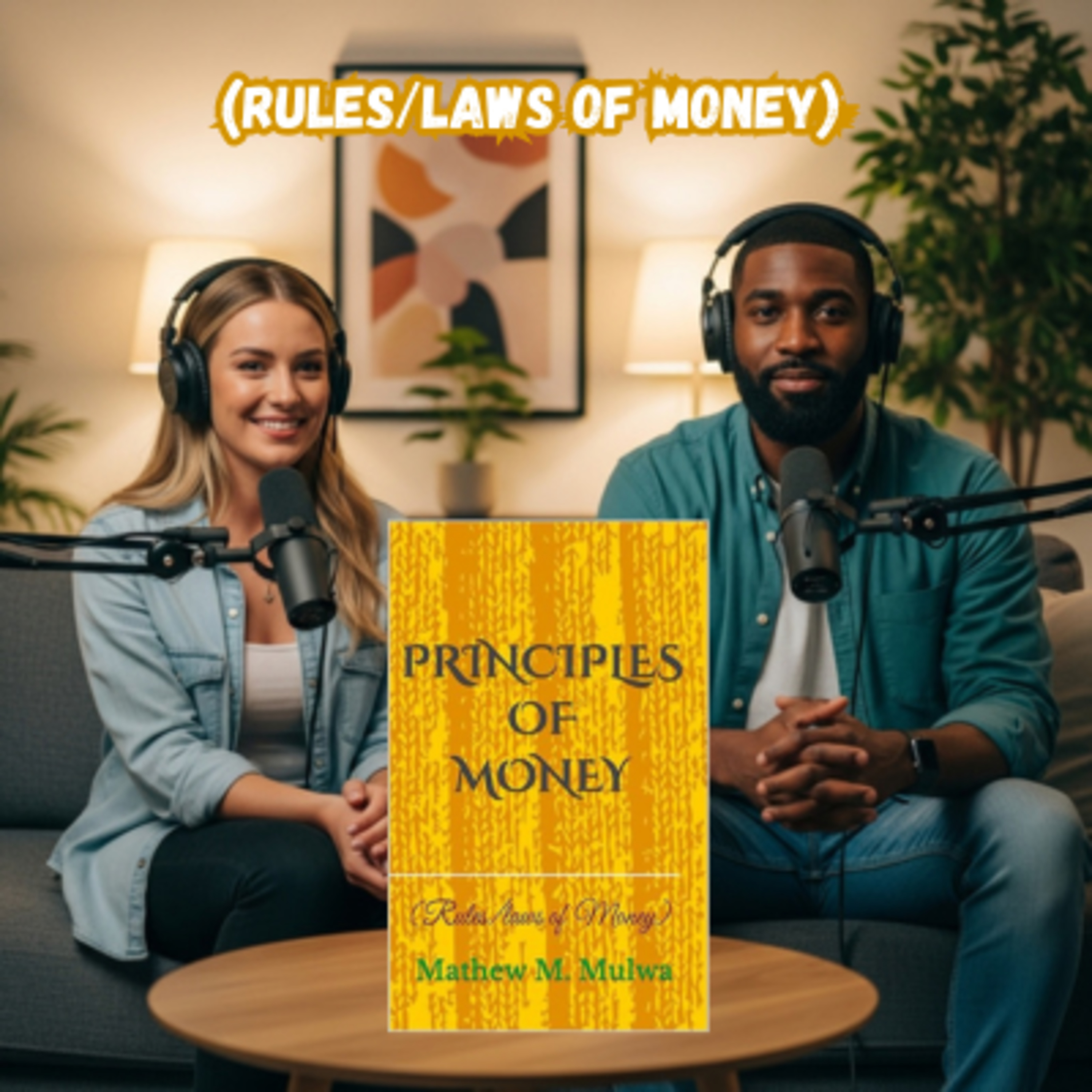
"PRINCIPLES OF MONEY" : (Rules/laws of Money)
is a book written to help readers to know how to be wise with money. The book is written to equip the reader(s) with the knowledge about how to accumulate money (wealth).
Many people all over the world desire to become rich, but most of them don't know how to play the game of money, in this book there are some of the secrets of the game. If you liked "Rich Dad Poor dad" by Robert Kiyosaki you may like this book, if you liked "Think and grow rich" by Napoleon Hill, you may like this book.
Learn and practise the secrets of self-made millionaires and billionaires in this book and you will soon join them if you will adapt their lifestyle.
SOME RULES OF MONEY.
- Truck your spending.
- Pay yourself first.
- Study smart investors. e.g. (Warren buffet).
- Live below your means.
- Plan for retirement.
- Learn to negotiate.
- Play the money game
Mathew Mulwa’s work serves as a comprehensive guide to mastering personal finance by exploring the historical evolution and fundamental roles of money. The author explains how currency transitioned from barter systems to a modern tool for measuring value and facilitating trade. Beyond theory, the text provides practical strategies for wealth accumulation, such as budgeting strictly, living below one's means, and establishing multiple income streams. A significant portion of the advice focuses on the psychological differences between economic classes, advocating for a growth mindset and continuous self-improvement. Ultimately, the source emphasises that while money provides comfort and convenience, long-term success requires financial literacy and the pursuit of goals that align with personal values.
Welcome to the Deep Dive. This is a show where we take whole stacks of expertise, books, research, you name it, and we pull out the essential insights just for you. And today we are basically grabbing the cheat code for financial success. We're doing a deep dive into the work of Matthew Malwa, specifically his book Principles of Money, the Playbook for Financial Wisdom. Yeah. And our mission today is really clear. We want to extract the most straightforward, but also the most effective guidelines from this playbook.
The goal is to equip you right now with what you need to start building a well, a more promising financial future. Think of it as your shortcut. Your shortcut to being genuinely well informed on what money really is and how to actually master it. So to do that, we have to start where Malwa starts and it's not with transactions, it's with the the fundamental definition. Right. You have to appreciate the tool before you try to use it. So chapter 1 asks what is money really? And the answer? It goes way beyond just the paper in your wallet.
Absolutely. Money, at its core is a tool, a pretty sophisticated one. It helps us manage resources. It gives things a common value and it you know it lets trade happen seamlessly. And that core idea breaks down into two two key lessons. The first one is probably the one we all get, which is money as a medium of exchange. It's a uniform way to trade. But it's worth pausing on why the old way the barter system was so bad. I mean, it wasn't just that you needed someone who had what you wanted. No, that's the thing.
You needed what he calls the double coincidence of once. They had to want exactly what you're offering at the exact same time. It sounds exhausting. It was more than just time consuming, it was a huge psychological burden. Imagine the concept and haggling, the lost time, trying to figure out if a basket of your eggs is worth, I don't know, a week of their labor. Money just cuts right through that it. Eliminates all that friction and that leads right into the 2nd and I'd argue more powerful lesson from the book Money as an accounting unit.
OK. So it's not just for trading, it's for for measuring. Exactly. It lets us quantify and compare the worth of completely different things. A car payment versus groceries. A college degree versus three years of wages you could have earned. It's like a standardized Ledger for for everything. It is. And without that, modern economic planning is just well, it's impossible. So when we look at the origin story in Chapter 2, when early communities went from bartering to using things with intrinsic value, you know, metals, shells, beads, it wasn't just about finding something small and portable.
No, it was about solving that accounting problem and the trust problem all at once. Gold or silver, for instance. They had real worth and everyone accepted them. It made transactions reliable. And what's wild is that even our super complex digital money systems today are still built on those two basic promises. They are universal trust as a medium of exchange and reliability as an accounting unit. It all comes back to that. OK, that sets the stage perfectly. We've defined the tool, we've looked at its history.
Now let's get into the ractical stuff. Ection 2. The practical playbook for management and accumulation. Right, so this is where Molwa shifts from theory to, you know, what we actually do. And Chapter 3 is all about how to be wise with money. And he's very clear that this isn't just about saving or investing. Not at all. He emphasizes that financial wisdom is about making sure every choice you make aligns perfectly with your personal values and your specific goals. It has to be a personalized strategy.
OK. So strategy one from the playbook, establish specific financial objectives. We hear this a lot, but how specific are we talking? We're talking measurable and value aligned. So instead of just saying I want to save money, you'd say I want to repay my $15,000 credit card debt in 30 months. Which means allocating $500 a month. That's tangible. It is That level of detail guides every single spending decision, and crucially, it keeps you motivated. It anchors you to a real outcome. Without that anchor, you're just drifting.
And then Step 2, which is the foundation for everything else, establish a budget. Now I think everyone knows what a budget is, but a lot of people see it as a punishment. Right, and that's where MOWA tries to reframe it. A budget isn't about restriction, it's a forward-looking allocation tool. You track your money to see where it's actually going. So you find the leaks. You find the leaks so you can plug the hole. That knowledge lets you control costs, boost your savings, and point every dollar towards those goals you just set.
But let's be honest, budgeting is hard. We all struggle. How does the playbook suggest we get over that hump? You automate the hard part. The book is very blunt about this. A budget is just a piece of paper unless it's executed automatically. So you're talking about automatic transfers? Automatic. Transfers for savings for debt, payments for investments the second your paycheck hits your account. It's the single best way to maintain discipline because you're not relying on willpower everyday. It turns your intention into action immediately.
That makes a ton of sense. So once we have that structure, we have to talk about something deeper, which is Chapter 4, Money's Power and Its Limits. Yeah, this is so important for managing expectations and honestly preventing burnout while you're trying to build wealth. It raises that big question, what can money actually buy? MO Wah is pretty clear. He is Money buys convenience and comfort. It buys stability, a cozy home, good healthcare, educational opportunities. These things aren't small, they massively reduce stress.
But here's where it gets interesting. MOA insists money cannot buy long term contentment or happiness. Now wait a minute. If it buys comfort and removes stress, isn't that a Direct Line to being happier? It's a fantastic point, and the playbook hits it head on. Money buys comfort, but true, sustained happiness that comes from meaningful experiences, from personal growth, from relationships. And here's the other thing money buys. It buys time, but if you don't know how to use that time for growth in relationships, then the money has failed its purpose.
So you could spend decades accumulating well, thinking the money itself is the prize, only to get there and realize you've neglected everything that actually brings you joy. Exactly. It's about preventing that endless treadmill. Understanding the limits helps you focus your efforts without expecting money to be a cure all. Which brings us to accumulation. Chapter 5 is all about how to actually build that wealth, and the core idea is that just working harder isn't enough. No, you have to be more strategic.
You have to build permanent financial habits and step one for accumulation is the golden rule and it's totally non negotiable. Live below your means. Spend less than you make it sounds so obvious. It does, but it requires constant vigilance to control unnecessary expenses. And this is the big one to resist lifestyle creep. Oh, lifestyle creep is the killer, isn't it? Your income goes up and somehow your expenses it's just magically rise to meet it. It's a huge behavioral hurdle, Mwah suggests. You have to see that gap, the difference between your income and expenses, not as leftover fund money, but as capital that needs to be deployed immediately.
And that ties into step two, Save Often this isn't something you do when you feel like it. No, it's a habit. A set percentage of your income every single month automatically. We mentioned automation before, but it's worth saying again. It's the key to consistency because it takes the daily decision out of your hands. So successful is really about turning these big financial decisions into well into non decisions through habits and automation. That's the. Core of the practical playbook right there.
Perfect. Now we're going to shift gears a bit. In Section 3, we move beyond the how to steps and look at the mindset, the behavioral differences that really drive long term success. Yeah. If the practical playbook is the engine, this section is all about the fuel and it starts with chapter 6 asking why the wealth gap exists and the. Analysis looks at both the big picture structural stuff and the individual factors, right? Factor 1 is foundational education and skills it's a simple truth that higher education or very specialized training often leads directly to better jobs and more pay.
Investing in yourself here is one of the first major financial moves you make and. Factor 2 is financial literacy and we don't just mean knowing what a stock is not. At all, we mean a real working knowledge of budgeting, of managing debt effectively, of compound interest. It's the difference between just having income and knowing how to make that income work for you. So. Better financial literacy leads to better choices, demonstrably. People who understand these concepts are just more likely to build and keep wealth.
They avoid costly debt traps and they, you know, they get their money working for them. It's a skill set you have to learn which. Is a great lead into Chapter 7, What the rich do in secret? And these aren't conspiracies, right? They're just routines and behaviors that aren't widely copied. Exactly, and secret number one is constant learning and self improvement. Wealthy people tend to see personal growth training new skills as a critical investment, not an expense. They're always. Trying to stay ahead of the curve.
Always it helps them adapt in their careers and their investment strategies and secret number 2 is just crucial for stability, creating multiple income streams, so. Not putting all your eggs in one basket. Not. At all, relying on a single salary puts you at maximum risk, but if you establish other streams, side business, a dividend portfolio, rental income, you diversify that risk so if. One stream dries up during a downturn. Your. Whole financial house doesn't collapse. It's a difference between just surviving and actually thriving through economic shifts.
OK. Now we hit chapter 8, and for me, this was the most insightful part of the entire playbook. It's all about mindset, the cognitive differences between people who succeed financially and those who struggle it. Really is the core of it all. Let's break down the first big contrast, a growth versus a fixed mentality, OK? So the growth mentality, which the book says the wealthy favor, is the belief that your skills, your intelligence, they can be developed through effort. Right. They welcome challenges.
They see a set back not as a failure, but as a chance to learn something and improve. And the. Opposite is the fixed mentality, the. Contrast is really sharp. People with a fixed attitude often shy away from challenges because they believe their skills or their financial ability are just set in stone. So how? Does a fixed mind set directly sabotage your finances? Well, think. About it, it prevents you from taking all the steps we just talked about. If you believe your earning potential is fixed if you tell yourself I'm just not good with money, then.
Why would you bother investing in new training or starting a side business? Exactly you. Wouldn't you wouldn't stick to a hard budget? You assume the outcome is already decided, so why even try? That's wow. That's profound. It reframes effort as the source of ability, not just a response to it. What's the second contrast? The second. Is about focus possibilities versus restrictions. This is huge. The affluent actively focus on the abundance of opportunities. They're always looking for new projects, new ways to grow, new capital.
Their question is always how can I achieve this? Whereas the. Playbook suggests that those who are struggling tend to focus on the constraints, the hurdle they. Do they dwell on all the reasons something can't happen and that makes them feel trapped? Their question becomes why even bother trying and that. Focus becomes a self fulfilling prophecy completely. A restrictive mindset sees a budget not as a tool, but as a cage. It sees investing not as an opportunity, but only as a risk. So the attitude directly sabotages the execution of the entire practical plan, it seems.
Like the big take away from this whole playbook is that financial success isn't really about some flash of luck. It's about the disciplined, automated execution of these core principles all. Powered by a proactive, self improving growth mindset. You said it. Perfectly. Yeah, the. Key message from this deep dive into Molwa's work is that financial wisdom isn't some complex, scary thing. It's about applying these principles, defining your goals, automating your savings, living below your means with real consistency and, you know, with a belief in your own ability to grow.
You shouldn't feel overwhelmed. Start. Small. Start with tiny repeated steps. Just pick one principle and start with that today and AS. We close out this deep dive. Let's leave you with one final thought to chew on. We learned that money can buy you comfort and it can buy you time, but it can't buy you happiness. But changing how you think about money, specifically adopting that growth mentality, that can fundamentally change your access to possibilities, and therefore it can change your access to the conditions that create happiness.
So here's the challenge for you. What is 1 fixed assumption you hold right now about your own financial ability or your capacity to earn that you could consciously challenge and start working to change starting today?
 Apple Podcasts
 Castbox
 Castro
 Goodpods
 Moon FM
 Overcast
 Pocket Casts
 Podbean
 Podcast Addict
 Podcast Republic
 Spotify