Million Dollar Weekend by Noah Kagan | The Surprisingly Simple Way to Launch a 7-Figure Business in 48 Hours
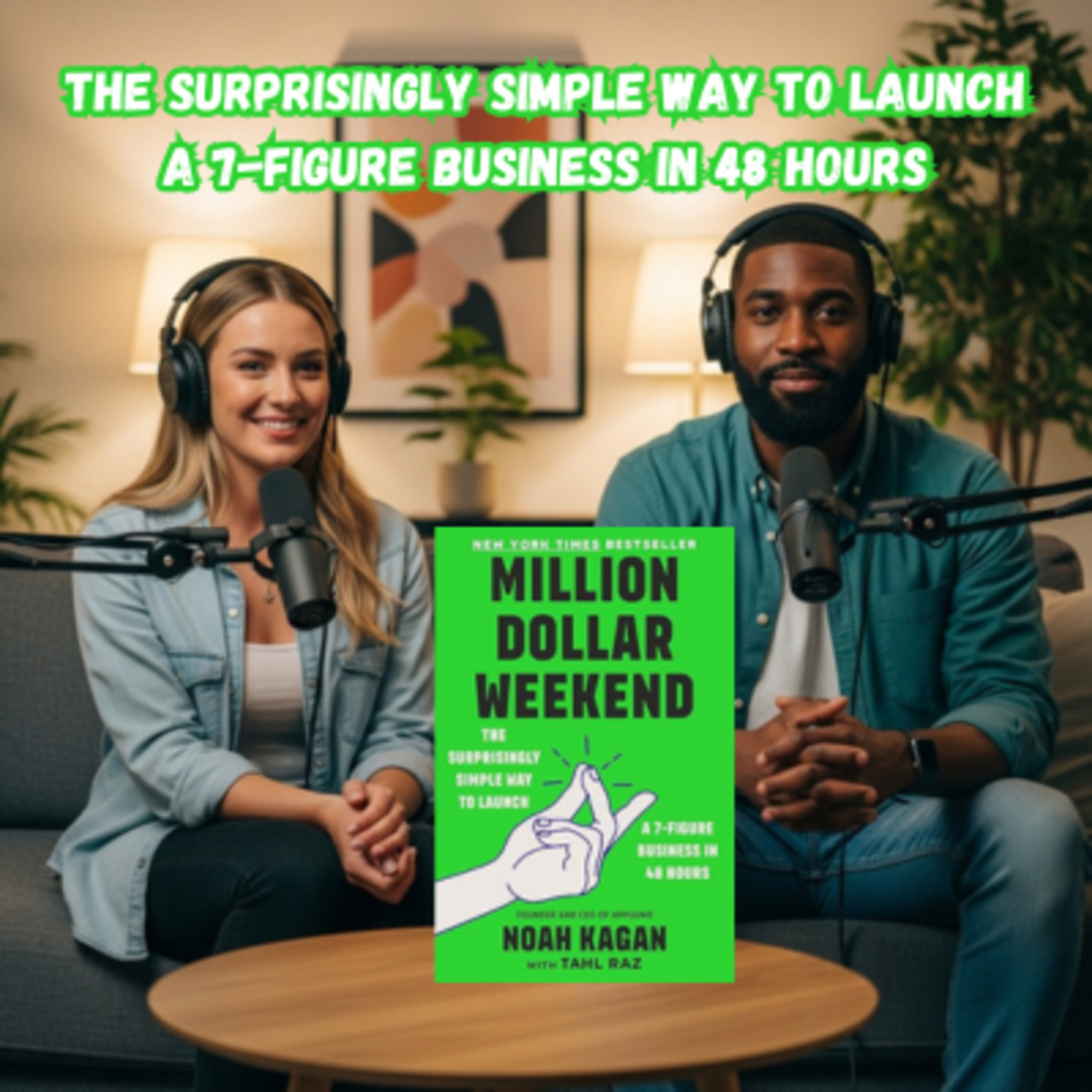
The provided text outlines the core principles of entrepreneurship found in Noah Kagan's book, which advocates for rapid business creation through immediate action. It emphasizes the importance of overcoming the fear of rejection by frequently asking for feedback and sales rather than waiting for a perfect product. Successful ventures are framed as simple solutions to everyday problems that should be validated through direct sales instead of complex planning. The source also highlights building a community via social media and using email marketing as essential strategies for sustainable growth. Finally, it stresses that long-term success is achieved through consistent, incremental improvements rather than overnight results.
Welcome to The Deep Dive, the place where we cut through the noise and give you the absolute most targeted, actionable insights from the sources you need to master. Hey there, if you're listening to this, you've probably got a great business idea. Or maybe like 10 of them. But you're stuck. You're an analysis paralysis. Oh yeah, you're consuming information instead of producing results. It's the modern entrepreneur's disease for sure. And today, we are tackling the cure. We are our source material is Noah Kagan's phenomenal guide $1,000,000 weekend.
And this isn't just another motivational book. It's a radical call to action that promises to take an idea and turn it into real revenue, generating cash in just 48 hours. Right. And we know you, the learner, are looking for that shortcut, the clearest path to turning that idea into profit without the, you know, overwhelming 50 page business plan. Exactly that is our mission today, to give you the most powerful Nuggets of knowledge, focusing on the mindset shift and the brutally practical strategies needed to just execute quickly.
We've synthesized Kagan's work into 8 essential bite sized lessons. They're all designed to break that cycle of procrastination. We're moving from endless planning to immediate, profitable action. And we're starting with the foundational challenge, the mind. It all starts there. OK, let's unpack this. We have to start with the hardest thing to conquer, right? The internal resistance. Lesson 1 is foundational to everything else. Start before you're ready. What does Kagan actually mean by ready? Ready is a myth.
I mean, it's perfectionism in disguise. This is one of his biggest points. Because the waiting game it doesn't make your product better. It just delays things. It delays crucial learning and more importantly, it delays income. You need to gather data from the real world, and you can only do that by launching something, well, something imperfect. But wait, isn't launching 1/2 baked product kind of risky? Doesn't that hurt your brand long term? We've all seen those disastrous early launches that get mocked online.
That's a great question, and it's the primary fear that stops people, Kagan argues. There's a massive difference between launching something imperfect and launching something unprofessional. When you're trying to validate an idea in 48 hours, imperfect just means you're using a simple landing page instead of some custom coded site. It means you're focusing on the core value proposition. That's it. Give us a concrete example from the book. How do you apply this? OK, think about AT shirt line. If you wait for the perfect design, the fully polished e-commerce store, the professional photography, you've already wasted three months and probably a few $1000, right?
Instead, the start before your ready mindset means you pick three decent designs, mock them up quickly, and sell them on Instagram or, I don't know, even a Google form to your immediate network. So you use that initial transaction to validate the demand and the design. You adjust your whole approach based on actual money being spent, not just your gut feeling. Precisely. You immediately learn which designs people pay for, what sizes they want, what questions they ask. That data is gold, and if you waited for perfection, you'd never get it.
The 48 hour constraint forces you to prioritize that first customer interaction above all else. That urgency flows right into Lesson 2, which is another massive mental hurdle. Ask, ask, and ask some more. This one tackles the fear of rejection, which is, I think, just as paralyzing as the fear of imperfection. Absolutely. The average person will invent 100 reasons not to ask for feedback, for help, or the most terrifying one for the sale. But asking is the only mechanism that opens new doors. If you are not actively asking, you are passively waiting to fail.
It's so psychological, though, we just don't want to hear no. How does Kagan recommend we overcome that initial flinch? You start small and you build up. Instead of immediately asking a stranger for a $500 project, you ask for feedback on a smaller piece of work first. The experts tip here is to use what we call the soft pitch technique. The soft pitch. Tell us more about that. So if you're say, a freelance graphic designer, don't just say hire me, say something like, hey, I saw your website and noticed a potential inconsistency in your branding.
I put together one small mock up to show how it could look cleaner. Would you mind giving me 60 seconds of feedback? If you like it, we can talk next steps, but no obligation. You see, you're leading with value and asking for a small investment of their time, not their money. Not at first. That makes the no much less scary because you're asking for advice, not a commitment. Exactly. And the core lesson is this. Every no, you hear is not a judgement on your worth. It's just statistical progress toward that.
Essential yes. If you're launching an app, you need to ask a dozen potential users for feedback immediately. And that brutal feedback shapes your product. Yes, and it build early adopters who feel invested in what you're doing. So the mindset shift is clear, action beats in action and seeking feedback beats retreating into silence. Now let's pivot. Once we're comfortable with action and asking, how do we make sure the idea itself is, you know, profitable? Lesson 3 is key. Solve real problems. Right, most people launch solutions that are just looking for a problem.
Great businesses though, They're rooted in simple, real world frustrations. You mentioned sticky notes, a profoundly simple fix for the need for temporary reminders. It didn't need a huge ad budget to explain what it did. Not at all. It's interesting how often the most profitable solutions are the ones that address the smallest, most constant annoyances. What practical advice does Kagan offer for identifying these problems? He suggests what we can call the flinch test. Pay attention to the problems that make you flinch, or the things you're already willing to spend money on to avoid.
Like if you personally hate doing laundry so much you use a service, that service is solving a real problem. If you hear friends constantly complaining about how hard it is to find healthy, quick food, that's not just complaining. That's market research. That's market research, yes. The key takeaways to look for that small persistent irritation and ask how could I make this 10% easier or 10% faster? The simplest fixes often turn out to be the most scalable. Right, because they require the least explanation.
Exactly. OK, so once you've identified that simple flinch worthy problem, lesson 4 is critical for keeping momentum. Keep your business model simple. This is where most ambitious people get totally bogged down. A complex business plan is a launch killer. It demands capital, increases risk, and drastically slows down your feedback loop. If your plan needs 5 revenue streams, 3 suppliers, and proprietary software, you're not ready to launch. You're ready to write a thesis? Exactly. We see the brilliance of simplicity and behemoths like Uber and Airbnb.
Their whole model is just connecting two parties who need each other. That's it. Let's go back to that simple candle model you could try to launch. Artisanal temperature controlled monthly subscription. Customizable eco friendly candles. And you'll never start. You will never start, a simple model says I'll make eco friendly candles and sell them for $15 each to people who love unique home decor, starting at the local farmers market. That clarity lets you execute immediately. So what are the three core questions you should restrict yourself to?
Keep it brutally short 1 what specific simple problem am I solving, 2 who exactly needs this solution? And three, how, using the simplest path, will I reach them and make the transaction? And if you can't answer those in under 30 seconds, your model. Is too complicated for $1,000,000 weekend launch. That structure leaves us directly to the point where all the planning stops and the data begins. Lesson 5, which is to test ideas with real sales. This is arguably the most important lesson in the entire.
Book it really is. Validation is not your mom saying oh that's a cute idea. No validation is proof that people will exchange their hard earned money for your solution. If you skip this step and spend 6 months building based on assumed demand, you've essentially signed up for massive risk. Testing fast proves if there is true willingness to pay. So how do we apply this in that high velocity 48 hour context? You can't build a full e-commerce site in a weekend. You don't need to. This is where simple tools come in.
If you want to offer online yoga classes, don't build the entire 12 week course. So what do you do? Build a simple landing page, maybe using a tool like Card describing the idea for the course. Then, and this is crucial, set up a simple payment link using Stripe or Gumroad to charge for a single introductory class or even pre sell the whole course at a discount. You're testing the commitment level before you commit your own time and capital. Precisely, if 10 people pay you $20.00 for that first single class, you have immediate, undeniable validation.
You now have initial operating capital and committed customers. This shifts you from a dreamer to a business owner. Because you have revenue, use that immediate payment and feedback to improve your core offering. OK, here's where it gets really interesting. Once you have that validated revenue generating idea, how do you move past the initial launch and build genuine long term momentum? Section 3. This is about audience connection and consistency. And Lesson 6, build an audience with social media.
Social media is your modern megaphone, but most people use it like a billboard. The goal isn't just to share photos, it's to build a community, right? Think about that small bakery example again. They aren't just posting pictures of cakes, they're sharing the story of the ingredients, maybe a quick video of a technique or asking followers what flavor they want next. They're acting as a guide and a resource, not just a storefront. Exactly. When people feel connected to the process and the personality behind the product, they become loyal.
Look at how Jim Shark revolutionized their space. Their growth wasn't through huge ad budget. Not at all. It was through building a community of creators who genuinely shared fitness tips. They focused on helpful content, not just promotional noise. The core principle is focusing on shared value. If you provide content that helps solve your audience's other problems, they'll trust you when it's time to solve their main problem with your product. Which is why you shouldn't obsess over vanity metrics like follower count.
Obsess over engagement and community. And that leads us right to lesson 7, the monetization mechanism. E-mail could yield profits. This is a vital distinction. Social media builds the community, but e-mail is often where the real sales and the highest conversion rates happen. Why the focus on e-mail specifically? Because e-mail is an owned channel, you don't rent space from Instagram or TikTok. You own your subscriber list. More importantly, the people who sign up for your emails have a higher intent level.
They've raised their hand and said yes, I want to hear from you. Exactly. So how do we make that e-mail list profitable without just spamming customers with coupon codes? You treat it like a personalized conversation. Ecommerce brands are great at this. They use e-mail to remind customers about sales or new products, but they personalize it based on purchase history. If you run a small online bookstore, you e-mail readers personalized recommendations based on the genres they browse. The goal is to make it feel like, hey, we thought you'd specifically love this new release, not just here's a generic 10% off coupon.
Correct. The sales come from providing exclusive value, early access or deeply personalized content that couldn't be mass posted on social media. All of this rapid action, validation and audience building culminates in the final and maybe the most difficult long term discipline. Lesson 8. Stay consistent and improve over time. Yes, because the $1,000,000 weekend is the start, not the end. This is the critical shift from a Sprint mindset to a marathon strategy. And Kagan emphasizes that success is rarely one big leap or one perfect launch.
Progress is about small, measurable steps taken every single week. And we love the math here. By setting small, manageable goals and making tiny incremental improvements each week, like learning a new skill, tweaking a product feature, you achieve 52 substantial improvements in a single year. That compound momentum is impossible to fake. It's the total opposite of the go big or go home philosophy. Think of it like a gardener. A little effort daily or weekly watering wedding leads to something beautiful and robust overtime.
You have to schedule time for the goal and the review. You must. If you don't review, you can't learn and you can't consistently improve. OK, let's unpack this one last time and distill those eight powerful lessons into your immediate action plan. We are moving you from thinking and planning to delivery and profit. First, you must start. Pick the smallest possible project you've been putting off. Launch it today. Focus on learning, not perfection. Just get that first version out there. Second, you have to ask.
Build your confidence by starting with small asks like feedback before you move to the sale. Remember, every no is just data driving you toward that yes. Third, solve simple, real problems. Use that flinch test, Focus on what people, including you, complain about and create the most basic direct solution you can. 4th plan. Simply define the problem, who needs it and your single clear path to reach them. Keep the structure clear so you can focus 100% on execution. 5th immediately test with sales.
Use simple tools to pre sell or offer a minimum viable product. That immediate willingness to pay is your only true validation. 6th and 7th build community and capture and test. Use social media to share helpful content, build engagement and, crucially, collect e-mail addresses to deliver valuable, personalized content that actually converts sales. And 8th commit to consistency. Set small weekly goals and commit to reviewing your progress. Aim for those 52 improvements this year. In conclusion, the key message of this deep dive is that starting and growing a business.
It doesn't have to be some multi year slog reserved for the wealthy or brilliant. It just requires consistent, immediate action, the humility to ask for what you need, the ability to identify simple, profitable ideas, and the discipline to test them quickly. If you embrace these constraints, the 48 hour launch mentality, the simple structure, the focus on immediate revenue, you bypass the analysis paralysis that kills most good ideas. And you start building genuine bankable momentum. Here's where it gets really interesting.
We've talked today about how consistency and small changes lead to big rewards. The question now is which one single simple, imperfect step, like setting up that Gumroad payment link or reaching out to one potential client with a soft pitch? Are you going to stop postponing this week? What simple action will start your count toward those 52 yearly improvements? Go make the first transaction happen.
 Apple Podcasts
 Castbox
 Castro
 Goodpods
 Moon FM
 Overcast
 Pocket Casts
 Podbean
 Podcast Addict
 Podcast Republic
 Spotify