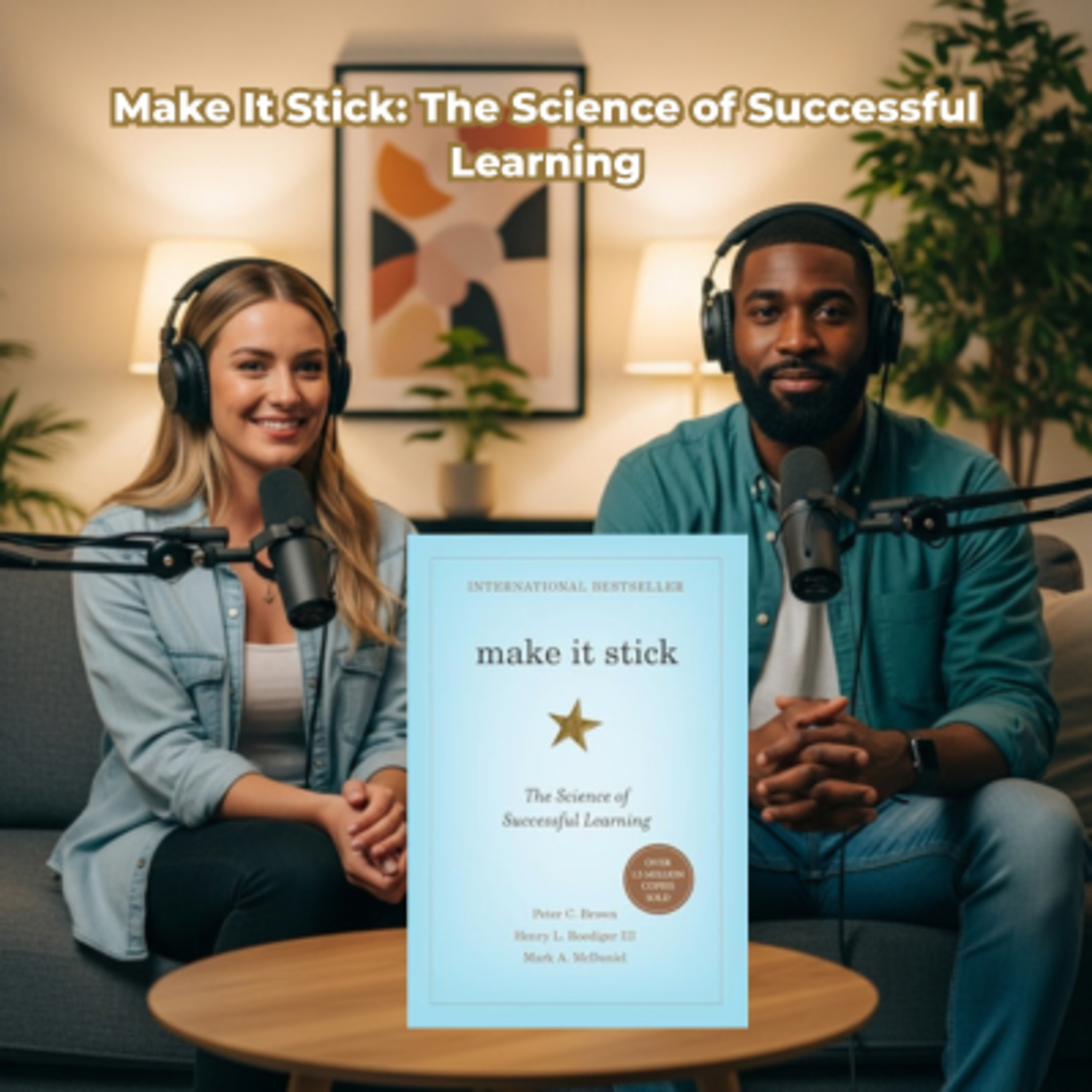
Make It Stick by Peter C. Brown | The Science of Successful Learning
“We have made Make It Stick a touchstone for our instructors … to gain a real advantage for our learners as they tackle some of the toughest work in the world.” ―Carl Czech, former Senior Instructional Systems Specialist/Advisor, US Navy SEALs
Are you tired of forgetting what you learn? This groundbreaking book, based on the latest research in cognitive science, offers powerful strategies to boost memory and learning.
To most of us, learning something “the hard way” means wasted time and effort. Good teaching, many believe, should be tailored to the different learning styles of students and should use strategies that make learning easier. Make It Stick turns fashionable ideas like these on their head. Drawing on recent discoveries in cognitive psychology and a ten-year collaboration among some of the world’s leading experts on human learning and memory, the authors explain what really drives successful learning. With clear, real-world examples, they show how we can confidently hone our skills and learn more effectively.
Many common study habits simply don’t work. Underlining, highlighting, rereading, cramming, and single-minded repetition of new skills create the illusion of mastery, but gains fade quickly. Science shows that more durable learning comes from self-testing, introducing certain difficulties in practice, waiting to re-study new material until a little forgetting has occurred, and interleaving the practice of one skill or topic with another. Make It Stick breaks down these proven approaches in compelling ways and offers concrete techniques for becoming more productive learners.
Full of eye-opening and inspiring stories for students, educators, and parents, Make It Stick is an indispensable guide for all those interested in the challenge of lifelong learning and self-improvement.
This episode outlines evidence-based strategies from the book Make It Stick designed to replace ineffective study habits like cramming and repetitive reading. It emphasizes Retrieval Practice and the Spacing Effect, which involve actively recalling information and spreading study sessions over time to build lasting memory. The source also advocates for Interleaving, or mixing different topics, and Embracing Challenges to deepen understanding through productive struggle. Furthermore, it warns against the Illusion of Knowing, where familiarity is mistaken for mastery, and encourages a Growth Mindset to view intelligence as a quality developed through effort. Ultimately, the text provides a practical framework for transforming these scientific principles into Daily Habits to ensure long-term educational success.#productivityhacks #personaldevelopment #successstrategies #businessinsights #leadershipskills #leadership #ambitiousprofessionals #businesstips #self help #scaling business #businesstactics #professionaldevelopment #startupgrowth #entrepreneurship #businessmindset #growthstrategies
What if I told you that the harder you feel like you're studying right now, the less you are actually learning? I mean, that sounds completely backward, but it's true. Right. Picture this. It's late at night and you were sitting at your desk, staring at just a mountain of notes. You're prepping for a high stakes meeting at work tomorrow. Or, you know, maybe cramming for an exam that basically dictates your entire grade. No, we have all been there. The classic all nighter. Exactly. You're reading, You're highlighting, You are rereading those exact same paragraphs over and over again.
You're burning the midnight oil, feeling highly productive, just hoping that sheer repetition will magically glue this information to your brain. And you probably feel pretty good about it in the moment. Right, Yeah, You finally go to sleep feeling somewhat prepared, but then you wake up the next day, you sit down for the test or the presentation, and you just draw a total. Blank like it was never even there. Yes, it feels like half of what you so painstakingly reviewed just slipped right out of your mind overnight, and it is incredibly frustrating.
It's. Arguably one of the most universally shared frustrations in the modern world. We put in the time, we grind through the material, and the return on that cognitive investment is just dismal. It really is. And when that happens, you know the natural instinct is to assume that our memory is broken or that we just aren't smart enough to grasp the material. But what if the problem isn't your memory at all? What if the problem is simply the instruction manual you were given for how to use it? That's the $1,000,000 question.
And that is our mission for today's Deep dive. We are. We're exploring the cognitive science behind how the human brain actually acquires and retains knowledge. We're looking at insights from this incredible book, Make It Stick by Peter C Brown, Henry L Roedeker The Third, and Mark A McDaniel. It's such a foundational book for understanding this stuff. It really exposes the reality that the traditional methods we all default to, you know, highlighters, late night cramming, endlessly rereading our notes, they're actually destroying your memory.
Oh, absolutely. They're actively working against your brain's biology. So today we are going to tear down those flawed strategies and rebuild your approach using the actual science backed mechanisms that guarantee information will lock in permanently. OK, let's unpack this. Yeah, so to really rebuild how we learn, we first have to understand why our current methods are so incredibly deceptive. Right, because they feel so right. Exactly. We have to talk about a psychological trap called the illusion of knowing.
This is This is the foundational error we all make. The illusion of knowing. OK, Yeah. As humans, we have this biological tendency to mistake the feeling of recognizing a fact for the act of truly mastering it. Interesting. When you read a page in a textbook for the 4th time, the words are highly be familiar to you. Your brain processes that text really smoothly. And because that processing is frictionless, your brain sends you a chemical signal like a little hit of cognitive ease saying, ah yes, I know this, but you don't.
Actually know it. It's like it's like the analogy from the book about driving in your car and a popular song comes on the radio. Oh, that's a perfect way to look at it, yeah. Right. You recognize the melody instantly. You might even hum along or tap your fingers on the steering wheel and you think, oh, I know this song. Sure, you feel like an expert in that moment. But imagine someone in the passenger seat suddenly reaches over, turns the radio completely off and says OK, sing the second verse from memory right now, no music.
Could you actually do it? I know I couldn't. The vast majority of us couldn't get past the first line. Right. If you Can't Sing the lyrics without the music guiding you along, you do not know the song, you're just highly familiar with it when the external cues are present. That is exactly it. Rereading your notes with a highlighter is basically just listening to the song on the radio with the volume turned all the way up. You're relying on the cues sitting right in front of your eyes. Yes, recognizing the information when it's on the page is a completely different neurological process than independently retrieving it from your own mind when you actually need.
It so they're literally different functions in the brain. Entirely. The former relies on perceptual fluency. You know how easily you perceive something, but the latter requires conceptual fluency because how deeply you understand and can reconstruct. It OK, I get the logic, but I have to play devil's advocate here on behalf of everyone listening. Go for it. Why does our brain lie to us like this? I mean, when I have my yellow highlighter out and I'm methodically going over a dense paragraph, I feel like I am doing the work.
It's just like studying. Exactly. I feel productive. Why is that illusion of fluency so convincing if it's biologically useless? Well, it comes down to the fact that your brain is basically an evolutionary masterpiece of energy conservation. Energy Conservation. Yeah, it takes a massive amount of cognitive energy, literal calories, to actively pull complex information out of your memory banks and construct a thought. Oh wow, I never thought about it taking actual. Calories. It really does. Conversely, it takes almost 0 energy to simply confirm that you've seen a pattern or a word before.
Your brain just naturally prefers the path of least resistance to save energy. Because in the prehistoric world, saving energy kept you alive. Exactly. Quickly recognizing the familiar pattern of a predator was essential for survival. Memorizing like the exact number of scales on that predator's back? That was a waste of calories. So when you reread, your brain is just saying, yes I recognize this pattern, we are safe, move on. That's it. To turn that mere familiarity into real, usable knowledge, you have to actively fight millions of years of evolutionary programming.
You have to force yourself to explain the concept in your own words. Yes, deliberately confronting the gaps in your understanding. You have to, as you said, turn off the radio. Turn off the radio. I love that. So if rereading creates a false sense of security because it lacks friction, the antidote has to be forcing that friction back into the system. And that brings us to the actual biological mechanism for cementing knowledge, which the authors call retrieval. Right retrieval practice. It's the exact opposite of trying to cram information in, like rehearsing lines for a play.
Instead of staring at your script, you close the book, look away, and force yourself to pull the information out. And that act of pulling it out is what trains the brain to retrieve every time you successfully recall a piece of information from memory. You aren't just looking at a static file in a mental cabinet. You're doing something physical. Yes, you are literally rewiring the physical connections in your brain. But wait, if I'm struggling to remember something and I'm getting the answers wrong during this retrieval practice, isn't my brain just practicing the wrong information?
That's a super common fear. How does making errors actually help me learn the right thing? I mean, it just feels like failing. This is where we have to fundamentally redefine what struggle means. When you strain to remember something, you're engaging in what cognitive scientists call a desirable difficulty. Desirable difficulty? That almost sounds like an oxymoron. It does, but let's look at the neurology of what happens when you make an error during retrieval. When you try to recall a fact and get it wrong, you create a prediction error in the brain.
A prediction error. Yeah, your brain realizes its internal model doesn't match reality, and that realization actually primes your neural circuitry. Oh, interesting. When you then look up the correct answer, your brain releases a precise cocktail of dopamine and acetylcholine. That chemical release marks that specific neural pathway for strengthening. Wait, really? So the mistake itself is what tells the brain which wires need upgrading. Exactly. And that upgrade is very much physical. It's a process called myelination.
Myelination. Right when a neural circuit fires under strain, the brain responds by wrapping that specific neural Axon in a fatty white tissue called myelin. Like wrapping tape around a leaky pipe. Very similar myelin acts like insulation on a copper wire. It prevents signal leakage and allows the electrical impulse to travel up to 100 times faster next time. So the friction you feel, that frustration of not quite remembering is literally just the biological signal that myelination is being triggered.
What's fascinating here is that we are so culturally conditioned to view struggle as a sign of failure. Oh, absolutely. If a study session is hard, we think we aren't smart enough. Right, but neurologically it is the exact process of learning taking place. If your study session feels incredibly easy, you aren't learning anything, you're just experiencing that illusion of fluency again. Think about learning a new language. You naturally want to practice the easy phrases because it makes you feel fluent and smart.
Exactly, rolling your Rs on the words you already know. Right. But actually wrestling with the tough, complex grammatical structures, the ones you constantly stumble over and mispronounce, that is what builds the myelin. Real learning requires that productive struggle. If you aren't struggling, you aren't changing the physical structure of your brain. It is really that simple. All right, so giving the brain this intense friction filled workout makes sense for cementing a single concept, but what about the timing?
Timing is crucial. Because if I just sit there and aggressively struggle to retrieve information for 10 hours straight, my brain is going to melt. There has to be a rhythm to this, right? There absolutely is, and it brings us to the spacing effect. You cannot just apply maximum friction indefinitely. OK, so how does it work? The rule of spacing dictates that you must spread out your retrieval practice. You have to allow time to pass between your attempts to recall the information. Because the memory consolidation actually happens during the rest periods, just like working out, right?
That's a great analogy. You go to the gym, the workout breaks the muscle down, but the biological adapted. The actual muscle growth happens while you sleep or rest or like practicing the piano. Playing a song a little bit each day let's your fingers remember it better than just banging on the keys for six hours on a Sunday. Exactly right. But with the brain, why does time apart from the material help? Shouldn't we want the material fresh in our minds? Actually, no, and this is highly counterintuitive.
A small amount of forgetting is biologically necessary for deep learning to occur. Wait, forgetting is a requirement for learning? Yes. Think of forgetting as a filter. As time passes between your study sessions, the superficial short term memory traces begin to decay. OK, so the easy stuff fades. Right. And when you sit down two days later and force yourself to retrieve that same information, you have to work significantly harder to find it because those easy short term pathways are gone. And that increased difficulty forces the brain to dig deeper.
Exactly. It recruits more neural networks to reconstruct the memory. Because the effort is higher, the subsequent myelination is thicker. By allowing yourself to slightly forget, you ensure that the next retrieval attempt builds a much more durable long term pathway. OK, so we space out our practice to leverage the power of forgetting. That makes sense. But here's where it gets really interesting. What happens when you have to learn 3 completely different subjects for the same exam or prep for multiple clients in the same week?
Does the brain need a different kind of workout for variety? It absolutely does, which introduces a concept called interleaving. Interleaving, yeah. Interleaving means that instead of focusing on just one topic or skill at a time until you master it, you deliberately mix them up. You constantly switch tasks during your practice session. See, that sounds like a recipe for a panic attack. It usually does sound that way to people, yeah. If I am barely holding on to the concepts in algebra, yeah, and I'm already using spacing and retrieval practice, why on earth would I mix in geometry and calculus problems into that exact same 20 minute session?
I know. It sounds chaotic. Shouldn't I just focus all my energy on getting the algebra down first before moving on? It feels like you should we call that blocked. Practice doing the same thing over and over, and block practice does produce immediate short term performance games. So it works in the short term. Yes, but it fails completely in the long run. Let's look at why interleaving works. Think of your brain like a search engine. OK, search engine. When you only do algebra problems for an hour, your brain essentially caches that one specific folder.
It stops analyzing what kind of problem it's looking at and just blindly applies the same formula over and over. It becomes mindless repetition. Ah. So you aren't actually practicing problem solving, you're just practicing a reflex. Exactly. But when you interleave, when you do an algebra problem, then a geometry problem, then a calculus problem, you force your brain to constantly query the main index. You're strengthening the search algorithm itself, not just pulling from a cached file. Yes, by constantly switching context you force the brain to evaluate the underlying structure of each problem.
You're training the brain to identify which tool to pull out of the toolbox, not just how to swing a single hammer. That's a great way to put it. It's like the athlete example from the book. Think about how a basketball player trains. If they stand at the free throw line and shoot 100 free throws in a row, they'll get exceptionally good at that one isolated, repetitive motion. But a real basketball game doesn't look like that. A real game is absolute chaos. You never get to shoot the exact same shot twice in a row.
Precisely so. A much more effective practice session, an interleave session, is to practice dribbling, then immediately transition into a contested shot and then into a quick pass. Mixing it all. Up. Yes. By switching tasks and mixing the skills, the athlete prepares their brain for the unpredictability of reality, where they have to recognize a sudden pattern on the court and instantly deploy the correct response. Yeah, interleaving builds a robust, adaptable intelligence. It makes complete sense when you frame it as strengthening the search engine.
But these mechanisms, you know, spacing, interleaving, retrieval practice, they are universal biological truths about how the human brain retains information. Very true, and pointing out that they're universal directly contradicts a massive myth that almost all of us were indoctrinated with in school. Ah. Yes, the pervasive myth of learning styles. I vividly remember taking those quizzes in middle school to find out if I was a visual learner, an auditory learner, or a kinesthetic learner. Well, we all took them.
We were taught that we each have this highly unique, specialized brain, and if a teacher didn't present the information in our specific style, we couldn't possibly learn it. But why did this myth catch on so aggressively if the science doesn't support? Well, it caught on because it's incredibly flattering. It feels good to be told that you have a unique cognitive profile. Oh sure, everyone likes feel special. Exactly. Furthermore, there's a multi billion dollar educational consulting industry built entirely around selling these assessments and specialized curriculums to schools.
Of course there is. And once we're labeled as a visual learner, cognitive confirmation bias takes over. We selectively noticed the times a diagram helped us and ignore the times we successfully learned from a, you know, a lecture or a book. But decades of cognitive psychology research show conclusively that catering to these supposed styles does not improve learning outcomes. Think about it like cooking. Let's say you want to learn how to make a complex multi layered lasagna. OK, I'm with you. It truly doesn't matter if you read a written recipe which is visual input, or if you watch a video, or if you listen to a chef explain it on a podcast.
The input method doesn't change the ultimate task, because at the end of the day, when you are standing in your kitchen staring at a pan, you still have to retrieve the sequence of steps from your memory. The sensory way you initially absorb the information is far less important than how you practice retrieving it. That is the ultimate take away the fundamental mechanics of human memory, the need for myelination, the required struggle of retrieval, the necessity of spacing. They do not change just because you happen to prefer watching a video over reading a textbook.
So what does this all mean for you? If you're going to willingly subject yourself to the frustration of interleaving and the struggle of retrieval, you have to cultivate what psychologists call a growth mindset. Yes, mindset is critical. Here. But this isn't just a motivational poster slogan, is it? There is an actual biological reason why mindset matters. Very much so. Mindset dictates your neurological response to stress. A fixed mindset is the belief that your intelligence and skills are static traits you know set in stone at birth.
Like you're either good at math or you aren't. Exactly. If you have a fixed mindset, the moment you experience one of those desirable difficulties, like the moment you get an answer wrong during retrieval practice, your brain interprets that failure as a direct threat to your identity. Because if you believe intelligence is fixed, failing means you are permanently flawed. You think, well, I'm just not a math person. Right. And when your brain perceives a threat, the amygdala, the fear center of the brain, activates.
It floods your system with cortisol, a stress hormone. So you're basically having a physiological stress response to studying, Yes. And this biological stress response literally hijacks your brain, physically blocking the prefrontal cortex from engaging in the complex thought and memory consolidation required for learning. You biologically shut down your own ability to learn. Wow, so a fixed mindset chemically prevents learning? It really does. But with a growth mindset, you believe that intelligence is malleable.
You recognize that the brain is plastic. So when you hit a wall and struggle to recall a fact, your amygdala doesn't freak out. No, it stays calm. You interpret that friction not as a threat, but as the sound of the mental weights being lifted. You keep your prefrontal cortex online because you know the struggle is just the myelination process happening in real time. That's exactly what happens neurologically. A growth mindset keeps you in an optimal state for neuroplasticity. It allows you to embrace the challenge rather than chemically retreating from it.
Understanding the deep cognitive science of these tools is incredibly empowering. But knowledge is only valuable when it's rigorously applied. Let's take all of this neuroscience and build it into a tangible daily routine. Let's do it. I mean, learning doesn't end when you close a book. You have to turn these strategies into automated habits. It's like the tooth brushing analogy from the text. You don't brush your teeth once and expect them to stay clean forever. Right. Definitely not. You do it daily for long term health.
Learning strategies require the exact same consistent maintenance, so if you've got a massive presentation on Friday or a licensing exam coming up, here's exactly how you should structure your preparation based on everything we've covered today. OK, step one. Ditch the passive reading and force immediate recall. When you read a crucial report or a chapter of a textbook, do not immediately read it again. Read it once, close the document, look away and force yourself to explain what you just read out loud, or write the core concepts on a blank piece of paper.
Expose what you don't know immediately. And then Step 2, set up a staggered spacing schedule. Do not cram on Thursday night for a Friday presentation. Worst thing you can do? Study the material for 30 minutes on Monday, then walk away. Let the forgetting filter do its job. Force yourself to review and retrieve that same material on Wednesday. It will feel harder, but that friction is building the myelin. Then review it one final time on Friday morning. Perfect Step 3. Implement interleaving by aggressively switching contexts.
If you're practicing a presentation, do not practice it from slide one to slide 20 over and over in order. Mix it up. Yes. Practice the middle, then jump to the conclusion. Then practice fielding a difficult Q&A question, then jump back to the introduction. Scramble the order so your brain has to constantly query the main index and adapt to the chaos. And finally, Step 4. Track your progress. Keep a simple journal or a checklist to track what you studied, the spacing intervals you used, and how difficult the retrieval felt.
Visually, seeing your own improvement over time creates a positive dopamine feedback loop. It proves to your brain that the growth mindset is real, which keeps you motivated to endure the productive struggle tomorrow. But turning these individual scientific strategies into an automated daily system, you fundamentally upgrade how you interact with information. You stop relying on the fleeting illusion of fluency and start building permanent adaptable mastery. So let's do a quick recap of the paradigm shift we have explored today.
We are officially abandoning the comfortable illusions of cramming, highlighting, and passive rereading. Goodbye to the highlighters. We are actively embracing the productive myelin building struggle of retrieval practice. We're going to strategically space out our study sessions to leverage the power of getting. We are going to intentionally interleave our subjects to build a more robust mental search engine. And we're anchoring all of this in a growth mindset that views friction as growth, not failure.
It is a profound shift in how we operate. But, you know, understanding that biological necessity is struggle leaves us with a rather alarming question about the technological trajectory of the world we currently live in. Oh. This is the perfect place to go. Let's hear it. If deliberately straining to recall information is the fundamental, non negotiable biological key to building long term memory and complex understanding, what happens to our brains when we remove that friction completely? How is our modern reliance on instant search engines and more recently immediate AI generated answers fundamentally rewiring our capacity to learn?
If we never have to struggle to retrieve a fact or synthesize a concept because the answer is always instantly populated for us on a screen, are we inadvertently outsourcing our neuroplasticity? That completely changes how I view the devices sitting on my desk right now. By constantly reaching for the immediate, frictionless answer, we are entirely bypassing the biological struggle required to build deep, adaptable knowledge. We're trading actual intellectual mastery for the cheap illusion of digital fluency.
Which brings us right back to sitting at that desk, staring at a mountain of information, wondering why our minds feel so empty. Maybe it's because we've stopped asking our brains to do the heavy BE lifting required to actually grow. Thank you so much for joining us on this deep dive. Keep questioning the easy answers, embrace the struggle, and keep learning.
 Apple Podcasts
 Castbox
 Castro
 Goodpods
 Moon FM
 Overcast
 Pocket Casts
 Podbean
 Podcast Addict
 Podcast Republic
 Spotify