High Road Leadership by John C. Maxwell | Bringing People Together in a World That Divides
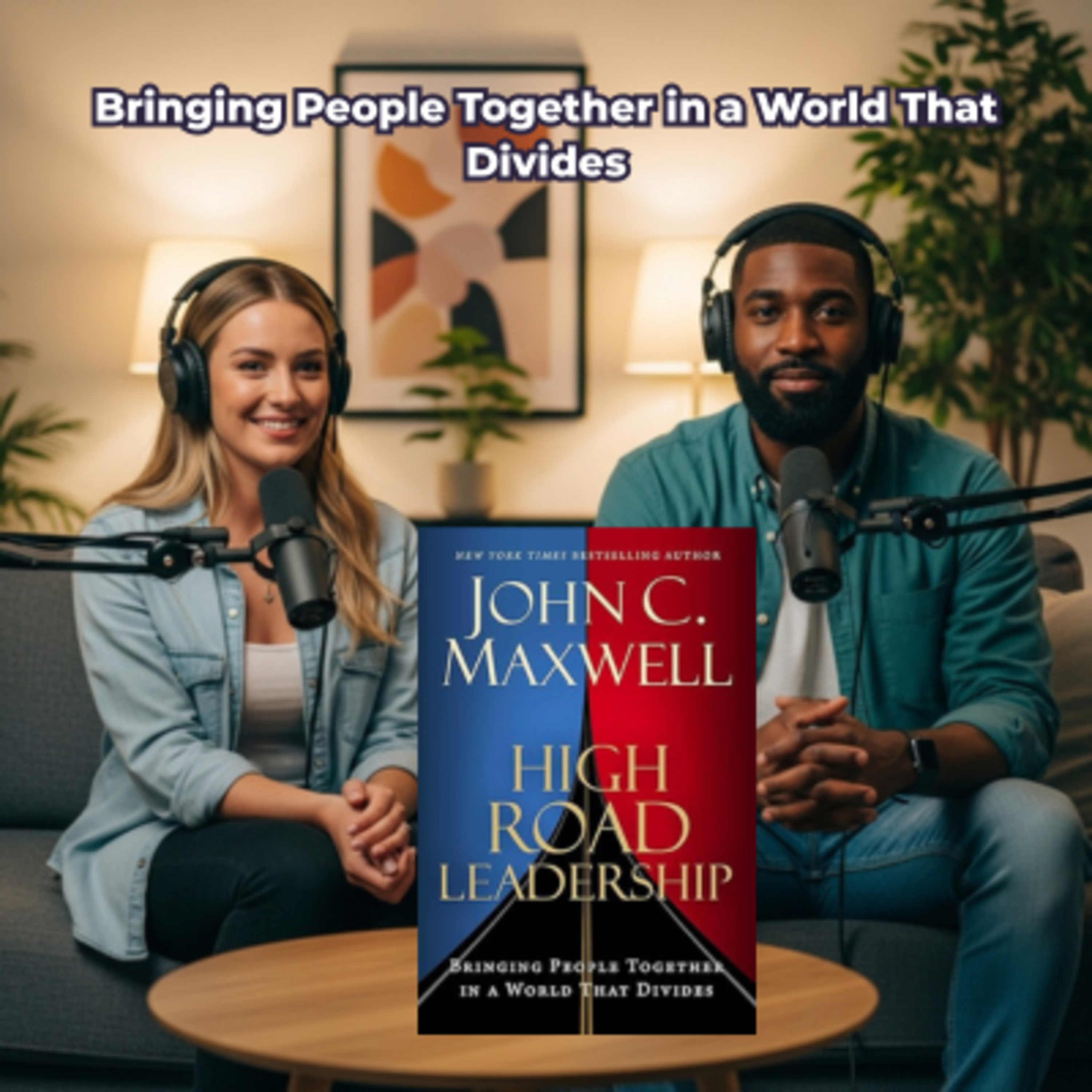
This episode outlines core leadership principles from John Maxwell’s "High Road Leadership," focusing on how to foster unity and prioritize people over personal agendas. It highlights that effective leaders build trust and loyalty by valuing individual contributions and maintaining integrity even during difficult circumstances. The source emphasizes the importance of emotional resilience and authenticity, suggesting that admitting mistakes makes a leader more relatable and credible. By focusing on generosity and open communication, leaders can create an environment where every team member feels heard and motivated. Ultimately, the text serves as a guide for those seeking to inspire others through selfless service and consistent moral values.The world’s most influential leadership expert, John C. Maxwell, tackles the problem of our divided world in his latest book High Road Leadership. “Everything rises and falls on leadership,” says Maxwell. “Today it is causing people to fall—into disputes, frustration, anger, and despair. His solution is to expose the problems of taking the low and middle roads when interacting with others and teach people how to instead take the high road. Leaders who practice high road leadership value all people, do the right things for the right reasons, take accountability for their actions, and place people above their own agenda. In his trademark communication style, Maxwell teaches the principles and practices of high-road leadership that can increase anyone’s influence and help them make their world a better place.#HighRoadLeadership#JohnMaxwell#Leadership#LeadershipDevelopment#LeadershipSkills#LeadershipMindset#LeadershipLessons#LeadershipGrowth#InfluentialLeadership#ValuesBasedLeadership#productivityhacks #personaldevelopment #successstrategies #businessinsights #leadershipskills #leadership #ambitiousprofessionals #businesstips #self help #scaling business #businesstactics #professionaldevelopment #startupgrowth #entrepreneurship #businessmindset #growthstrategies
Imagine, if you will, a team that is just absolutely drowning. Oh man. Yeah, like they are in the middle of this massive project, right? The deadline is just breathing down their necks and the immense pressure is completely cracking the foundation of the group. Everyone's stressed out. Exactly. People are stressed out, arguments are flaring up over like the absolute smallest logistical details, and it genuinely feels like the entire initiative is just going to shatter. We have all been in that room.
We really have. And then the leader steps into the room. But they don't do what you typically expect in a high stakes corporate drama. They don't start yelling. Right. They don't start barking orders. They don't, you know, slam their Fisk on the table and demand better results or threaten people's monuses. Which usually just makes it worse anyway. Exactly. Instead, they walk in with a calm demeanor, pull up a chair, and they simply listen. They don't push people harder. They they pull them together.
That's. A great way to phrase it. Yeah, they make every single person in that room feel like their specific hurdles are heard and understood. And almost like magic, the tension in the room just evaporates, the teamwork comes rushing back, and the project suddenly takes off. You know, it sounds like a Hollywood script or some idealized Business School case study, but it's actually the blueprint for what we are exploring today it. Really is. That scenario captures the absolute essence of what John Maxwell calls High Road leadership.
It's the ability to inspire and unite with genuine empathy, especially when the pressure is at its absolute peak, rather than just, you know, relying on positional authority or force. Yeah, and we're pulling today's insides from some really detailed notes on a summary of Maxwell's book, High Road Leadership, Bringing people together in a world that divides. Very timely topic. Extremely, and the source notes actually come from a Booktunez summary, and they open with this very enthusiastic plea to like, hit the bell, like and subscribe.
Of course they do. Right, But we are going to bypass the subscribe button today and get straight into the actual mechanics of how this works. Because the mission for our deep dive today is to unhover the specific, actionable secrets to bring people together in a landscape that often feels incredibly divisive. And, crucially, doing so without burning yourself out in the process. Yes, that is the key. Because the core thesis Maxwell is delivering here is that High Road leadership isn't about maintaining some rigid hierarchy, OK.
It's about recognizing that in challenging times, people don't need a dictator, they need an anchor. An anchor. I like that. Right. And the first step to becoming that anchor is a deliberate choice to lead with unity rather than division. But unity isn't just a byproduct of putting smart people in a room together. No, it definitely isn't. You see that fail all the time. Exactly, it has to be actively engineered by the leader. And the source material focuses heavily on the idea that to get to that stress free, high performing project we talked about at the beginning, a leader really has to build a foundation where people actually want to work together long before a crisis hits.
Yes. Preparation is everything. You can't just, you know, flip a collaborative switch when the building is already on fire. No, absolutely not. You build that foundation through a very specific environment where open communication is structurally embedded into the workflow. OK, So what does that look like practically? Well, it goes far beyond like standard team building exercises or trust falls. It's about how a leader manages the day-to-day interactions. For instance, in literally any meeting, you have a natural distribution of personalities.
You have the loud voices who process information externally and just naturally dominate the conversation. Guilty as charged, honestly. Right. And then you have the internal processors who sit back and take it all in. A High Road leader actively looks for the quietest people in the room and deliberately carves out space for them to speak. They ensure their strategic input is integrated into the final decision. Let's unpack the mechanism there. Because it's not just about being polite, right? Or making sure everyone gets a turn to speak like some kindergarten circle time.
No, not at all. It's about cognitive diversity. If a manager only listens to the loudest voices, they are artificially narrowing the team's entire problem solving capacity. Exactly. When a leader explicitly asks for the quiet person's perspective, they are signaling to the entire room that insight is actually valued over volume. And that ties directly into the psychological concept of belonging. The source notes emphasize the importance of valuing the individual, not just their output. Yeah, making them feel seen.
When an individual feels that their specific, unique perspective is recognized by the leader, their internal motivation fundamentally shifts well. They transition from compliance, which is just doing the job because they have to, to actual commitment. They start working for the success of the community they belong to. How that makes sense? It's like a choir, you know? A choir. Yeah, Unity isn't about everyone singing the exact same note in unison. Unison is just compliance. It's flat and frankly, eventually it's just boring.
That's a really good point. Unity is about harmony, and to get harmony you absolutely need those distinct individual voices to feel safe enough to sing their specific part. Right. If everyone is just trying to blend in, you lose the richness. Exactly. If they don't feel valued, they stay quiet and the whole song suffers. But the notes also point out that valuing the individual requires specific action. It's not just some abstract concept. It has to be tangible. Yeah. It means acknowledging someone's hard work in front of the group, saying something highly specific like I noticed how hard you worked on this or the way you structured the data in that third quarter report completely changed our approach.
Yes, specificity is the currency of genuine appreciation. I love that specificity is the currency. Because generic praise feels transactional. It feels like you're just checking a box, but specific praise shows that the leader is actually paying attention to you. Right, they actually see the work you put in. And when a leader consistently demonstrates that level of attention, they build the psychological safety that is absolutely necessary for true collaboration. OK, so if valuing individual voices builds the team's foundation, the next phase is building the deep, unshakable trust required to keep them together when things get complicated.
Which they always do. Always. And according to the material, the answer here is to drop the corporate facade entirely and really lean into being human. This is a huge shift. It's a transition from what a leader does to who a leader is. The material emphasizes the absolute necessity of acknowledging and embracing imperfections. Leaders just must systematically dismantle the illusion that they are infallible. OK, So what is the example they give? The primary example is a boss who makes a strategic error and addresses it head on.
They literally stand in front of the team and say I was wrong about that approach. Here is what I missed and here is how we are pivoting. Wait, OK, I have to push back on this a little bit. Sure, just on behalf of anyone listening who manages a high stakes team, Let's say you are leading a critical medical intervention or you're the lead architect on a massive infrastructure project. Right, high pressure. Very high pressure. If you stand up and openly say I was wrong or you openly display your personal flaws, doesn't that inherently make you look weak?
It's a common fear. Because I feel like the team and your own superiors would instantly lose confidence in your competence. I get that, and it stems from confusing character trust with competence trust. OK, tell me more about that. We often assume that leaders must project this aura of absolute perfection to maintain authority, but the psychological reality of vulnerability and leadership operates completely differently. How so? Well, when you are leading a team, everyone already knows you weren't perfect.
That's true, they see it everyday. Exactly. They can see the mistakes. If you make a strategic error and try to cover it up, or shift the blame, or pretend it was part of the master plan all along, your team immediately spots the insincerity. Oh yeah, nothing is worse than a boss trying to spin a failure as a win. Right, and that triggers an internal threat response. They realize that if things go South, you will protect your own ego over the team's well-being. Oh wow, so the cover up destroys the character trust which is far more damaging than the initial mistake.
Precisely. But when you own the mistake openly, you single to your team that the truth is more important to you than your ego. You're putting the reality of the situation first. Yes, you demonstrate that the organization's success supersedes your personal image. And that kind of authenticity doesn't erode authority. It actually insulates you against doubts about your competence because your team knows you aren't hiding fatal flaws. Right. They don't have to second guess everything you say. Exactly.
It makes you deeply relatable and, crucially, it gives your team permission to take calculated risks and flag their own problems early. Without the paralyzing fear of being destroyed if they fail. Exactly. Because you are modeling the exact behavior you need from them. Like if you want a culture where a junior engineer feels safe raising their hand and saying I think there's a flaw in this code before the product launches, you have to be the one to show them that admitting A flaw isn't a career ending move.
And couples with that is the idea of leading with authenticity. The notes stress that you should be the exact same person in the workplace as you are outside of it. Oh, that's tough for a lot of people. It is, but you shouldn't be hiding your personality or trying to fit into some rigid preconceived mold of what a boss should look like. Because playing a character just takes an immense amount of cognitive energy. Energy that should be spent on solving actual problems. Right now, it's relatively easy to be authentic and kind on a calm Tuesday afternoon when the market is up and everyone is hitting their targets.
Sure, anyone can lead when the sun is shine. Exactly. But the true test of a High Road leader like the Crucible happens when the pressure is absolute. When the project is failing, the deadline is tomorrow and the client is furious. That is where emotional resilience enters the equation. OK, the material defines this as the ability to handle severe stress without losing your executive function, because when chaos strikes, an organization functions sort of like a flock of birds. A flock of birds. Yeah, everyone looks to the leader to see how they should react if the leader's anxiety spikes.
That anxiety cascades through the entire team. Like a contagion. Exactly. It shuts down the creative problem solving centers of their brains and triggers A collective fight or flight response. The source material actually uses this really visceral example of a firefighter leading a team in an emergency. The building is burning. It's a literal lot of our death situation. You can't get higher stakes than that. No, you can't. But the leader remains perfectly calm, guiding everyone to safety and keeping the entire team focused on the tactical execution of their jobs.
They don't panic, which means the team doesn't panic. And what's critical here is that this level of calm isn't just some innate personality trait you are born with, it is a cultivated practice. Oh really? So you can learn this? Yes. The notes highlight very practical steps to achieve this, centering on physiological regulation. It involves practicing mindfulness, taking tactical pauses, or utilizing deep breathing exercises to collect yourself before responding to a crisis. So it's biological. Completely.
By consciously slowing down your breathing, you keep your prefrontal cortex online. You are biologically preventing yourself from reacting out of sheer fear. Thinking about this dynamically, it sounds like the leader is acting as a thermostat, not a thermometer. That is a brilliant analogy. Yeah, because the thermometer is purely reactive, right? It just passively reflects the temperature of the room. If the room is panicking, the thermometer shoots up. Right, it just tells you it's hot. Exactly.
But a thermostat is programmatic. It has a set point. It actively dictates the emotional temperature for the entire group. When the room gets too hot, the thermostat kicks on the cooling system. Taking that thermostat analogy a step further, the internal wiring of that device, the mechanism that ensures the set point is correct, is the leader's integrity. OK, connect those dots for me. Well, the source material pairs emotional resilience directly with integrity, doing the right thing even when the pressure makes the wrong thing incredibly tempting.
Oh wow. Because when we talk about integrity and leadership, we often default to these simplistic, moralistic examples. We think of like finding a wallet on the street and returning the cast. Right, the easy examples. But in a high stakes environment, integrity is usually much more complex and honestly, painful. Painful. It's the leader who realizes a new software release is riddled with bugs two days before launch. Yes, this happens all the time in tech. Right. And the easy thing, the selfish thing, is to just push it out anyway.
Hit the quarterly targets, secure your own bonus, and just let customer service deal with the fallout. Exactly. Let someone else handle the mass. But the High Road action is delaying the launch, taking a massive public hit and absorbing the anger of the board of directors to protect the customer and the team's long term reputation. And that visible integrity rewires the team's trust in real time. How so? Well, during chaotic times, people naturally lose their bearings. The temptation is to take shortcuts just to survive the immediate pain of the moment.
Yeah, just make it stop hurting, right? But when a leader aligns their difficult, painful choices with their stated core values, they provide a moral and emotional anchor for the entire team. They give the organization something solid to hold onto when everything else is shaking. That is incredibly powerful, and that actually brings us to what feels like the most challenging, but perhaps the most rewarding part of the source material. The ultimate shift. Yes, the ultimate shift once a leader can regulate their own emotional temperature and once they've built that unshakable character.
Trust through authenticity and integrity they can achieve the highest level of this model. And that requires fundamentally changing their own personal agenda. Right. This is the inflection point where a person transitions from being a highly effective manager to being a truly transformative leader. It requires shifting your primary focus from taking to giving. The notes talk about a generosity of time, of knowledge and of support. They argue that true leadership is about lifting others up and prioritizing the team's needs over your own personal goals.
It's servant leadership at its core. Yeah, and the source provides the example of a teacher who stays after school to help students who are struggling. There is no extra pay for this. There is no immediate personal gain or career advancement. Right, they aren't doing it for a bonus. They are simply investing their time to ensure the success of their students. And translating that to a corporate setting, it describes a manager who routinely puts aside their own daily tasks to help A-Team member with a bottleneck.
OK, I have to stop you there. I have to challenge the operational reality of this. Let's hear it. It sounds wonderful in theory to put people above your own agenda. But managers have bosses too. They. Absolutely, absolutely do. They have strict KP is massive personal workloads and relentless deadlines. If a manager is constantly putting aside their own tasks to help their team, won't their own work suffer? That is the logical assumption, yes. How does prioritizing their team's needs lead to a successful outcome for the manager?
Aren't they just setting themselves up to miss their own targets and eventually get fired? It's a fair question. But if we look closely at the underlying philosophy of the source material, it argues that a leader's true success is inextricably linked to the team success. OK, this isn't about the manager abandoning their responsibilities, it's about redefining what their primary responsibility actually is. So their primary job isn't the individual output or the paperwork, it's the capacity of the people.
Exactly. We often carry the individual contributor mindset into leadership roles. Oh totally, because that's what got you promoted in the 1st place, right? An individual contributor's value is based on what they produce, but a leader's value is based on what their team produces. That is a huge paradigm shift. It is if a manager hits all their personal metrics but their team burns out, misses deadlines and ultimately fails. The manager has failed. The company doesn't care about the managers pristine To Do List if the department is collapsing.
So putting people 1st and creating a culture of generosity creates this massive operational multiplier effect. Yes, it fundamentally changes the math of productivity. How does the math change? Well, yes, the manager might spend 2 hours today helping a struggling employee navigate a complex client negotiation. That is 2 hours. The manager didn't stand on their own quarterly projections, right? But because of that intervention, that employee now feels supported, learns a critical new skill, and can handle the next 10 client negotiations autonomously.
Oh wow. By removing a bottleneck for an employee today, the manager is actually reclaiming future time. Over the long term, that leads to an infinitely more scalable operation. Because the team becomes self-sustaining. Exactly. Highly loyal and capable of executing at a level the manager could never achieve alone. It's playing the long game instead of the short game. You're treating your time not as a resource to be hoarded, but as capital to be invested in the people around you. Capital to be invested.
That's a great way to look at it. And that investment yields a much higher return than just checking off your own tasks. When the team's capacity grows, your capacity as a leader grows exponentially. It also creates a self replicating culture. What do you mean by that? If the leader models that they are willing to sacrifice their own time to ensure a team member succeeds, the team members will inevitably start doing that for each other. Oh, so it spreads? You eradicate the silo mentality because the structural incentive has shifted from individual survival to collective success.
Man, let's pull all these pieces together for everyone listening, because we've extracted some incredibly powerful, counterintuitive Nuggets today from Maxwell's framework. We really have. The core message of High Road leadership is that true authority isn't about enforcing A hierarchy or managing through intimidation. It is a deliberate daily choice to be authentic, to be generous, and to be completely committed to the well-being and capacity of the people around you. Absolutely. By applying these lessons, like deliberately seeking out cognitive diversity by valuing the quiet voices, embracing your own flaws to build character trust, using physiological regulation to stay calm and act as the thermostat under pressure, and redefining your agenda to prioritize the team's capacity, you transition from just holding a title to becoming an anchor.
True anchor for the team. You become someone who truly uplifts others and makes a lasting operational difference. And to you, the listener, the true utility of these concepts lies in their immediate applicability. Yeah, you can start today. Exactly. You don't need a promotion or a new job title to start utilizing them. Whether you are prepping to run a major corporate strategy meeting tomorrow morning, managing a local community project this weekend, or frankly just trying to navigate a tense family dynamic, the mechanics hold true.
They really do apply everywhere. The practical steps we discussed, taking a tactical pause and a deep breath before you react to a crisis, taking a moment to offer a highly specific praise, or having the courage to look at your group and say, I made a mistake here. These are tools you can deploy the moment you take your headphones off. It really is a shift in operational mindset that changes the entire environment around you. But as we wrap up this deep dive, I want to leave you with a final thought.
Something to really Mull over on your own as you process this material. A parting thought. Yeah, We've talked extensively about the mechanics of putting others needs above your own agenda. We've talked about being the thermostat and engineering harmony. But think about this. When you dedicate yourself entirely to elevating the capacity and the success of the people around you, does your own original personal agenda simply fade away? Oh, that's interesting. Or does taking the High Road force you to completely redefine what personal success actually looks like for you in the first place?
That is a fundamental question worth carrying with you into your next interaction. Thank you so much for joining us for this deep dive. Keep learning, keep questioning, and we will catch you next time.
 Apple Podcasts
 Castbox
 Castro
 Goodpods
 Moon FM
 Overcast
 Pocket Casts
 Podbean
 Podcast Addict
 Podcast Republic
 Spotify