Just Sit by Sukey Novogratz & Elizabeth Novogratz | A Meditation Guidebook for People Who Know They Should But Don't – An Eight-Week Beginner's Plan for Stress and Anxiety Relief
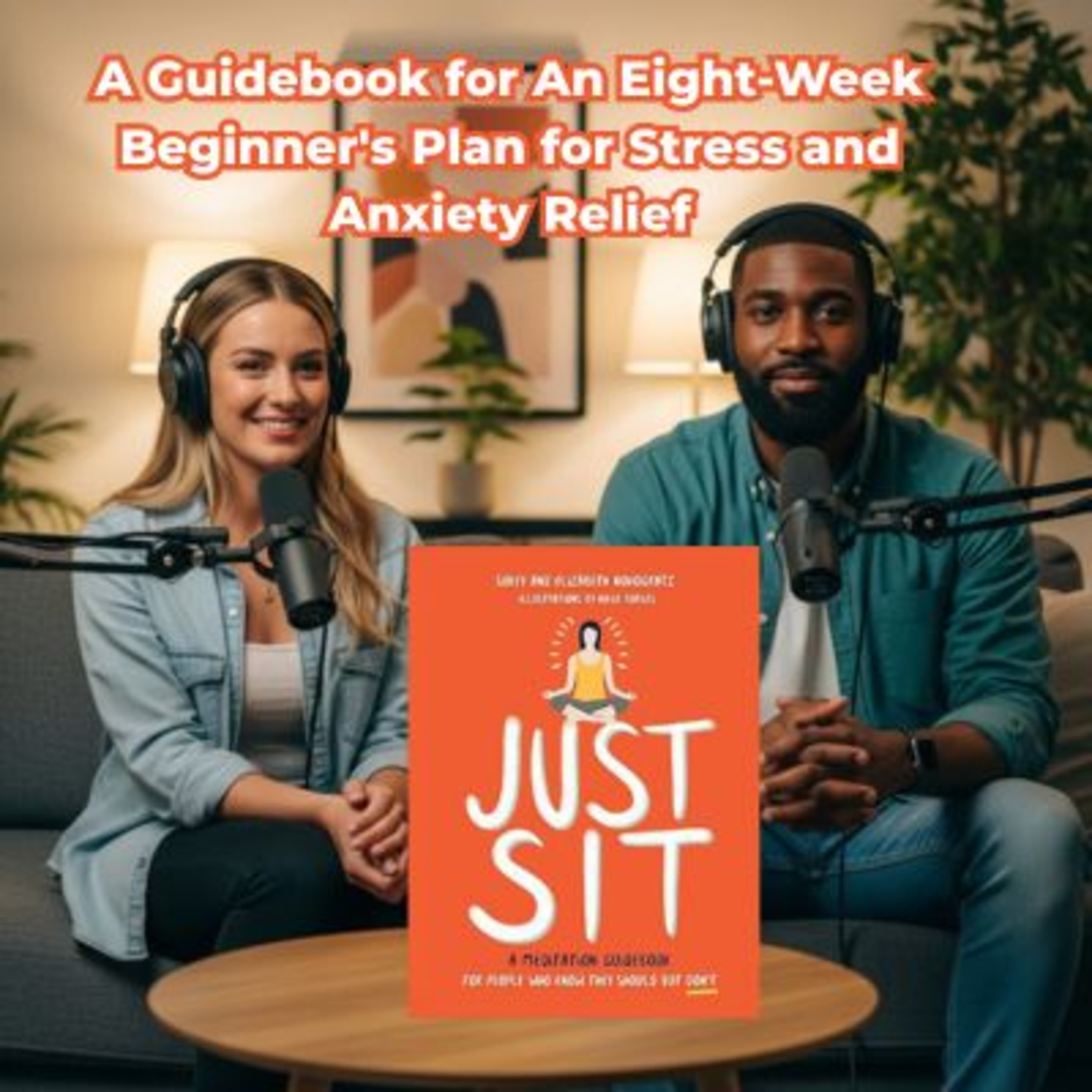
From the cofounders of The Well Daily, a playfully-illustrated, informative, and easy-to-use meditation guidebook—including an eight-week plan for busy novices—that helps even the busiest would-be meditator incorporate this practice into their lifestyle and enjoy its many physical and emotional benefits.
We’ve all heard the reports about meditation: that it helps us relieve stress and anxiety, improve our moods, lose weight, and sleep better. We know that it can make us healthier, nicer, a kinder parent, a better coworker, a more thoughtful spouse. But there’s a catch—you actually have to do it.
Written for the many, many people whose schedule or skepticism has kept them from trying meditation, Just Sit is an approachable and visually engaging beginner's guide. Assuaging fears, answering questions, and providing real-world information to demystify the process, Sukey and Elizabeth Novogratz provide a hands-on look at what meditation really is, what is does, and how to do it. The authors make clear that meditation doesn't have to be complicated or follow a specific protocol. The most important part, to "just sit," can lead to a lifelong practice, tailored to anyone's lifestyle.
A perfect blend of information and instruction, Just Sit covers everything you wanted to know but were too afraid to ask. Sukey and Elizabeth address meditation myths and realities, offer advice on how to combat awkwardness, extoll the physical and emotional benefits of meditation, show readers how to find those precious minutes to meditate every day, and more. They also include an eight-week plan to get help readers kick start—and stay with—their own daily practice.
Time to ditch the excuses. With this warm, encouraging, sassy guide, everyone will want to show up—and sit down—every day.
- Meditation for Beginners: No jargon, no dogma, no impossible poses. This sassy, illustrated guide answers the questions you’ve been too afraid to ask and makes starting a practice feel like talking to a good friend.
- Anxiety and Stress Relief: Discover how just a few minutes a day can lower cortisol, improve sleep, and help you respond to life’s challenges with more calm and clarity instead of reacting on autopilot.
- The Eight-Week Plan: Kickstart your commitment with a practical, week-by-week program designed to build a consistent habit, taking you from a curious novice to a confident daily meditator.
- Mindfulness in Real Life: Learn how to take the awareness you cultivate on the cushion into the rest of your day, transforming daily chores, commutes, and conversations into opportunities for presence.
This episode summarizes Just Sit, a guidebook by Sukey and Elizabeth Novogratz designed to make meditation accessible for beginners and skeptics. The authors emphasize that mindfulness does not require complex rituals, but rather a simple commitment to focusing on one's breath and returning to the present moment. Throughout the chapters, the book addresses common hurdles like busy schedules and wandering minds, encouraging readers to prioritize consistency over perfection. It also explains how to connect with the physical sensations of the body and observe thoughts without judgment to foster personal growth. Ultimately, the sources advocate for integrating mindful awareness into everyday activities, such as eating and walking, to achieve a more peaceful life.
Right now you are probably multitasking. You know you're listening to us while commuting or making dinner or or maybe staring at a laptop screen with like 27 different tabs open. Which is pretty standard these days honestly. Oh yeah, totally. You are constantly absorbing information, rushing from one commitment to the next. And somewhere in the back of your mind, you know, amidst all that craziness, there is a quiet kind of nagging voice telling you that you really should be meditating. Yeah, the classic guilt trip.
Exactly. It is a bizarre phenomenon. I mean, we have somehow taken the ultimate tool for relaxation and just turned it into the ultimate modern guilt trip. It really is the great paradox of our current Wellness culture. We take a practice that is fundamentally designed to, you know, relieve stress, and we inadvertently weaponize it against ourselves. It stops being a refuge and becomes just, well, another item on an already impossible To Do List. Yeah. Like a tour. Exactly. It transforms into just another metric of self-care that you are somehow failing to meet on a daily basis.
And that guilt is exactly what we are dismantling in today's deep dive. Our mission is to completely demystify meditation and make it immediately actionable for you. We're going to strip away the whole intimidation factor. Which is huge for a lot of people. It really is. So we are pulling insights from a book tune as summary, a fantastic book called Just Sit, a meditation guidebook for people who know they should but don't. It's by Sookie and Elizabeth Novogratz, and honestly, the title alone speaks directly to that nagging voice we all have.
Oh for sure. The authors designed this specifically for the skeptics, the over scheduled and the perpetually overwhelmed. They deliberately strip away the mysticism and the, you know, the aesthetic that we usually associate with mindfulness. Like the incense and the robe? Exactly. They choose instead to focus purely on the functional mechanics, because the most valuable knowledge you can acquire about a practice like this is the kind you can actually apply to the reality of your daily. Life. Yeah, that makes sense.
I mean, if finding peace requires you to retreat to a silent mountaintop for an hour, that practice is entirely useless to you when you are stuck in gridlock traffic, right? Right. Or staring down a massive deadline at work. OK, let's unpack this because I think that's the perfect place to start. Let's look at that very first barrier, which is just the sheer intimidation of the setup. Yeah, the optics of it, right. When we picture meditation, we usually imagine this highly complicated ritual. We picture someone sitting in a perfect Lotus position, surrounded by incense, in absolute silence, dedicating an entire hour to achieving like, total enlightenment.
Which is a lot of pressure. It's so much pressure, but the source material immediately shuts that down with the directive to just keep it simple. You don't need a special cushion, you don't need to contort your legs into a pretzel. A regular office chair is totally fine. Where? The edge of your couch. Yeah, the edge of your couch is fine. You just need to find a relatively quiet spot, keep your back straight but relaxed, and focus on your breath. That is the entire starting framework. And by lowering that physical barrier to entry, they are setting the stage to dismantle the mental barriers too.
Specifically, the excuse of time. Oh, the time excuse is a big one. It's the biggest one. We tell ourselves we cannot meditate because we do not have a spare 30 minutes, but the authors explicitly state that starting with just 5 minutes is perfectly adequate. Wow, just five. Just five. But even more importantly, they address the single biggest misconception that keeps people from starting the pervasive idea that meditating means you must completely clear your mind of all thoughts. See, I always struggled with that idea of clearing my mind I literally cannot do.
It almost nobody can. Right the second I try to force my brain to be empty it gets like 10 times louder. But reading this summary I had this realization about how we frame the goal. When you are a high achiever or even just a busy person, sitting in a chair doing quote UN quote nothing for 5 minutes feels like a catastrophic failure of productivity. It feels like wasting time. Exactly. So the way I like to think about this, my own personal analogy here, is that meditation is essentially a software update for your brain.
How a software update. What's fascinating here is how that shifts the perspective. Walk me through mechanics of that well. Think about what happens when your phone installs a major update. You don't actively do anything to make the code compile. You just plug the device in, set it down, and leave it alone, right? The screen goes black, little progress bar appears, and the system just does its own internal work. If you get impatient and try to poke at the screen or press buttons to make it do things faster, you actually interrupt the process.
You might even crash the system. Yes, you might crash it. You just have to stay plugged in and let it run. So sitting for 5 minutes focusing on your breath isn't wasting time any more than letting your phone install critical security patches is wasting time. That's a great way to put it. Thanks. You're stepping away from the active interface so the system can recalibrate in the background. I love that, and the psychological relief in that approach is profound. By explicitly telling you that the goal is not to clear your mind completely, the authors completely lower the stakes of the practice and the reasons they are giving you permission to let your mind wander.
The act of practice, the actual work of meditation, is simply the gentle act of noticing that you have wandered and bringing your focus back to the physical sensation of the breath. It's just about noticing. Exactly. By removing the impossible pressure of achieving a perfect, completely empty mind, they transform meditation from a frustrating exercise and suppression into a manageable exercise and observation it. Changes the entire game. I mean, you aren't failing when a thought about your grocery list pops up.
Noticing the thought about the grocery list is the meditation. Precisely. But let's look at the reality of this. Let's say you've carved out the 5 minutes you were sitting in the chair. You understand you aren't trying to empty your brain. You press start on your timer and then your nose starts to itch. Always. Your lower back aches. Your brain starts screaming about an e-mail you forgot to send. The physical and mental resistance kicks in almost immediately. So how do we survive that first wave?
Well, the source material tackles this by deeply exploring the mind body connection during those crucial 5 minutes. The authors highlight that physical tension is very often the first tangible symptom of a wandering, stressed mind. Oh interesting, so the body reacts first. Often, yes. To combat this, they introduce the technique of a body scan. They suggest mentally scanning your body from head to toe, noticing areas of tightness. You know, maybe your jaw is clenched or your shoulder shoulders are creeping up toward your ears.
I do that all the time. We all do, and then you are instructed to visualize your breath physically flowing into those tense areas to relax them. OK, but how does visualizing breath flowing into my tight shoulders actually do anything? I mean, is it just a distraction technique or is there something structural happening there? It is much more than a simple distraction. The body scan works because it anchors your wandering cognitive processing to tangible present moment sensations. OK. Break that down for me, sure.
When your mind starts spinning an anxious narrative about, say, a work project due next week, your brain is living in an abstract, stressful future. That abstraction triggers a real physical stress response in your body today. Hence the tight shoulders, right when you force your attention to actively scan your physical body for tension, you pull your cognitive processing away from that abstract anxiety and force it to process concrete physical reality. That makes a lot of sense. Yeah, you are effectively short circuiting the mind's tendency to get overwhelmed by its own chatter by giving it a highly specific physical task in the present moment.
So you are basically grounding the machine. Exactly. And that physical grounding pairs directly with how the text addresses the mental side of the resistance. The authors validate that a continuous, chaotic stream of thoughts is entirely normal. Your brain is going to throw things at you. It's. What brains do? Right. The objective is simply to recognize when you are caught up in thinking. The source uses a very classic metaphor here, treating your thoughts like clouds passing by in the sky. You acknowledge the cloud, you let it drift past, and you return your gaze to the breath.
It is a common metaphor because it works conceptually, but executing it in real time is where the friction lies. We naturally want to attach to those clouds and follow them. Which is why I think the cloud analogy, while poetic, doesn't always capture the aggressive nature of modern distractions. I would give it a slightly more modern, perhaps aggressive spin. OK, I'm intrigued. Instead of Jekyll clouds, I think of thoughts during meditation like pop up ads on a sketchy website. Pop up ads instead of clouds.
Expand on that. So when you are meditating, you are basically trying to read an article, in this case focusing on the sensation of your breathing, and suddenly BAM, a giant neon ad for a blender pops up in your brain. A blender. Nice. Right. Or maybe an ad featuring a memory is something embarrassing you said in the meeting three years ago. The natural instinct is to click the ad. Yeah, you engage with it. You start thinking about the blender, which makes you think about making smoothies, which makes you realize you need to buy kale, which makes you stress about your grocery budget.
Before you know it, you are 20 Taubes deep into a rabbit hole of anxiety. That is painfully relatable. Isn't it the practice is recognizing the pop up ad, realizing you don't have to click it, and simply clicking the little X to close the window and go back to the article? That is a remarkably accurate way to describe the modern cognitive experience. We are so heavily conditioned by our digital environment to click the ad, to follow the dopamine hit, to engage with every stimulus that flashes before us.
We really are. Your meditation practice is literally retraining your brain's Moto response. You are building the neurological discipline to look at the stimulus, recognize it for what it is, and consciously decide not to engage. But as the text notes, this takes immense patience. You're training an observational muscle that has likely been entirely ignored for your entire life. It is a mental workout. You are quite literally lifting weights with your attention span. Every time you close a mental pop up ad and return to the breath, that is one Rep.
Exactly 1 Rep. So let's say you master this. You have the tools to handle the physical tension through a body scan and you know how to close those mental pop up ads. You survive the 5 minutes. The challenge then shifts from the micro level to the macro level. How do you actually get yourself to sit down and do it again tomorrow? That's the real test. Yeah, this brings us to the hurdle of forging A consistent habit. Consistency is where most well-intentioned Wellness routines completely fall apart.
We rely on initial motivation, but motivation is a finite resource. It runs out fast, and the source material addresses this head on by highlighting the incredibly common excuses we all use. We are too busy, we are too tired, we are just not in the right headspace. The classics. The classics. The authors insist that to breakthrough this we have to treat meditation like a non negotiable daily habit. The specific comparison they use as brushing your teeth. Right, you don't wait for motivation to brush your teeth.
Exactly, you do not skip brushing your teeth just because you are feeling slightly uninspired. But alongside that strictness, they emphasize A surprising amount of flexibility and self kindness. Which is crucial. It is if you miss your planned morning session, do not throw your hands up and quit. And more importantly, do not launch into a guilt spiral. Just find another pocket of time later in the day. That flexibility directly combats the all or nothing mentality that sabotages so many habits. We tend to operate under the assumption that if we cannot complete our perfect 20 minute session in total silence, the entire day is a failure and we might as well skip it entirely.
Yeah, we're very hard on ourself. We are the authors are aggressively pushing back against that perfectionism, OK? Here's where it gets really interesting because I want to push back on the authors a little bit here on behalf of the listener. Let's say your alarm doesn't go off, your entire day is chaotic, and the only sliver of time you have left is literally 3 minutes while sitting in your parked car before walking into a crowded grocery store. OK, fix your painted. Right. Is a random squeezed in three minute session in a parked car actually doing anything physiologically?
I mean, is it actually lowering your cortisol or are we just checking a mental box so we can tell ourselves we didn't fail today? That's a very fair question. It is doing something profoundly important, but not necessarily the physiological relaxation you are looking for in that specific moment. Oh really? Yeah. The core message regarding habit formation is that the habit loop itself is far more important than the duration or the quality of any single session. When you take those 3 minutes in your car, even if your mind is racing the entire time, you are actively reinforcing the neural pathway of the habit.
You are casting a vote for your new identity as a person who meditates daily. OK. So it is about maintaining the infrastructure even if the payolute is small that day. Precisely building a consistent, unbreakable practice over time is the ultimate goal, not achieving momentary Zen perfection on a random Tuesday. That takes the pressure off. It really does. It is identical to the dental hygiene analogy. Brushing your teeth for an aggressive 30 seconds because you are late for work is not a deep cleaning, but it is infinitely better than not brushing them at all because you are maintaining the behavioral routine.
Wow, yeah, that makes total sense. This is also why the authors strongly suggest using a journal to track your progress. When you document those 3 minute car sessions alongside the really profound, deeply relaxing sessions, you start to see a narrative of consistency, right? The journal helps transition the act of meditation from feeling like a daily chore into a rewarding cumulative journey. You start to see the data of your own consistency, which sets up the final and arguably most important piece of this entire deep dive.
If we successfully build this daily habit, if we overcome our excuses, put in our daily reps and learn to close those mental pop up ads on the cushion, well, what is the actual tangible payoff for you in the real world? Right. What's the point of it all? Yeah. How does sitting in a chair for 5 minutes translate to a better life? The source material moves from the isolated practice into practical application. And this is where the true return on investment reveals itself. The authors outline how this localized practice of personal growth ripples outward.
When you spend time observing your own mind, you naturally begin to reflect more clearly on your core values. Which is huge. It is. You become better at setting intentional goals rather than just reacting to circumstances. You improve your ability to manage massive emotional swings, which inherently reduces your baseline stress and ultimately leads to vastly improved decision making. And it isn't just about the big life altering decisions either. The text details how this awareness integrates into incredibly mundane everyday activities.
Like what? Well, they suggest practicing mindfulness while eating, actively savoring the specific taste, texture and smell of the food instead of just inhaling a sandwich while scrolling through emails. Guilty of that. Same. They also suggest being mindful while walking, focusing completely on the mechanical sensation of your feet hitting the pavement. But the application that really stopped me in my tracks was the concept of mindful listening. Oh yeah, mindful listening is perhaps the most difficult, yet most rewarding real world application of this entire practice.
Is a universal struggle. Think about a typical scenario in your life. You are in a high stakes meeting at work, or maybe you are in the middle of the heated argument with your partner. How often are you actually deeply hearing the nuance of what the other person is communicating? Honestly, for most of us, the answer is rarely. Rarely, we are usually just politely waiting for our turn to speak. We sit there, our internal monologue is racing at 1,000,000 miles an hour, we are grafting our brilliant counter argument and we completely miss the reality of the person sitting in front of.
Us, we aren't listening, we're just reloading. Exactly. So what does this all mean? If we connect this to the bigger picture, that internal drafting process is exactly what you are training yourself to stop when you are sitting on the cushion, when you practice recognizing a thought about a blender and choosing to let it go, to return to your breath, you are building a specific cognitive mechanism. You're building that muscle. Yes, you are widening the gap between a stimulus and your response to it.
Oh I see, so the breath becomes the conversation. When you catch yourself drafting A rebuttal, you notice the pop up ad, close it and return your focus to the words the other person is saying. Exactly. The authors of Just Sit are not trying to help you become a champion sitter. I mean, there is no trophy for sitting perfectly still the longest. The ultimate objective is to take that calm, non judgmental awareness you cultivate during your isolated 5 minutes and weave it directly into the chaotic fabric of your life.
That's the real goal. Right when your boss sends a passive aggressive e-mail, your amygdala wants to hijack your brain and fire off a furious defensive reply. But because you have been doing your mental push ups, you now have a buffer zone. A buffer zone. I like that. You can observe the anger rising in your body, just like observing a tight shoulder during a body scan. You can pause, regulate your nervous system, and choose a strategic response rather than acting on blind impulse. That buffer zone is how meditation literally helps you become the best version of yourself.
It is the profound difference between automatically reacting to the world and intentionally responding to it. And the beautiful thing is that this entire transformation starts with simply finding a chair and paying attention to an inhale and an exhale. It really is that simple. To pull all of this together for you, this deep dive has shown us that the benefits of meditation are completely accessible to you right now. It does not require spiritual awakening, special gear, or hours of empty time you do not have.
It starts with finding a comfortable spot. It requires entirely abandoning the guilt of doing it wrong. And the ultimate payoff is that the focus you build bleeds into how you eat, how you walk, and how deeply you connect with the people around you. As we wrap up this analysis, I want to leave you with one final lingering thought to ponder on your own. It builds directly on the texts core theme of observing your own thoughts without passing judgement on them. OK, let's hear it. If you can train yourself minute by minute, day by day, to sit quietly and not react to the chaotic, unpredictable, and sometimes frustrating thoughts within your own mind, consider how that might eventually fundamentally change the way you react to the chaotic, unpredictable behaviors of the people around you.
What if the incredibly simple act of just sitting is actually the ultimate training ground for profound human empathy? Wow, that completely reframes the entire purpose of the exercise. It means the practice isn't just a selfish pursuit of your own inner peace, It is a mechanism for changing how you impact everyone else's world. I love that. Me too. Thank you so much for joining us on this deep dive. Your challenge for today is incredibly straightforward. Take just 5 minutes, find a normal chair, let the software update run and see what happens.
We will see you next time.
 Apple Podcasts
 Castbox
 Castro
 Goodpods
 Moon FM
 Overcast
 Pocket Casts
 Podbean
 Podcast Addict
 Podcast Republic
 Spotify