Get Scalable by Ryan Deiss | The Operating System Your Business Needs To Run and Scale Without You
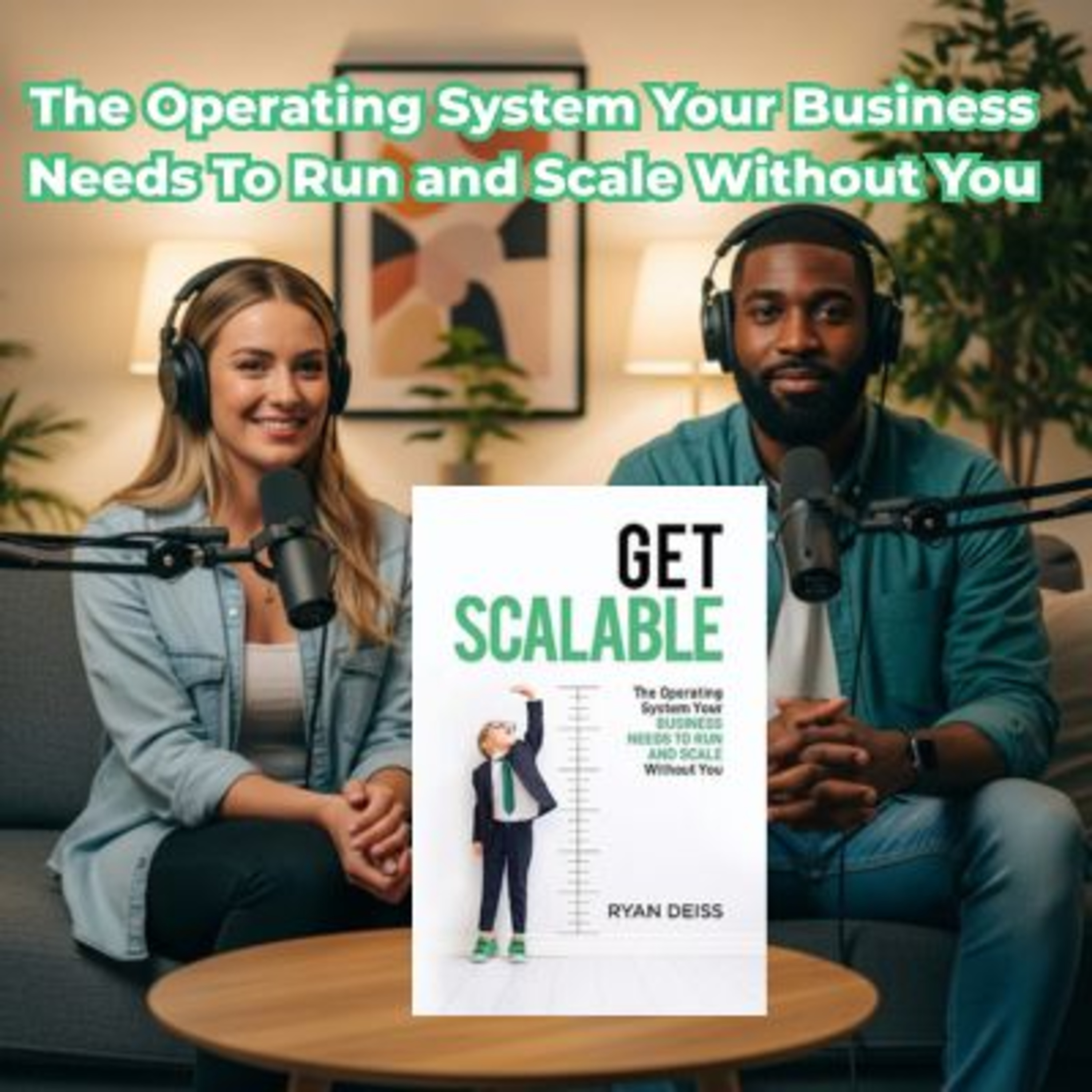
You started your business because you wanted more. More wealth. More freedom. A greater impact. But these days, it feels like you're working harder than ever for less and less money, and you barely have time to take a coffee break, much less a vacation. Sound familiar?
If your answer is a weary "yes," then Get Scalable is here to change the game...and your life.
In the entrepreneurial journey, many fall prey to the Founder's Curse-the dangerous notion that their business's success hinges solely on their effort. But Ryan Deiss is here to shatter this illusion and usher you toward a reality where your business doesn't just survive without your constant input-it thrives.
The secret? An "operating system." Deiss convincingly argues that this is the secret weapon of the world's most successful companies. It's their playbook-the guide that outlines what the company does, how it does it, and how it's progressing toward its goals. This isn't just an abstract concept, but a practical tool for unlocking the potential you know exists within you and your company.
Get Scalable provides a tangible, step-by-step plan to swap your exhausting "YouOS" for a powerful, tailor-made "Scalable OS." This isn't just another business book filled with vague advice and buzzwords. This tactical guide will equip you with the tools to forge a system that ensures your company runs seamlessly, expands rapidly, and, most importantly, doesn't burn you out.
With a mix of intriguing real-world examples, lightbulb-moment insights, and straightforward strategies, Deiss will walk you through the whole process. By the end of the book, you'll have a whole new operating system in place that lets your business thrive, scale, and zoom ahead, whether you're in the driver's seat or not.
It's time to break free of the Founder's Curse. It's time to Get Scalable.
This episode outlines the core principles of Ryan Deiss’s book, Get Scalable, which provides a blueprint for achieving operational freedom through systematic business growth. The author argues that true success involves creating independent processes and documented playbooks that allow a company to function smoothly without the owner’s constant intervention. Key strategies include identifying value engines to drive revenue and establishing high-output teams with clearly defined roles and responsibilities. To maintain oversight from a distance, the text suggests using performance scorecards and a disciplined meeting rhythm to track essential metrics and ensure team alignment. Ultimately, the guide encourages entrepreneurs to install a comprehensive operating system that empowers staff to make decisions independently, allowing the business to thrive while the owner enjoys personal liberty.
Imagine for a second that you are on vacation. OK? And I don't mean like a working vacation where you're hiding in the hotel bathroom at 6:00 in the morning. Yeah, frantically answering emails on your phone. Exactly. While your family is down at the pool having fun, I mean, you are thousands of miles away, totally unplugged. Sounds amazing. Right. Your phone is just buried at the bottom of the suitcase somewhere. And your business, it is running Florida State? Without, you know. Entirely without you, you haven't received a single panicked phone call.
Not one. You know, Slack notification asking how to handle a disgruntled client. Wow. Yeah, no one is putting out fires because the systems you built are, well, they're preventing the fires from starting in the 1st place. Sounds like an absolute dream, right? I mean, for a lot of founders and senior managers listening to us right now, that scenario probably sounds less like a dream and more like a frustrating fantasy. Totally. It feels impossible, right? Because we are deeply conditioned by hustle culture to believe that if the person in charge steps away, the whole House of Cards inevitably collapses.
Yeah, there's this, this ingrained psychological barrier. Exactly. We equate our physical presence and honestly, our constant suffering with the actual value we bring to the company. We think if we aren't stressed, we aren't working well. That is the exact pain point we are targeting today. We are going right to the heart of how you actually strip away that anxiety. And make that fully detached vacation an actual reality, yes. So we've been doing a deep dive into the step by step blueprint laid out in Ryan Dice's book, Get Scalable.
It's a great book. It really is, and our mission for this deep dive is to extract the concrete mechanics of how you achieve what he calls total operational freedom. Which is a bold claim. It is, but we want to show you how to build a business that scales on autopilot without you constantly having to hold the reins, you know, or act as the the chief firefighter. Because I mean a business that requires your constant minute by minute intervention. It isn't actually a business. What is it then? It's just a highly demanding, incredibly stressful job that you happen to own.
Ouch. Yeah, that hits close to home. Right. To actually scale beyond your own personal bandwidth, you have to undergo a fundamental shift. You have to transition from being the primary operator of the machine to being the architect who designs the machine. OK, let's unpack this, because going from the dream of sipping a drink on a beach to the hard reality of Step 1 is, well, quite a leap. It is a massive. Leap and step one is building that machine like foundation. I mean, you clearly can't step away of all the operational knowledge, all the nuanced secret sauce of how you do things.
If it's all trapped inside your head. Exactly. But getting it out of your head feels like, I don't know, a monumental task. It is the classic Founders trap. You know exactly how you like things done right? You have a very specific standard of quality. So you just do it yourself. Exactly. Or at best you verbally tell a new hire how to do it in passing and just hope they remember. Which they never do. Right, these emphasizes that the foundational element of scaling is building a solid system. A solid system.
Yeah, that means you have to document your processes. You have to extract the methodology from your brain and formalize it on paper. So think about like a local, highly successful independent coffee shop. OK, great example. If you are the owner and you are obsessed with quality, your first instinct is to personally shadow and train every single barista who walks through the door. Of course you want to show them exactly how to tamp the espresso. Right, the exact angle to hold the pitcher when steaming the milk.
You feel like your personal oversight is the literally the only guarantee of quality. But the moment you open a second location little on 1/10 that model breaks completely. You become the ultimate bottleneck. And that bottleneck limits your growth to the amount of hours you can physically stay awake. Which is not scalable. Not at all. The solution, Dees points out, is creating the playbook library. The playbook library. Yeah, instead of relying on the owner's physical presence or, you know, their personal shadow, you build step by step manuals or training videos.
Yeah, it sounds almost aggressively simple. It does, but it fundamentally shifts the power dynamic of the entire business. The system becomes the guarantor of quality. Not the founder. Exactly. No matter who is working the espresso machine on a Tuesday afternoon, the customer gets the exact same high quality product because the playbook dictates the outcome. It's basically like writing down the exact recipe for your grandmother's famous pasta sauce. Oh, I love that analogy. Right. Because for decades she just stands at the stove throwing a pinch of this and, you know, a dash of that into the pot, adjusting by taste.
It's pure magic. It is, but it's magic only she can perform. If she finally writes down the exact measurements, like 2 teaspoons of salt, simmer for exactly 20 minutes. Suddenly anyone in the kitchen can replicate the magic. They don't have to possess her culinary intuition. Exactly. Or if you're a gamer, it's like creating a master save file for your business. Oh yeah, you document the progress and the rules of the world so you never have to start from level 1 every single time you onboard someone new.
That save file analogy captures the compounding value of this work perfectly, right? And this extends far beyond making coffee or pasta. I mean, it applies to highly complex creative or technical service businesses too. Like what? Give me an example. Consider a digital marketing agency. The founder might be an absolute genius at client strategy. OK, if they build a playbook for how to conduct the initial client discovery call, how to structure specific ad campaigns, and how to format the monthly reporting, they're creating an infrastructure.
Oh, I see. This collection of processes allows the team to execute complex workflows entirely autonomously. Which means the senior account managers aren't knocking on your door every Tuesday asking hey, what format does this specific client want their analytics in again? Exactly. It's already in the playbook. But, you know, this brings up a massive, immediate problem that I think stops most people from ever starting. OK, what's that? Well, if I sit down on a Monday morning and decide I need to document my business, I'm going to look around and see a million different micro tasks happen.
Oh sure, the sheer volume. Right, I could easily spend 3 weeks writing a beautifully formatted 50 page manual on how to properly load the office dishwasher and, you know, order printer ink. Which is a terrible use of your time. Exactly, There is a very real risk of information overload and wasted effort, so I would assume the solution is to follow the money and only document revenue generating tasks. What's fascinating here is the strategy of elimination that Dice advocates. OK, it's not just about blindly following the money.
It's about identifying what he calls your value engines. Value engines. Yeah, because documenting everything is a trap. It's process for the sake of process, and it just scales bureaucracy. Nobody wants more bureaucracy. Right, You only want to document the specific vital activities that actually deliver the core value your business is known for. Take an e-commerce clothing brand for instance. A founder could get bogged down documenting how to organize the digital filing cabinet, but their true value engines are likely the website user experience.
Yes, the high end product photography. Right. And the speed and accuracy of the shipping process. Exactly. Those are the specific mechanisms that actually convince a customer to click buy and ensure they get the product fast enough to leave a five star review. So it's about focus. Once you map out a business and identify those 3 or 4 core value engines, it acts as a harsh but necessary filter. How so? Well, identifying where you should invest your system's building energy is equally about identifying what you need to explicitly stop doing.
Oh wow, so it's an elimination game it. Forces an audit of your calendar. You realize you are spending hours tweaking the font on internal team memos or like debating the color of the break room coffee. Mug all your product photography playbook hasn't been updated in two years exactly. So if you're listening right now, take a second and really audit your own week. What are your actual value engines? Yeah, what really matters. What are the handful of levers that actually move the needle for your business?
And what is just comfortable busy work cleverly disguised as productivity? Comfortable, busy work? That's a trap. It really is. We all fall into the trap of doing the easy low value tasks because they give us a quick dopamine hit of crossing something off a list. We gravitate toward the tasks we can control. Right. But if you spend your time building rigorous documentation around busy work, you are just optimizing for inefficiency. You're just getting really good at doing the wrong things. Exactly.
The mandate is to ruthlessly eliminate the noise and build systems exclusively around the engines that drive your unique value. OK, let's play this out. We've audited our time. We have our playbook library focused exclusively on our critical value engines. The manual is written and the noise is eliminated. Great. You're in a good spot. But a brilliantly written manual sitting on a digital shelf doesn't run a business. A machine still needs operators. Yes it does. How do you get human beings, with all their complexities and varying motivations, to actually run this machine without constantly reverting back to you for permission and direction?
This is the critical transition from systems to human behavior. Dice introduces the framework of high output. Teams High output team. Right, The objective is to engineer an environment where teams can perform at an elite level with very little friction. And how do we do that? Motivational speeches. No, the primary mechanism to achieve that isn't motivational speeches. It is ruthless, almost aggressive clarity regarding roles and responsibilities. The ambiguity of who does what is what causes teams to freeze and wait for the founder to make a call.
A great way to visualize this is to look at a high end commercial kitchen. Oh, we'll have culinary examples. Right on the surface, a busy restaurant kitchen during a Friday night dinner rush looks like absolute chaos. It's loud, it's high pressure. There's literally fire everywhere. Total madness. But the best kitchens operate with mind bending efficiency because there are highly specific non overlapping stations. You have one chef dedicated solely to the grill, another handles only the cold appetizers.
1/3 is exclusively plating desserts. The key is that they aren't bleeding into each other's territory, right? The grill chef doesn't pause the steaks to wander over and check if the Thalids have enough dressing. Because that would ruin the flow. Exactly because each person knows the absolute boundaries of their specialized role, the entire kitchen functions as a single, unified Organism. Wow. You define the role with crystal clarity. You provide the tools and playbooks we just discussed, and then you just get out of the way.
I understand the rule clarity, but a business isn't a static menu. Unpredictable things happen constantly all the time. Dice talks about decision making guidelines to handle the chaos right? Yes, he argues for establishing clear frameworks. So think about a retail store where a frontline employee is faced with an angry customer demanding a return that falls slightly outside the normal rules. Classic scenario. If the company policy, the framework is clear that employee knows exactly what parameters they have to to resolve the issue on the spot.
They don't have to pause the transaction, hold up the line, and call a manager over to make a $20 decision, right? The framework authorizes them to act. OK, I have to push back hard on this. Putting myself in the shoes of an anxious business owner giving employees the keys to the vault and letting them make financial decisions on their own is terrifying. I get that. What if that empowered retail employee messes up? What if they use their, you know, decision making freedom to give a massive unauthorized refund to someone who is clearly scamming the store?
And it cost the business thousands of dollars. Yes. Doesn't this whole concept of empowering the team basically mean opening yourself up to massive, unpredictable financial risk? Financial ruin is exactly what keeps founders shackled to their desks. It's a valid fear though. It is, but the pushback assumes that empowerment means anarchy. Dice pairs empowerment with those strict decision making guidelines for this exact reason. So the framework is a safeguard. The framework is your financial safety net.
You aren't telling the employee. Use your best judgement and do whatever you want. Oh. OK, what are you telling them? You are giving them a highly defined sandbox. You are saying you have the absolute authority to resolve any customer complaint up to the value of $50. Got it. If it exceeds $50 or involves these three specific edge cases, it escalates to a manager. But if the framework is too tight, say they can only approve a $5 refund, they can't actually solve any real problems and they still have to call me.
And if it's too loose, I lose money. So how do you find that Goldilocks zone? Do you just guess and hope for the best? You iterate, You start with the conservative sandbox, you monitor the outcomes, and as the team proves they understand the core philosophy behind the playbook, you widen the sandbox. Ah, so it grows with trust. The beauty of defining the boundaries clearly is that you eliminate the risk of a catastrophic business ending mistake. Right, the retail worker doesn't have unlimited power.
Exactly. They have total autonomy within the framework. Because they know where the walls of the sandbox are, they can move incredibly fast without second guessing themselves. The customer gets an instant resolution. And you don't get a frantic phone call on your vacation. Exactly. So the autonomy actually comes from the constraints? Yes. They don't have to suffer decision fatigue figuring out what the policy should be in that moment. They just execute the play within the boundaries. The ambiguity is the enemy of speed.
You remove the ambiguity, you increase the speed. Right. Let's assume the machine is fully built. OK, the value engines are humming, the team knows their specific roles and they have a well calibrated framework to make decisions safely. Sounds perfect. But if I'm miles away, totally unplugged, how do I actually know it's working? That's. The $1,000,000 question. Right. If the team is handling all the daily operations and resolving all the issues, I'm completely out of the loop. How do I know if the business is quietly succeeding or if it's slowly bleeding cash and failing while I'm sitting on the beach?
You need Instruments. Instruments. Yeah, if a pilot is flying a 747 through heavy clouds, they don't roll down the window to see where they're going. That would be bad. Very bad. They rely entirely on the instruments on the dashboard. They trust the data. DACE calls the business equivalent of this dashboard company Scorecards. Company scorecards. So you essentially build a customized report card for the health of the operation. Exactly. And we aren't just talking about checking the bank balance.
You have to design scorecards that track the deeper metrics. Things like customer acquisition cost, churn rate, or specific productivity targets. Look at how a fitness gym operates. A hands on owner might walk the floor everyday, see a lot of people lifting weights, check the bank account and assume business is booming. But it might not be. Right, but a scorecard forces a much deeper level of objective analysis. It tracks the month over month member retention rate. It tracks the conversion rate of free trials to pay personal training sessions.
Yes, it monitors the attendance capacity of the Tuesday night spin class. Which is huge because if you are looking at that scorecard from a cafe halfway across the world and the data shows that the Tuesday night spin class attendance has dropped by 40% over the last three weeks, you instantly know an intervention is required. You don't have to physically be standing in the gym staring at an empty room to spot the failure that's. Powerful. If we connect this to the bigger picture, what a scorecard effectively does is replace a founder's subjective gut feeling with objective reality.
The gut feeling. Yeah, founders love their gut feeling. We really do. When you spend years doing everything yourself, you develop a highly attuned intuition for how the business is breathing. You can just, you know, feel when a week is slow. But intuition is unscalable. Exactly. You cannot hand your gut feeling to a new manager. Data, however, scales perfectly. The scorecard forces everyone to look at the exact same objective truth. And to ensure that data doesn't just sit in a forgotten dashboard being ignored by the team, Dice pairs the scorecard concept with meeting rhythm.
Meeting rhythms, yes. Which frankly sounds like a nightmare to a lot of people. I mean the general consensus is that most corporate meetings are soul crushing. Time sucks that prevent actual work from getting done. I don't disagree, but meetings only become time sucks when they lack structure and purpose. Dice advises engineering a highly intentional schedule of meetings that keeps everyone aligned without devastating their deep work time. And I'm guessing the scorecard is central to that. The scorecard is what saves the meeting.
You aren't gathering to just chat about how everyone feels, you are gathering to review the specific metrics on the scorecard. Consider a fast-paced tech startup. They might utilize a very strict daily 10 one minute stand up meeting. The only agenda is what did you do yesterday, what are you doing today and what is blocking you? It's a rapid fire unblocking session. Exactly, but they pair that micro meeting with a longer, deeper monthly strategy session where they pull up the scorecard and analyze the macro trends and long term goals.
The choice of the word rhythm is vital here. How so? It creates A predictable heartbeat for the company culture. The daily 10 minute check in is the quick pulse, right? The monthly strategy review is the deep breath. By establishing this predictable rhythm, your team never feels abandoned to figure things out alone. But they also don't feel suffocated by micromanagement. They know exactly when they will have a forum to raise issues. And they know exactly what objective data will be discussed. OK, so we have all the individual puzzle pieces laid out on the table.
We do. We have the documented playbooks targeting the value engines, we have the high output teams operating inside safe decision making frameworks check in check, and we have the scorecards and meeting rhythms acting as our dashboard and heartbeat. The final step is clicking all of these distinct pieces together so the machine actually powers on and runs. Dice refers to this final critical phase as installing your operating system. Installing your operating system, yeah. This is the friction heavy moment where all these theoretical documents, flow charts and dashboards become the actual living reality of your daily operations.
Think about scaling from that single independent coffee shop we talked about earlier to a regional chain of 20 locations. Right when you are opening store number 14, you aren't flying by the seat of your pants. Hopefully not. Because you have truly installed the operating system, the hiring playbooks are active, the barista training modules are mandatory, the daily the way scorecards are being reviewed, that 14th location spins up and runs smoothly without the founder ever stepping behind the counter.
The system genuinely becomes the manager, but. We need to be incredibly honest about this installation phase. Very honest. It is not just flipping a switch and walking away. It requires immense patience and a willingness to watch things break. Oh, they will break. You have to stress test the machine. You put the systems in place and then you have to actively look for the points of failure. Actually stress test it without risking the business. Do you intentionally sabotage? Things no, no sabotage.
You run drills or you operate in shadow mode. Shadow mode, yeah. You tell your team you are going on a fake vacation for three days. Oh, I like that. You are still in the office, but you refuse to answer any operational questions. You forced the team to use the playbooks and the decision frameworks. And when they inevitably stumble? When a customer gets angry or a deadline is missed, you don't jump in to save the day. Nope. You let the system handle it, or you let it fail safely. And then what? Then you review the failure.
Is the manual confusing? Do we need to widen the framework? Exactly. Did we track the wrong metric on the scorecard? You refine the system based on the real world friction. So what does this all mean? Well, it means the payoff of this entire methodology isn't instantaneous, but if you put in the grueling work upfront, the freedom is absolute. It really is. You build the architecture, you aggressively stress test it by forcing your team to rely on the systems instead of you. You refine the broken pieces and then you actually step back.
You let the machine you built do the heavy lifting. You step back and you watch the system execute the vision. If you are listening to this right now and you are physically and mentally exhausted by the relentless daily grind of managing your own company, this blueprint from Get Scalable is your escape hatch. It's a way out. Applying these mechanics, auditing your value engines, constraining decisions with frameworks, managing reality through scorecards, this is the tangible path to freeing yourself from the cycle of constant firefighting.
You do not have to remain the bottleneck of your own success. To take that a step further, there's a profound, almost uncomfortable implication hidden beneath all these operational steps. Oh, absolutely. It's the inevitable psychological result of successfully executing this process. If you follow Dace's blueprint to the letter, if you build the ultimate machine, your business runs Florida State without you, and you actually achieve total operational freedom, you're forced to ask yourself a very confronting question.
Who are you then? Exactly who are you then? That is a heavy thought. Think about it when you are no longer the essential, indispensable doer putting out the daily fires. When your ego and identity are no longer fed by being the hero who swoops in to save a client relationship at the 11th hour. You are forced into a completely new paradigm. You have to become the pure visionary. Your only remaining job is to look at the horizon, focusing entirely on long term strategy, capital allocation and expansion.
Which sounds great, but. For a lot of brilliant, hard working founders, surrendering the intoxicating identity of the daily hustler to become the quiet strategic architect is the most painful transition of the entire journey. Are you genuinely prepared for that identity shift? It's a big question. If the dream actually comes true and the phone finally stops ringing while you're sitting on that beach, do you even know how to just look at the horizon without feeling completely lost? Most people don't.
We are going to leave you with that massive question to Mull over on your own. Thank you so much for joining us on this deep dive. It's been great. Keep refining those systems, embrace the shift an we will catch you on the next one.
 Apple Podcasts
 Castbox
 Castro
 Goodpods
 Moon FM
 Overcast
 Pocket Casts
 Podbean
 Podcast Addict
 Podcast Republic
 Spotify