It's Not Supposed to Be This Way by Lysa TerKeurst
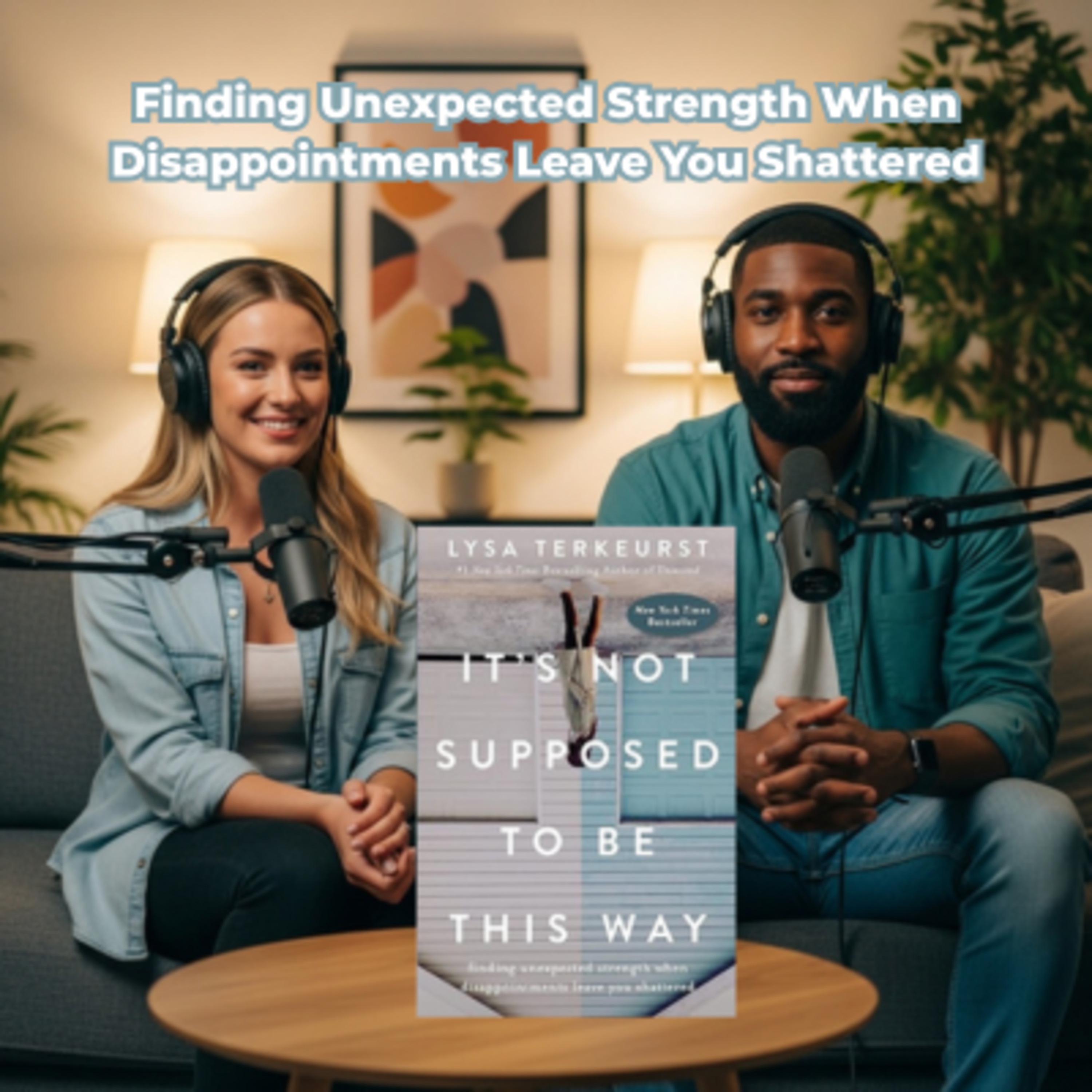
What do you do when God’s timing seems questionable, his lack of intervention hurtful, and his promises doubtful? Lysa TerKeurst unveils her heart amid shattering circumstances, inviting you to live assured when life doesn't turn out like you expected.
Life often looks so very different than we hoped or expected. Some events may simply catch us off guard for a season, but others shatter us completely. We feel disappointed and disillusioned at best and overwhelmed and hopeless at worst. We quietly start to wonder about the reality of God’s goodness and why he allows us to suffer and experience grief and loss.
Lysa TerKeurst understands this deeply. But after many tears, godly counseling, and prayerful seeking, she's also discovered that our disappointments can be the divine appointments our souls need to radically encounter God. In It's Not Supposed to Be This Way, Lysa invites us into her own journey of faith and, with grit, vulnerability, and honest humor, helps us to:
- Stop being pulled into the anxiety of disappointment by discovering how to better process unmet expectations and other painful situations.
- Train ourselves to recognize the three strategies of the enemy, so we can stand strong and persevere through unsettling relationships and uncertain outcomes.
- Discover the secret of being steadfast and not panicking when God actually does give us more than we can handle.
- Shift our suspicion that God is cruel or unfair to the biblical assurance that God is protecting and preparing us.
- Know how to encourage a friend and help her navigate hard realities with real help from God's truth, the Bible.
Look for additional biblically based resources and devotionals from Lysa:
- Good Boundaries and Goodbyes
- Forgiving What You Can't Forget
- Uninvited
- You're Going to Make It
- Embraced
- Seeing Beautiful Again
#productivityhacks #personaldevelopment #successstrategies #businessinsights #leadershipskills #leadership #ambitiousprofessionals #businesstips #self help #scaling business #businesstactics #professionaldevelopment #startupgrowth #entrepreneurship #businessmindset #growthstrategies
So have you ever spent months or maybe even years planning for something really big? Oh, like a a major life milestone. Yeah, exactly. Like you're aiming for a specific career trajectory, or maybe you're building a relationship that you are just certain is the one. Or, you know, pouring years of capital and sweat into this dream project. You've got the exact coordinates mapped out, So what happens neurologically and emotionally when that future you spent so much time planning when it just completely ceases to exist?
It's devastating. It really is. You're just left standing in the wreckage of a plan that detonated, thinking, I mean, this is not what I planned. It wasn't supposed to go this way. And that causes a well, a profound systemic shock when a meticulously crafted plan just collapses. Your brain literally doesn't have the code to process that new reality. Because it's a prediction machine. Right. Exactly. It's a terrifying, deeply isolating feeling, but today we're actually approaching that exact moment of collapse from a completely different angle.
Yes, we are. We are diving into a summary of Lysetre Kerst's book. It's not supposed to be this way. And our mission for this deep dive is to take a hard look at the raw reality of those shattered expectations. We want to extract a tangible psychological blueprint for rebuilding using the rubble itself. OK, let's unpack this, but first, just to set the context for you, our listener, the author approaches this whole concept through a pretty strong theological lens. Right. Heavily using Christian and Biblical frameworks.
Yeah. And just to be totally clear, we're remaining impartial here. We aren't endorsing any specific religious viewpoints or taking sides. We're simply imparting the ideas from the source material. Because honestly, whether you're deeply religious or totally secular, the psychological applications of her concepts are they're incredibly universal. They really are. Because the way I've always sort of conceptualized a massive disappointment is, well, it's like spending months meticulously building a delicate House of Cards.
Oh, that's a good analogy. Right. You place every single card with absolute precision. You step back to admire it, and then out of nowhere a random gust of wind just knocks it completely flat and you're just standing there staring at the table. I like the House of Cards imagery, but if we look at what is actually happening in your brain, it's it's more like running a really complex software program on your computer and suddenly the operating system gets a fatal error. Oh wow, just the blue screen of death.
Exactly. You were staring at a blue screen. We are fundamentally talking about cognitive dissonance here. The pain you feel isn't just, you know, you know, garden variety sadness that your plan didn't work out. It's deeper than that. Much deeper, it is this violent psychological clash between the world you meticulously plan for, the one you believed was a guaranteed contract, and the messy, chaotic, completely indifferent reality you suddenly find yourself in. That makes a lot of sense. It's like a glitch in the universe, and the source material actually has a really fascinating historical and theological concept to explain why we feel that glitch so acute.
The. Eden concept. Yeah, it points back to the story of Adam and Eve in the Garden of Eden. The book's central argument is that we are essentially living in an in between state. Right, caught between 2 worlds. Exactly. There's the perfect world as it was meant to be, the Eden, you know, the flawless, predictable plan. And then there is the world as it actually operates right now, which is broken, unpredictable, and just inherently messy. And that tension is where the pain lives. Yeah, because we walk around with this deep internal, almost genetic longing for perfection, but we're navigating a reality where entropy is the rule.
Things just naturally fall apart. What's fascinating here is that this is a brilliant framework to understand our baseline anxiety, even from an evolutionary psychology standpoint. We are quite literally wired to expect Eden. Wait, really? We're wired for perfection. Well, we're wired for predictability. Our brains demand safety and order because for our ancestors, predictability meant survival. Oh, OK, that makes sense. So when life deviates from that, when the career tanks or the relationship ends, it doesn't just feel like a change in your itinerary, your brain interprets it as a violation of how the physical world should operate.
It's like an existential threat. Precisely understanding that we live in this in between state validates the pain. It's a morning for perfection. We instinctively feel we are owed, but you know, we've never actually possessed. I see the logic there totally, yeah. But I do want to push back on the application of it just a little bit. Sure. If the first major take away here is just like accepting that life is messy and out of our control, isn't that inherently defeatist? It sounds like it, right? Yeah.
It reminds me a lot of the sunk cost fallacy. We hold on to the broken plan. We keep staring at the collapse, the House of Cards, because we spent so much time building it. But if we just accept that life is broken, aren't we just giving up? It sounds like resignation on the surface, but functionally it's the exact opposite. Letting go of the illusion of control is actually the very first required step toward reclaiming any actual executive power over your life. Wait, how does surrendering control give you power?
That feels like a paradox. Think about your cognitive bandwidth. When we demand affection, or when we refuse to accept that the plan is dead, we spend all of our emotional and mental energy trying to retroactively control things we cannot change. Like the gust of wind? Yes, the wind, the market crash, the actions of a former partner. It is exhausting and it traps you in this state of paralysis. By accepting that we live in a broken in between world, you stop wasting energy fighting the reality of the wind.
You just accept the fatal error on the screen. Exactly. And the second you accept the mess, all that trapped cognitive energy is freed up. You can suddenly redirect it toward the only variable you actually control, which is your response to the rubble. So it's shifting from, you know, why did the wind blow to what do I do these cards now? Precisely. And that, naturally, brings us to one of the most compelling refrains in the text. Once we accept that the plan is completely shattered, how do we look at the wreckage?
The book uses this incredible metaphor about dust. Oh yes, the dust metaphor completely shifts the paradigm of how we view failure. Yeah, so the source points out that historically and biblically, God formed humanity from dust. Dust is essentially the foundational molecular element of creation in this specific framework. The ultimate building. Block right? So when your life feels like it is crumbling into dust, when everything you build is just reduced to absolute powder, the instinct is to view it as a graveyard.
Of course it feels like an ending. But the book argues that those broken moments, that exact dust, is actually the necessary raw material for something new. You are a masterpiece in progress and the ultimate artist actually needs that dust to work with. It's such a vital reframing. Usually when a structure crumbles into dust, we think the story has concluded. But if dust is the prerequisite for creation, then a crumbling structure isn't an ending at all. It's a beginning. Right, it is an active construction site.
Exactly, you are standing in a construction site. But let's be pragmatic here for a second, right? Walking through a construction site is incredibly uncomfortable. Very messy. It is loud, there is debris everywhere, and nothing is finished. Which brings up this very specific, slightly quirky detail from the text that I love. Tan feet moment. Yes, those moments of acute awkward discomfort. Right. The book describes these as times when we feel entirely out of place. Imagine you have your tan lines.
You were used to wearing certain comfortable shoes, walking a very specific paved path. And suddenly you're not. Yeah, suddenly you are barefoot on completely different rough terrain. Yeah, everything feels wrong and awkward and deeply uneasy. You just want to put your shoes back on and go back to the paved Rd. And our biological urge, when we feel that unease on unfamiliar ground, is to flee. As humans, our nervous systems are practically designed to run from discomfort. Because familiar equals.
Safe. Free. Exactly. But the text insists on something that aligns perfectly with modern behavioral science, and that is that discomfort is not a signal that you are doing something wrong or that you're failing. It's. Not a warning sign. No discomfort is the exact mechanism of growth. Meaning the pain itself has a utility. It's doing something active. Precisely. We can compare it to physical hypertrophy. You know, the way a muscle grows. Oh. Like lifting weights? Right. For a muscle to get stronger, it has to be subjected to unfamiliar your tension.
It has to be stressed to the point where microscopic tears actually occur. It is damaged. So it's literally breaking down. Yes, and then through the recovery process it rebuilds denser and stronger than it was before. Psychological and emotional resilience works the exact same mechanism of stress, inoculation, hard times and tan feet. Moments are not meaningless voids of suffering, they are the required tension, hearing the muscle. So when you feel that deep unease, instead of panic, the goal is to observe it and ask, what is the specific discomfort trying to teach me right now?
I really love the comparison to muscle tearing because it grounds the emotion in a physical reality, but I want to keep this grounded in the day-to-day for our listener too. Because understanding the pain conceptually, like knowing the dust is a construction site, knowing the discomfort is building a stronger mental muscle. That is highly logical. But how do you actually survive the crushing weight of just a terrible Tuesday? When you're in the thick of. It Yeah, when you aren't thinking about hypertrophy, you are just drowning in panic.
What do you do? That is the critical pivot from theory to survival, and the source material addresses this by taking direct aim at a very common, deeply ingrained cliche that honestly often does more harm than good. Oh yes, the text aggressively challenges that old saying. God won't give you more than you can handle. I think anyone who has gone through a severe crisis has had someone offer them that phrase at some point. It is almost always offered with good intentions, but it can be profoundly alienating because when you are quite literally feeling like you cannot handle it, that phrase just becomes an indictment.
Exactly. If you buy into the idea that you are never given more than you can handle, and yet you currently feel completely crushed and unable to function, the only logical conclusion your brain can draw is I must be exceptionally weak. I must be failing at handling my own life. So what does this all mean? Is the book essentially giving us radical permission to completely breakdown and admit we actually can't do it? If we connect this to the bigger picture, yes. Yes, it absolutely is giving you permission to surrender.
The text asserts that life absolutely will give you more than you can handle. It's guaranteed. Yes, and here's the paradigm shift. That overwhelming crushing weight is not a bug in the system. It is a feature. It is by design. Wait. Why would a system be designed to completely crush us? Because if we could handle every crisis perfectly on our own, we would never reach out. We would remain fiercely independent, completely isolated in our own self-sufficiency. Oh I see, evolutionarily speaking, humans do not survive in isolation.
We survive in tribes. Being given more than we can handle forces us out of our ego. It forces us out of our isolation. It breaks down the walls. Brutally, it brings us to the end of our own capacity, which is the exact threshold where we are forced to surrender and actively ask for help, whether that's from friends, from family, a therapist, or, you know, a spiritual community. The overwhelm is the catalyst. Exactly. The overwhelm is the required catalyst for vulnerability, and vulnerability is the glue of human connection.
So the breakdown is what actually forces the connection to the tribe. But man, even when you do reach out, the sheer volume of time you have to endure when you are in acute emotional pain, it is staggering. It feels endless. It really does, but the book offers a highly specific tactical coping mechanism to get through that time, and it involves the number 86,400. It is a brilliant approach to time management during a neurological crisis. Yeah, so when a whole day feels totally impossible, like we're just opening your eyes and thinking about making it all the way to bedtime induces a panic attack, the book says.
Do not look at the day the. Day is too big. A day is way too massive a data set. Instead, break it down into the 86,400 seconds that make up that day. Don't worry about the next hour. Focus entirely on the next few seconds. What the author is describing here is a really effective way to bypass an amygdala hijack. OK, wait, how does shrinking the time horizon affect the amygdala? Well, the amygdala is the fear center of your brain, right? When you look at the massive, shattered reality of your failed plan, your brain registers A catastrophic threat.
Because it's looking at the whole ruined House of Cards. Exactly. So the amygdala fires, flooding your body with cortisol and adrenaline, and you go into a freeze response. You literally lose access to your prefrontal cortex, which is the logic and problem solving center of your brain. So you just shut down? You shut down entirely, but when you shrink the horizon from how do I fix my entire life today to how do I survive the next 5 seconds, you drastically reduce the perceived threat level. You give the nerve system a task it can actually succeed at.
Precisely. You tell your brain for the next 5 seconds we're just going to take 1 deep breath, and then you accomplish it. That micro success signals safety, which pulls blood flow away from the firing amygdala and back into the prefrontal cortex. You regain executive functions simply by making the tasks microscopic. Then for the next 10 seconds, maybe you send one text message to a friend saying hey, I am really struggling right now. You don't have to fix the overarching crisis, you just have to navigate the next few seconds.
OK, so surviving the microseconds stops the bleeding, gets us through the acute panic, but it doesn't build a new house. How do we actually start stacking the dust? That's the next phase. Right. We transition into what the text calls the tactical rebuild, and it starts with a very uncomfortable process, which is a ruthless inventory. Rebuilding is not a passive waiting game. It requires active, intentional pruning. The first step is identifying exactly what you are holding on to that is anchoring you to the rubble.
The text walks through shedding very specific weights here. This could be toxic relationships that drain the energy you need to rebuild, or limiting beliefs like I'm too old to start a new career or I'm fundamentally unlovable. Those are huge anchors. Yeah, and you have to actively release what no longer serves you to literally make physical and emotional space for the new structure to be built. And this process introduces what the text refers to as an enemy. Now, depending on your worldview, this can be interpreted literally, but psychologically, this enemy represents the force that actively feeds on our fears and doubts.
It's like the voice inside your head. Exactly, It is the internal negative self talk that tries to keep us paralyzed in the dust. It's like an internal algorithm that has just been poorly trained and it constantly feeds you worst case scenarios and heavy self criticism. Precisely, and the text emphasizes that this internal algorithm must be actively fought. Rebuilding is a defensive and offensive battle for your own mindset. You cannot construct A resilient new life while simultaneously allowing toxic thoughts to just run rampant in your head.
Which is why the book provides concrete physical actions to fight back. We aren't just talking about, you know, thinking happy thoughts. I know it has to be actionable. For example, it talks about setting firm boundaries. It talks about using a timer to stay present, literally setting a physical clock for 15 minutes to tackle one single task. Let's look at why that 15 minute timer works so well when you are rebuilding your life. The cognitive load is immense. Everything feels extremely urgent. Overwhelmingly urgent, right?
A timer artificially constrains that load. It creates A defined boundary of effort, telling your brain we only have to endure this difficult task for 15 minutes and then we have absolute permission to stop. It lowers the barrier to entry for action. That makes total sense, and alongside the timers, the source heavily emphasizes the physical act of writing things down and intentionally changing your vocabulary. Yes, the vocabulary is key. Suggest keeping a physical note on your phone or like a piece of paper in your pocket that simply says I may not understand now but this will make sense one day.
It also says that when that enemy attacks with negative thoughts, you don't just passively ignore them, you physically write down 1 positive truth to counter every single negative thought you notice. Writing externalizes the internal chaos. It takes a nebulous anxiety that's just bouncing around your head and forces it into a concrete, manageable form on paper. But the most striking example for me was the instruction to catch yourself saying the phrase I can't do this, and physically forcing yourself to change the words out loud to I'm trying my best.
That is a crucial shift. But I have to ask, why do do the specific words matter so much? Is there actual science behind this or is it just like a motivational trick? This raises an important question, and yes, it is deeply rooted in neuroscience, specifically neural plasticity and a concept called Hebian learning. There's a famous axiom in neuroscience. Neurons that fire together wire together. Wait, so every time I say I can't I'm actually physically changing my brain? You are reinforcing A neural pathway of despair every time you repeat a negative thought.
Myelin, which is an insulating layer, builds up around that specific neural circuit. Like insulating a wire. Exactly, and it makes that thought pattern faster, stronger, and more automatic. Your brain basically becomes highly efficient at feeling hopeless. Oh wow. But when you consciously stop yourself and you force yourself to substitute, I'm trying my best for I can't. You are executing A deliberate cognitive pivot. You are interrupting that well worn neural pathway and forcing your brain to fire a completely new set of neurons.
That is wild. So by forcing the vocabulary change, you are literally carving a new physical path in the brain's architecture. Exactly, over time the I can't pathway weakens from disuse and the I am trying pathway becomes myelinated and automatic. The words you use do not merely describe your reality, they actively construct it. They're the building blocks. Right. Choosing words that build you up changes your perception from being a passive victim of the rubble to being the active architect of the new foundation.
This. Has been an incredibly layered journey. Today, let's pull these concepts together for the listener. We started with a harsh reality. The brain expects Eden, but life will hand you entropy, The operating system will crash and your plans will crumble into dust. But instead of seeing a graveyard, we have to look at that dust as the ultimate raw material for a construction site. You accept the discomfort of the unfamiliar ground, those awkward tan feet moments, knowing that the discomfort is the exact stress required to build stronger psychological muscle.
You discard the toxic myth that you should be able to handle everything on your own. You let the overwhelming weight force you to reach out to your tribe. You survive the paralyzing days not by looking at the mountain of the whole year, but by shrinking your horizon to 86400 seconds, taking back control of your prefrontal cortex 5 seconds at a time. And finally, you prune away the toxic ties and you actively rewire your brain's neural pathways by forcing a change in the very words you speak. It is a profoundly realistic, scientifically sound blueprint for navigating the total collapse of our expectations.
And I want to speak directly to you, our listener, one last time. Whatever specific crisis you brought with you to this deep dive today, whether it's the career that stalled, the relationship that broke, the project that failed, I want you to hear this clearly. The pain you are in right now is not wasted. Every uncomfortable step you take, every microsecond you manage to breathe through is actively forging an invisible, unshakable resilience inside you. You are not just surviving the dust. You are being shaped by it.
I love. That, and I want to leave you with a final thought to explore on your own, building on the mechanics of that dust. We've established that complete brokenness creates the exact raw material necessary to build something new. The essential building block. Right. So if that is true, does that mean our most shattered, painful moments are actually our moments of maximum potential? Could the very event you are desperately wishing had never happened actually be the exact unavoidable prerequisite for the stronger, wiser person you are about to become?
That is a brilliant question to sit with. The fatal error in the software isn't the end of the machine, it's just clearing the hard drive so you could install an operating system that can actually handle the complexity of the real world. Thank you so much for joining us and for bringing such a deeply universal, difficult topic to the deep dive today. I love it when we can take something so painful and uncover the hidden mechanics of growth inside it. Keep taking it one second at a time.
 Apple Podcasts
 Castbox
 Castro
 Goodpods
 Moon FM
 Overcast
 Pocket Casts
 Podbean
 Podcast Addict
 Podcast Republic
 Spotify