The First Minute by Chris Fenning | How to Start Conversations That Get Results
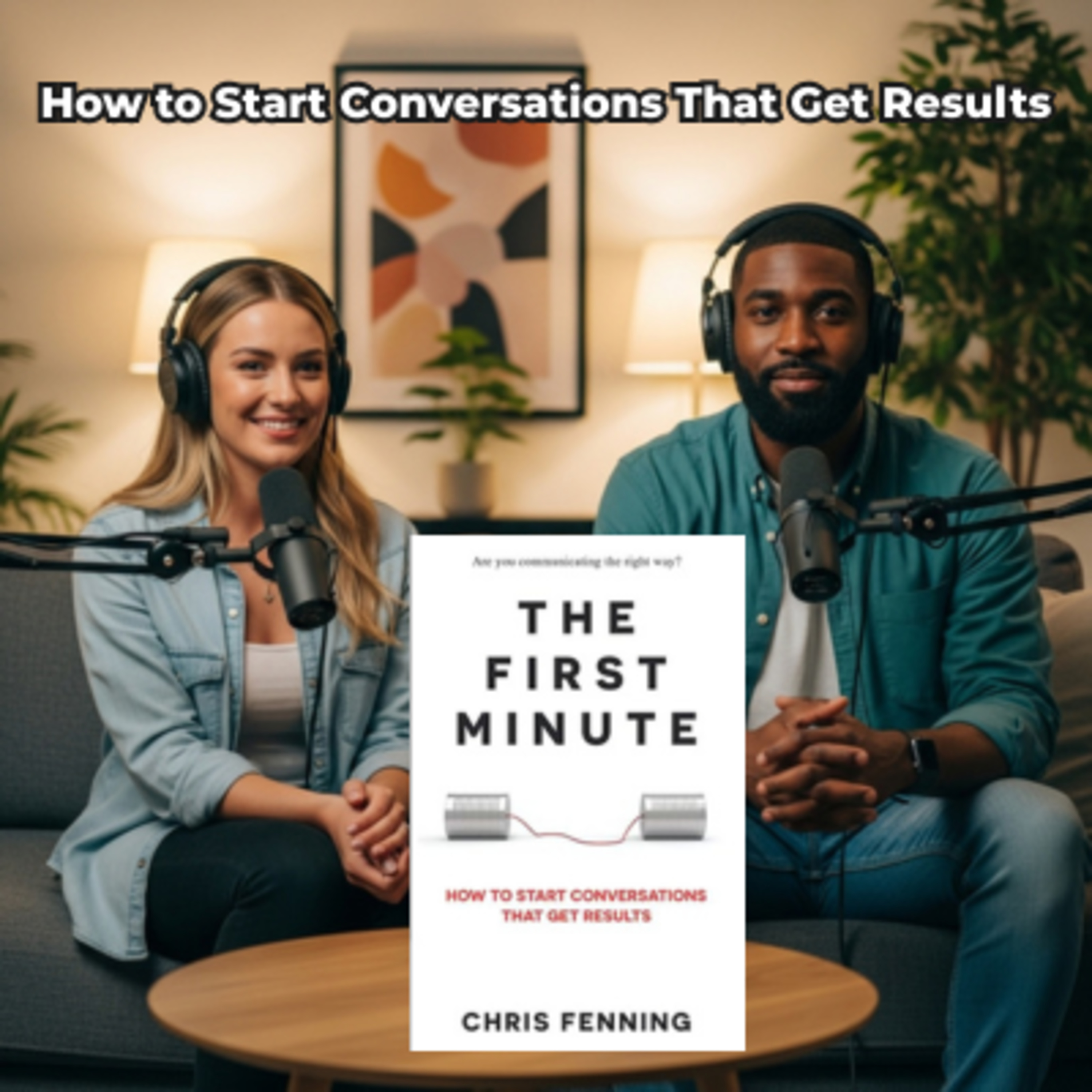
Rambling conversations.
Confusing updates.
Emails that somehow get longer with every reply.
Most workplace communication problems begin in the first minute.
When people do not quickly understand:
- the topic
- why it matters
- what you need
- or what happens next
conversations become slower, more frustrating, and less effective.
The First Minute gives you practical methods to communicate clearly, concisely, and confidently in meetings, presentations, emails, interviews, status updates, and everyday workplace conversations.
Instead of vague communication theory, this book focuses on simple, immediately usable techniques that help busy professionals:
- get to the point quickly
- explain complex topics clearly
- keep discussions focused
- reduce misunderstandings
- communicate effectively with leaders, clients, and teams
- avoid rambling or unnecessary detail
- lead conversations toward decisions and action
Inside the book, you will learn:
- How to structure conversations in the first few seconds
- Practical frameworks including Goal, Problem, Solution (GPS)
- How to quickly explain why something matters
- How to make technical or detailed topics easier to understand
- Methods to improve meetings, presentations, emails, and status updates
- Techniques to sound more organized, clear, and confident
This book is for you if:
- People misunderstand your updates or emails
- You struggle to get to the point quickly
- You work with technical, detailed, or complex information
- You want to communicate more effectively with executives or stakeholders
- You are tired of wasting time clarifying confusing conversations
Based on more than 20,000 workplace conversations and communication coaching sessions, these methods have helped professionals around the world communicate with greater clarity and impact.
Whether you lead meetings, manage projects, present ideas, work with clients, or simply want to communicate more effectively at work, this book will help you make your message clear from the very beginning.
Because when the first minute is clear, everything after it becomes easier.
#TheFirstMinute #ChrisFenning #CommunicationSkills #WorkplaceCommunication #LeadershipCommunication #BusinessCommunication #ProfessionalDevelopment #CareerGrowth #ExecutiveCommunication #CommunicationTips #LeadershipSkills #BookSummary #Productivity #ProfessionalGrowth #CareerSuccess
You know that feeling when you're talking to someone and you can literally pinpoint the exact second their their brain just leaves the room? Oh yeah, it is universally painful. Right, Like your mid sentence, maybe you're prepping for a high stakes pitch or trying to give some, I don't know, nuance feedback to a colleague or honestly just trying to get a point across to a friend and you just see it. The eyes glaze over. The eyes completely glaze over. The lights are on, but nobody's home. You can practically see the little the little buffering icon spinning right above their head.
And the tragedy is the information you're sharing might actually be incredibly valuable, but the connection has just, it's been completely severed. Yeah, and our natural instinct when we see that buffering icon is usually the absolute worst thing we could possibly do. We panic. We panic, We start talking faster or louder or or we try to bury them in this avalanche of facts to just, like, win their attention back. But today we are taking a deep dive into a completely different approach. How much better approach?
Exactly. We're looking at a breakdown at Chris Fenning's book The First Minute, and the mission for this deep dives is to extract the exact practical techniques you need to make every single conversation count. You know, cutting through the noise and fundamentally avoiding that dreaded information overload, which is critical because our goal here isn't just to learn some performative corporate jargon, right? Right. We want to understand the underlying mechanics of why certain communication lands effortlessly and why some of it, well, why some of it fails so spectacularly, right?
And it ultimately comes down to the biology, like how humans physically process and categorize new information. OK, let's unpack this, because frankly, the core premise here starts at the literal beginning, and it makes a pretty bold claim. We're talking about the first 60 seconds, the. Crucial minute. Yeah, the argument is that the first minute of any conversation sets the immutable tone for everything that follows. Like if you are unclear at the start, people simply stop paying attention. But I mean, is that really true?
It sounds a little exaggerated. Are our attention spans genuinely that fragile? Well, it's less about attention span and more about metabolic economics. Metabolic weight like calories. Literally yes. The human brain is a massive energy hog. It accounts for about what, 2% of our body weight? But it consumes nearly 20% of our energy. Oh wow. Right. So because of that, the brain is constantly looking for ways to conserve power. It has to. So when you start speaking to someone, the listener's brain engages in this immediate mechanism of cognitive triage.
Just scanning for threats. Basically exactly. It's asking a rapid fire series of questions like what is this? How much mental energy do I need to spend on this? Is this directly affect my survival, my status, my workflow? And if you don't answer those questions immediately. It just unplugs. It literally shuts the gate to conserve of cognitive fuel. You're talking to a wall. That makes a lot of sense when you frame it as an energy saving mode. It actually makes me think of a movie trailer. OK. I like that.
Imagine going to the theater, right? The lights go down and a trailer comes on, but instead of establishing the plot, it's just two solid minutes of random out of context dialogue and like, chaotic explosions. No title, no voiceover. Right. No title, no setup, no clear genre. It's just a confusing mess now. It doesn't matter if the actual movie is an Oscar winning masterpiece, you're not going to buy the ticket because the trailer gave your brain absolutely no coherent framework to process what you were looking at.
That is precisely the dynamic at play here. The first minute is your trailer. It's the preview that convinces the listener's brain that the next 10 minutes are actually worth spending their mental currency on. But. OK, I want to push back on the application of this a bit. Sure. What if the topic you're bringing to your team is incredibly complex? Let's say you're detailing a massive back end, data migration, or some highly sensitive departmental restructuring. If the goal is absolute brevity right out of the gate, aren't you essentially forced to dumb the topic down?
What's fascinating here is that brevity at the start has absolutely nothing to do with dumbing the topic down. Not at all, really. No, it is entirely about managing cognitive load. We have to look at how human working memory actually operates. Cognitive psychology tells us that working memory can only hold about 3 to 5 discrete items of information at any given time. It's not a lot. It's really not. Think of it as a very small table. If you walk into a room and immediately dump a massive disorganized box of complex files all over that small table it all.
Spills off the edges. Everything spills onto the floor. It's chaos. Being brief and clear in the first minute is just you setting up the table organizers. You're priming the listener, you're giving them the high level category so that when you do get into the highly complex weeds a few minutes later their brain actually has a pre labeled folder to put that information into. OK, so I'm not skipping the complex details, I'm actively building the scaffolding so their brain doesn't just collapse under the weight of those details later.
Which I guess leads us to the specific mechanism for building that scaffolding. We know clarity is the goal, and preventing cognitive overload is the why, but how do we actually do it? The framework relies heavily on this technique called framing. Framing is the absolute foundation of clear communication. I mean, you wouldn't start telling a compelling story from the middle of the third act, right? Right, you'd be totally lied. Exactly. You have to give the listener an idea of what the boundaries of the conversation are right from the jump, and crucially, why they should care about it.
There's a brilliant example of this from the source material. Imagine walking up to a director in your company and just opening with I've got an idea that could save us 3 hours a week and significantly cut overhead costs. Boom. You have their full attention. You've. Instantly hooked them. You haven't explained how you're going to do it yet, but you frame the value immediately. So the actionable tip we pull from this is to literally begin with, and this is a quote. Here's what I want to discuss and why it's important.
And the reason that works so well is because it creates psychological predictability. You know, uncertainty is a massive driver of anxiety in the workplace. Oh, absolutely. When someone approaches you and just starts talking about a process or a problem without a frame, your brain spikes with mild cortisol. You're sitting there thinking, wait, are they complaining? Am I in trouble? Do they need me to fix this right now? Yeah. Your brain is just spinning its wheels trying to figure out your role in the conversation.
Exactly, by stating the what's in the why upfront, you completely remove that anxiety. You allow the listeners nervous system to relax and actually focus on your words. It's like handing someone 1000 piece jigsaw puzzle framing is showing them the picture on the front of the box first. Oh, that's a great way to put it. Right. If you just jump 1000 tiny cardboard pieces on the table without showing them the final picture, they're going to be so overwhelmed they might just walk away. But if you show them the box and say, hey, we are building a picture of a sailboat, suddenly every little blue piece makes sense.
They know the blue pieces are sky or water. They have context. Without the frame, every piece of data you share is a cognitive burden. With the frame, every piece of data is a helpful, satisfying addition to a picture they already understand. The sailboat analogy tracks beautifully, but, and I do have a hesitation regarding the execution of this. Let's hear it. If I'm sitting down for like a casual coffee chat with a EER and I stiffly announce here's what I wanted to discuss and why it is important, does that risk alienating them?
I mean, it feels a little robotic, almost like I'm reading from a corporate script rather than just having a human interaction. Sure, Yeah. If we connect this to the bigger picture of social dynamics, we have to recognize that the concept of framing is what matters, not necessarily the rigid phrasing. OK, so you don't have to sound like a robot. No, please don't. The underlying function is psychological readiness. You absolutely must adapt the execution to the environment you're in. Like in a formal board presentation.
Yes, use the formal phrasing, but in the break room with a peer, your frame might just be hey, I had a quick thought about Tuesday's client presentation that might make our lives way easier tomorrow. Got a second? Oh, I see you've still done exactly what the framework demands, right? Yeah, you stated the topic and you stated why they should care, but you've matched the casual social tone of the room. That distinction is incredibly helpful. It's about the architectural function of the sentence, not the specific vocabulary.
Precisely. O let's say we've mastered those first 60 seconds, we've shown them the Uzzle box, we've bypassed the brain's energy saving mode, and we're now actively sharing our detailed, complex information. But if we just talk at them for the next 15 minutes, we're likely to lose them all over again, right? Without a doubt. And this is where a lot of highly intelligent, well prepared people completely drop the ball. They just keep talking. They nail the introduction and then they essentially filibuster.
They fall in love with their own explanation, but we have to recognize the friction points in continuous communication. The framework emphasizes the absolute necessity of integrating time checks and validation checkpoints. Right, the idea of pausing to actively check if the listener is still with you. It sounds simple enough, like asking, Does that make sense or do you follow? Yes, but you'd be surprised how few people actually do it. The. Logic makes total sense though. You want to catch misunderstandings at Step 2 rather than rushing through your entire 20 minute presentation only to find out they got lost at minute 3.
Really. To read the room, look for the furrowed brows, that kind of thing. It's. Also a fundamental issue of nonverbal respect. Honestly, time consciousness. If you sense a meeting is dragging or the energy is dipping, having the situational awareness to summarize quickly and move on shows you value their day as much as your own it. Feels a bit like guiding an Alpine expedition. OK, I'm intrigued. Go on. Well, you're the leader, right? You're cutting the path, but you can't just March forward staring at the summit.
You have to constantly check the tension on the rope behind you, because if the rope goes slack, it means someone fell into a crevasse a mile back and you've just been dragging dead weight. You had to turn around and check the wine. I love that image because it highlights the interconnectedness of the process. You cannot successfully guide people who are no longer on the rope with you. Exactly. But let me play devil's advocate on the mechanics of checking that rope. If I'm explaining a new software integration to my team and I keep stopping every 4 minutes to ask, do you understand?
Or does that make sense? Isn't there a high probability I'm going to trigger a defensive reaction? Like I worry I might come across as patronizing, like a frustrated school teacher, or conversely, that I sound deeply insecure about my own material. This raises a really important question about the psychology of defensiveness in the workplace. Because you're right, if delivered poorly, A validation checkpoint doesn't feel like collaboration. It feels like a pop quiz, right? And no one likes the pop quiz.
And pop quizzes trigger the brain's amygdala. They trigger a status threat. No one wants to look stupid in front of their colleagues by admitting they don't understand something it. Just puts them on the spot. The secret lies entirely in how you distribute the burden of clarity The. Burden of clarity. Yes, you aren't asking do you understand to test their intelligence. You should be asking questions to test your clarity. So if you shift the phrasing slightly to did I that clearly or I know I just threw a lot of data out there.
What are your thoughts on that piece before we move on? You completely disarm the threat response. You transform the checkpoint from an interrogation into psychological safety. It makes them a copilot rather than a student being graded. That is a massive paradigm shift. Did I explain? That clearly takes the burden of comprehension completely off of them and puts the burden of delivery on me. That instantly diffuses the tension. It's. Magic. But here's where it gets really interesting. The validation checkpoints are working.
You're checking the rope tension. But what if the climbers on your expedition require totally different pacing? The framework moves into this vital concept of understanding and adapting to the audience. Because of the brutal reality of communication is that one size emphatically does not fit all. You simply cannot use the same communication template for a CFO that you use for a junior developer. There's a really illuminating anecdote from the source about this. The author, Chris Fenning talks about early in his career when he tried presenting to a group of senior executives using the exact same detail heavy style he used with his engineering team.
I can. Imagine how that went. It bombed spectacularly. The executives were visibly bored and irritated. And he realized eventually that executives need big picture ideas and bottom line results. But his engineers, they crave the granular details on exactly how the architecture would be built. So the actionable insight is that you have to categorize your audience. Are they detail oriented or big picture focused? And you have to do that before you draft a single slide. It's an exercise in overcoming your own ego, really.
We usually default to communicating in the way we prefer to process information. If you're a detail person, you inherently believe the details are the most fascinating part, so you force them on everyone else. Yeah, look at all my cool spreadsheets. Exactly. But empathy and communication means stepping outside your own preferences and asking what does this specific brain need to hear to make a decision. Executives operate on decision matrices that require high level variables. You know, time cost.
Risk engineers operate on execution models that require methods, dependencies, and sequence. It reminds me of being a D. J the DJ OK. Yeah, like if you were booked to play a corporate retirement party for a bunch of 60 somethings at 2:00 PM on a Sunday, you are not going to play the exact same 140 BPM techno set list that you'd play at an underground nightclub at 2 AMI Hope, right? You might be playing the exact same instrument using the exact same speakers, but you have to read the room's energy and adapt the music to the specific biology and preferences of the people standing in front of you.
Precisely. If you stubbornly play the club set at the retirement party just because it's your style, it doesn't matter how technically flawless you're cross fading is, the audience is going to hate it and you failed at your job. But what about the ultimate nightmare scenario? How do you handle a mixed room? The mixed room. Because in the real world, audiences aren't perfectly segregated. What if you were presenting to the big picture executive boss, but the highly detailed oriented head engineer is sitting right next to them at the exact same table?
You play the club track, you lose the boss. You play the jazz track, you lose the engineer. How do you not alienate half the room? That is the advanced class of communication, but the solution actually synthesizes everything we've unpacked so far. You use a structured chronological funnel approach A. Funnel approach, meaning you start wide. Yes, you start incredibly broad to satisfy the executive. You deploy your first minute frame. You deliver the bottom line results, the time and money saved. You satisfy their neurological need for the big picture immediately.
Then, and this is key, you actively and verbally signal a transition. Like telling them you're shifting gears. Exactly. You say something like, OK, that is the high level strategic view now for the engineering team, I want to pivot and dive into the specific technical architecture of how we actually build this over the next three months. Oh, I see. You're explicitly managing their expectations in real time. Exactly. By doing that, you've given the executives brain permission to relax. They have their variables they can check out or half listen to the rest without anxiety, and simultaneously you've promised the engineer that they're required.
Details are coming right now. You satisfy both conflicting cognitive needs by structuring the flow of information sequentially and signposting exactly where you are in the journey that is. Brilliantly tactical. So let's say you've successfully navigated the mix room, the meeting is wrapping up and you've tailored your message perfectly. But human memories? Well, notoriously terrible. It really is. How do you guarantee the executive and the engineer don't walk out that door, get distracted by an e-mail, and immediately forget the customized message you just delivered?
Which brings us to the final piece of the puzzle, the habit loop and the power of summarization. The exit from a conversation is arguably just as critical as the entrance. Psychologists talk about the recency effect, the cognitive bias where humans best remember the most recently presented information. So if you end a complex 30 minute meeting on a random minor tangent about AI don't know a minor bug fix, that tangent is what they will remember. So you have to leverage that recency effect intentionally.
The advice from the source is to keep your summaries brutally short and perfectly clear using a simple anchor phrase like to sun up. The main action item we're taking away is. But the broader take away here is about the transition from theory to practice. These aren't just neat psychological tricks to passively agree with, they are skills that require active behavioral change. You have to practice. Yeah, the recommendation is to practice framing, checking in and summarizing in extremely low stakes environments, like figuring out weekend plans with your spouse or picking a lunch spot with a friend long before you try to deploy them at high states board meeting.
Because under pressure, your brain relies on habituated neural pathways. You don't magically rise to the occasion during a stressful pitch. You fall to your highest level of automatic preparation. But I'll. Be honest, when you lay it all out like this, it sounds incredibly overwhelming. It's a lot to juggle. It is. I mean, I have to remember my 62nd clarity. I have to design the puzzle box frame, I have to constantly monitor the rope tension without triggering their threat response, I have to adapt to my DJ set list on the fly for mixed audiences, and then I have to exploit the recency effect with a crisp summary.
That's quite the list. How do you prevent yourself from experiencing cognitive overload while trying to process all this social data simultaneously? It is a completely valid concern when you first start applying these mechanics. It will feel clunky, It will feel exhausting. But think about it like cutting a new path through a dense, overgrown jungle with a machete. OK, the first time you try to hack your way through it requires massive, conscious, agonizing effort. Every swing is deliberate. But if you walk that same path every day in those low stakes environments you mentioned, you clear away the brush, The path gets wider.
Eventually he gets paved. Just becomes muscle memory. Neurologically, yes, you are insulating those pathways with myelin through repetition. What once required massive conscious effort morphs into unconscious competence. You won't have to actively think about framing or checking the rope, your brain will just default to it naturally. It is incredibly reassuring. It's just about putting in the reps to widen the path. So looking back at our journey today on this deep dive, we started with the biological reality of the 1st 60 seconds.
Recognizing that preventing cognitive overload beats flashy rhetoric every single time, we learned to show the puzzle box right away by framing the Y, lowering the listeners anxiety. We unpack the necessity of checking the Alpine rope with validation checkpoints, carefully phrasing them to ensure we don't trigger a defensive threat response. Shifting that burden of clarity. Exactly. We explored the DJ mindset, adapting our data for whether the audience needs executive summaries or engineering details, and managing mixed rooms with a funnel approach.
And finally, we lock it all in by leveraging the recency effect with a crisp summary, building the muscle memory in the shallow end. It is a remarkably cohesive, psychologically grounded framework for ensuring that the message you intend to send is actually the message that lands. But I want to leave you with one final, slightly provocative thought that builds on everything we've discussed today. Oh, I am all ears. Let's hear it. Throughout all this material, the focus is heavily, almost exclusively, on using this framework to ensure others understand you.
It's an outwardly focused tool. But consider this. What if the true hidden power of this framework is entirely internal? Think about the process. If you force yourself to frame your scattered idea, to distill it down to its absolute clearest 62nd essence, and to formulate the summary in your own head before you ever open your mouth. Is it possible that this communication tool is actually the ultimate life hack for clarifying your own thoughts before you can successfully build the scaffolding for someone else's brain?
This framework ruthlessly forces you to organize the chaotic files on your own mental table that. Fundamentally changes how I view this. The tool isn't just fixing the external conversation, it's auditing the internal thought process itself. Like if you can't build the 62nd frame in your own mind, you essentially have no business bringing it to a meeting yet because you don't actually know what you're trying to say. Precisely, it holds an unforgiving mirror up to your own understanding of your own material.
I absolutely love that. What a perfect, profound way to wrap this up. Thank you so much for joining us on this deep dive. Our challenge to you, the listener, is highly practical. Try it out sometime today in your very next conversation. Whether you're pitching a massive project timeline to a client or just texting a friend to figure out where to grab dinner tonight, try actively using a 62nd frame. State exactly what you want to discuss and why it matters to them, because the next time you start speaking, your ideas deserve better than watching the lights go out in the other person's eyes.
Until next time.
 Apple Podcasts
 Castbox
 Castro
 Goodpods
 Moon FM
 Overcast
 Pocket Casts
 Podbean
 Podcast Addict
 Podcast Republic
 Spotify