How to Build Value Through Values | Conscious Business by Fred Kofman
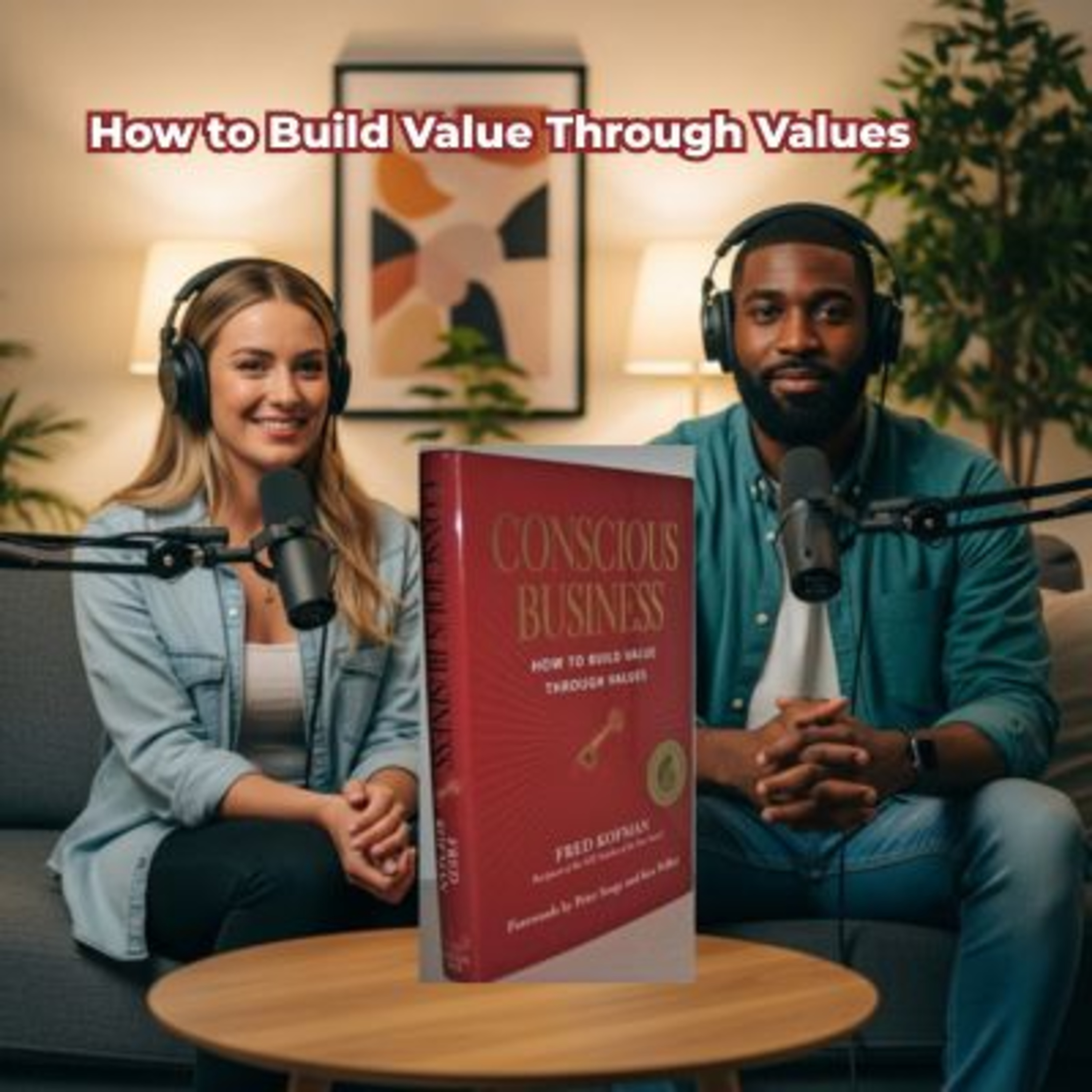
Consciousness is the main source of organizational greatness. Conscious business, explains Fred Kofman, means finding your passion and expressing your essential values through your work. A conscious business seeks to promote the intelligent pursuit of happiness in all its stakeholders. It produces sustainable, exceptional performance through the solidarity of its community and the dignity of each member.
Conscious Business presents breakthrough techniques to help you achieve:
- Unconditional responsibility—how to become the main character of your life
- Unflinching integrity—how to succeed beyond success
- Authentic communication—how to speak your truth, and elicit others' truths
- Impeccable commitments—how to coordinate actions with accountability
- Right leadership—how being, rather than doing, is the ultimate source of excellence
A conscious business fosters personal fulfillment in the individuals, mutual respect in the community, and success in the organization, teaches Fred Kofman. Conscious Business is the definitive resource for achieving what really matters in the workplace and beyond.
This episode outlines five fundamental principles derived from Fred Kofman’s teachings to help professionals operate with greater purpose and awareness. The author emphasises unconditional responsibility, urging individuals to focus on their own reactions and solutions rather than assigning blame during setbacks. By maintaining essential integrity, workers align their daily actions with their core moral values to build lasting organisational trust. The source also highlights ontological humility and authentic communication, which involve staying open to diverse perspectives and speaking with honest vulnerability. Finally, the concept of constructive negotiation encourages a collaborative mindset that seeks mutually beneficial outcomes rather than competitive victories. Through these lessons, the text illustrates how emotional mastery and conscious choices can transform workplace culture and personal effectiveness.#ConsciousBusiness #Leadership #EmotionalIntelligence #WorkplaceCulture #PersonalDevelopment #BusinessLeadership #Accountability #ProfessionalGrowth #CommunicationSkills #LeadershipDevelopment #BusinessPodcast #OrganizationalCulture #MindsetShift #BookSummary #SuccessMindset
Imagine you're sitting in a a sterile, slightly too cold conference room. You know the. Kind. Oh, absolutely. The classic corporate freezer, right? And you just realized you missed a massive deadline? Like it is probably going to cost the company A6 figure account. That is a terrifying feeling. It is. Your heart is just pounding in your ears, and in a fraction of a second, your brain starts desperately scrambling for a scapegoat. Just looking for anyone else to blame. Exactly. You think, well, it was the faulty project management software.
Or, you know, it was the client who changed the scope of the last minute. Or maybe that Co worker who was 12 hours late sending you a crucial file. Yes, literally anything to avoid the reality that the ball dropped on your watch. It's just pure survival instinct. I mean, in that moment, taking the blame feels like a physical threat to your identity and your livelihood. Yeah, your job is on the line. Exactly. The brain treats a threat to your professional status exactly the same way it treats a predator in the wild.
It just triggers a fight or flight response. So you either want to like fight someone else on the team, or just flee from the responsibility entirely. Flea and hide, yeah. But doing either of those things usually just makes the exhaustion of the modern workplace so much worse. I mean, we're all running on this treadmill of stress. Right. Pointing fingers, putting out fires all day. And the advice we always get is to just, you know, put our heads down and grind harder. But today, we're looking at a framework that asks you to do the exact opposite of what your survival instinct is screaming at you to do.
Which is so incredibly counterintuitive. It really is. Today's deep dive is pulling from some really fascinating concepts from Fred Kaufman's book Conscious Business. Specifically, we're breaking down what he calls the Five Pillars of Conscious Business Success. And the overarching mission of this deep dive is to explore a total paradigm shift. What if the secret to handling stress and, you know, not feeling entirely drained by Friday at 5:00 PM isn't actually about working harder? What you mean I don't just need to drink more coffee and sleep less?
Surprisingly, no. What if it's about completely restructuring how you react to crises, how you communicate, and how you work with purpose? I love that. Yeah. So we are going to extract the core mechanisms of this approach, looking at things like integrity, humility and communication and really see how they function when the pressure is actually on. OK, let's unpack this by saying right there in that freezing conference room, the disaster just happened. In six figure disaster, right? And the instinct is to point fingers.
But Kaufman's framework introduces this concept called unconditional responsibility. Unconditional responsibility. Yeah, the idea here is that regardless of external circumstances, even if the software really did crash or the Co worker really was late, you always have the power to decide your reaction. Which is, I mean, let's be honest, a very bitter pill to swallow when you genuinely feel you were wronged by someone else's incompetence. 100% it feels incredibly unfair. But looking at the psychology of it, searching for justifications, actually reinforces A victim mentality.
How so? Well, it signals to your brain that you're powerless, that you are just at the mercy of strict timetables and, you know, broken coffee makers. It's like you're just a passenger. Exactly. Think about it like being the project manager for a massive house build. You hire a plumber, the plumber installs the pipes incorrectly and overnight the entire basement floods. A total disaster. Right now, is it your fault the plumber messed up? No, you didn't solder those pipes. But whose house is flooding?
Yours. Yours. You are still the project manager. You still have to grab a bucket, shut off the main valve, and figure out how to dry out the drywall. You can't just stand there. No, you don't just stand in waist deep water yelling at the plumber while the house rots. Unconditional responsibility is realizing you own the reality of the flood, regardless of who caused it. And by claiming that ownership, you immediately regain your agency. You stop being a victim. In fact, the source notes detail a scenario where a professional missed a crucial deadline and instead of throwing the team under the bus, they just stepped back.
They didn't point fingers. Nope, they looked at the wreckage. Without trying to assign blame, they went to their team mates and simply laid out the difficulties they were experiencing. And the mechanism here is what fascinates me. They asked what could I have done better and how can I help resolve this right now exactly? They shifted the brain's focus from the past, which is unchangeable and just causes anxiety, to the future, which is actionable. It's a total pivot, and by doing that, they actually modified their workflow with the team.
They didn't just survive the missed deadline, they fortified the partnership moving forward. So once you take the wheel and know your actions, how do you decide which direction to steer? Because that brings us to your internal compass. Right, because once you stop seeing yourself as a passenger and start acting like the project manager of your own career, you have to figure out how to navigate the fallout. Which is where things get really messy. So messy. Let's say you take ownership of that missed deadline.
The very next thing that happens in many corporate environments is the cover up. Oh yeah, the classic scramble to hide the mistake. You walk out of the conference room and a senior Co worker pulls you aside and says look, the client doesn't know we missed the deadline yet, let's just fudge the timeline. Just tweak the dates right? We will backdate the forms, tell them the system was down and buy ourselves a weekend to fix it. And this brings us to the second pillar, the necessity of essential integrity.
Essential integrity, yeah. It is the practice of maintaining your moral principles even when you are facing immense peer pressure to abandon them. It's about coordinating your behavior with your genuine beliefs. OK, I have to play devil's advocate for anyone listening who has been in this exact scenario, because this is incredibly difficult to do in the real world. Oh, it's agonizing. When your boss or someone who literally controls your promotion trajectory is actively pressuring you to bend the rules, I mean, standing up to them feels like career suicide.
It does. Isn't it so much easier to just comply and say sure, let's backdate the forms? It absolutely is easier in the short term because peer pressure is an evolutionary mechanism designed to force conformity. To keep us in the tribe. Exactly. Historically being exiled from the tribe meant death. So when your boss pressures you, your amygdala just fires up and your brain prioritizes immediate safety over long term morality. Wow, so we're literally wired to cave under that pressure. Yes, but the source material provides A surprisingly simple physical pattern interrupt for this.
This is the tip about keeping a visible list of your basic principles right on your desk, right? Yeah. Just a physical piece of paper next to your keyboard. With words like integrity, honesty, teamwork. Exactly because under acute stress your brain shifts to rapid instinctual processing, you lose access to complex moral reasoning. You just want to survive a conversation. Right. Having a physical visual cue forces cognitive friction. It forces your eyes to look at a word, process its meaning, and re engage the prefrontal cortex.
So it slows you down. It prompts you to do a quick internal check in, like does lying to this client align with my values? It grounds you, preventing you from just blindly reacting to the dominant personality in the room. There is a scenario highlighted in the text about a team debating whether to hide less than ideal news from a client. Oh, that's a great example. The tension was massive. Do they tell the truth and risk losing the whole account or do they just gloss over it? What's fascinating here is the psychology of what they chose to do and the result.
Yeah, they chose to speak honestly, and the text notes it was terrifying, like stepping out on a tightrope without a net. But they refused to withhold the truth. Right. And the incredible thing is, the client actually expressed immense gratitude for their candor. They didn't get fired. They developed invaluable trust. Which makes perfect sense biologically. People, whether they are clients or colleagues, have an incredibly sharp subconscious radar for authenticity. We can smell a lie. We can. We evolved to detect deception because trusting a liar is dangerous.
When your behavior consistently aligned with your stated principles, it signals predictability and safety to the primate brains of everyone around you. You become a known quantity. Exactly. Essential integrity is not just about feeling morally superior. It is the literal biological foundation of workplace credibility. But having strong personal principles doesn't mean you're always right. Not at all. True integrity requires the humility to recognize your own blind spots. OK, so you took responsibility for the flooded house.
You maintained your integrity and told the client the truth about the delay. The hard part is done right. You wish. Now you actually have to fix the problem. So you call a brainstorming session, you pitch your grand idea to fix the workflow and immediately a Co worker shoots it down and says no that won't work, we need to do it this way instead. And boom, we are right back to the fighter line response. Your heart rate spikes, your face gets hot. You immediately start formulating your rebuttal while they are literally still talking.
Because your instinct is to defend your idea like it's a fortress under siege. Exactly. But if we want to actually solve the problem, we have to deploy what the source calls ontological humility. I know it is a very dense term. It sounds like a philosophy class. But the underlying concept is vital. Ontological humility is just the realization that your comprehension has limits. OK, your perspective is not objective reality. It is just a perspective colored by your specific experiences and your specific blind spots.
Here's where it gets really interesting. I think it is like upgrading your phone software. Oh, I like that analogy. When your phone gets a notification that a new operating system is available, you do not get defensive. You don't feel insulted by Apple? No, you don't yell at the screen. My current software is flawless. How dare you suggest I need an update? You click accept because you know the new data is going to fix bugs and make the whole system run more efficiently. Right, we accept the phone update effortlessly because it doesn't threaten our ego.
But when a Co worker suggested an update to our ideas, we perceive it as a threat to our competence. We take it so personally. So personally, ontological humility is consciously deciding to accept a software update for your brain. You are taking in new data from others to improve your own processing power. But to install that update, you actually need a physical practice. The text suggests that the moment you feel that heat rising in your chest, you notice you're getting defensive. You deliberately remind yourself that you do not hold all the solutions.
And you do something very physical. You literally take a deep breath. That deep breath is not just metaphorical. Oxygenating the blood actually helps regulate the nervous system, bringing you out of that defensive posture. So instead of arguing, you force yourself to ask a question. The notes highlight a very common brainstorming clash regarding this. Right. An individual felt very strongly about their specific method for a job, and a teammate presented a completely different, contradictory idea.
Total collision. The initial reaction was pure disagreement, but they use this mechanism. They took the breath. They suspended their ego just long enough to ask for additional information about the teammates approach. And by simply asking, can you explain how that would work? How they completely removed the friction? Just one question changes the whole dynamic. Yes, they saw the promise in the new approach, combined the ideas and achieved A remarkably better outcome. The ripple effect of this practice is just profound.
Because it's contagious. Exactly. When you are receptive to other people's perspectives, you remove the fear of judgement from the room. You create psychological safety, which is frankly the only environment where true creative problem solving can occur. So you've opened your mind to others, Now how do you actually open your mouth and share your own truth without causing a localized explosion? That is the tricky part. Because you've got this great combined idea, but you still have to communicate the logistics of this fix.
And let's be real, the team is probably stressed overwork and walking on egg shells because of the initial crisis. Oh, the tension in that room is thick. You are in a meeting. Everyone is talking at each other, not with each other. The air is just heavy with unspoken frustration. And this is where the source introduces authentic communication. And it requires 3 distinct layers. Being entirely honest with yourself about your emotional state, making room for others to do the same, and engaging in deep, active listening to Foster Ties.
But here's my question. How do you actually speak from the heart in a corporate environment without crossing the line into oversharing? Right, nobody wants that. There is a very fine line between authentic communication and treating your project team like your personal therapist. You don't want to walk into a room and just dump all your anxiety on the table. You absolutely do not because emotional dumping just triggers anxiety and everyone else. The key is in the architecture of how you share. The architecture.
Yeah, the source material breaks down a scenario where an individual was feeling incredibly frustrated and overwhelmed by a project problem. Now, the standard corporate instinct is to either bottle that up until you become resentful, or to lash out aggressively at like a junior staff member. Right, just kick the dog. Yeah. But instead they chose to speak up, saying I'm feeling a little overwhelmed right now. I'd love to hear your ideas on how we can tackle this together. If we connect this to the bigger picture, let's dissect why that specific phrasing work so beautifully.
That's good. First, they named the emotion overwhelmed. In cognitive science, this is called effect labeling. Effect labeling. Yes, naming an emotion immediately de escalates the amygdala and shifts the brains processing to the prefrontal cortex, the logical center. Wow, so just saying I'm overwhelmed physically calms your brain down. Exactly. But more importantly, they immediately paired that vulnerability with an invitation for collaboration. How can we tackle this together? Right. They didn't make their feelings the team problem to solve.
They use their feelings to humanize the situation and invite partnership. They use vulnerability to create a safe space. Exactly. An authentic communication is inherently reciprocal. The framework points out that active listening is the other half of this equation. It's a two way St. It is active listening isn't just silently waiting for your turn to speak while you secretly plan your next sentence. Guilty as charged. We all do it, but real active listening is fully focusing on the other person and genuinely appreciating their perspective.
When you fully listen, you guarantee that your teammates will provide honest feedback in return. So you are working with the actual facts of the situation, not the polite, sanitized fictions people usually share in corporate meetings. Exactly. The masks come off. OK, and when people are finally speaking honestly and all the polite fictions are gone, all the cards are on the table. Disagreements are absolutely inevitable. That brings us to our final pillar, how to handle those clashes, because they will happen.
You are going to clash over how to execute the solution. The notes refer to this final phase as constructive negotiation. Constructive negotiation OK, let's set the final scene. You and a Co worker have completely different ideas on how to allocate the remaining budget to fix this project. Classic turf war. Yep. They want to spend the money on rushing the manufacturing. You want to spend it on expedited shipping. There is an impending confrontation. Tempers are flaring. And the tech says the key here is abandoning a competitive attitude for a collaborative one, finding solutions that satisfy everyone.
So what does this all mean? I need you to prove this to me because in the real world, someone has the bigger budget, someone has more authority. Isn't collaboration in this context just corporate speak for compromise? That's a very common assumption, right? And isn't a compromise just a situation where everyone gives up a little bit of what they want and both parties leave the room feeling slightly resentful and unhappy with a watered down result? Well, that is the traditional 0 sum view of negotiation.
It assumes the pie is a fixed size and every slice I take is a slice you lose, right? But constructive negotiation doesn't ask you to divide the pie differently. It asks you to change the nature of what you are baking entirely. OK, I like that. Is a fundamental shift toward creative problem solving. But how does a mindset shift change the literal math of a budget? I mean, if we only have $10,000 left, we can't magically think our way into 20,000. No, it doesn't print money, but it changes what you are buying with it.
The text provides the exact phrasing to pivot this dynamic. What's the phrase? Instead of loudly expressing your own demands and digging your heels in, you stop the argument and ask one question. What can we build jointly that will satisfy both of us? What can we build jointly that will satisfy both of us? Wow, that completely changes the geometry of the conversation. It does. You are no longer 2 opposing forces pushing against each other from opposite sides of the table. You take your chairs, you move them to the same side of the table, and you look at the problem together.
Exactly. There is a story in the notes about this exact type of disagreement over resource allocation. Everyone was fighting over who should get what percentage of the resources. Just battling it out. Right. But they applied this principle. They clearly communicated their core needs, not just what they wanted, but why they needed it. And the outcome proves this isn't just a slightly unhappy compromise, right? Totally. By focusing on comprehending the underlying needs of the other party, they discovered that one department needed the funds early in the quarter, while the other only needed them at the.
End They didn't have to split the budget down the middle and leave everyone underfunded. They staggered the allocation. They found a third option that wasn't just a compromise, but actually better for the project's overall outcome. And because they approached the negotiation with an open mind, it promoted unity. Everyone departed feeling respected and valued, rather than feeling like they had to concede their territory just to keep the peace. Looking at the whole picture, it is amazing how these five concepts interlock like gears in a watch.
They really do support each other. I mean, you cannot successfully execute that kind of constructive negotiation without authentic communication. You have to be able to state your underlying needs honestly. But you can't have authentic communication without ontological humility. You must be open to actually hearing the other person's needs without your ego getting in the way, right? And you can't maintain that humility without essential integrity. You have to know your own core values so you don't just fold under pressure or give up your.
Boundaries. And none of it works. The entire system falls apart unless it is built on the absolute bedrock of unconditional responsibility. Pillar #1. Yes, you have to be the project manager of the flooding house. You have to decide that you are going to pick up a bucket and put these tools into practice instead of standing around blaming the plumber. The ultimate goal here, as laid out in the excerpts we reviewed, is to completely change how you operate under pressure. A total paradigm shift. And there is a direct request from the material that we want to pass along to you.
If you found these mechanics useful, apply them. Test them out in your own life. See what happens. Yeah, share this deep dive with someone who is constantly overwhelmed or could benefit from a new approach. And of course, subscribe and like to keep getting insights that help you advance both personally and professionally. As we close out this deep dive, I want to leave you with one final thought to Mull over. The very first concept we discussed tells us that we always have the power to decide our reaction.
The steering wheel is always in your hands. Exactly. So think about a difficult conversation or a tense meeting that you have been dreading this upcoming week. You know the. We all have one on the calendar. Maybe your heart rate is already spiking just thinking about sitting in that room. If you walked into that specific conversation right now, which is an ounce more ontological humility, just opening your mind to the possibility that your software needs an update, how completely different could the outcome be?
 Apple Podcasts
 Castbox
 Castro
 Goodpods
 Moon FM
 Overcast
 Pocket Casts
 Podbean
 Podcast Addict
 Podcast Republic
 Spotify