How Great Leaders Build Trust and Get Extraordinary Results | Conversational Intelligence by Judith Glaser
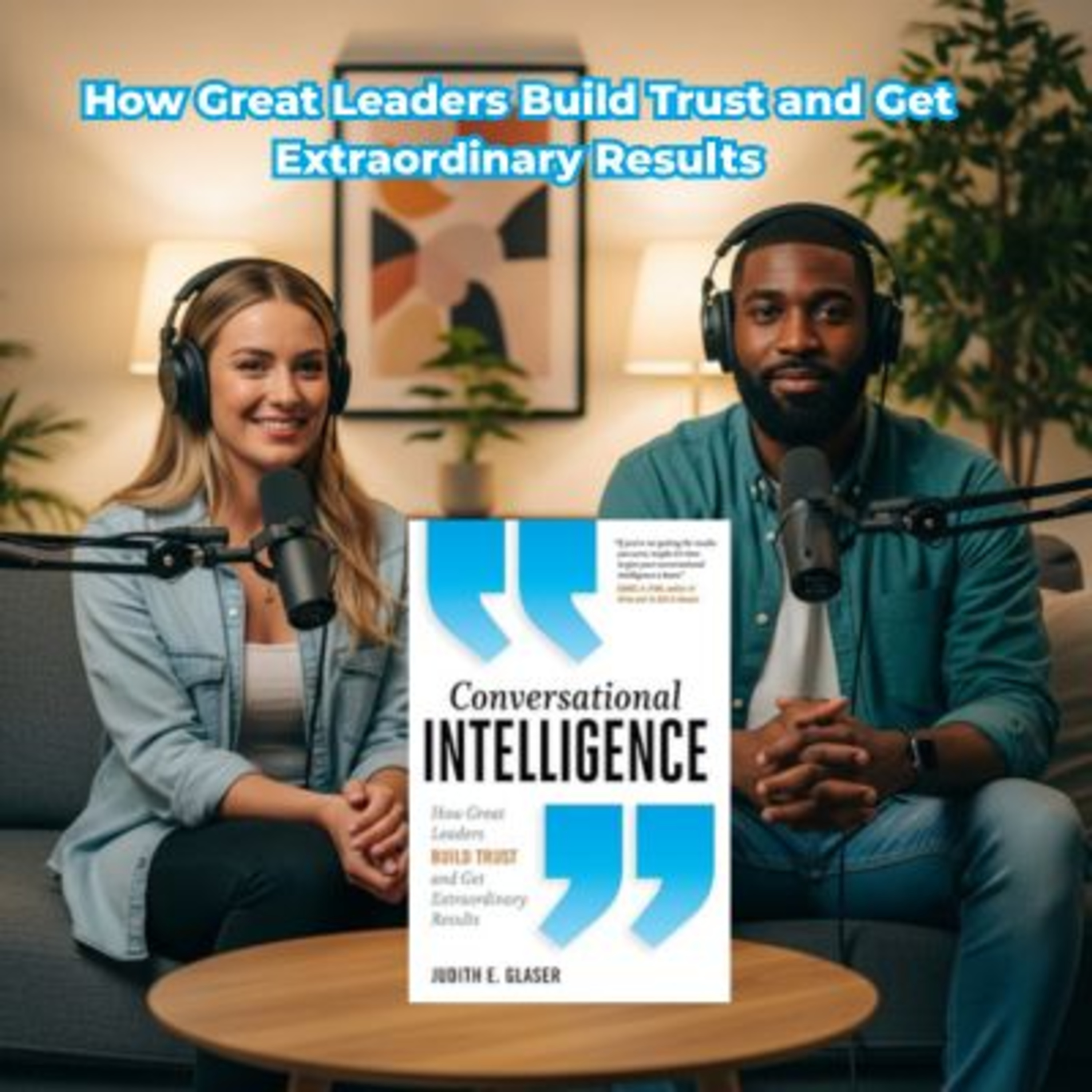
The key to success in life and business is to become a master at Conversational Intelligence. It's not about how smart you are, but how open you are to learn new and effective powerful conversational rituals that prime the brain for trust, partnership, and mutual success. Conversational Intelligence translates the wealth of new insights coming out of neuroscience from across the globe, and brings the science down to earth so people can understand and apply it in their everyday lives. Author Judith Glaser presents a framework for knowing what kind of conversations trigger the lower, more primitive brain; and what activates higher-level intelligences such as trust, integrity, empathy, and good judgment. Conversational Intelligence makes complex scientific material simple to understand and apply through a wealth of easy to use tools, examples, conversational rituals, and practices for all levels of an organization.This episode explores the concept of conversational intelligence, focusing on how the quality of our dialogue determines the level of trust and success within relationships. It highlights that communication can be categorised into three distinct stages, ranging from transactional exchanges to high-level collaborative partnerships. By moving beyond simple persuasion and focusing on genuine connection, individuals can trigger positive neurological responses that foster innovation and safety. The author emphasises that active listening without judgement is a vital tool for transforming tense interactions into productive discussions. Ultimately, prioritizing transparency and vulnerability allows teams to solve complex problems and achieve superior results together. This guide serves as a practical framework for anyone looking to improve their interpersonal dynamics through mindful speech.
#ConversationalIntelligence #Leadership #CommunicationSkills #EmotionalIntelligence #TrustBuilding #LeadershipDevelopment #BusinessLeadership #WorkplaceCulture #ProfessionalGrowth #Teamwork #Communication #BusinessPodcast #BookSummary #PeopleSkills #PersonalDevelopment
So I want you to think about the physical sensations in your body during the last truly tense conversation you had. Oh yeah, we all have one of those burned into our memory. Right, you know the exact scenario. Maybe it was like a product road map discussion that just went completely off the rails. Or sit down with your manager that turned unexpectedly adversarial. Exactly. Your heart rate elevates just a little bit, your vision kind of narrows and you're sitting in that room and you suddenly realize everyone is just talking at each other.
Yeah, nobody's actually talking with each other. Right. The air just feels dense, defenses are visibly up, and absolutely nothing productive is getting done. You just walk away feeling physically exhausted. Oh, completely drained. And when you dissect that moment, you know, and look at the underlying mechanics of what went wrong, the missing ingredient in the room wasn't intelligence, it wasn't data. It was trust. Yeah, it is a universally draining experience and it happens because we fundamentally misunderstand what a conversation even is.
Well, we treat these interactions as like simple data transfers. We completely ignore the invisible, high stakes biological mechanisms that are running right underneath them. We assume we're just exchanging information when in reality we are triggering cascading chemical reactions in each other's brains. Which is wild to think about. And that is exactly why, for today's Deep Dive, we are pulling back the curtain on that hidden neurobiology of trust and communication. It's fascinating stuff. It really is.
We're synthesizing insights from Judith E Glaser's groundbreaking framework on conversational intelligence. We want to understand the actual mechanics of our daily interactions. Yeah. And the mission for you today is to learn how to use this biological reality to, you know, transform your conversations to take them from frustrating dead end transactions into deep, productive connections. I love that. Think of your daily conversations like an operating system running in the background of your life, right, Right.
Most of us are walking around running on a severely outdated version, and today we're downloading the patch. I like that analogy. And to install that patch, we have to start by completely shifting how we view the act of talking itself. OK, Lay. It on me. So we have this tendency to think of conversations as just a mirror reflecting our reality, right? We use words to report on a project status or to pass along instructions. Sure. Just the facts. Exactly. But conversations do not just report on reality.
They actively construct the reality of our relationships, our corporate cultures and even our physical environments. OK, let's unpack this. Because the idea that conversations literally build our reality, I mean, it sounds a little abstract. It does, yeah. Until you look at the mechanics of leadership. If you have a boss who runs a meeting by constantly interrupting, dominating the floor, firing off rigid orders, who? All had that boss. Right. They aren't just communicating poorly, they are actively constructing an environment of defensiveness.
In that specific environment, ideas just disappear. They vanish. People stop contributing entirely. Exactly. It's like trying to build a secure house by throwing raw bricks at your team. You aren't building a shared structure, you're just triggering everyone's reflexes to protect themselves. And what you're describing there is the physiological reality of the trust switch. The trust switch. Yeah, trust is not a passive state. It's not this abstract concept that you establish once during like a corporate trust fall retreat and then coast on for the next five years.
Right, checking that box. Right. No, It is an active, highly sensitive biological switch. When you throw those metaphorical bricks, you flip that switch off and the brain's immune system activates. Oh, it's immune system. Basically, yeah, the people in that room begin filtering every single word that boss says through a lens of potential threat. So it requires constant maintenance, Then you have to actively keep the switch flipped on. Constant deliberate maintenance through openness and genuine listening.
Because when that trust switch is flipped to the on position, those biological threat filters drop. But people feel safe. Exactly. They feel secure enough to share an original, untested idea. They feel comfortable owning up to a critical error without that intense fear of retribution. That makes so much sense. Like if you have to give difficult feedback, the state of that trust switch determines literally everything. 100% If it's off, the receiver's brain immediately perceives the feedback as an attack.
And the walls go straight up. Yep. But if you've done the work to keep that switch on, they receive the exact same words. Literally the same sentence as an opportunity for growth. So we know the trust WIC is the foundation, but I want to look under the hood here a bit. Why does a lack of trust cause us to literally physically shut down? Like what is actually happening in the brain? Well, to understand this, we have to break our interactions down into three specific levels of conversation and the unique neurochemical cocktail that each level produces.
OK. 3 levels let's get into. It so level 1 is transactional communication. This is your simple low stakes exchange of information like what time is the quarterly review. It's at 2:00 PM. Exactly. It's just radar pinging radar. There's no deep emotional resonance, no perceived threat, and crucially, no significant chemical shift. It's just necessary data transfer. Chick in the boxes. Safe, but surface level. Right. But then we get to level 2, and this is where the landscape gets incredibly complicated and potentially dangerous.
OK, why dangerous? Because level 2 is positional, it's characterized by persuasion and advocacy. This is when you approach a conversation with a fixed agenda. Like a you need to fix this mentality. Or I need to convince you that my strategy is the only right one. Biologically, this is a minefield. Oh, wow. Yeah. Because when someone senses they're being pressured, criticized, or manipulated into agreement, even subtly, their brain doesn't just interpret that as a simple annoyance. What is it interpreted?
As a social threat which actually triggers the exact same biological alarms as a physical threat. Wait, wait. Here's where it gets really interesting because I kind of have to push back on this premise a little bit. Sure, go ahead. Isn't Level 2 persuasion like the absolute cornerstone of business? It's definitely how we're trained to operate. Right, because if I don't persuade my clients to buy or persuade my board to approve a budget, my company goes under. Are we saying persuasion itself is inherently toxic?
No. Because if I'm aggressively pitching a strategy in a slide deck, I mean, I'm just trying to win the deal, but you're saying my client's brain is processing my pitch as a biological attack? Well, persuasion itself isn't toxic, but treating a dialogue as a 0 sum conquest is biologically restrictive. If we connect this to the bigger picture of our neuroanatomy, you have to look at the amygdala. The fear center right? Exactly. The amygdala, the part of the brain responsible for processing fear and threat, operates faster than conscious thoughts.
Faster than conscious thought. Wow. Yep. So when you approach a client with a forceful Level 2 agenda, prioritizing your win over mutual understanding, you're engaging in advocacy. Without inquiry, you're just pushing. You're pushing, not pulling. And their brain detects a threat to their autonomy or their status. It immediately releases a massive surge of cortisol and adrenaline. And what does that cortisol actually do in the moment, like physically? It initiates an executive shutdown. The blood flow literally shifts away from the prefrontal cortex.
Wait, the logical part of the brain. Exactly the area responsible for logic, empathy, strategic thinking, evaluating complex pitches. The blood diverts away from there and goes straight to the primitive survival centers. So you're starving their rational brain. You are starving their rational brain of glucose and oxygen. So to answer your pushback, yes, you need to win the deal, but by using aggressive level 2 persuasion, you're chemically forcing your client's brain to barricade itself. You are trying to reason with a bunker.
That is a great way to put it, yes. That fundamentally changes how I view meeting dynamics. When I feel myself getting hot under the collar in the negotiation or when I just completely check out because someone is talking down to me. Yeah, that is a biological mandate. Right, your prefrontal cortex is basically offline. And worse, from what I understand, that chemical hangover lasts a really long time. Oh, it does. Cortisol has a half life in the body that can keep those defensive walls up for over 26 hours.
26 hours from one bad meeting, yes. A single aggressive Level 2 interaction on a Tuesday morning can chemically impair a colleagues ability to think creatively well into Wednesday afternoon. That is terrifying. It is, and This is why forcing a solution at level 2 almost never yields real innovation. It only yields compliance or resistance, which brings us to the absolute necessity of Level 3. OK, the promised land Level 3. Level 3 is transformational communication. It is where true cooperation and trust flourish.
And you reach this level not by telling, persuading or dominating, but by posing open questions. And demonstrating A sincere biological signal of safety. Adam Ash. Exactly. Sincere safety. So let's look at how that shift happens in practice. Imagine a high stakes scenario where a massive product launch fails because a specific team just dropped the ball. OK, high stress situation. Right, the default level two response, the threat posture is the manager walking and demanding. Why did this fail and who is fixing it?
And boom, you're immediately triggering cortisol. Exactly. But if that manager approaches the same massive failure and asks how can we work together to untangle this, you're still addressing the exact same problem. Right, you aren't lowering your standards at all. But the phrasing acts as a physiological safety cue. It shifts the brain's chemistry away from cortisol and triggers the release of oxytocin. And oxytocin is the neurochemical of connection, trust and bonding. The good stuff. The very good stuff.
But unlike cortisol, which lingers for a day, oxytocin metabolizes quickly. It has to be constantly replenished through continuous cues of safety and mutual respect. So you can't just say one nice thing and be done. Nope. But when oxytocin flows, blood returns to the prefrontal cortex. The brain quite literally opens up to new possibilities, complex problem solving and empathy. It's just so vital to understand this neurobiology. It prevents us from accidentally triggering a 26 hour fear response in our teammates when really we're actually just trying to be passionate about a shared goal.
Exactly. You might just be excited, but they perceive a threat. So Level 3 is the biological ideal. We want the oxytocin flowing, we want the prefrontal cortex fully on lawn and engaged. But like, how do we actively stay there? That is the hard part. Let's be real, when we are in the middle of a heated disagreement over a budget or a timeline, our natural instincts literally scream at us to drop right back down into level 2. Of course we want to be right, we want to persuade. Exactly. The secret to overriding that primitive instinct lies entirely in how we listen.
Yes, listening is arguably the most weaponized communication tool in the modern workplace. Weaponized. Think about it, if you are hearing someone speak only to pass judgment on their logic, or to actively prepare your own counter response while they're still talking. Which we all do. Right. If you're doing that, you are not actually listening, you are reloading. You are reloading that hits close to home. It's an uncomfortable truth, isn't it? It really is because our entire corporate culture trains us to treat conversations like competitive debates.
We listen exclusively for the flaw in the other person's argument, so we can jump in, expose it, and win the point. But true listening, the specific kind of listening that sustains a Level 3 interaction and keeps oxytocin levels high, must be used to explore, not to conquer. It's an active biological intervention. Precisely. So what does this all mean in the heat of the moment? Imagine you're in a contentious argument. Tempers are flaring. Your instinct is to interrupt, talk over them and deploy the perfect counter argument you just formulated in your head.
You just want to drop a mic, yes. It feels like holding your breath to stop yourself. You have to actively fight the egos urge to dominate the interaction. But instead you force yourself to pause, look at them and ask. Could you elaborate on why you see the timeline that way? And you genuinely ask For more information without a hint of sarcasm. Right. No fate politeness. That single question is a neurological reset button. A reset button. Because by asking them to elaborate, you are sending a massive biological safety signal.
You're telling their amygdala, hey, I value your perspective. I am not trying to eliminate your autonomy. And that halts the cortisol. Immediately halts the production of cortisol. It lowers the tension in the room because you've shifted the objective. From winning to understanding. Exactly. And this raises an important question about our internal metrics for success in a conversation, right? Are we communicating to win or are we communicating to understand? When you shift that internal goal to understanding, you fundamentally change the rules of engagement.
You aren't just being polite, you are chemically disarming this situation. Chemically disarming. I love that phrasing. And that brings us to the ultimate payoff. Mastering the art of listening to connect and successfully maintaining that level three brain chemistry isn't just about reducing conflict. Right. No, not at all. It's not just a soft skill to make the office more pleasant. There is a tangible, measurable business result. Staying in Level 3 unlocks Co creation and breakthroughs. Because Level 3 is about significantly more than just sharing information politely.
It's about exploring the unknown together. Yeah, in a true Level 3 dialogue, the end product is fundamentally greater than what either individual could have imagined on their own. It's the realm of exponential thinking. The math basically becomes 1 + 1 = 3. Exactly. Let's examine a scenario where a group is just completely deadlocked on a complex engineering problem. Frustration is. A classic level 2 trap. Right. The default is to start interrogating the room who has the right data. Who is at fault here?
And people immediately retreat into their silos to defend their turf. They bunker down, but if a leader can shift that room to Level 3, the question changes entirely. They ask, what can we build together that none of us have thought of yet? I see, so if level 2 is like a fire alarm or all normal operation stops so everyone can deal with a perceived threat, Level 3 is like mixing 2 volatile chemicals in a lab to create an entirely new stable compound. You aren't just putting your ideas next to their ideas, you are fusing them together to generate something unprecedented.
And the science backing that up is just remarkable. When people engage in sustained Level 3 conversations, functional MRI scans show a phenomenon called neural coupling. Neural coupling weight like their brains link up. Literally the brain waves of the speaker and the listener actually begin to synchronize. Wow. They are operating on the exact same wavelength, and this synchronized state is what produces genuine breakthroughs. It allows the combined prefrontal cortices of the group to generate answers that were biologically inaccessible during a level 2 state of defensiveness.
Because they were locked in the bunker. Exactly. And as a vital byproduct, engaging in this level of deep Co creation makes people deeply invested in the final outcome. Oh completely. They don't just feel like they were handed a finished blueprint and told to execute it. They know their neurochemistry. Their ideas are baked right into the DNA of the solution. They are active Co creators of their environment at that point, maintaining that continuous openness, curiosity and a focus on the shared horizon rather than the individual victory is what allows those innovative ideas to flow continuously.
It really is a complete paradigm shift in how we view human interaction. It changes everything. To recap the journey we've taken today, we started by recognizing that our conversations are the invisible architecture of our reality. They don't just report on our world, they build it. Brick by brick, right? By becoming deeply mindful of our brains natural chemical reactions to threats and safety. You know, the 26 hour cortisol hangovers versus the fleeting power of oxytocin. We can learn to navigate away from the transactional pings of level 1 and the defensive battlegrounds of level 2.
And we achieved that by striving for Level 3 conversations, prioritizing inquiry over advocacy, and using genuine curiosity as a biological intervention. And the key to staying in Level 3 is transforming the way we listen. We have to stop listening just to reload our next argument and start listening to truly connect and understand. When we do that, we flip the trust switch, keep the prefrontal cortex online, and open the door to neural coupling and actual breakthroughs. So my challenge for you this week is to audit your interactions.
Just pay attention to them. Yeah, pay close attention to the undercurrents of your meetings and ask yourself a very direct question. Are my conversations constructing walls of defense, or are they fostering trust? It's a powerful question, and you know, if every conversation we have literally shifts the neurochemistry of the people involved, that means you have the power to alter the cognitive capacity of your team. That's a huge responsibility. It is, but consider this as you move forward. If triggering oxytocin and neural coupling relies so heavily on biological safety cues like tone of voice, eye contact, physical presence, what happens to our trust which when the vast majority of our daily communication is stripped of those exact cues?
Right? As we rely more and more on asynchronous texts, Slack messages, emails, we are navigating this complex neurobiology blindfolded. How do you actively construct a Level 3 reality when you are just typing into a void?
 Apple Podcasts
 Castbox
 Castro
 Goodpods
 Moon FM
 Overcast
 Pocket Casts
 Podbean
 Podcast Addict
 Podcast Republic
 Spotify