Discrimination and Disparities by Thomas Sowell
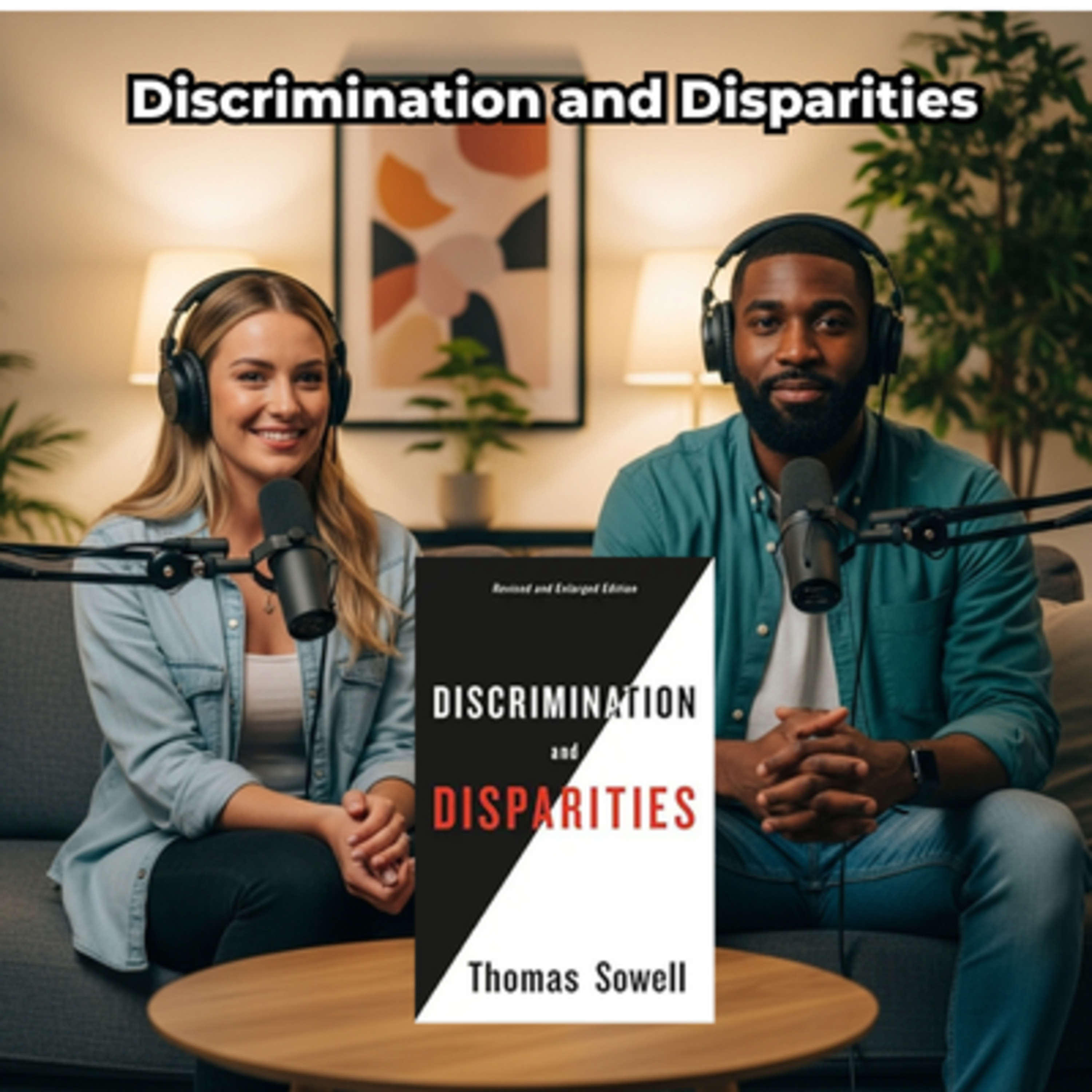
Economic and other outcomes differ vastly among individuals, groups, and nations. Many explanations have been offered for the differences. Some believe that those with less fortunate outcomes are victims of genetics. Others believe that those who are less fortunate are victims of the more fortunate.Thomas Sowell’s work examines the complex origins of social and economic inequalities, challenging the common assumption that all disparities are born from discrimination. He distinguishes between prejudicial bias, which carries heavy economic costs, and sorting, which serves as a practical way to categorize individuals based on skills and education. Through a meticulous analysis of statistics and language, the text warns that raw data can be misleading if the underlying context is ignored or manipulated by rhetoric. Sowell also explores how conflicting social visions of human nature influence government policies and their ultimate effectiveness. Ultimately, the source advocates for a fact-based approach to social issues that separates personal assumptions from the reality of human prerequisites for success.
#productivityhacks #personaldevelopment #successstrategies #businessinsights #leadershipskills #leadership #ambitiousprofessionals #businesstips #self help #scaling business #businesstactics #professionaldevelopment #startupgrowth #entrepreneurship #businessmindset #growthstrategies
Have you ever really grappled with that fundamental, that really complex sculption? Why do we see such profoundly different outcomes in life? Why do some people or some groups achieve far greater success or just follow completely different paths than others? It's a conversation that gets heated fast. It really does. It often leads us to some very strong, very emotionally charged conclusions. Right. And you know, almost reflexively, those conclusions often land on a single explanation that these different results must be because of unjust treatment, systemic discrimination.
But that's where our subject today, Thomas Saville, comes in. It is, he argues, that, well, if you want to be truly informed, you have to be ready to look beyond that easy singular answer, which is. Exactly why we're doing this deep dive. We're focusing on the concepts from his book, Discrimination and Disparity. And, you know, we're not here to cheerlead for his conclusions. No, not at all. We're here to rigorously test his framework. Our mission for you is to unpack the challenge he's issuing.
He's essentially forcing all of us to question that initial assumption. That all disparities come from bias. Exactly. We need to examine his evidence, his distinctions, and just see if his framework gives us a sharper lens to understand these really complex human outcomes. OK, so let's jump right in. He starts with a pretty big assertion. He says disparities and results are not necessarily the product of discrimination. And this is where he brings in the idea of prerequisites. That's the anchor point of the entire book.
He argues that when you look at groups with vastly different outcomes, you almost always find these prior variations in the prerequisites for success. And what does he mean by prerequisites exactly? We're talking about differences in education quality, specific skills, you know, experience, even cultural knowledge that you might need for a certain job. But hold on, this is where I think a lot of the criticism comes from. Wouldn't someone argue that focusing on prerequisites that it risks victim blaming?
That's the essential tension, yes. I mean, if systemic discrimination denied a group access to good education in the 1st place, isn't the current result still fundamentally traceable back to bias? And Soul acknowledges that he's very clear that discrimination can be a major cause, especially historical discrimination that creates those different starting lines. But his point is that by the time we see the disparity today, focusing only on that final result obscures all the other variables in between.
He's saying we also have to look at non discriminatory factors. Like individual choices. Individual choices, different cultural norms around work or family, even just, you know, the geographic location that shaped opportunities. It's a much bigger picture. So it's a call for a more a more 360° view. Instead of defaulting to the most obvious explanation, we have to look at everything. Right. And that complexity is key when he tackles the definition of the word discrimination itself. Which he says is crucial.
Absolutely, he says. If we use the same word for different behaviors, our policy discussions are just, well, they're poisoned from the start. He breaks it into two very distinct concepts. OK, so the first one is what we usually mean. Discrimination is bias, the damaging, unfair prejudice based on something irrelevant like race or gender. Correct the thing everyone agrees is wrong. But then there's the second form, discrimination as sorting. Sorting. So Noel argues this is a reasonable, even essential process based on relevant criteria.
I mean, think about it. A bank discriminates when it looks at a credit history for a loan. Or a sports team discriminating based on skill. Exactly. We expect people to choose based on relevant data. If you're hiring a pilot, you need to discriminate based on flying hours, not charm. So let's connect that back to the economy. How does discrimination as bias, the bad kind, actually hurt the economy? It's pure inefficiency. If a company, because of bias, hires a less qualified person over much more skilled one, society loses out.
How so? We lose the productivity, the innovation, the taps revenue that the more skilled person would have generated. It's squandered human capital. The economy just operates suboptimally. So if we're going to fix the problem, we first have to be very clear about which kind of discrimination we're even talking. About we have to be. Which brings us to how this idea of sorting plays out in society. Because if it's a reasonable behavior, then society is constantly organizing itself this way. So Well sees this sorting as an inherent and inevitable reality.
People sort themselves geographically. They cluster in areas with better schools or jobs. Professionally, they seek roles that match their skills. And in his view, that's necessary. It's necessary for efficiency. It's how specialization and markets work. But this leads to what he calls the challenge of unsorting. We often hear calls to, you know, engineer society to create a perfect mix everywhere. Yes, and while the goal might be equity, Sewell warns that if you ignore the underlying reasons for the inequality, those differences in prerequisites we talked about, just forcing this unsorting can create huge new problems.
Can you give an example? Sure. Imagine a policy tries to force a company to hire purely based on demographic quarters, ignoring a massive skill gap in the local population for those technical jobs. What happened? You get inefficiency, you get product failures, and eventually you get resentment when the unprepared workers fail and the whole organization suffers. He's urging caution before we just start moving the pieces around on the board. That makes sense, and that brings us perfectly to how we measure all this, which is usually with statistics, the world of numbers.
Right, because numbers are supposed to be the unbiased truth. The Sol's point is that context matters more than anything. Because raw data could be deceptive. Incredibly deceptive. He shows example after example where the raw statistic like average income for Group A versus Group B suggests a huge disparity. But then you start controlling for other factors. Exactly. You control for age, hours worked, cost of living, education, and those huge disparities often shrink dramatically. Sometimes they even disappear.
I think we've all seen headlines that do that, they just screen the wrong number without any context. And it becomes a rhetorical tool, Saul would say. For instance, comparing 2 immigrant groups where one has been in the country for 50 years longer than the other. Of course, their incomes would be different. Right, it doesn't necessarily prove current discrimination, it might just prove one group has had two more generations to build wealth and skills. Interpreting stats without that context is how you draw the wrong conclusion.
So we've covered definitions and data. Now let's get into rhetoric, the world of words, because this is where the debate often goes off the rails. Oh, absolutely. He finds that the language used in these discussions is often specifically chosen to bypass critical thinking and just get an emotional response. It's not just about what is being said, but how it's being said. He warns US against this kind of rhetorical manipulation. It often oversimplifies really complex subjects like that difference between bias and sorting to just arouse anger and shut down reasoned debate.
So if an argument relies on words designed purely to assign blame. So Weil suggests you should probably look twice at the underlying facts. And these powerful words, they feed into larger frameworks, which brings us to what he calls social visions and human consequences. This is a huge part of his work. He argues that major policies aren't random. They're driven by these deep seated, often unconscious views about human nature itself. He breaks it down into two visions, right? Yes, 2 primary social visions.
First is the confined vision. This view sees human nature as inherently flawed, constrained, you know, imperfect. People act in their own self-interest. Right, and total social perfection is impossible. So the best you can do is create policies that maximize benefits while minimizing the damage from human error and the. Other one. That's the unconstrained vision. This one maintains that people in society are basically perfectible. It sees flaws like poverty or crime as just the result of bad institutions.
So if you just fix the institution, you can. Achieve perfect human outcomes. Total equity. And the policy implications are? Massive. Enormous A policy from the unconstrained vision might try to completely restructure society, assuming everyone will cooperate perfectly once you remove the bad system. But if the confined vision is closer to reality. That policy will inevitably fail. It'll lead to bureaucracy, inefficiency, maybe even harm because it ignored the reality of self-interest and human limits.
The whole thing depends on which vision of humanity you start with. Which brings us to his final synthesis where he pulls it all together, facts, assumptions and goals. This is his final call for intellectual discipline. He stresses that to analyze disparity effectively, we have to clearly separate those three things in any discussion. So facts are what we actually know to be true and verifiable. And assumptions are what we believe to be true, which often come from those social visions we just talked about, he says.
So many policy arguments are just polluted by unproven assumptions that are disguised as facts. And that's where the goals go wrong. Exactly. He insists on setting reasonable goals that account for reality as it actually is, not as we wish it was. Policies that aim for the impossible often end up just causing a lot of collateral damage. So the ultimate take away he leaves you with is this. Be disciplined. Separate facts from assumptions. Make sure your goals are tethered to reality. It's a powerful and, you know, often unwelcome call for rigor in a debate that usually prefers moral righteousness.
So to recap, yeah, we started with the idea of prerequisites, then the two kinds of discrimination, bias versus sorting and the absolute need for context when you look at any kind of data. Right, because raw numbers can easily lie. It's an extensive unpacking of a foundational but often misunderstood work. So we're really forces you to to abandon simple narratives. He does, and maybe to leave you with a final thought to Mull over. Think about the intersection of that sorting and the data. If so, is right and sorting based on relevant criteria like skills is an editable for an efficient society?
How reliably can our current statistics, knowing how deceptive raw data can be, really distinguished between disparities caused by those legitimate differences and disparities that are rooted in subtle, unacknowledged biases? Where do you draw the line? Exactly where is the real world line between sorting and bias actually drawn in the policy debates happening right now? That's the challenge he leaves us with.
 Apple Podcasts
 Castbox
 Castro
 Goodpods
 Moon FM
 Overcast
 Pocket Casts
 Podbean
 Podcast Addict
 Podcast Republic
 Spotify