Die with Zero | Not Broke by Bill Perkins
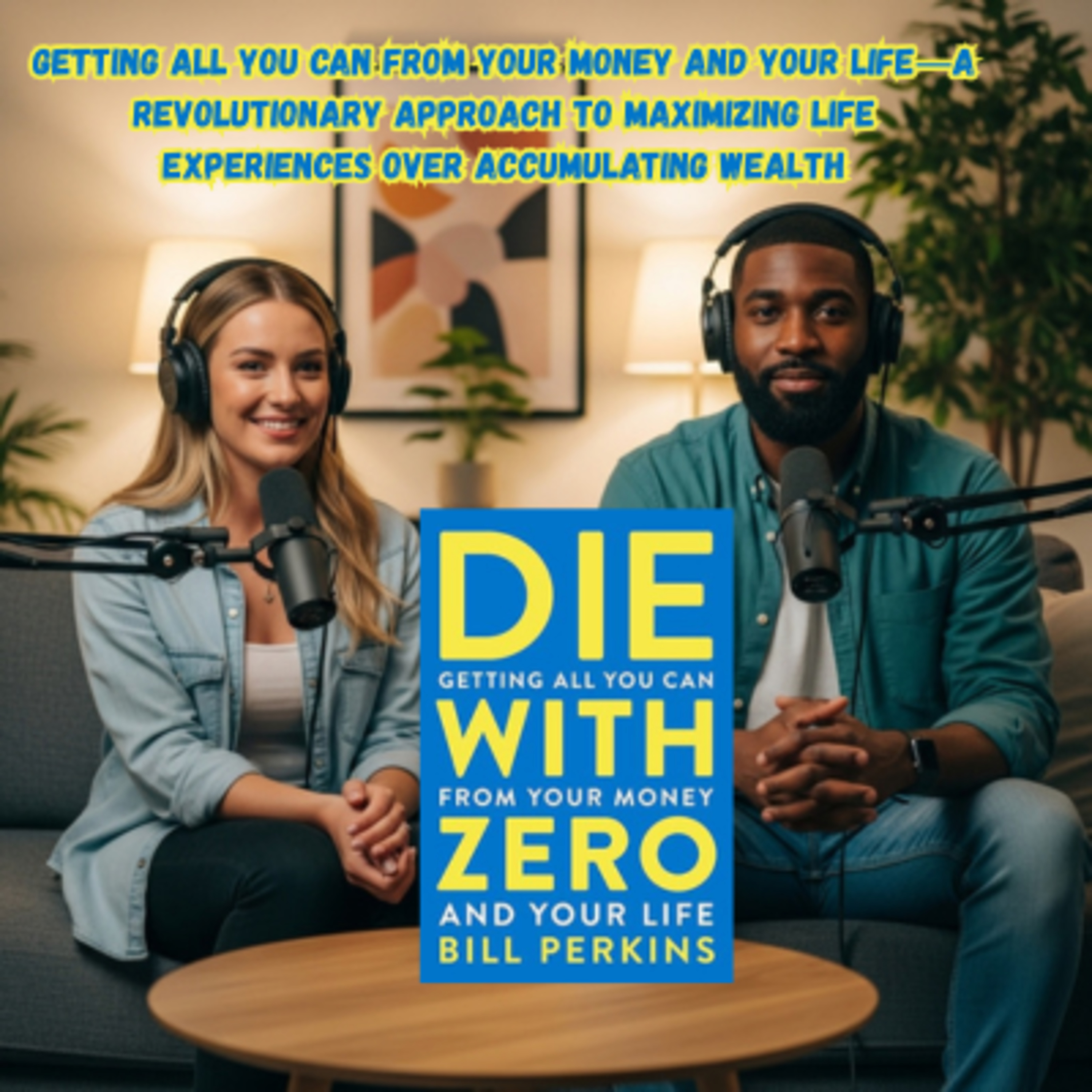
This episode summarizes Bill Perkins’ book, Die with Zero, which advocates for a radical shift from lifelong wealth accumulation to maximizing life experiences. The author argues that individuals should prioritize meaningful memories while they are young and healthy, rather than waiting for a retirement that may come with physical limitations. By using "time bucketing" to plan adventures across different life stages, people can ensure their resources are spent purposefully to avoid the regret of unspent potential. The guide also provides strategies for smart financial planning, such as giving to heirs earlier in life and balancing bold personal goals with sensible safety nets. Ultimately, the goal is to optimize fulfillment by strategically depleting one's assets to align with the finite nature of time.
Imagine if by the time you died, you did everything you were told to. You worked hard, saved your money, and looked forward to financial freedom when you retired.
The only thing you wasted along the way was . . . your life.
Die with Zero presents a startling new and provocative philosophy as well as practical guide on how to get the most out of your money—and out of your life. It’s intended for those who place lifelong memorable experiences far ahead of simply making and accumulating money for one’s so-called “golden years.”
In short, Bill Perkins wants to rescue you from over-saving and under-living. Regardless of your age, Die with Zero will teach you Perkins’s plan for optimizing your life, stage by stage, so you’re fully engaged and enjoying what you’ve worked and saved for.
You’ll discover how to maximize your lifetime memorable moments with “time-bucketing,” how to convert your earnings into priceless memories by following your “net worth curve,” and how to navigate decisions about whether to invest in, or delay, a meaningful adventure with your “fulfillment curve” and “personal interest rate.”
Using his own life experiences as well as the inspiring stories and cautionary tales of others—and drawing on eye-opening insights about time, money, and happiness from psychological science and behavioral finance—Perkins makes a timely, convincing, and contrarian case for living large.#productivityhacks #personaldevelopment #successstrategies #businessinsights #leadershipskills #leadership #ambitiousprofessionals #businesstips #self help #scaling business #businesstactics #professionaldevelopment #startupgrowth #entrepreneurship #businessmindset #growthstrategies
Welcome back to the Deep Dive. Today we're diving head first into a book that it really aims to fundamentally rewire how you think about saving, spending, and. And just living, really. Exactly living. We are examining the philosophy laid out by Bill Perkins in his Well, let's call it a highly provocative work. Die with 0. Oh, it's definitely provocative. It's a concept designed to hit you right where it hurts. Your savings account. Right in the savings account. The mission here is to move beyond that traditional almost, you know, compulsive desire to just accumulate the largest pile of money you can, right?
Perkins suggests. The ultimate goal isn't accumulation at all. It's it's optimization. We're here to figure out how to maximize the joy you get out of your money while you're actually healthy enough to enjoy it. And we all grew up hearing some version of that same financial rulebook, right? Yeah. Save, save, save. Defer everything. Wait for the promised land of retirement. Exactly. But Perkins asks this brilliant and honestly pretty unsettling question If you save so much that you die with a huge surplus, didn't you actually miss out on life?
That's the core tension right there. And look, the book isn't advocating for reckless spending. Not at all. No, it's arguing for deliberate, timely, and optimized spending. The whole goal is to make sure that when your time runs out, you've truly lived a rich and fulfilling life. Not just, you know, saved for a hypothetical 1. OK, so let's unpack that core realization right away. It's such a simple premise, but it's revolutionary in practice. Time is fundamentally more valuable than money. It sounds so obvious when you say it out loud, but then you look at how we actually live.
We often treat money as the scarcest resource. We're constantly chasing more of it. Perkins really forces you to confront the fact that time is the only truly finite resource. You can always earn more money. Always. But you cannot buy back a single hour of your past. It's gone. And if you can't buy back time, then that decision to put off, say, an incredible trip until you're 70, or to wait until the kids are grown to learn a new skill that comes with a real nonrefundable cost A. Huge. Cost your youth, your energy, your physical ability.
That's the crux of it. The focus has to shift, and shift immediately to using your money now while you have the time and the energy to create these rich experiences. The consequence of, well, excessive saving is accumulating all this wealth while you're simultaneously running out of the ability to even use it. Which leads us right into where we should put our investment priority. I mean, traditionally we invest in stocks, bonds, maybe some real estate, the. Usual suspects. But Perkins argues for investing in a completely different asset class, experiences.
So why are memories, let's say, from a family backpacking trip or taking a year off to volunteer? Why are those fundamentally more valuable than just accumulating more stuff? It all comes down to how memory works. Buying things gives you a quick hit of dopamine, what we might call temporary happiness. The new car smell. Exactly. That new gadget or car depreciates instantly, and the joy fades so quickly. But experiences, They create these lasting memories that actually compound over time. They shape your identity, they strengthen your emotional resilience.
And they don't fade. In fact, they get richer. They get richer through recollection, yeah. That's fascinating, the idea that memory compounds. You don't just get the value of the trip when you take it. You get every time you retell the story or look at a photo or even just remember a shared laugh. Absolutely. And the source also highlights the the critical role of timing here. The best time to invest in experiences is when you are young and healthy. Makes sense. Your energy, your capacity for novelty, your physical ability, it's all higher.
Waiting until retirement often means those same activities become physically strenuous, maybe less enjoyable. Or even impossible. Or even impossible, yeah. And we can't forget the social component here, shared memories like a big family reunion or maybe a new business venture with friends. They strengthen those bonds. Which just makes the experience itself even more joyful. It all adds to what the book calls net fulfillment, which is, you know, the ultimate currency we're talking about. OK, we have to talk about the title though.
Die with 0. I mean, that sounds terrifying to the average saver, especially anyone who's lived through any kind of economic uncertainty. It's designed to be jarring. So what does Perkins actually mean by that traumatic command? It seems utterly reckless on the surface. Right, but it's not a literal instruction to be broke the day before you die. It's a philosophical framework. It's designed to get you to maximize your life while minimizing your legacy of, well, unspent resources. It just means optimizing your life so that your health curve and your wealth curve intersect at the right moment.
Dying with a large surplus suggests you either miscalculated or, and this is more likely, you unnecessarily gave up opportunities for happiness and fulfillment because you were just overly fearful. I get the theory, but let's get practical. How do we stop the financial jitters? How does Perkins build a safety net under this whole philosophy? Because for most people, die with 0 immediately translates to die broke, independent. And that's where the methodology becomes so crucial. Spending wisely means managing your money smartly, so you strike that essential balance between enjoying the now and securing the later.
The book details some really clear, practical steps to do this without taking on undue risk. So what's the number one rule of thumb here for this kind of smart spending? It starts with absolute clarity on your numbers. I'm talking rigorous cash flow management. You have to know your income, your current expenses, and critically, you have to project your future expenses. So this isn't just about what you spend next. Month. No no, it's about modeling your entire financial runway and second you must plan for the long term and future needs.
Healthcare is the massive 1. OK. So we're not just throwing caution to the wind here. We're being hyper vigilant about the minimum that you need for later life security. Precisely, you calculate your required safety cushion, and everything above that cushion is what you have permission to deliberately allocate toward those timed experiences. And the third step follows from. That right, you prioritize investing in those experiences over acquiring more material goods. And finally, you have to be flexible.
This is an active financial plan. You review it, you adjust it, because life is, well, life is unpredictable. This all seems to fly in the face of the traditional American dream, where the goal often culminates in leaving a huge inheritance. It really does. Which brings us to the thorny question. What about the kids? This is a huge psychological hurdle for a lot of people. Perkins directly challenges this idea that the biggest inheritance is the best inheritance. He questions the value of sacrificing your own peak experiences just to leave a massive sum to your children when they're already, what, 65 years old?
So what's the advice on timing then? The key insight is timing. The source suggests giving money to your children when it makes the most difference in their lives. You have to think about the maximum leverage moment. You mean when they're struggling to pay tuition or trying to buy their first home, not when they're already approaching retirement themselves? Exactly that. The book specifically sites funding education, helping them start a career or contributing to a down payment on a home. Giving early provides this life altering acceleration.
A delayed large inheritance is often just a boost to an already established life. And it's not just about the money transfer. This philosophy also argues that shared experiences are a more cherished legacy than a bank account balance. Oh absolutely. The money you spend on a memorable intergenerational family trip or on supporting their early endeavors, that builds a much stronger emotional capital than a check they get years later. Those shared moments become the true family wealth. They do, and as a sort of necessary side effect, this lets you teach financial education in real time.
Right. Instead of dropping a mass, maybe overwhelming inheritance on them later, you're involving them in managing smaller, more impactful amounts now. It gives them the necessary experience to handle finances responsibly. They learn to value the money because they used it at a critical moment in their lives rather than just passively receiving it. So maximizing life requires this intentional balancing which takes us away from just the financial spreadsheets and into, well, the architecture of fulfilment itself.
If we want happiness, what are the key non financial elements that we need? The book really emphasizes that a fulfilling life is built on conscious choices. It's not enough to be financially optimized. Your entire lifestyle has to enable the experiences. That means prioritizing experiences now, not someday. I just later. Right, It means setting boundaries and actively avoiding overworking to prevent burnout. I mean, you can't travel the world if you're too exhausted to leave the couch. We're talking about valuing relationships, spending quality time with family and friends, which takes time, not necessarily money.
Precisely, and maybe most fundamentally, you have to take care of your physical and mental health. Exercise, eating well, taking breaks. These are the enabling functions. If you sacrifice your health to earn more money, you are literally destroying the capacity to enjoy the wealth you're accumulating. The most structural tool to manage all this is one of the books most famous concepts, Time bucketing. This is where the whole philosophy gets its planning framework. How does dividing your life into these periods actually help?
Time bucketing is essentially proactive life design. Instead of seeing your life as one long continuous stream, you divide it into these distinct buckets of, say, 5 to 10 years. OK. And each bucket has specific experiences, goals and capacity levels associated with it. It sounds great, but I'm 45 and I'm feeling behind. Yeah. How does someone start their bucketing process today? You start by defining what experiences are capacity dependent. For example, maybe your 20s bucket was for peak physical travel, you know, hostels, roughing it, climbing mountains.
Your 30s bucket might shift focus to career consolidation and starting a family. Your 50s could be about complex long duration luxury travel or maybe deep dives into intense hobbies like learning a language or sailing. The key is that the goals must be specific and planned, even if the plan itself stays flexible. And the reason time bucketing works is because our abilities aren't static. They change. Which brings us to that crucial concept. Know your peak. What are we looking for when we try to identify these peak moments?
You're looking for the intersection of desire, capacity, and time. Your physical and mental abilities, your social environment, your interests, they all peak at different times. So if your dream is a physically demanding trek like Everest Base Camp. Right. Your physical peak for that might be in your late 20s or 30s. If you wait until your 60s, that goal might become medically unwise or just not fun anymore. So we identify the peak window for a specific experience, adventure, travel, starting a business, whatever it is, and then we have to execute it within that window or risk missing the opportunity entirely.
That is the accountability that time bucketing enforces. If you defer a physically demanding trip until your interest or your ability has diminished, you've essentially squandered that time bucket forever. Wow. You don't just lose the experience, you lose the decades of compounded memories that would have followed it. The final piece of advice really encourages massive action. Be bold, not foolish. What separates the bold decisions from the reckless ones in this kind of financial context? The difference is calculation.
Being bold means pursuing those major life dreams, significant travel, career pivots, starting that challenging hobby, but doing it through calculated decisions that are informed by the financial planning we just talked about. So you take the risk, but you mitigate the danger. Exactly. Recklessness is spending your last penny without a safety net. Boldness is assessing the potential rewards of the experience, the fulfillment, the joy against the dangers, and making sure you have that adequate financial cushion established first.
A. Safety net. That safety net is non negotiable even in the Die with 0 philosophy. You have to learn from your mistakes and plan for uncertainties. You know what Perkins ultimately shows us is that life optimization. It's not about maximizing your net worth at death. It's about maximizing your life experiences while you're healthy and you're energetic enough to do them. It's a system to balance bold actions, prioritizing shared experiences with wise spending and financial flexibility, making sure you find fulfillment every step of the way.
And building on that really powerful concept of know your peak and time bucketing, here is a final thought for you to carry forward based on the knowledge of your own current physical, educational or maybe relational peaks, what experience are you currently deferring? What's on that? Bucket list. That you might not be able to fully enjoy 5. Years from now. Lanning starts today.
 Apple Podcasts
 Castbox
 Castro
 Goodpods
 Moon FM
 Overcast
 Pocket Casts
 Podbean
 Podcast Addict
 Podcast Republic
 Spotify