Factfulness by Hans, Anna Rönnlund & Ola Rosling | Ten Reasons We're Wrong About the World
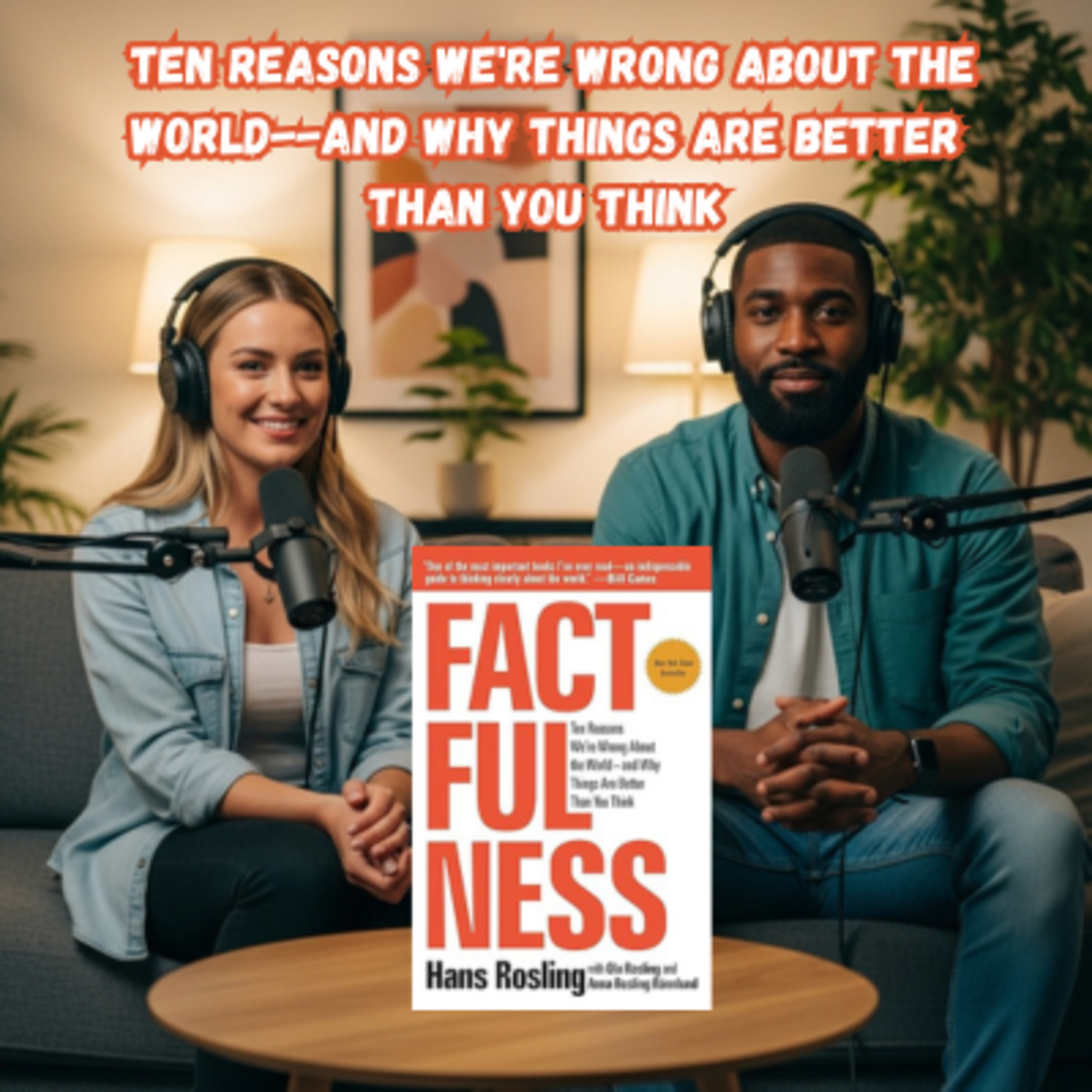
This Episode outlines the core principles of the book Factfulness, which aims to replace misconceptions and fear with a data-driven perspective of the world. The authors identify several psychological instincts, such as the tendency to simplify complex realities into "us versus them" categories or to focus disproportionately on negative news.
By recognizing these biases, readers can better understand that global trends in health, education, and poverty are actually improving. The source emphasizes the importance of critical thinking, questioning urgency, and seeking multiple perspectives to avoid common mental traps. Ultimately, the summary serves as a call to action to view the world with curiosity and humility, replacing dramatic distortions with a more hopeful and accurate reality.
Welcome to the Deep Dive. We're here to take on those dense game changing books and pull out the core ideas for you, giving you that shortcut to being genuinely well informed. And today, we've got a big one. It's factfulness, a guide to seeing the world clearly. Which is, you could argue, pretty much the instruction manual for thinking about the world. Today, I think so. It's by the statistician Hans Rosling with his team Ola Rosling and Anna Rosling Rundland. And it's not really just a collection of facts, it's more of a an intervention.
An intervention. I like that. Yeah, it uses really clear data to make a frankly shocking point that most of us are walking around with a completely outdated, negative and just fundamentally wrong picture of the world. Exactly so. Our mission here is to slice through that negativity and get to the books central discovery, which is that the world is in fact much better than we think. And that understanding how global trends actually work is the key. It lets you replace that sense of panic with, you know, a more rational kind of optimism.
The authors say this distorted view isn't because we're not smart, it's our instincts. Right. We are hardwired with these 10 human instincts that basically act like filters on reality. They're constantly twisting what we see, making things seem simpler or scarier or more hopeless than they really are. So if we can spot these 10 filters we can start to override our brains knee jerk reactions and see things based on facts. That's the goal. OK, let's unpack this, starting with the big one. The way our minds try to simplify everything.
This is where we fall into the first major trap. And that brings us straight to the most powerful instinct of all, the gap instinct. The gap instinct. This one is so tricky because it just insists on splitting the world into two simple opposing teams. You know, the classic US versus them. And on a global scale, that shows up as the old developed world versus the developing world. A model that is, as Rosling shows, statistically, just a disaster. It's a total catastrophe for clear thinking. He proves that this idea of a huge gap, this clean split between rich and core countries, it just doesn't exist anymore.
So it's not two boxes. No. When you look at health or wealth or education, the world is really on 4 distinct income levels. This is his famous level 123 and four. And why is it so important for us for the listener to switch from that 2 box model to these 4 levels? Because the vast majority of humanity, we're talking billions of people, now live in the middle. They're on levels two and three. OK, they aren't the extremely poor people on level 1 you might see in a charity appeal, but they're also not the wealthy level 4 consumer.
By sticking to that old developing world language, we make billions of people invisible. We miss the progress. We miss the single biggest story of the last 50 years, the story of people moving out of extreme poverty. It just completely blinds us. That's a really powerful point, and OK, even if we accept things are more complex than two boxes, we still tend to lump everyone inside a group together. Which brings us right to the next trap, the generalization instinct. This is where we assume that you know everyone on a continent or in a religion or a culture is basically the same.
Exactly. We swap lazy stereotypes for actual data. You hear one scary statistic about, say, 1 country in Africa. And your brain just applies it to the entire continent. The whole continent, the generalization instinct just runs with it, but the reality is always, you know, incredibly diverse. So what's the practical advice here? How do we fight that? Rosling says we have to actively look for differences within the groups. Don't just look for similarities. Ask yourself, does this stereotype cover the richest people and the poorest people?
The city and the countryside, right. When you start to see that variation, the world becomes so much more interesting and much more real than our simple categories would have you believe. OK, that makes sense. So once we get past our need to group and simplify, the next big hurdle is, well, our feelings. Let's dig into the instincts driven by pure emotion, starting with the negativity instinct. The negativity instinct. This one is maybe the toughest to beat because it's so tangled up with how we consume media.
We're drawn to bad news. We are, and the media knows it. They amplify crises because, well, bad is more dramatic than better. It gets clicks. It gets views. And if the only thing you're ever seeing are disasters and wars and failures, you just naturally assume the whole world is going downhill of. Course, but the data shows the opposite. So the challenge is how do you balance the real suffering that's out there with the the quiet progress that's also happening? That's the key question. And factfulness isn't about ignoring problems, it's about holding 2 ideas in your head at once.
The world can be bad, and it could be getting better. So you have to consciously look for the good news. You have to. You have to actively seek out those slow positive trends like falling child mortality or the drop in extreme poverty to balance out the emotional pull of all the dramatic negative headlines. So if negativity is that constant low hum of anxiety. Then the fear instinct is the loud blaring siren. Our brains just lock onto sensational threats, and Roslyn's whole point here is that we have to learn to separate the feeling of being afraid from the actual statistical risk.
When we're scared, our rational brain just switches off. Completely. We start to overestimate these very dramatic dangers, you know, terrorism, plane crashes, natural disasters, because they're so vivid and intense in the news. It's like the fear of a shark attack versus the actual tiny probability of it happening. Precisely that, yeah. So if the data is showing a steady decline in something like deaths from global conflict, but the headlines are screaming that we're living in the most dangerous time ever, you have to take a step back.
And check the numbers. Check the numbers. Overcoming fear means replacing those vivid stories with the quiet reality of the data. Ask yourself, what's the actual scale of this risk? That's a great tool for managing that immediate panic. But then there's this other, longer term emotional trap, this kind of global hopelessness. The destiny instinct. This is the belief that that things just can't change, that certain cultures or nations or entire societies are somehow fixed, that their destiny is set in stone.
And if you believe that a place is just doomed to fail, why would you ever invest your time or your hope in it? Exactly. What's fascinating here is how the author's just completely dismantle this idea with history. They show that cultures and societies are not like rocks, they're more like very slow moving rivers. The change is gradual. It can be frustratingly slow, but change is constant. I mean, look at Japan over the last century and a half. Look at South Korea since the war. They're unrecognizable.
That's a great. Point realizing that even slow change is possible and that it's driven by our actions. That's where real fact based hope comes from. Thinking the future is fixed makes you give up. Realizing you can influence that slow river, that gives you agency. That sense of agency is everything. OK, let's pivot now to the instincts that mess up our analytical thinking, how we misread data even when it's right in front of us. Starting with the size instinct. Right, The size instinct is our habit of looking at a big lonely number and freaking out.
We see a huge figure, say 80,000 cases of something, and we instinctively think it's the worst crisis in the world. But 80,000 cases in a small city is a very different story from 80,000 cases spread across the country of a billion people. Totally different. So the rule for you, for the listener, when you see a big number, is to always, always look for a rate or a percentage to give a context. Don't just look at the raw total. Never divided by the total population or compared to other similar numbers.
The advice is to look at the detail up close. That's the raw number, but then step back to see the rate. That gives you the whole picture. Context is key. And when we try to predict where those numbers are going, we run into another problem, the straight line instinct. Oh yeah, we love a straight line predictable. We just assume that trends will continue on the same pass forever. If the population grew by a certain out last year, we think it'll do the same thing next year and the year after that.
Which leads to all these terrifying predictions about, you know, endless population explosions that will crush the planet. Yes, but Rosling shows that almost no important global trends are straight lines. They're curves. They're S curves. They're slides. They're bumps. The global population, for instance, is already leveling off. Because birth rates are falling as living standards rise. Exactly. So you have to understand the reason for the trend, the mechanism behind it, not just draw a straight line from the last few data points into the future.
OK, so we've covered seeing data clearly, but there's another equally bad analytical trap which is relying on just one way of looking at the world. You're talking about the single perspective instinct. Yeah, this one is a really profound trap. We get comfortable seeing the world through one single lens. Maybe it's economics, maybe it's climate change, maybe it's political freedom. We see every problem as a nail because the only tool we have is a hammer. So if you're an economist, every global problem looks like an economic problem at its core.
You might ignore all the cultural or environmental factors. That's the danger. It leads to really biased and frankly ineffective solutions. Factfulness demands that you carry a whole toolbox. You have to be humble enough to admit that a single problem needs multiple perspectives, maybe a bit of anthropology, some public health data and economic analysis to really see. It clearly no single perspective is ever enough. That's brilliant. Now let's get to the pitfalls and decision making that happen when we ignore all this complexity.
When things go wrong, our first move is often the blame instinct. We have this desperate need to find one simple cause, one person, one company, 1 evil villain to point the finger at. It feels good, you know it's satisfying, but it's also incredibly lazy. Because complex problems don't have simple causes. They're caused by a complex system of interconnected factors and the big problem with finding a scapegoat. Is that it stops you from looking for the real problem. It stops you cold. It lets you feel like you've done something without actually having to do the hard work of understanding the system and figuring out how to fix it.
Real solutions, whether it's for poverty or disease, they require systems thinking and cooperation, not pointing fingers. And that brings us to the last of the 10 instincts, one that feels very relevant in our crisis and minute world, the urgency instinct. This is that feeling that we have to act right now, that sense of panic, usually driven by those fears we talked about or by not having all the facts. And that urgency just overrides our rational thinking and. We end up choosing bad solutions just because they're fast.
Or we focus on the wrong priorities altogether. So the counter move isn't to do nothing, but to intentionally create some space for careful thinking. Take a breath. Exactly. Take a breath. Not every problem needs a frantic, immediate reaction. Sometimes the best action is calm, measured, detailed planning. Insist on getting the data, evaluate all the options and avoid panic. Rationality deployed calmly leads to much better, more lasting decisions, especially in a crisis. So that's the full set, the 10 instincts that really cloud our judgement.
So what does this all mean for you, the listener? I mean, how do we take this whole framework of factfulness and actually use it in our daily lives? That's the whole point of the end of the book. It really comes down to cultivating a new mindset. First. You just have to stay curious and constantly question your own assumptions. Assume your first instinct is probably based on one of these traps. Don't just trust your gut reaction. Right. And you have to proactively look for different viewpoints. Use that whole toolbox we were talking about an insist on getting reliable data with context.
Fight misinformation by sharing actual facts. And maybe most importantly, stay humble. Be willing to update your worldview when the data changes. And the final take away from the book is really one of optimism, isn't it? It's that the world is incredibly complex, yes, and full of huge challenges. But it's also demonstrably full of progress and hope. By challenging our own biases, we don't just become better informed, we become more thoughtful, more rational, and more effective at actually making things better.
A more effective global citizen. And if we connect this to the bigger picture, factfulness shows that human progress is possible when we challenge that belief that our futures are fixed. That was the destiny instinct. So given that you now recognize that powerful urge to rely on a single perspective which really limits your options, I'd encourage you to think about this. OK, what long held assumption in your professional or personal life a problem you see as totally complex or just fixed? What might happen if you viewed it through just one additional different perspective?
What unexpected path might open up? That is the challenge to take away. Keep learning, question the straight lines and the simple gaps, and always, always consider a different viewpoint. Thanks for joining us for this deep dive into the clarity and optimism of Factfulness. I'll see you next time.
 Apple Podcasts
 Castbox
 Castro
 Goodpods
 Moon FM
 Overcast
 Pocket Casts
 Podbean
 Podcast Addict
 Podcast Republic
 Spotify