Resolving Conflicts at Work by Kenneth Cloke and Joan Goldsmith | Ten Strategies for Everyone on the Job
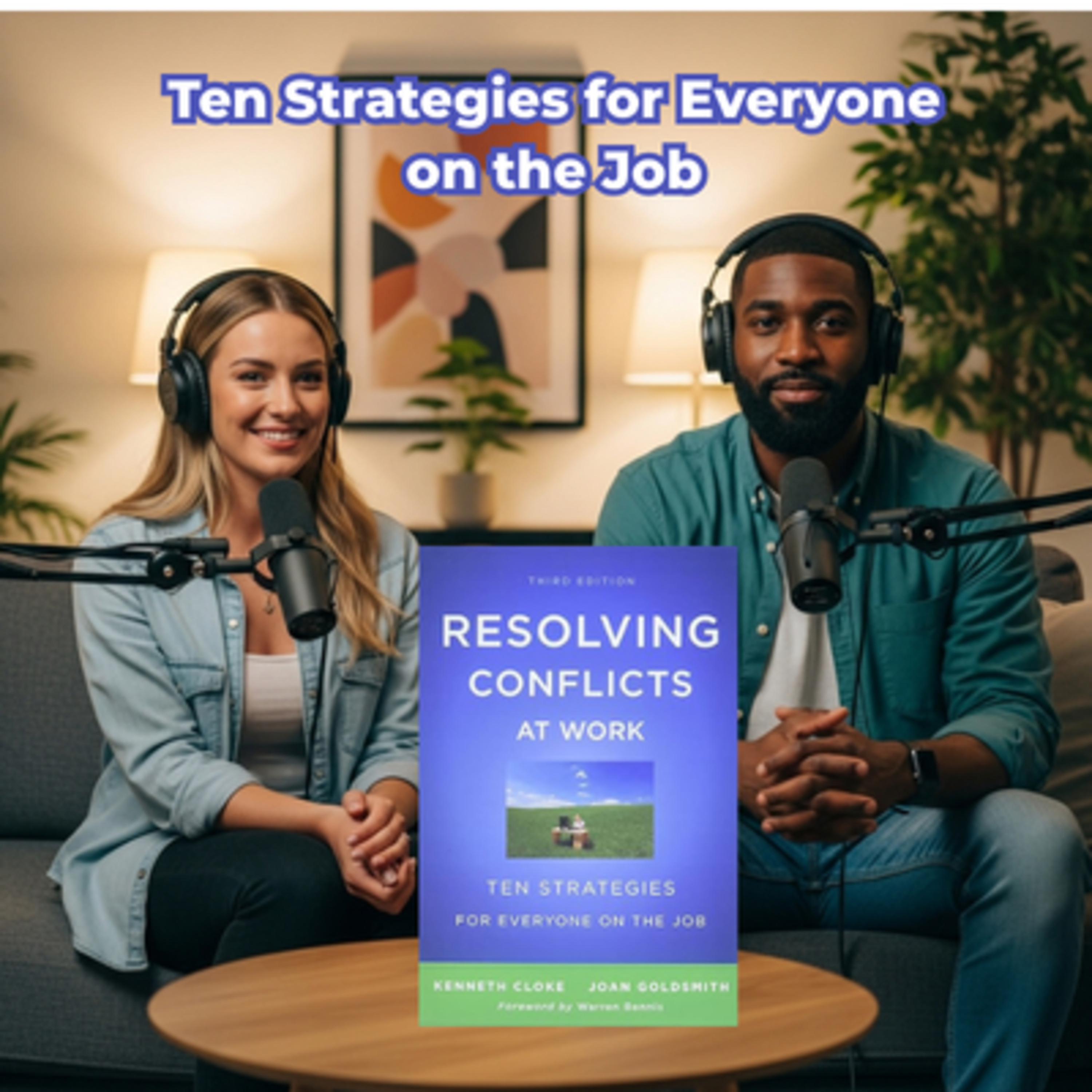
This episode summarizes key strategies from the book Resolving Conflicts at Work, focusing on transforming professional disputes into opportunities for team growth. The authors emphasize that understanding an organization's internal culture and addressing hidden emotional layers are essential steps toward finding lasting solutions. Readers are encouraged to practice empathic listening and creative problem-solving to look past surface-level arguments and identify core issues. The material also highlights the importance of collaborative negotiation and the role of leadership in coaching others toward better communication. Ultimately, the source provides a framework for building preventative systems and mediation practices to foster a more peaceful workplace.
The classic text on resolving workplace conflicts, fully revised and updated
Resolving Conflicts at Work is a guide for preventing and resolving conflicts, miscommunications, and misunderstandings at work, including dozens of techniques for revealing how the inevitable disputes and divisions in the workplace are actually opportunities for greater creativity, productivity, enhanced morale, and personal growth. In the third edition of this text, all chapters are completely infused with additional content, updated examples, and new case studies. Like its predecessors, it identifies core strategies for preventing and resolving both intermittent and chronic conflicts in the workplace. In addition, the book
- Includes a new foreword by Warren Bennis, which represents his most recent thinking about judgment calls and candid communications in the workplace
- Presents new chapters on leadership and transformational conflict coaching, and organizational systems design
This definitive and comprehensive work provides a handy guide for managers, employees, union representatives, human resource experts, and consultants seeking to maintain stable and productive workplaces.#productivityhacks #personaldevelopment #successstrategies #businessinsights #leadershipskills #leadership #ambitiousprofessionals #businesstips #self help #scaling business #businesstactics #professionaldevelopment #startupgrowth #entrepreneurship #businessmindset #growthstrategies
Do you ever find yourself spending more time managing, you know, emotional tension at work than actually managing projects? If you've ever had a dispute escalate from some minor e-mail disagreement into a a week long source of anxiety, you are definitely not alone. The default state for conflict often feels so overwhelming. It's like a crisis we just have to survive. But what if that feeling of crisis was just a signal? That is the core idea we're exploring today. We're diving deep into the systematic approach from experts Joan Goldsmith and Kenneth Cloke.
They argue that conflict, far from being toxic, is actually one of the greatest opportunities for development and for building genuinely stronger teams. Wow, that's a huge reframe right out of the gate. Yeah. So our mission in this deep dive is to give you a shortcut, a really powerful synthesis of their ten essential strategies for mastering workplace conflict. We're trying to move beyond a simple disagreement to, well, proactive cooperation and, you know, lasting calm in the organization. And we begin where all solutions really have to by understanding the terrain.
Their work emphasizes that before you can even address a conflict, you have to recognize the organizational culture that let it happen in the first place. OK, let's unpack this idea of culture and dynamics. It sounds like the organizational culture is almost like the DNA of conflict. They point out that a positive open culture, one that actually rewards transparency and welcomes tough conversations, it naturally lessens disputes. Exactly. And on the flip side, a rigid one, it makes them worse. Think about it.
When a team avoids issues because the culture punishes bad news, those issues don't just vanish. They go underground. They fester. They turn into resentment, passive aggression. So what we see on the surface is almost never the real issue. It's just the place where the pressure finally blew. Understanding those deep dynamics means we stopped treating the symptom like the noisy keyboard and start treating the underlying disrespect or stress. Right, it's the classic symptoms versus the disease. So once a conflict actually erupts, the first, most crucial skill they highlight is the ability to listen responsibly and empathically.
And this sounds like it goes way beyond just nodding along while you wait for your turn to talk. Oh absolutely. This is where we learn the difference between just hearing someone and actively listening. True act of listening involves paying close attention to the non verbal cues and this is critical. The emotional content, the feelings, the concerns underneath, not just the words being said. You're not just trying to build your counter argument, you're trying to reconstruct the entire reality of the person who's speaking.
OK, can you give us an example? How does that work in practice? Let's say someone's complaining that a team member missed a deadline. How does active listening transform that statement? Well a surface level listener just hears they're incompetent and they miss the deadline. But a responsible, active listener hears the tone, the frustration, maybe fear or even panic and translates that to something more like I am being held accountable for their failure and I feel unsupported and totally exposed.
And that translation, that's the key to empathy, because once you understand the feeling unsupported, exposed, you can actually put yourself in their position. Precisely. Empathy isn't about agreeing with them about the deadline, it's about reacting in a way that acknowledges their thoughts and worries are legitimate. You might say something like it sounds like you're under immense pressure because this deadline was missed and you're worried about the fallout. Is that right? Just giving people that sense of being genuinely heard is the single most powerful de escalation tool we have.
That brings us to where the analysis gets really, really interesting. Once that immediate emotional spike is handled, Goldsmith and Cloak tell us we have to look below the surface for hidden meanings. This feels like we're moving from basic communication skills to, I don't know, deep organizational archaeology. It really is. The central point here is that complex conflicts often look simple on the surface, but they're usually driven by systemic or structural or even historical issues. You know, the classic office dispute over who gets the corner desk?
It's never about the desk. Right, it's about status recognition. Perceived fairness may be rooted in things that happened years ago. So we have to identify those emotional foundations fueling the fire. We mentioned fear, irritation. How do we actually probe for those without making things worse? By asking open-ended questions. Questions that encourage storytelling, not just complaint logging. So instead of asking what did John do wrong, you ask what was the consequence of John's action for you? The answer to that question reveals the vulnerability.
Once you understand the role that hidden feelings are playing, like a threat to their status or insecurity about their job, you unlock a path to empathy. The solution is no longer about the desk, it's about their perception of value. But dealing with that sudden rush of emotion, that can feel like a tidal wave. Chapter 4 teaches us to acknowledge and reframe emotions. But I worry sometimes that reframing just sounds like corporate jargon for minimizing someone's legitimate anger. How do you avoid that?
That's a critical question, and they're very clear. Reframing is not minimizing, it's repositioning. First, you have to acknowledge the emotion fully. You have to say, I can see you are incredibly frustrated right now, and that frustration is completely valid. That validation builds trust. Then the reframe happens when you pivot that emotional energy away from blame and toward discovery. So instead of letting the frustration just stop the conversation cold, we see the emotion as a kind of hint. Exactly.
You shift the focus. If someone is furious about a new policy, the reframe isn't calm down. The policy is fine, the reframe is. That theory tells me this policy is having a major negative impact on your ability to do your job, which is something we absolutely need to fix. By reframing the emotion from a roadblock to a signal, we can actually move the discussion forward toward workable answers. That structural focus brings us right into the next step. Divide what matters from what gets in the way.
We have to find the core issues and avoid getting sidetracked. The goal here is just relentless distillation. I mean many conflicts are just these multi layered messes of old grievances. You need a process to strip away the noise. A great tool for this is the five wise technique. So you ask, why are you upset? Because the report was late. Why was it late? Because the data wasn't approved. Why wasn't it approved? Because it needs 3 signatures. Why 3 signatures? Because two years ago someone made one error.
So the core issue isn't the late report at all, it's the outdated over engineered approval process from two years ago. Exactly. And the most dangerous distraction here isn't even the side problem, it's the bias in yourself. We all have to recognize our own assumptions, our judgments, our tendency to favor people or ideas that just confirm what we already believe. If you as the manager have a bias that marketing always over promises, you're going to spend more time trying to prove that than actually listening to the dispute.
That kind of self reflection is it's hard work. How do you even recognize your own bias when you're in the heat of the moment? You look for the moment you stop asking questions and start making assertions. The second you think, oh I already know what the real problem is. That's your bias talking. You need to pause mentally set your hypothesis aside and force yourself to find three pieces of evidence that contradict your assumption. It keeps you honest. OK, shifting gears a bit. What if the standard process of, you know, defining and negotiating just isn't working?
Chapter 6 encourages us to solve paradoxically and creatively. This implies that sometimes the logical, direct approach is the reason it's failing. It is. They urge us to embrace paradoxes, the core conflict paradoxes off of this. To gain control over the resolution you must first give up control of the outcome. Traditional methods look for the one best answer. Paradoxical methods explore counter intuitive ideas without fear. So what would a paradoxical solution actually look like in an office? Well, let's say you have two department heads who are constantly clashing over resources.
They both want 100% control of their budget. A traditional solution would be to split at 5050. A paradoxical solution might be to temporarily force them to share a single combined budget. Now they have to negotiate daily on every priority, which forces collaboration and interdependence. That sounds terrifyingly effective. It promotes originality by breaking them out of that My way or the highway box. It requires thinking beyond that box and being open to new, sometimes uncomfortable ideas. If the standard approach failed, you need creativity to break that cycle.
And Chapter 7 follows right on that, urging us to learn from difficult behaviors. We all have that one person in the office we secretly labeled the difficult one. We all do, yes. But the authors argue that these behaviors are rarely just random malice. They frequently result from serious underlying organizational problems that the person is either not equipped to talk about or is just uniquely sensitive to. So instead of writing them off as a problem, we should see their behavior as data, an opportunity for insight.
Exactly. If someone is consistently aggressive in meetings, that behavior is a symptom. It might reveal a system where thoughtful contribution isn't rewarded, or a structure that makes them feel powerless, or maybe unclear roles that force them to overstep just to get their work done. So every time a manager successfully navigates a difficult personality, they aren't just solving a personal issue, they're learning how their own systems are failing. Right. And that improves conflict management across the whole organization.
You shift the focus from policing the person to fixing the system that created the behavior. That responsibility falls squarely on management, which takes us into the final set of steps, the systemic approach, starting with Chapter 8, lead and coach for transformation, the leader sets the norm. But what does that modeling actually look like? It's the difference between a leader who delegates conflict resolution and one who demonstrates it. It means setting the example, admitting your own mistakes, publicly showing vulnerability when you're mediating, and demonstrating that a productive, hard conversation is valued more than just keeping a superficial peace.
Your method becomes the standard. And that standard then has to cascade down through coaching for growth. Yes, absolutely. Leaders need to provide team members with ongoing guidance and mentorship to improve their own skills. This isn't about sending them to a seminar once a year. It's integrating conflict coaching into performance reviews into weekly check insurance. When you equip the team to handle small problems on their own, you build incredible organizational resilience. Then we get to Chapter 9, which tackles the inevitable pushback.
Explore resistance and negotiate collaboratively. When you make these big changes, people resist. And that resistance isn't an insult, it's an early warning system. Resistance often points to underlying worries, concerns about workload or status, or even job security. We have to investigate those worries to find solutions that work for everybody. You can turn resistance into a useful tool by making the resistors part of the design team. And when we negotiate those final solutions, the book stresses A collaborative approach, not a competitive win lose mentality.
Right, The goal is mutual gain, not winning the argument. Collaborative negotiation means finding the maximum shared value. So instead of just splitting the difference, you look for trade-offs. If one person values time off and the other values a bonus, you might give the bonus entirely to 1 and the time off entirely to the other. Both get something they value highly, even if it's not what they first asked for. So finally, what does all of this mean for the long term health of the organization? Chapter 10 brings it home.
Mediate and design systems for prevention. First, they acknowledge that sometimes you do need effective mediation. You need an impartial third party when trust is completely breaking down. But the ultimate goal is to make mediation less and less necessary. Which brings us to prevention. How do we shift from being reactive firefighters to, I guess, proactive architects? By creating preventive systems. This is the difference between having a line in a handbook that says be respectful, and having clear institutionalized processes.
We're talking about frequent mandatory training, clear communication, charters for how feedback is given, established procedures for reporting issues. These systems are designed to stop the conflict cycle before it can even get going. This has been a tremendously systematic journey. We went from understanding how culture impacts conflict to digging into reframing our emotions as useful data, and finally designing systems to stop problems before they even start. The central principle, as Goldsmith and Cloak remind us, is that conflict is unavoidable, but suffering is optional.
Every single dispute is an opportunity to strengthen teams and lead to positive change if you have the courage to treat the system, not just the symptom. So what does this all mean for you right now? We talked about self reflection, about identifying our own biases in the heat of a dispute. That's maybe the hardest step as you consider these principles of distillation and focus. Can you identify the one single conflict you're in right now where your own unexamined assumption, your own bias, is the biggest obstacle to a resolution?
Something to think about is you get ready to lead your next tough conversation.
 Apple Podcasts
 Castbox
 Castro
 Goodpods
 Moon FM
 Overcast
 Pocket Casts
 Podbean
 Podcast Addict
 Podcast Republic
 Spotify