Alchemy by Rory Sutherland | Hidden Power of Irrationality
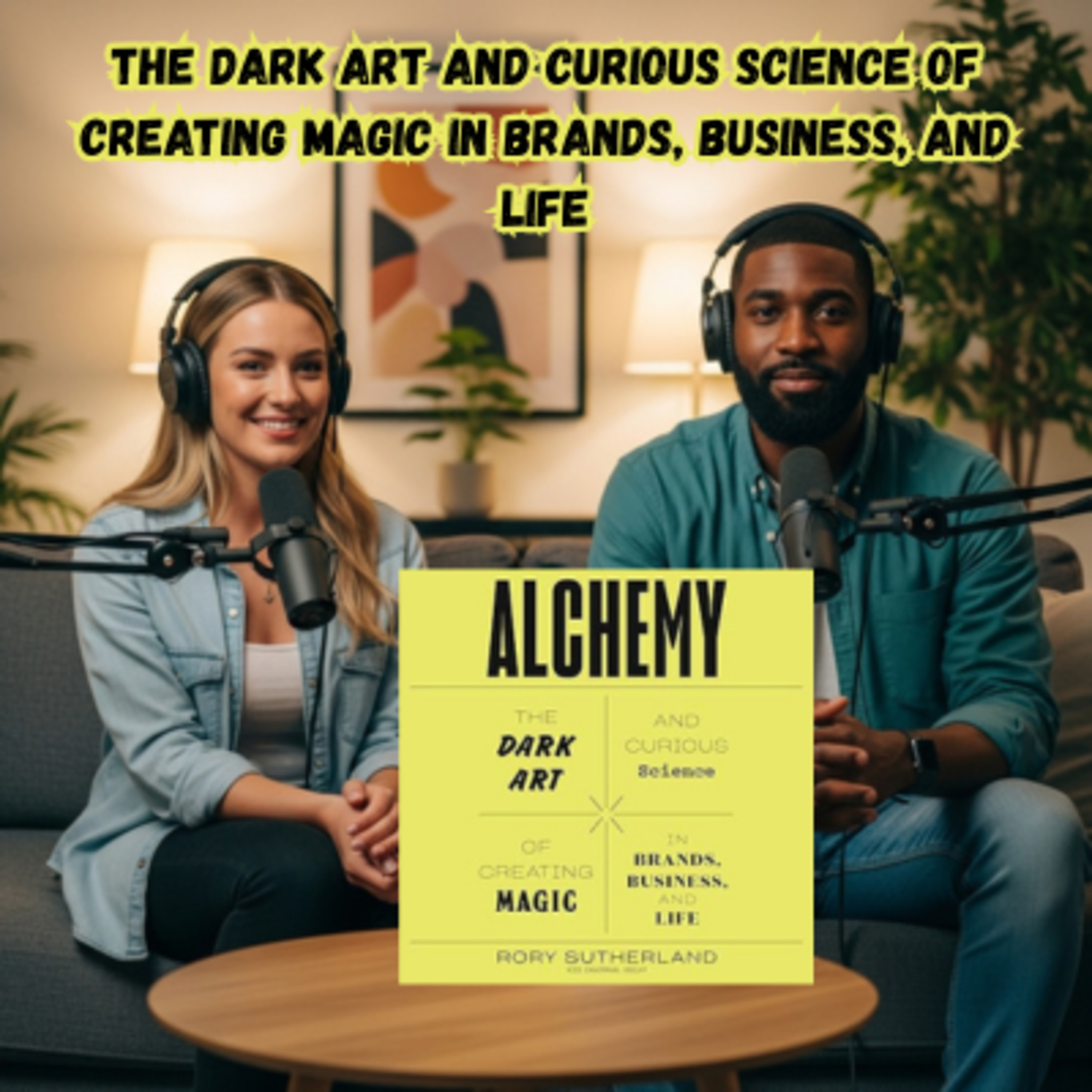
Rory Sutherland’s Alchemy explores the hidden power of irrationality in business, branding, and daily life. The text argues that logical reasoning has limits, suggesting instead that human perception often matters more than objective reality. Through concepts like signalling and subconscious hacking, the author demonstrates how unconventional thinking can solve complex problems more effectively than traditional data. By embracing the magic of psychology, individuals can create extraordinary value through subtle environmental cues and creative framing. Ultimately, the work serves as a guide to challenging status quo logic to unlock innovation and influence behaviour.
So have you ever looked at a really successful product or a huge business decision and just thought to yourself, that makes absolutely no logical sense all the time? I mean, we're always taught that the market rewards, you know, the most efficient thing, the cheapest option or the one that's technically superior. And yet we all seem to love stripey toothpaste, which is purely cosmetic. Or look at Red Bull. It's this global giant, even with its high price and a taste that, let's be honest, is kind of an acquired taste.
It's the perfect paradox to start with, isn't it? That's the core of our deep dives today. When you have these technically superior, more rationally priced options right there, why do people so often choose the Irrational 1? And. That question leads us straight into the sources we've been looking at, specifically Rory Sutherland's book Alchemy, the Dark Art and Curious Science of Creating Magic in Brands, Business and Life. Absolutely. And our mission today is, well, it's pretty straightforward.
We want to give you a shortcut to thinking differently, to becoming an unconventional thinker. Yeah, moving beyond the standard business playbook, it's all about data and spreadsheets. We want to show you how understanding and even using irrationality isn't just about spotting human quirks, it's a really powerful strategic tool you can use to get genuinely amazing results. So I guess the first step is just accepting that this perfectly rational world we think we live in, it's full of holes, right?
The main idea, which Sutherland brings up right away is that while logic and reason are useful, they absolutely have their limits. Not everything that looks rational on paper is actually the best solution when humans are involved. OK, so let me really dig into that idea. The limitation of reason, because we're all trained to optimize, right? Find the fastest route, the cheapest part. But the book suggests that people almost never make decisions based on like a spec sheet or pure efficiency. They choose something because it looks nice, or maybe, and this is the big one, because it makes them feel good.
Exactly, and that feeling is more important than the technical reality. Think about something like train travel. Logically, the best train journey is the fastest 1 from A to B. But Sutherland points out that British Rail spent millions trying to shave a few minutes off journey times. Which sounds like the rational thing to do. It does, but maybe a better, more irrational solution would have been to just install great Wi-Fi that makes the journey feel shorter, or put in more comfortable seats which makes it feel better.
So the perception of the improvement matters more than the actual objective improvement. It often outweighs it completely. That's so provocative because it goes against everything we learn about optimization. It suggests that if you have two companies with nearly identical products and one spends all its money on tiny technical games. And the other one spends its money on the perception of quality, the packaging, the story, the feeling. The one selling perception is probably going to win, and that takes us right into what he calls modern magic, right?
So if logic has its limits, this is where the real value comes from. Yes. Modern magic isn't about spells, it's about how we perceive and emotionally connect with brands and ideas. The take away is simple. Perception is everything. It almost always beats objective features when feelings are involved. And the best way to see that is to ask where value even comes from. It's not inherent in an object. It's totally subjective. It's manufactured by us. The classic example, and it's kind of fundamental to this whole idea, is the diamond.
Of course. I mean, if you strip away all the cultural meaning, what is it? It's just high pressure carbon, chemically inert. Not even that rare. It's actual material cost is tiny in comparison to its price, but through decades of really powerful cultural conditioning and social signaling, it's transformed. It stos being just carbon. And it becomes this powerful, irreplaceable symbol of eternal love and commitment, that perceived value which the industry carefully created through advertising and, you know, manufactured scarcity is what drives the whole market.
So they weren't selling minerals, they were selling confidence, emotional insurance. Exactly. That's the big picture magic. But what about the really subtle signals? The things that influence us without us even realizing it, like. The sound of a luxury car door closing. That heavy, satisfying thunk. That sound is completely intentional. It costs real money to engineer that specific sound. And it tells you nothing about the engine or the gas mileage. Nothing, but subconsciously it screams structural integrity, quality craftsmanship and therefore high value.
This is where you learn to trust your intuition. Sometimes if the data says a flimsy door is just as safe, but the experience feels cheap, people will reject the logical answer. So true innovation, the alchemist's way, is about looking past the data and enhancing that human experience. Yes, which leads us to the tools of the trade. How do we actually do this? It starts with the concept of signaling OK. Signaling. So this is all the nonverbal stuff. It's the language of cues. It's how we communicate our taste, our status, our intentions without saying a word.
It's why you choose one brand of shirt over another or a certain restaurant for a date. And a huge part of that is the price signal. That has to be one of the most powerful irrational factors there is. Oh. Absolutely. A high price tag works as a cognitive shortcut. It often signals quality and exclusivity. If you, the customer, can't really assess the quality of, say, a complex piece of software, you rely on the price as a substitute for the quality you're hoping for. But hold on, isn't that just manipulation?
If a brand charges $1000 for something that costs fifty to make, and it does the same thing as a competitor's product, are they just exploiting us? That's a fair question, but The Alchemist would see it differently. They'd say they're meeting a real, though irrational human need. The need for status or the need to reduce risk, or just the need to feel confident in a purchase. Solitary brands aren't just selling a watch, they're selling the certainty that it won't be a bad choice. Exactly. You're paying for psychological security, and that is a real form of value.
So the lesson for you listening is you have to obsess over every detail. The font on your site, The hold music for customer service, the weight of the box. Because they're all subconscious messages. It's not about what you say, it's about what you signal. OK, so that's external signaling, but then the book turns this whole idea inward, which I love, and talks about subconscious hacking signaling to ourselves. Yes, we often think we need willpower to achieve goals, but willpower runs out. Yeah, this is about influencing our own behavior by strategically sending signals to ourselves through our environment.
You're basically designing a system so that the right choice is the easiest choice. You've got it. You design your environment to guide your actions so you don't have to have that little debate with yourself every single day. Can you give us a few practical examples of that? The simplest 1 is about food. Instead of using willpower to not eat junk food, you just put the healthy snacks out where you can see them in easy reach and you hide the unhealthy stuff. You haven't removed the choice, you've just hacked the immediate low effort decision.
You're leveraging the subconscious signal of what's visible. Or think about routines. A simple, consistent morning routine is a powerful signal that sets a positive focus tone for the whole day. Because the brain likes predictability. It loves it. Those little habits reduce cognitive load and tell your mind, OK, it's work time now. You can even use visual cues, like putting an inspirational quote somewhere. You'll see it every day. It's a quiet, constant motivation that doesn't require conscious effort.
It's like self manipulation but for a good cause. For achieving your own goals, yeah. So we've gone from external perception to internal self influence. Now let's talk about efficiency, which kind of ironically sometimes means not choosing the most optimal path. This is satisficing. Satisficing is such a liberating idea. It's a blend of 2 words, satisfy and suffice. It just means choosing a solution that's good enough instead of burning all your energy trying to find the absolute perfect one. And this came from the economist Herbert Simon, right?
He was pushing back against that idea of humans as perfectly rational, optimizing machines. Exactly, he realized. We're not computers, we can't process infinite information, and we don't have incident time. The problem that satisficing solves is decision paralysis. Oh, that's so real. We're just flooded with choices for everything, which phone to get, which show to watch. Right. And trying to find the absolute best choice often means you make no choice at all, or you finally pick one and then regret it because you spent so long agonizing over it.
So just settling for good enough saves time and reduces stress. It saves a huge amount of cognitive energy, and for a business, this is critical. When you stop obsessing over that last 1% of efficiency, which can take 50% of the total effort, you free yourself up for creative thinking. The good enough solution becomes a stepping stone to something new. A different, unexpected opportunity. It's about making practical choices that free up your mind for the really important innovative work. That idea that our brains use shortcuts in comparisons is a perfect bridge to the next topic, psychophysics.
Yes, psychophysics. It's basically the study of how our minds interpret the world around us. It's the meeting point between physical reality and our subjective perception of it. And the key thing here is that our brains rarely judge anything in isolation. We're always comparing. Always, and that is what powers the contrast effect. Context completely changes our perception of value. Give us that wine example. It's a perfect illustration. OK, so you have a $20 bottle of wine. If you put it on a menu next to $100 bottle, that $20 bottle suddenly seems very reasonable, a sensible choice.
But if you put that same $20 bottle next to a $5 bottle. Now it seems expensive, maybe even a luxury. The wine hasn't changed at all, but it's perceived value just flipped completely because of the context. And This is why things like anchor pricing work. When you see a huge discount, your brain is anchored to that original higher price. Exactly. It's also why psychological pricing works. The actual difference between 499 and 5 dollars is 1 cent, but our brain gets stuck on the four. It feels significantly cheaper.
It's breaking that mental $5 barrier. For sure, and it goes beyond price to the environment itself. Is a context queue. The same exact cup of coffee will taste better and feel more valuable if you drink it in a cozy cafe versus a sterile office cubicle. The environment amplifies or dampens the quality. Understanding that value is subjective and totally dependent on context is one of the alchemists greatest tools. OK, so we've covered a lot of ground. We've questioned logic, we've talked about signals and now context.
How do we pull all this together and actually become an alchemist? I think the biggest theme is just to embrace unconventional thinking, to actively challenge the idea that logic is always the answer. You have to allow room for uncertainty and for creativity. Because innovation doesn't happen when everyone is optimizing the same spreadsheet. Never. You have to allow for those unexpected positive outcomes that don't fit the model. But with all this talk about psychology, we can't forget the actual people involved.
Right, the data is important, but it doesn't tell the whole story. Not even close. It fails to capture the messy reality of human emotions and feelings. If you want real insight, you have to value human experience. The stories, the observations, the why behind those seemingly irrational choices. So you balance the hard data with those soft psychological insights. Precisely, and then you apply the techniques we've discussed. Framing how you present information changes the decision and social proof that deep human need to follow what others are doing, especially when we're unsure.
This has been a fantastic deep dive into the power of, well, getting things wrong on purpose. We've seen how logic can limit us, the power of subtle signals, how satisficing saves our sanity, and how value is all in our heads thanks to psychophysics. It's a huge strategic advantage if you know how to use it. And that really brings us to our final thought for you to take away. If you really fully accept that people, your customers, your colleagues, even yourself often act irrationally, what is 1 seemingly trivial, non rational detail you could change a color, a word in an e-mail, an element of your daily routine.
What could you tweak to send a radically different subconscious signal? Because that small tweak might just create more magic than the biggest, most logical budget increase ever could.
 Apple Podcasts
 Castbox
 Castro
 Goodpods
 Moon FM
 Overcast
 Pocket Casts
 Podbean
 Podcast Addict
 Podcast Republic
 Spotify