Work Won't Love You Back by Sarah Jaffe | How Devotion to Our Jobs Keeps Us Exploited, Exhausted, and Alone
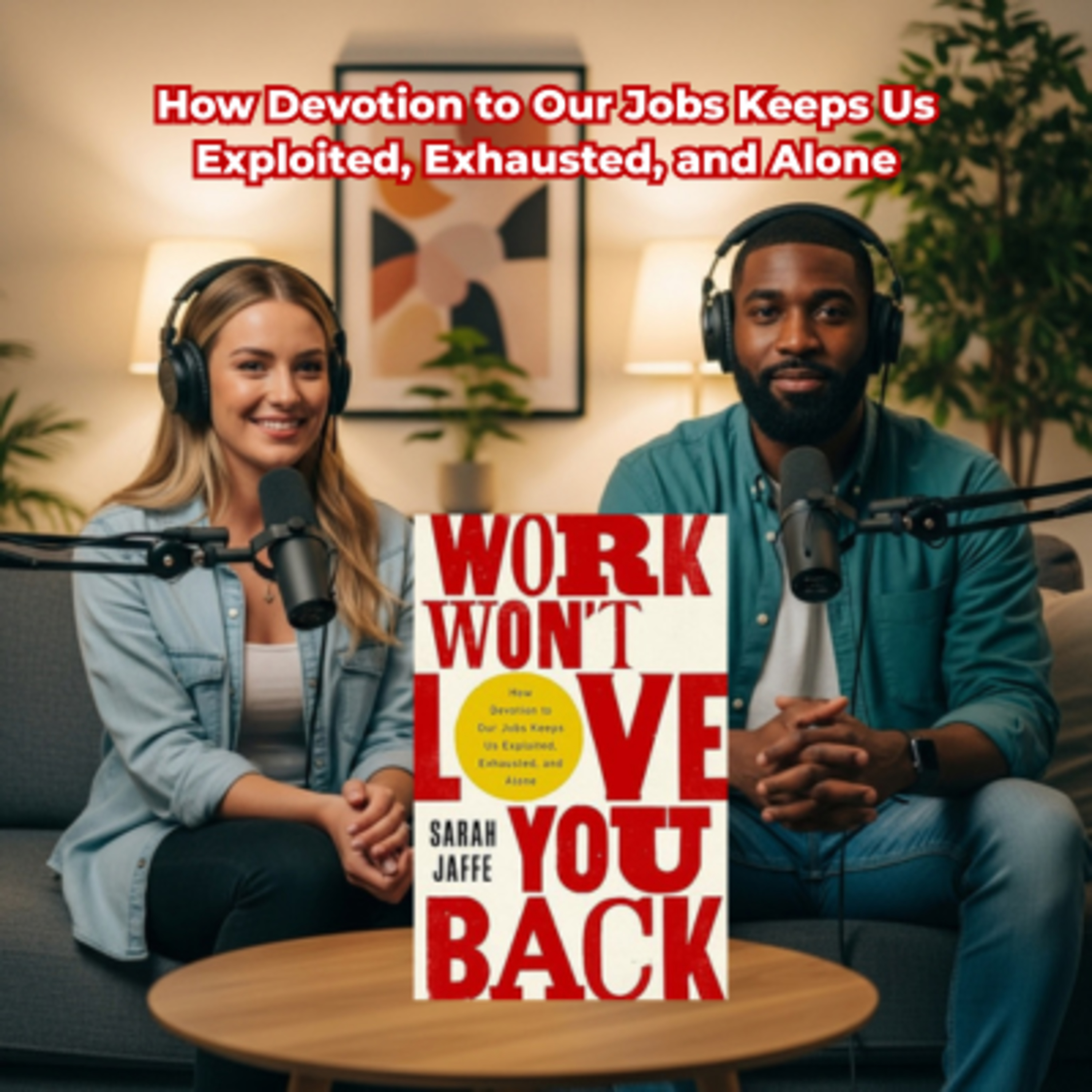
You're told that if you "do what you love, you'll never work a day in your life."
In Work Won't Love You Back, Sarah Jaffe, a preeminent voice on labor, inequality, and social movements, examines this "labor of love" myth—the idea that certain work is not really work, and therefore should be done out of passion instead of pay. Told through the lives and experiences of workers in various industries, Jaffe reveals how all of us have been tricked into buying into a new tyranny of work. Once freed from those binds, we can finally figure out what actually gives us joy, pleasure, and satisfaction.
In this episode we summarized Sarah Jaffe’s book, which critiques the modern cultural expectation that individuals should find ultimate fulfillment and love through their employment. By examining diverse sectors such as education, retail, nonprofits, and the arts, the source illustrates how employers often exploit a worker’s passion and emotional investment to justify low wages and poor conditions. It highlights the invisible labor performed in domestic settings and the precarious nature of internships and academic roles, where ambition is frequently used as a tool for manipulation. The author argues that this relentless drive for professional devotion results in severe burnout and a profound imbalance between one's career and personal life. Ultimately, the text serves as a warning against allowing workplace demands to overshadow physical health, financial security, and human relationships. It encourages readers to establish firm boundaries and recognize that their inherent value extends far beyond their productivity or professional titles.#productivityhacks #personaldevelopment #successstrategies #businessinsights #leadershipskills #leadership #ambitiousprofessionals #businesstips #self help #scaling business #businesstactics #professionaldevelopment #startupgrowth #entrepreneurship #businessmindset #growthstrategies
Imagine working like 60 hours a week, destroying your physical health and constantly stressing about rent. Yeah, it's a nightmare. Right. And then when you finally hit a breaking point and ask for a raise, your boss just looks at you disappointed and accuses you of, you know, not caring enough about the cause. Which is just. I mean, it's a brutal scenario, but it happens all the time. It really does. Today we are unpacking a really fascinating analysis of Sarah Jeff's book Work Won't Love You Back, and the mission for this deep dive is to explore how the ultimate modern trap might just be that famous phrase.
Do what you love. Exactly. We're going to look at how modern work expectations actively wears down, why striking a balance is crucial, and how to start reclaiming it. OK, let's unpack this. Because I mean, it really makes you audit your own life, doesn't it? Oh completely. Whether you're commuting to a job that is like your lifelong passion or you are just clocking in to collect a paycheck to pay your rent, this deep dive is a shortcut to looking at the mechanics of your career in a totally different way.
Yeah, and the core argument we are exploring today turns a very widely accepted cultural mantra just completely on its head. Right, that idea of finding your calling. Exactly. We are conditioned from a very young age to believe that finding your calling and being deeply passionate about your employment is the key to a fulfilled existence. Like it's the ultimate goal. Right. But the premise here is that this specific expectation that we must love our jobs is the exact mechanism driving chronic stress, systemic inequity and, frankly, outright exploitation in the modern economy.
Wow. So it's not a bonus, it's a trap. Basically, yeah. We've essentially been conditioned to believe that if we just love the work enough, the exhaustion doesn't count. Which is wild when you really think about it. But the analysis points out that to really understand how these expectations wear us down, we actually have to step outside the traditional workplace first, right? Yeah, we do. The foundation of this entire dynamic starts in the living room, actually. Wait, really? The living room. Yeah, it begins with the invisible, unpaid labor of home and family.
Which I got to say, seems like a counterintuitive place to start an analysis of the workforce, but it complete sense when you look at the mechanics of work life imbalance, right? I mean, we've all seen or experienced the reality of sitting in the dinner table while secretly answering an e-mail under the table. Oh totally the constant pinging. Yeah, the pressure to always be available completely destabilizes the private sphere. And that destabilization reveals a massive fault line in how labor is valued because, you know, due to conventional gender norms, women are historically and frequently expected to perform the vast majority of unpaid domestic chores.
Right, like cooking, cleaning, childcare. Eldercare. Yeah, all often on top of paid employment. Which is just a recipe for disaster. Exactly. It's a primary driver of burnout. Yeah, but more importantly for our economic understanding, it introduces the concept of invisible labor. Invisible labor, right? This is work that is absolutely essential to keeping the economy running, yet it is completely disregarded from a financial standpoint. You know, I kept thinking about this in terms of the operating system on a smartphone.
Oh, that's an interesting way to frame it. Yeah, because like, the operating system runs absolutely everything in the background is the only reason the phone is a functional tool and not just, you know, a very expensive paperweight. Right, it's foundational. Exactly. It makes all the shiny, highly visible apps, which in this analogy represent paid professional jobs, function properly, but the operating system gets zero credit. Nobody praises the OS until the entire system crashes if. We connect this to the bigger picture.
That analogy actually works perfectly on an economic level too. Really. How so? Well, think about how a tech company views an operating system update that they push out for free. Because it doesn't generate direct immediate revenue, it is treated as a baseline expectation, not a premium product. Oh wow, yeah. Our economic system treats invisible labor at home the exact same way. By inherently undervaluing the care required to keep humans fed, clothed and emotionally stable, treating it as a duty performed purely out of love, society sets a very dangerous precedent.
Because it just assumes it'll happen for free. Right. It establishes A structural baseline where the act of caring itself is not viewed as real compensable work. OK, so if caring is expected for free in the private sphere, that completely recontextualizes what happens when we leave the house and go into fields that actively require care. Precisely, It explains the foundational logic of why professionals whose paid jobs revolve around caring are treated so poorly by the free market. Let's look at teachers, for instance.
Yeah, perfect. For example the. Dedication teachers have to their students is legendary, but the analysis points out how that very dedication is weaponized. Teachers are frequently required to work massive amounts of extra hours, entirely uncompensated. And they're buying school supplies out of their own pockets. Exactly. It's wild. It is, and it's a reliance on what the book calls emotional labor. Teachers are investing heavily in the psychological well-being and success of their students. Right, They aren't simply delivering a curriculum.
No, not at all. They're acting as counselors, mentors and emotional anchors. And the systemic issue here is that Seoul districts and local budgets implicitly rely on the fact that a teacher's love for the children will prevent them from letting those kids suffer. So they just stretch them to the limit. Yeah, the system stretches a teacher's personal finances and their working hours to the breaking point because it knows their empathy won't allow them to just walk away at 30 PM. That is man, that's heavy.
And the same underlying mechanism shows up in the retail health sector, but in a slightly different flavor. Definitely, retail workers face famously low wages and job insecurity, but they're also mandated to provide a different kind of emotional labor. They have to offer service with a smile. Right, keeping a cheerful outlook and controlling their emotions no matter how terrible the working conditions are. Or how rude a customer might be. But let me play devil's advocate for a second here, though, OK?
Go for it. Is asking a retail worker for a smile really labor? Or isn't that just basic human decency? Like aren't we just asking people to be polite in public? It's a really common pushback, but there's a massive distinction between natural human politeness and mandated emotional labor. OK, what's the difference? Well. Politeness is a voluntary social lubricant. Emotional labor in this context is the commercialization of human feeling. The labor part comes from the requirement to suppress your genuine emotional state.
Oh I see, like if you're feeling exhausted or stressed about paying rent. Or demeaned by a hostile customer. You have to artificially project joy because your literal survival and your paycheck depend on it. Doing that for eight straight hours creates severe cognitive dissonance. Because you're outside, doesn't match your inside. Right. It is mentally exhausting to constantly manage your emotions to soothe someone else. The service industry realized decades ago that monetizing an employee's emotional state drives customer loyalty.
So they aren't just buying the physical task of scanning groceries. Exactly, they are renting the workers emotional state but paying only for the physical task. Renting your emotional state? Wow, that reframes the entire concept of customer service for me. And this dynamic doesn't stop at jobs we typically associate with caregiving or retail, does it? No, it actually intensifies in fields where the work itself is perceived as a higher calling. Here's where it gets really interesting. The nonprofit and art sectors are prime examples of this.
Yeah, this is where the cultural narrative of doing what you love becomes overtly, structurally manipulative. Analysis highlights how nonprofit workers face enthusiasm, exploitation because these individuals are working for a noble 'cause you know, saving the environment, helping the unhoused, fighting for human rights. They are fully expected to accept lesser pay and work significantly longer hours. Right, their passion isn't just a nice bonus. Exactly. It is literally factored into the business model of the organization.
And it creates an impossible moral trap if a worker in a nonprofit asks for a living wage or refuses to work a 60 hour week without overtime. The pushback from management isn't just about the budget. What is it about? The worker is accused of not caring enough about the 'cause they are told they are hurting the mission. Oh, that's incredibly manipulative. It is. It weaponizes their own morality against them to suppress labor costs. The result is severe physical and emotional burnout because the human body cannot run purely on moral superiority.
It's the ultimate irony. Having a strong sense of purpose for your work makes you more vulnerable to abuse, not less. And we see the exact same thing in the art world too. Absolutely. Artists face what is called the exploitation of passion. Because art is so heavily romanticized by society, artists are expected to labor for a little to no pay, just to have the privilege of doing what they love. And the defining characteristic of the art world, and increasingly the modern economy of the whole, is precarity.
Precarity, right? Yeah, and precarity isn't just a fancy word for being broke. It is a structural economic shift. It means a life defined by unpredictable income, gig work, 0 long term contracts and a complete lack of safety Nets like healthcare or pensions. Because the institution, the galleries, the publishers, the streaming platforms shifts all the financial risk onto the individual artist. Exactly. This raises an important question. How do we as a society genuinely value the arts if the entire industry model relies on the financial instability of its creators?
We happily consume the art, but we expect the creator's passion to act as a substitute for a living wage. It's a huge disconnect. Yeah. And if you're listening to this and thinking, well, I'm not a painter and I don't work for a charity so I'm immune to this, we have to talk about the aspirational trap. We do this passion tax is woven into the entry points of almost all professional careers today, and it reaches the highest levels of academia and the tech industry. The. Aspirational Trap is brilliant in its design.
Honestly. Let's look at the entry level mechanism internships. Right, the classic unpaid intern. The expectation that young professionals should toil away for little to no compensation is framed as paying your dues. It is ambition exploitation. You are paid entirely in quote UN quote, experience and exposure. Exactly, but experience doesn't pay rent. No it doesn't. The crucial take away here is how this practice drives massive systemic inequality. Unpaid or drastically underpaid internships act as a socio economic gatekeeping mechanism.
Because who can actually afford to labor for free for a year in an expensive city like New York or London? Only individuals who already possessed generational wealth or substantial family support. Which means that highly influential fields like journalism, politics and publishing are structurally designed to filter out working class voices from the very beginning. It's a rigged game, and even if you make it through those gates and earn a highly specialized degree, the precarity follows you. Right.
Look at academia. Yeah, the bulk of teaching and research today is not done by tenured professors. It's done by adjuncts. And these are highly educated professionals facing extreme instability, right? Total instability, no long term contracts, shockingly low pay per class and incredibly demanding workloads. The university system leverages the sheer prestige of academia against the adjuncts basic needs. The implication being that you should put up with subpar conditions simply because you have the honor of being part of the intellectual elite.
Exactly. We see a very clear pattern emerging here. Institutions leverage the prestige, the morality or the supposed joy of the work to suppress wages. But perhaps the most insidious, modernized version of this is found in the tech sector and digital businesses. Oh, the tech world is notorious for this. They call this the labor of love, play and labor mashed together into one concept, right? Digital businesses create a culture where they intentionally blur the boundaries between work and personal life.
They conflate work with play, so employees feel pressured to be constantly engaged. They engineer a corporate culture where pushing yourself to the absolute limit isn't framed as overwork, it is celebrated as demonstrating how passionate, innovative and motivated you are. You know, I kept visualizing a casino when going over this part of the analysis. A casino? That's an interesting comparison. Yeah, well, working at a massive modern tech campus operates on the exact same psychological principles as a Vegas casino.
Oh, I see where you're going with this. Right. A casino pumps in fresh oxygen, hands out free drinks and removes all the windows and clocks so you completely lose track of time. They make it feel like a fun game so you don't realize you're losing your money. And the tech companies do the exact same thing with time and labor. Exactly. They give you ping pong tables, free catered dinners, nap pods, and beer on tap. They make the office feel like an adult playground so you forget you are spending your entire youth there.
Let's look at the economic mechanics of that casino analogy, because it is spot on. Yeah, a casino is. It's designed so the house always wins the. House always wins. The Tech campus is no different. It is an ROI calculation masquerading as corporate culture. A return on investment calculation. Yeah, a company might spend $5000 on a ping pong table and free kombucha, but if those perks convince a team of software engineers to stay at the office until 9.0 PM every night, the company extracts hundreds of thousands of dollars in unpaid overtime in return.
That is just brilliant and terrifying. By blurring the lines of work and life, they manipulate intellectual curiosity and the desire for community to extract maximum labor, completely ignoring the human need for rest. It is psychological manipulation scaled up to an industrial level. And while knowledge workers and creatives face the severe mental manipulation, the analysis points out an industry where this exploitation takes a devastating physical toll. Right, professional athletics. So what does this all mean?
I mean, it's easy to look at athletes and assume they've got it made. It is the ultimate extreme of trading oneself for the love of the game. The public perception of professional sports is dominated by the glamour of the top 1%. The massive contracts, the fame, the highlights. Exactly. But that illusion of success completely obscures the daily grinding reality of the profession as a whole. Athletes endure tremendous physical and emotional labor to reach peak performance, and they almost always do it at the direct price of their long term health.
They are quite literally trading their cartilage, their brain health and their joints for the job. And what we have to understand is the profound instability of this career path. The average career duration in most professional physical sports is shockingly short. One bad tackle, 1 torn ligament and the career is over instantly. And for the vast majority of athletes who aren't global superstars with massive endorsement deals, that leads to highly unpredictable post retirement finances. The industry extracts peak physical performance during an athlete's absolute physical prime, discards them when their body breaks down, and seamlessly moves on to the next rookie.
Wow. The passionate love of the game is used to justify treating the human body as a disposable commodity. For the love of the game, it's the exact same rhetorical smokescreen as suffer for the cause in a nonprofit or doing what you love in the art world it. Obscures the core transaction. Which leads us to the ultimate realization of this entire exploration across all these diverse fields, from the unseen domestic worker to the retail employee manufacturing a smile, the teacher buying supplies, the dedicated activist, the unpaid intern, the adjunct professor, the tech worker at the ping pong table, and the broken athlete.
The central theme holds absolute truth. Work will not love you back. Because an institution is a legal entity, it is structurally incapable of love. It can't hug you, can't visit you when you're sick. It can't hold your hand when you're stressed. Your work is undoubtedly vital to society, but it should not consume your entire existence. The key strategies to survive this culture of enthusiasm exploitation require setting firm limits, putting your physical and mental health first, and actively finding fulfillment outside of your economic output.
It requires A fundamental, sometimes painful shift in perspective. We have to stop looking to our employers or our economic productivity for our primary sense of identity and self worth. So think about your own routines right now. Are you answering emails on a Sunday morning? Are you taking on extra projects you aren't paid for because you want to be seen as a team player? Have you let the corporate casino trick you into staying past dinner time? Recognizing these mechanisms is the first step toward reclaiming your autonomy.
It is a difficult audit to perform, especially if you have spent your entire adult life tying yourself worth to your professional achievements. But setting those boundaries opens up a fascinating space for personal growth. If you successfully manage to detach your inherent value as a human being from your economic output, what entirely new, untapped parts of your identity might you finally have the energy to discover in your free time? Imagine what you could build if you weren't draining your entire battery on the background operating system.
Until next time.
 Apple Podcasts
 Castbox
 Castro
 Goodpods
 Moon FM
 Overcast
 Pocket Casts
 Podbean
 Podcast Addict
 Podcast Republic
 Spotify