Top 10 Ways to Avoid Taxes by Mark J Quann and Josh Shapiro | Strategic Wealth Preservation and Tax Avoidance Strategies
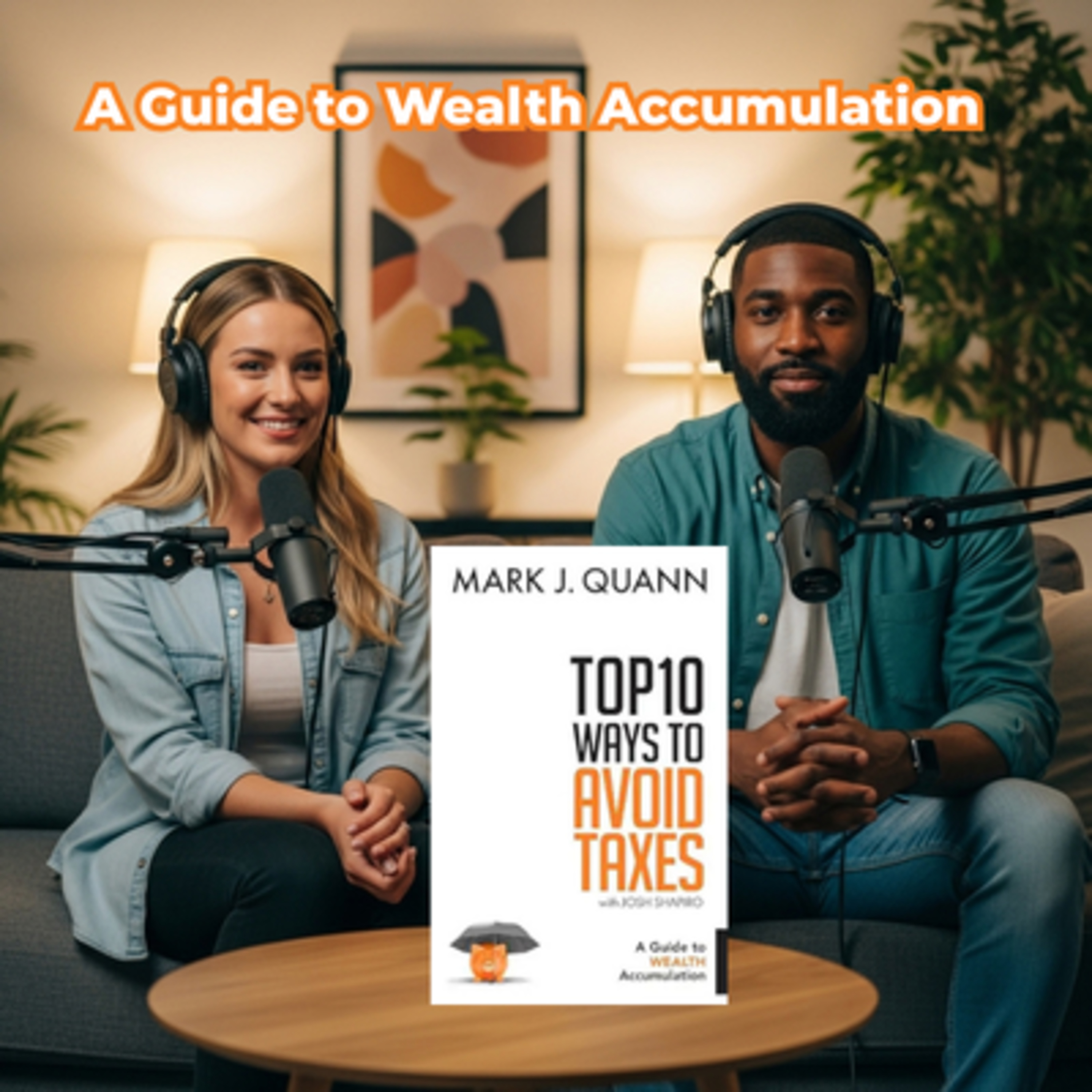
This episode outlines legal strategies for building wealth by minimising tax obligations as presented in a book by Mark J Quann and Josh Shapiro. The authors advocate for business ownership and the use of Roth IRAs to secure tax-free growth and deductions. Investment tactics such as purchasing municipal bonds, holding assets for long-term capital gains, and utilising tax-loss harvesting are highlighted as essential tools for financial efficiency. Furthermore, the source discusses real estate advantages, including leveraging debt, applying depreciation, and capitalising on home sale exemptions. High-income earners are introduced to the "Rich Man's Roth" and estate planning techniques to protect their legacy from heavy taxation. Finally, the guide suggests geographic relocation to states with lower income taxes as a practical method for increasing personal savings.Strategies for building wealth and avoiding excessive taxation from one of the most original finance thinkers of our time. Top 10 Ways to Avoid Taxes will teach you what the Top 1% know about money and the tools they use to grow, protect and pass that wealth to their heirs tax-free.#productivityhacks #personaldevelopment #successstrategies #businessinsights #leadershipskills #leadership #ambitiousprofessionals #businesstips #self help #scaling business #businesstactics #professionaldevelopment #startupgrowth #entrepreneurship #businessmindset #growthstrategies
What if I told you that the wealthiest people in the country view the IRS tax code not as this, you know, impenetrable penalty box, but actually is a heavily discounted catalog? Yeah, that is a wild way to think about it, but it's completely accurate. Right, because you know the reality most of us live in, you look at your net pay and 1/3 of it has just vanished into the ether. Entirely vanished. Yeah, it just feels like this massive, immovable wall between you and your actual financial goals. But today we are ripping apart a framework that proves taxes aren't just something that happened to you.
They are a rule book you can actively play, provided you know how to read the rules. I mean, the shift in perspective is profound. Once you stop viewing taxation as a purely passive, punitive experience for those who actually study the architecture of the tax system, it transforms into, well, an active strategic lever for accelerating wealth. And that is exactly our mission. Today we are taking a deep dive into the specific wealth accumulation strategy strategies outlined in the book Top Ten Ways to Avoid Taxes, A Guide to Wealth Accumulation by Mark J Kwan and Josh Shapiro.
It's a fascinating text. It really is, but I want to set the tone right out of the gate here. The phrase avoiding taxes sounds, I don't know, like offshore accounts and secret shell companies. Right, like you're hiding money in a mattress somewhere. Exactly. But that is not what this deep dive is about. We are talking strictly about smart, entirely legal frameworks designed by the government to be utilized. The foundation of this source material rests entirely on the distinction between tax evasion, which is illegal concealment, and tax avoidance, which is simply structuring your financial life to align with the legal provisions already baked into the tax code.
Like these are deliberate incentives. OK, let's unpack this. We're going to move through four key financial arenas today. First, how you structure your income. Second, how you protect your investments in retirement. 3rd, how you leverage physical assets. And finally, how geography and legacy dictate your ultimate wealth. A very solid road map. O Let's start with the absolute foundation, which is structuring your income through a business entity. Right, so the entire strategy begins with recognizing the structural disadvantage of a standard W2 paycheck.
With a classic 9:00 to 5:00. Exactly. As an employee, you face top line taxation. Your sequence is linear and rigid. You earn, the government immediately takes its cut from the pop, and you attempt to live on the remainder. Which is painful. Very. But a business operates on bottom line taxation. A business earns money, spends money to operate and grow, and is only taxed on the net profit that remains. So a regular W2 paycheck is essentially walking in the rain without an umbrella. You just get soaked by taxes immediately.
I love that analogy, Thanks. But creating a business entity is like opening up a financial umbrella. It Shields a massive portion of money flowing through your life because so many costs of doing business overlap with things you are probably already paying for. The overlap is where the legitimate tax advantages live. We are talking about deducting portions of your home, Internet, dedicated office space, phone bills, or travel that genuinely serves a business purpose. But wait, you can't just call yourself a business and start writing off your groceries, right?
How does one actually benefit from this without crossing a line? What's fascinating here is the boundary is firmly rooted in legitimate market rate compensation for actual work performed or actual business usage. You can't just write off personal meals. By running necessary expenses through a business structure before the tax is calculated, you mathematically lower your taxable footprint. OK, that makes sense. Furthermore, the text heavily emphasizes a structural maneuver called income splitting.
Now income splitting sounds like a massive red flag for an audit if you do it wrong. I assume the IRS frowns upon just arbitrarily paying your toddler a $50,000 salary to write off taxes. Oh, they absolutely do frown on that. Yeah, you cannot simply shift money to a family member's bank account and call it a salary. Right. So where is the actual legal boundary there? It's all about market rate compensation for real work, but if a spouse or a child is genuinely performed forming administrative work, managing social media, or handling bookkeeping, you can pay them a reasonable wage for that specific role.
I see, so it has to be a real job. Exactly. And by doing so, you move income out of your highest marginal tax bracket and shift it into their much lower, sometimes 0% tax bracket. Wow. Yeah, you shrink the family's total aggregate tax burden by distributing the income across multiple brackets. So we restructure our active income through a business entity to protect it today, but as soon as we start saving that money for the future, we expose it to a whole new set of tax vulnerabilities. You do. Passive income is a whole different ball game.
Right, So how does this framework solve for shielding passive wealth, specifically when it comes to retirement accounts? Well, the text focuses intensely on the Roth IRA, primarily because of the structural control it gives you over your future tax liability. With a traditional retirement account, you take a tax deduction today, but you are creating a massive, unpredictable tax bomb for your future self. Because you don't know what the tax rates will be in 30 years. Precisely. Every dollar of growth will be taxed at whatever the income tax rates happen to be when you retire.
The Roth flips the timeline. You pay taxes on the seed money today, but the harvest, you know the decades of compound growth, is completely immune to future taxation. That's huge, and the government doesn't force your hand later either. The lack of required minimum distributions or RMDS feels like the hidden superpower of the Roth. It really is like you are forced to pull money out and trigger a taxable event at age 73 just because the IRS wants their cut. The absence of RMDS is critical for generational wealth planning.
It allows the capital to continue compounding tax free for the entirety of your life if you don't actually need to spend it. Which is incredible. But the authors highlight a massive hurdle for high earners. There are strict income limits that legally ban you from contributing directly to a Roth IRA. Here's where it gets really interesting, because the book outlines the rich man's Roth or the backdoor Roth strategy. The backdoor Roth. But doing this conversion means triggering what they call conversion taxes.
If I'm a high income earner right now, I'm already sitting in a brutal top tier tax bracket. Yeah, you're already feeling the pain. Right. Voluntarily taking a tax hit on a conversion today sounds like financial self sabotage. Why pay maximum taxes today when I could just use a traditional account and kick the can down the road? Well, it requires A calculated bet on the macroeconomic future. The math relies on an assumption about long term tax rates. OK, walk me through that. Historically speaking, top marginal tax rates are currently quite low.
If you believe that national debt, inflation and public spending will inevitably force tax rates higher over the next 20 to 30 years, than paying 37% today is actually a bargain. Compared to potentially paying 45 or 50% on a much larger pool of money in the future. Exactly. You are essentially buying permanent tax immunity at today's prices. But there's a catch, right? If you have existing funds in a Traditional IRA, you have to navigate the pro rata rule. Oh, the pro rata rule. Because you can't just isolate the clean after tax money you just deposited and convert only that.
No, the IRS doesn't let you cherry pick. The IRS forces you to calculate the ratio of pre tax to after tax money across all your traditional Iras and taxes the conversion proportionally it. Sounds like a really complex maneuver. It is. The pro rata rule frequently catches high earners off guard. It underscores why these strategies require meticulous execution, often with ACPA, rather than just clicking buttons in a brokerage account. Definitely don't just wing it on an app. Absolutely not, but the payoff is permanent tax shelter.
So that solves the long term retirement problem, but we need liquidity before we hit age 59 1/2. Once we step outside of those sheltered retirement accounts and start investing in standard taxable brokerage accounts, the landscape completely changes. It does. In a standard brokerage account, you are constantly navigating the friction of capital gains taxes. Right, which eats into everything. Yeah. So the framework prioritizes the holding period of an asset. Selling an asset held for less than a year triggers short term capital gains, tying the profit to your ordinary income bracket.
Which could be really high. Exactly, but holding an asset for over a year drops it into the long term capital gains brackets which are significantly lower, sometimes saving you 15 to 20% on the tax bill for the exact same monetary profit. It's like patience is literally subsidized by the government. That's a great way to phrase it. But obviously, the market doesn't only go up. The book details a strategy for when an investment tanks called tax loss harvesting. Basically using your losers to protect your winners.
Right. The mechanism of tax loss harvesting turns portfolio loss into a literal tax asset. How does that work in practice? So if you lock in a $10,000 profit on a tech stock, that is a taxable event. But if you purposefully sell a different underperforming asset at a $10,000 loss, you use that realize loss to perfectly offset the gain. So they just cancel each other out. Exactly. The tax liability on the winning investment drops to 0. And the framework points out a very specific fall back. If the market has an abysmal year and your losses far exceed your gains, you get to carry that financial pain over into your regular life.
Yeah, the IRS allows you to take up to $3000 of excess capital losses and apply them directly against your ordinary W2 income every single year. Wait against your normal salary. Yes, against your normal income and if you are married filing separately, the limit is $1500. That's amazing. And the strategic value here is the indefinite carry forward. If you suffer a $30,000 portfolio loss, you can offset $3000 of your salary for the next 10 years. So it creates an ongoing multi year tax buffer out of a single market downturn.
Exactly. You turn a bad year into a decade of minor tax breaks. OK, so offsetting losses is great for the stock market, but what if you want a yield that simply isn't taxed at the federal level to begin with? The text introduces municipal bonds to solve this. Municipal bonds are debt instruments issued by local or state governments to fund infrastructure. You know, things like bridges, schools, highways. To incentivize capital flowing into public projects. The federal government makes the interest income completely tax exempt.
Oh wait, if the interest is federally tax free, why isn't every investor abandoning corporate bonds and pouring their cash into municipal debt? There has to be a catch with the returns, right? Yeah, the ceiling is the yield itself. Municipal bonds consistently offer lower raw interest rates than taxable corporate bonds or stock market index funds. OK, so you make less money on paper? On paper, yes. The actual value is determined by calculating the tax equivalent yield. Tax equivalent yield. Right.
So if a municipal bond pays a 4% tax free yield, a person in the 37% tax bracket would need a taxable corporate bond to pay over 6.3% just to break even after taxes. For an average earner in a low bracket, the math rarely works out. They are better off taking the higher taxable yield, but for the ultra high earner, that 4% tax free yield is mathematically superior to taking on the risk required to chase a 7% taxable return. It's all about calculating what you keep, not what you make. Precisely. But even with tax equivalent yields and loss harvesting, paper assets have limitations.
If we really want to amplify returns and tax advantages simultaneously, the source material points us away from paper entirely. It does. It leads us directly to hard assets and real estate. Real estate occupies a completely unique ecosystem within the US tax code. It acts as a financial multi tool, offering tax advantages at acquisition, during operation and upon exit. Let's start with acquisition. The acquisition phase relies heavily on OPM or other people's money through leverage. The debt itself becomes the tax shield, like you use a banks mortgage to control $1,000,000 asset while only putting down maybe $200,000, but you get to deduct the mortgage interest and the property taxes on the entire $1,000,000 value against your income.
You are amplifying your cash on cash return through leverage, while the tax code allows you to write off the cost of carrying that leverage. That's a double win. But the operational advantage of real estate, the element that generates the most profound wealth protection, is depreciation. OK, I love this part. Depreciation is effectively an invisible wear and tear coupon the IRS hands you. You get to and this coupon to the IRS every year to lower your tax bill, even if the building is appreciating wildly in the real market.
Yes, it is a phantom expense. The tax code assumes that physical structures degrade over time, which. They do, but maybe not as fast as the math says. Right. For residential rental properties, the IRS dictates a straight line depreciation schedule of 27.5 years. For commercial property, it's 39 years. So how does that look on a tax return? You divide the value of the building structure, excluding bring the land importantly by that timeline, and you deduct that exact amount from your rental income every single year.
So if you have a property generating $20,000 in positive cash flow from rent, but your depreciation formula gives you a $15,000 paper loss, the IRS only taxes you on $5000 of profit. Exactly. You keep the cash, but you don't pay the tax on most of it. If we connect this to the bigger picture, you see why real estate is favored. It shelters its own cash flow wild. And when you finally decide to exit a property, particularly a primary residence, the code offers an unprecedented wealth transfer mechanism through the home sale exemption.
Now, the rules on this are incredibly strict, but wildly lucrative. Very strict. You have to live in the home as your primary residence for two out of the five years prior to selling it. If you hit that exact metric, the capital gains wipeout is staggering. A single taxpayer can walk away with $250,000 of pure profit, completely untaxed. A married couple filing jointly can exclude $500,000 of capital gains. Half, $1,000,000 tax free. Yes, you can systematically upgrade your primary residence, adhere to the two year residency rule, and repeatedly capture half $1,000,000 of tax free wealth creation throughout your lifetime.
Usable once every two years, right? So we've legally shielded our business income, our market investments and our real estate. But the framework eventually forces us to look at the two most extreme absolute moves you can make to alter your tax reality. Yes, moving across state lines or planning for your own death. Let's look at geography first. The text explicitly points out the massive drag of high income tax states. Geographic arbitrage is a central pillar of the author's framework. The disparity in state income tax rates is massive.
It really is. Moving from a high tax jurisdiction like California to one of the states with 0 state income tax immediately captures a significant percentage of your gross earnings that would otherwise be lost. It is an instant structural raise without earning a single dollar more. Yeah, I have to play devil's advocate here and push back on the simplicity of just fleeing a state for tax reasons. Is moving purely for income tax avoidance a financial trap? This raises an important question. Right, because the text touches on holistic analysis and frankly if I move to a 0 income tax state but the property tax is on my new house triple and the sales tax is aggressive, did I actually outsmart the system?
It is a critical distinction to make state governments operate as closed ecosystems of revenue collection. The funds required to pave roads and fund local services must be extracted somehow. Someone has to pay for. It precisely If a state does not levy an income tax, it naturally shifts that burden to high property taxes, aggressive sales taxes, or exorbitant vehicle registration fees. So the math must be personalized. An ultra high income earner who rents an apartment will see an astronomical benefit moving to an income tax Free State.
Because they have no property taxes to worry about. Exactly. However, a median wage earner buying a massive home in that exact same state might actually face a higher aggregate tax burden due to the property tax variance. And we are just neutrally reporting the mathematical reality the book presents here. State tax structures are just different collection mechanisms. The text advocates for running the complete equation, not just reacting to a single tax rate. Makes total sense. And that brings us to the final ultimate exit strategy, estate planning and wealth preservation across generations.
Or, as the book bluntly implies, planning for when you die. The federal estate tax is designed to take a significant percentage of the wealth you leave behind. However, the system provides A substantial federal estate tax exemption, allowing a certain threshold of wealth to pass to heirs completely unhindered. But for estates pushing past that high threshold, the framework relies on systematically shrinking the estate while you were still alive. The primary mechanism is the annual lifetime gifting exclusion.
How does that work? The code allows you to gift a specific dollar amount to as many individuals as you want every single year without triggering any gift taxes or cutting into your lifetime exemption. Just giving away chunks of your wealth. Right. By systematically transferring assets to your descendants year after year, you slowly drain the taxable estate. You transfer the wealth on your own timeline, shielding it from the eventual death tax. So what does this all mean for you? We have covered massive ground today.
We really. Have we've seen that the frameworks for tax avoidance aren't hidden in in the shadows? They are utilizing the exact documented rules designed for business owners to write off expenses, for investors to shield compound growth, and for real estate holders to leverage phantom losses. It is a rule book waiting to be executed. And there is a unifying philosophy beneath every single strategy we explore today. What's that? Well, think about starting a business, investing in municipal infrastructure, providing rental housing, and independently saving for your own retirement.
The tax code is not actually a mechanism of punishment. It's not. No, it is a highly specific map of government incentives. By offering tax rates for starting businesses, providing housing, funding local projects via municipal bonds, and saving for retirement, the government is simply giving you a massive discount for doing the things they want society to do. They are heavily discounting the exact behaviors they desperately need to happen. Exactly, they need jobs created, infrastructure funded and citizens to be financially self reliant in old age.
It's an incentive map. They are basically bribing you to do the heavy lifting of society. That's a perfect way to look at. It which of those incentives are you currently missing out on? It's definitely something to consider the next time you look at that vanished third of your paycheck. The money didn't disappear by magic, it just followed the rules of the game. And now you know how to read them. Thank you for joining us on this deep dive.
 Apple Podcasts
 Castbox
 Castro
 Goodpods
 Moon FM
 Overcast
 Pocket Casts
 Podbean
 Podcast Addict
 Podcast Republic
 Spotify