The Power of Passion and Perseverance | Grit by Angela Duckworth
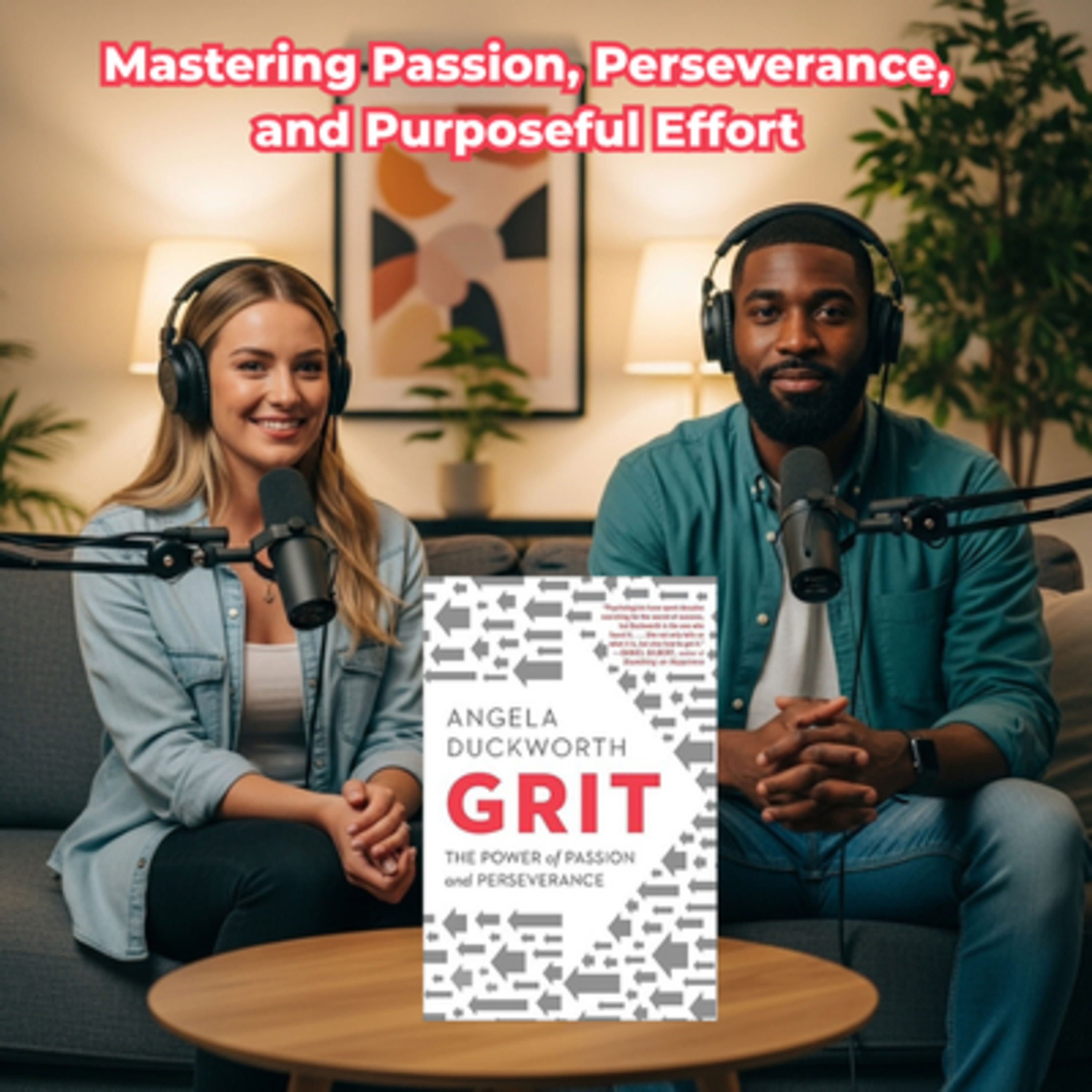
This episode provides a comprehensive summary of Angela Duckworth’s book, "Grit: The Power of Passion and Perseverance," through a series of structured video scripts. The content explains that long-term success is driven more by sustained effort than by natural talent, using a formula where labor counts twice. Key chapters detail how to measure and grow grit through the development of interest, purposeful practice, and a sense of hope. The sources also examine how parents, educators, and organizational cultures can foster these traits in others. Ultimately, the material serves as a guide for cultivating the endurance and dedication necessary to achieve significant life goals.In this instant New York Times bestseller, pioneering psychologist Angela Duckworth shows anyone striving to succeed—be it parents, students, educators, athletes, or business people—that the secret to outstanding achievement is not talent but a special blend of passion and persistence she calls “grit.”
Drawing on her own powerful story as the daughter of a scientist who frequently noted her lack of “genius,” Duckworth, now a celebrated researcher and professor, describes her early eye-opening stints in teaching, business consulting, and neuroscience, which led to the hypothesis that what really drives success is not “genius” but a unique combination of passion and long-term perseverance.
In Grit, she takes readers into the field to visit cadets struggling through their first days at West Point, teachers working in some of the toughest schools, and young finalists in the National Spelling Bee. She also mines fascinating insights from history and shows what can be gleaned from modern experiments in peak performance. Finally, she shares what she’s learned from interviewing dozens of high achievers—from JP Morgan CEO Jamie Dimon to New Yorker cartoon editor Bob Mankoff to Seattle Seahawks Coach Pete Carroll.
Among Grit’s most valuable insights:
*Why any effort you make ultimately counts twice toward your goal
*How grit can be learned, regardless of I.Q. or circumstances
*How lifelong interest is triggered
*How much of optimal practice is suffering and how much ecstasy
*Which is better for your child—a warm embrace or high standards
*The magic of the Hard Thing Rule
Winningly personal, insightful, and even life-changing, Grit is an inspiring self-improvement book about overcoming obstacles and what goes through your head when you fall down, and how that—not talent or luck—makes all the difference.#productivityhacks #personaldevelopment #successstrategies #businessinsights #leadershipskills #leadership #ambitiousprofessionals #businesstips #self help #scaling business #businesstactics #professionaldevelopment #startupgrowth #entrepreneurship #businessmindset #growthstrategies
You know, there is this almost universal frustration that I think every single person listening to this right now is felt at least once in their lives. No, absolutely. I mean, we've all been there, right? You are working yourself to the bone on a project or a new skill or you know a big career goal and you look over and there is someone just effortlessly gliding past you. Yeah, they just make it look so incredibly easy. It is infuriating sit there and think, well, they just have the gift, they have the natural talent and I simply don't.
But if you actually track those exact people over a lifetime, a really weird pattern starts to emerge. Yeah, that raw natural talent, it often completely falls short in the long run. So welcome to today's deep dive. We are talking directly to you today, taking a stack of chapter summaries and notes that breakdown Angela Duckworth's defining book, Grit, the Power of Passion and Perseverance. It is such a phenomenal breakdown of how success actually works. It really is, and our mission for this deep dive is to decode the true mechanics of success, to completely dismantle our cultural obsession with natural talent, and give you a tangible road map for cultivating unbreakable perseverance.
Which is something I think everyone could use a little more of. Definitely. OK, let's unpack this. Why is society so blinded by natural talent? It feels like we treat success as like a magic trick. We only want to see the final illusion, not the years of dropping the cards on the floor. It really is a pervasive illusion and what Duckworth calls the talent myth, it actively damages our potential. We are captivated by ease because if success is just a magical genetic lottery, well, it gives the rest of us an excuse not to try.
Right, because if it's a lottery, you either have the winning ticket or you don't. Exactly. When we see someone perform that flawless magic trick, we just assume they were born with a wand in their hand. And the moment we try that same trick, drop the cards and feel foolish, we immediately tell ourselves that we simply like the gift. We just quit, not because we actually can't do it, but because the whole cultural narrative tells us that struggling means you weren't meant to do it. Spot on. And to really understand the mechanics of why we fall for this, we have to look at psychologist Carol Dweck's research.
It forms the entire bedrock of this concept. Of the mindset stuff, right? Yeah, Dweck identified that human beings generally default to one of two ways of viewing their own abilities. You have the fixed mindset and the growth mindset. Right. So the fixed mindset is this idea that your abilities are like your eye color or your height. You were born with a certain amount of intelligence or a specific ceiling for athletic ability, and that is your permanent reality. Your stat sheet is essentially locked in at birth.
Yeah, and nothing you do is going to fundamentally change that underlying code. But it goes even deeper than just believing your stats are locked in a fixed mindset. The very act of trying hard is interpreted as a glaring red flag. But really, trying hard is a bad thing. Under that logic, yes, the internal logic dictates that if you were genuinely talented, you wouldn't need to sweat or study or practice relentlessly. Effort is literally seen as an admission of a deficit. Wow, so if I have to try hard it means I'm naturally bad at it?
That is a brutal way to live. It is the growth mindset, however, is the radical belief that your baseline abilities are just a starting point. They can be stretched and manipulated and fundamentally changed through dedication. And Duckworth takes that psychological foundation and turns it into a very specific math equation, right to explain the anatomy of achievement. She does. She argues that effort is a multiplier, but uniquely it counts twice in the formula for success. OK, lay the formula on us.
So the first part of the equation is talent multiplied by effort equals skill, and then the second part is skill multiplied by effort equals achievement. Here's where it gets really interesting. Effort is literally double weighted. It's like compound interest for your abilities. That is a perfect way to describe it. But I mean, multiplying it twice makes it sound like a neat symmetrical math trick for a textbook. Yeah, human psychology and real world success are incredibly messy. How does applying effort twice actually play out in a chaotic real world scenario?
Well, if we connect this to the bigger picture, it represents the literal progression of human capability. Talent is just how rapidly your skills improve when you invest effort. But having a skill doesn't inherently accomplish anything on its own, right? You then have to apply effort to that acquired skill to produce an actual achievement. Consider the notes we have on Alex and Janie, those two kids learning to play the piano. Yeah, Alex is the one with massive raw talent. Alex sits down, hits the keys and intuitively grasps melody and rhythm.
The brain pathways just connect effortlessly. Exactly. While Jamie's fingers are clumsy, hitting a simple chord is a frustrating physical struggle for Jamie. But because it comes so intuitively to Alex, Alex coasts. The fixed mindset kicks in. Alex is the quote UN quote piano prodigy, so practicing feels unnecessary. While Jamie, lacking that intuition, is forced to put in the daily grinding effort just to reach a baseline. And over the long run, Jamie overtakes Alex because Jamie used that daily effort to build the foundational skill and then, crucially, kept applying effort to turn that skill into mastery.
Yes. Jamie is out there actually playing in concerts, while Alex just occasionally plays a nice tune at a party. We see this exact dynamic mature in adult careers too. Like the writers from the notes, Sam and Chris? Right. Sam sits down and writes beautiful, flowing prose right out of the gate. Everyone praises Sam's raw talent. But because the praise comes so easily, Sam never develops the psychological calluses required to handle brutal editing or push through writer's block. And then you have Chris, who writes incredible, clunky, awkward drafts.
But Chris is forced to attend workshops, read vorationally to understand structure and write every single day. Chris actively seeks out harsh critique just to become passable, and years later Chris is a published author producing complex novels. While Sam has a drawer full of beautiful but entirely unfinished first chapters you. Even see it in physical sensory skills like the culinary world example with Emily and Jordan. Emily has this natural palette. She instinctively knows what flavors pair together.
And Jordan is the one burning the toast and over salting the soup. Exactly. But Jordan spends thousands of hours studying the actual chemistry of heat, experimenting with techniques, practicing knife skills until it becomes muscle memory. And Jordan eventually achieves culinary mastery running a whole kitchen, while Emily remains very good home cook. So talent definitely gives you a head start off the blocks, but without the engine of effort, that talent remains nothing more than unmet potential.
That is the core tragedy of the talent myth. Unmet potential. But you know it is also the great equalizer. If you are Jordan, you aren't doomed by your lack of natural intuition. You simply have a steeper initial climb, which is an incredibly empowering shift in perspective. It really is. But if effort is the primary engine driving this entire operation, how do we even know the horsepower of our engine right now? Like we could step on a scale to measure our weight, but how do you quantify something as abstract as perseverance?
Well, Duckworth actually had to solve that exact problem to prove her theory, and that resulted in the creation of the grit scale. The grit scale OK. Yeah, she needed to prove that grit isn't just, you know, poetic phrasing. It is a measurable, quantifiable psychological trait. The grid scale is a diagnostic tool designed to measure a person's specific combination of passion and perseverance over time. And when researchers studied people who scored at the absolute top of this scale, distinct patterns emerged right?
Definitely. They didn't just work hard, They had a remarkably clear sense of purpose. They held on to long term goals not just for weeks or months, but over years and even decades. Maintaining resilience in the face of massive, repeated public failures. But wait, here is where I think it gets really important. The score you get on the grit scale today is not permanent. No, not at all. It is entirely malleable. So you aren't stuck with your current level of perseverance, it can be intentionally engineered and grown.
Because grit is tethered to the growth mindset, grit itself can grow, and Duckworth isolates 4 specific factors required to cultivate it Interests, practice, purpose, and hope. Four factors, so let's start with the first one. Developing grit has to sequentially begin with discovering and nurturing an interest. Right. And a really common misconception is that gritty, highly successful individuals emerge from childhood with a singular burning life mission fully formed. Like they were just born knowing they were going to be an astronaut.
Exactly. But the reality is that deep interests are discovered through a very messy, inefficient period of broad exploration. Let's talk about that exploration phase because I think a lot of people feel super guilty for not knowing what their passion is. The notes provide 2 grim examples here, Lisa and Sarah. Yes, Lisa, She's the high schooler who desperately wants to be a doctor, but she is actively failing her science classes. Right. She takes the grid scale, realizes she has a deficit in perseverance, and instead of giving up on medicine, she sets very systematic long term behavioral goals.
She volunteers at local hospitals, forces herself to participate in science fairs despite her low grades. And eventually, through sheer exposure and repetition, she gets into medical school. And then look at Sarah's path, which is even less linear. Sarah just broadly like science. She doesn't have a master plan at all. She bounces around the biology club, the robotics team, chemistry labs, until she just stumbles upon a very specific, intense fascination with astronomy. Right, and only then, after finding that specific niche, does she partner with a mentor to build her own telescope and set her sights on astrophysics.
In both cases, there is an initial, unpolished period of simply figuring out what holds their attention. Wait, so passion isn't a lightning bolt that just hits you out of nowhere? Not at all, Because the way we talk about finding your passion makes it sound like a spiritual awakening. It actually sounds more like building a campfire. You start with these tiny, fragile twigs of curiosity. I love that analogy. If you don't actively blow on them, protect them from the wind, slowly add bigger pieces of wood, they just burnout.
You have to actively work to turn an interest into a roaring fire of passion. Because if you throw a massive log of intense 10,000 an hour commitment onto a tiny spark of curiosity, you will completely smother it. You absolutely must start with the twigs. And during this fragile twig phase, the surrounding environment is critical, isn't it? It's vital specifically the presence of parents, teachers and mentors. Greedy individuals almost universally report having supportive figures early in their journey who encourage them to explore without the crushing pressure of immediate excellence.
But once that fire is actually lit, once a genuine, durable interest is established, the rules of the game change entirely. You cannot continually feed that fire by just doing what is fun or comfortable. No, you feed it through a highly demanding, specialized type of action. Which brings us to the second factor, practice. And we aren't talking about just mindlessly logging hours. The notes make a brutal distinction here. We are talking about deliberate practice. Deliberate practice is intimidating.
Honestly reading the breakdown of it, it sounds awful. It is the exact opposite of getting into a chill flow state. It requires setting hyper specific micro goals, intense cognitive focus, and actively seeking out immediate harsh feedback. You are forcing yourself to constantly operate just past the edge of your current ability, specifically to expose and fix your weaknesses. It is entirely anti comfort. Consider John, the violinist from the case studies. John doesn't spend his practice time playing the beautiful concertos he already knows and enjoys.
Right, that would be regular, comfortable practice. Deliberate practice. Looks like John recording his daily 2 hour sessions, agonizing over a three second sequence where the exact angle of his finger is slightly off. And then taking that painful recording to a master teacher to be critiqued. He is actively hunting for his own flaws so he can systematically eradicate them. It's grueling. But I have to push back here. Deliberate practice sounds psychologically exhausting. If I am constantly obsessively focusing only on what I'm bad at just to get immediate feedback on how terrible my technique is, doesn't that just completely erode a person's confidence?
It sounds like a recipe for a breakdown, doesn't it? Yeah. How do gritty people subject themselves to that daily without just burning out and quitting? This raises a really important question, and it highlights why you cannot sustain grit on practice alone. The exhaustion you are describing is very real. You cannot survive deliberate practice without the third factor of grit, which is purpose. OK, so purpose functions as the psychological armor against the exhaustion of practice. Exactly. And Duckworth defines purpose not just as personal ambition, but as the deep realization that your work matters to the well-being of others.
It's the alignment of your personal deep seated interests with a broader external mission. That makes total sense when you look at Maria from the case studies. Maria the teacher. Right. Yeah, Maria initially entered the profession simply because she found history interesting. That was her foundational twig of interest. But over time, she discovers that her true purpose isn't just lecturing about the Cold War. It is inspiring and empowering vulnerable children to develop confidence in their own minds.
The motivation shifts entirely from oh, I like this subject to I am actively shaping the future of these human beings. And that deeper external mission is the only thing that sustains her when she is grading papers at midnight or dealing with an emotionally volatile classroom. Purpose shifts the focal point from the internal go to external contribution. Even when John the violinist is suffering through deliberate practice, his purpose isn't just to be technically perfect, he is to eventually move an audience to tears.
Beautifully said. However, even with purpose, setbacks are completely inevitable. The project will fail, a funding will fall through. Your technique is going to plateau. So what keeps you going then? The ultimate shock absorber for those catastrophic moments is the 4th and final factor, hope. But we need to be incredibly precise with how we define hope in the architecture of grit. Duckworth is not talking about passive wishful thinking. So it's not sitting on the couch visualizing success, hoping the universe magically delivers a published novel or a thriving business to your doorstep.
No gritty hope is fiercely, stubbornly active. It loops right back around to the growth mindset. It's the active, unwavering belief in your own agency. It's not hoping the obstacle disappears. It's hoping that you have the capacity to improve enough to climb over the obstacle. Exactly. It is the conviction that tomorrow can be better and, crucially, that you are the primary variable in making it better. The source has outlined very specific psychological strategies for cultivating this act of hope too, like setting small achievable micro goals to artificially create momentum when you feel stuck.
And deeply reflecting on past moments of resilience to remind yourself of your own capability and aggressively utilizing a support network. Look at Jake, the aspiring entrepreneur in our notes. He faces a massive, crushing string of rejections from investors that would make a rational person just fold the company. But instead of giving up or waiting for luck to intervene, he shrinks his operational focus. He sets minor daily milestones. He consciously celebrates the tiny incremental wins. He draws on his past successes in different fields and leans heavily on his peer network to stay mentally afloat until his business model finally gains traction.
That is active hope. So what does this all mean for the average person facing a crisis? Is this just a rebranded version of toxic positivity? Like what is the actual difference between the hope that builds grit and just wearing rose colored glasses while your business or your project burns down to the ground around you? What's fascinating here is the sharp distinction between denial and adaptability. Toxic positivity is pure denial. It is standing in a burning room and saying everything is fine.
The heat is actually quite pleasant. Right, delusion, basically. Exactly. Gritty Harp is looking directly at the flames and saying this is a total disaster. My current strategy has failed completely, but I believe if I can learn how to put this fire out and I will try a completely new method immediately. So it is based on rapid action and radical adaptability. If one approach fails, gritty hope doesn't internalize the failure and say I am a failure, It objectively states that specific method failed.
What is the next logical adjustment? Spot on. Furthermore, and this is perhaps the most critical pivot in Duckworth's entire philosophy, this level of resilient adaptability is rarely developed in isolation. You cannot simply lock yourself in an empty room and willpower your way to a high grit score. Your capacity for grit is heavily, heavily dictated by the people around you. Which brings us to the ecosystem. Because grit is not a solo sport, the sources dive deep into how our environment shapes our perseverance, starting with the literal beginning how we raise kids.
Yeah, they highlight parenting for Grit, focusing specifically on the authoritative parenting style. And to be clear, this is not authoritarian parenting, which is just cold strictness and punishment. Right. Authoritative parenting is this incredibly delicate, difficult balance of demanding high expectations while simultaneously providing massive emotional support. It's parents who demand excellence but direct all their praise at the effort the child exerts, rather than praising their innate talent OR just the final grade.
We see this balance perfectly illustrated in the example of Emma. Emma is a middle schooler struggling terribly with complex math. Her parents do not give her the 6th mindset out by saying Oh well nobody in our family is a math person anyway. But they also don't just scream at her to produce an A on the next test. They established the uncompromising standard that she must continue trying. But they sit down with her at the kitchen table, support her frustration and praise her specifically for the two hours she spent wrestling with the textbook.
And this ecosystem extends beyond the home to Emma's teacher reinforces this by creating a classroom culture that actively celebrates mistakes as necessary data points for learning. That specific ecosystem makes it psychologically safe for Emma to engage in deliberate practice without her ego being destroyed by every wrong answer. And you see this exact same scaffolding on the playing fields. Extracurricular activities act as real world grit simulators. Oh yeah, like Ben. Ben is physically outmatched and struggles with high school soccer.
At first, his immediate instinct is to quit to avoid the embarrassment. But he has an authoritative coach who guides him, pushing him to focus on specific skill improvements rather than his lack of natural speed. Ben commits long term, eventually earns the role of team captain, and learns a type of physical and emotional resilience that permanently wires his brain. And that perseverance then bleeds over into how he tackles his academic life. It's the sustained commitment to a difficult task supported by a structured community that builds the muscle.
But it's vital to note this isn't just a manual for raising kids or coaching teens. This exact framework applies to massive corporate ecosystems as well. It absolutely does. Organizations are living cultures, and the norms of those cultures will either actively foster grit or systematically crush it. Look at the software company detailed in the notes. Yeah, tech innovators. Right The CEO, Sarah, she doesn't just stand at the front of the boardroom and demand flawless execution from her engineers.
She actively normalizes struggle by sharing public stories of her own personal setbacks, failed product launches and miscalculations. The company structures its performance reviews to reward effort, creative problem solving and incremental progress rather than solely focusing on end of quarter financial results. They even established formal mentorship programs so junior employees aren't just struggling in a vacuum. When the leadership models vulnerability and resilience, and the institutional rules reward persistence over immediate perfection, the entire collective workforce becomes grittier.
It changes everything. I look at this authoritative environment, whether it is parents raising a struggling child, a coach training an insecure athlete, or ACEO leading a volatile company, and it reminds me of the scaffolding erected around the skyscraper under construction. That's a really good visual. You are providing total, unwavering structural support from the outside so the building doesn't collapse under the wind or the elements, but you still demand that the building itself, the Boston, is doing the actual internal structural work to stand tall.
You don't lay the bricks for them. Right, you ensure they have a safe framework to figure out how to lay the bricks themselves. The scaffolding is the defining variable. It is the culture, the mentorship, the shared values and the psychological safety to fail. And when you integrate all of these individual pieces, you get a full picture. Yeah, the growth mindset, the friction of deliberate practice, the external focus of purpose, the act of adaptability of hope, and the structural scaffolding of the ecosystem.
When you put that together, you produce someone like Clara. Clara's story from the sources perfectly encapsulates the entire architecture of the book. She is an aspiring novelist. She doesn't just write when inspiration strikes, she subjects herself to the grueling, deliberate practice of dissecting her own sentence structure. She anchors her work in the deep purpose of telling stories that help marginalized people feel seen. She maintains a growth mindset through years of rejection. But the crucial culminating factor is that she leans entirely on her writing group and her mentor, her scaffolding to survive the inevitable emotional devastation of those rejections.
Because she is embedded in that ecosystem, she sustains her effort long enough for it to count twice, and she finally publishes her novel. It's just a beautiful summation of the whole process. It is incredibly inspiring and honestly, deeply pragmatic to realize that the mechanics of success are actually accessible to all of us. As we wrap up this deep dive, I want to speak directly to you, the listener. Wherever you are right now in your life, whatever career pivot, personal project, or new skill feels impossibly out of reach because you feel like you just lack the natural talent.
Remember that grit is the true engine. Passion combined with perseverance. Natural talent might give someone else a three second head start off the block, but your effort counts twice. You can deliberately engineer your own grit by exploring your interests without judgement, committing to the uncomfortable friction of deliberate practice, connecting your daily grind to a higher external purpose, and aggressively maintaining active, adaptable hope. And to leave you with a final thought to ponder something that builds on everything we've dissected today, if effort truly counts twice, and if our capacity for grit is fundamentally shaped by our environment, consider the areas in your life right now where you feel like you have completely failed or permanently hit your limit.
Really, look at them. What if those weren't limits of your natural talent at all? What if you simply haven't yet placed yourself in an ecosystem, A supportive culture, a rigorous mentorship, or a structured practice routine? Yeah, that is actually designed to sustain your effort. Are you truly out of potential or are you just operating in the wrong environment? Think about that next time you see someone perform a magic trick. Remember they dropped the cards 1000 times in a room that supported them before they ever stepped on stage.
 Apple Podcasts
 Castbox
 Castro
 Goodpods
 Moon FM
 Overcast
 Pocket Casts
 Podbean
 Podcast Addict
 Podcast Republic
 Spotify