The Game of Life and How to Play It by Florence Scovel Shinn | Mastering the Laws of Prosperity and Mind
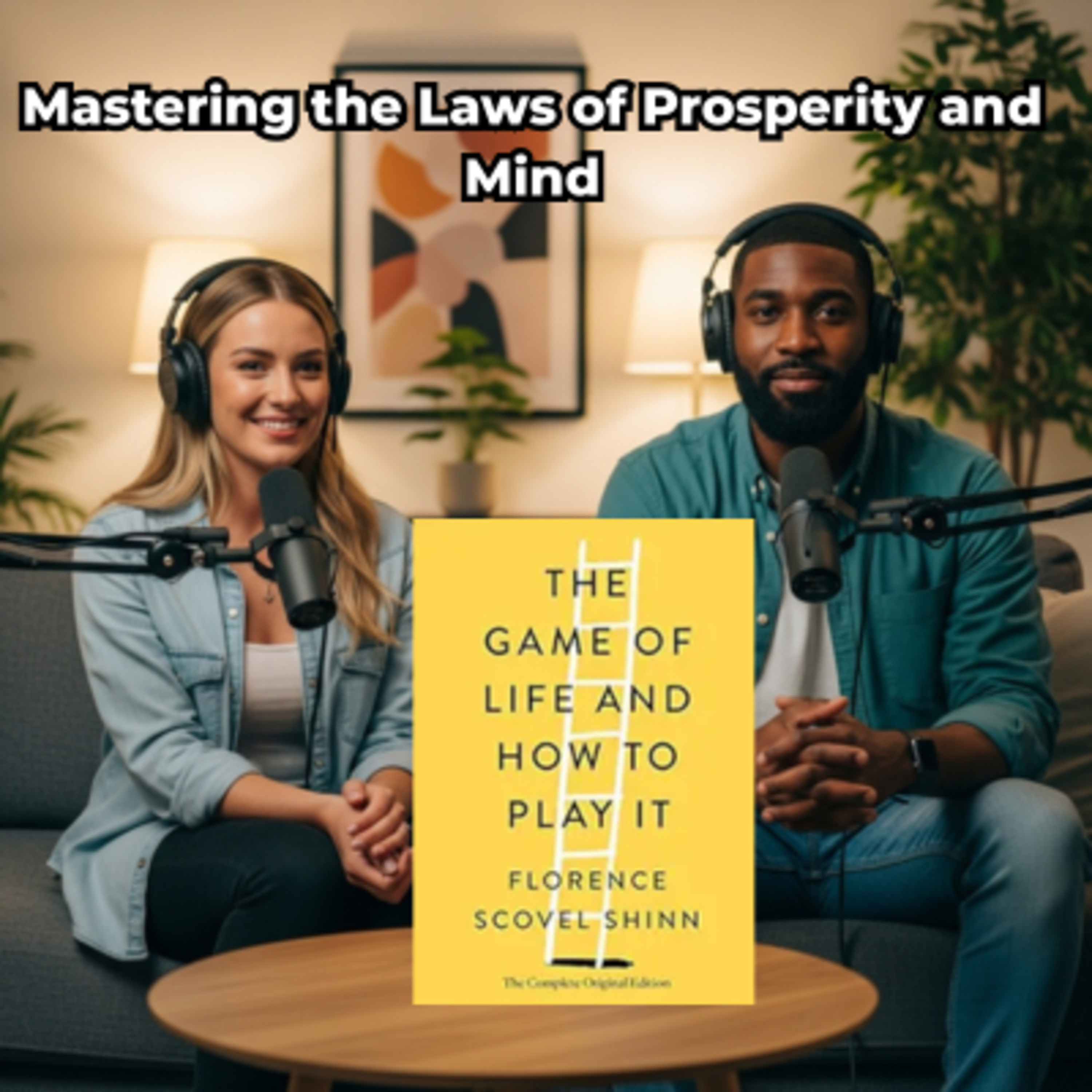
This episode summarizes Florence Scovel Shinn’s influential work, The Game of Life and How to Play It, which presents life as a strategic endeavor governed by spiritual laws. The source outlines ten chapters that teach readers how to harness the creative power of thought and the impact of spoken words to manifest their desires. Key principles discussed include the Law of Attraction, the importance of nonresistance, and the practice of forgiveness to clear negative karmic patterns. By utilizing affirmations and following intuitive guidance, individuals are encouraged to align themselves with a divine design centered on prosperity and joy. Ultimately, the text serves as a guide for personal transformation, showing how a shift in mindset can lead to a life of abundance and purpose.
Explore the wisdom of a New Thought classic and master the game of life!
In the classic bestseller The Game of Life and How to Play It, Florence Scovel Shinn helped to define the personal success genre. Written in the new thought tradition, her message is simple yet transformative—we receive back what we put into the world through our actions, energy, and attitudes. Negativity and pessimism are returned in kind, but by switching the script in favor of positive attitudes and affirmations, we are able to manifest success and joy in everything we do.
Life, Shinn tells us, is not a battle of us against the world, but rather a game of giving and receiving. What we give to the world we receive back—whether that be the dark weight of fear and inhibition or the freedom of joy and empowerment.#gameoflifeandhowtoplayit #gameoflife #FlorenceScovelShinn #productivityhacks #personaldevelopment #successstrategies #businessinsights #leadershipskills #leadership #ambitiousprofessionals #businesstips #self help #scaling business #businesstactics #professionaldevelopment #startupgrowth #entrepreneurship #businessmindset #growthstrategies
Imagine sitting down at a table to play just this incredibly complex board game. Oh yeah, like one of those massive strategy games that takes an hour just to set up. Exactly. The board is sprawling, right? It's stretching out past what you can even see, and there are countless pieces, intricate mechanisms, and the stakes are unimaginably high. High stakes for a board. Game. Well, yeah, because we're talking about your livelihood, your happiness, your ultimate fulfillment. Oh, I see. But there's a massive, glaring catch here.
Nobody handed you the rule book. Oh wow, that sounds incredibly stressful. Right. You're sitting there moving pieces around in the dark, rolling the dice and, you know, hoping for the best. And sometimes you went around but you have absolutely no idea why. Yeah, it's just pure. Look at that. Point totally. Most of the time, though, you hit a catastrophic set back and you were left sitting there feeling like the game is fundamentally rigged against you. It is an incredibly exhausting way to play.
I mean, when you don't know the rules, you are constantly forced to play on the defensive. Yeah, you're always reacting. Exactly. You live your life reacting to every single move on the board instead of actually plotting a strategy. You're surviving, You're not playing. And that is exactly how the vast majority of us are due to our own lives. We treat everyday existence like a chaotic, unpredictable battle where just have to, you know, keep our heads down and weather the storm. It's a very common default state.
But today we are looking at a philosophy that completely flips that script. We're diving into the classic, really groundbreaking work of Florence Govelshin, specifically her book The Game of Life and how to Play It. Such a fascinating read. It really is. OK, let's unpack this because our mission today is to extract Shin's 10 essential principles for achieving Success, prosperity, and joy. Right. We are going to map out exactly how these kindless teachings can help you, the listener, fundamentally rewrite the rules of your own life so you can start actively attracting wealth and purpose.
What's fascinating here is how Shin manages to take these massive, almost intimidating, universal laws of abundance and synthesize them into a highly practical, actionable framework. Yeah, she makes it so accessible. She really does. I mean, she wrote this back in the 1920s, yet she completely bridges the gap between, you know, abstract spiritual concepts and the gritty, everyday reality we all navigate. Doesn't feel dated at all. Not at all. She doesn't just offer platitudes like oh, think happy thoughts.
She provides a mechanical, almost psychological explanation for why our mindset directly dictates our external reality so. To play any game effectively, you first have to understand the board and the wind condition. Yeah, you need the lay of the land. Exactly. And the very first foundational principle Shin lays out is that life is in fact a game. It is not a battle. That's a huge distinction it. Is and the pieces we are playing with aren't little plastic tokens or even our physical actions. They are entirely made-up of our thoughts and our core beliefs.
That semantic distinction between a battle and a game is really the crucial first step. If you view life as a battle, your brain is actually operating in survival mode. Like, biologically. Yes, biologically you are triggering your amygdala living in a constant state of fight or flight, and that literally narrows your perspective. It forces you to view everyone around you as an enemy or an obstacle. That sounds exhausting. It is but a game. However implies a system. It implies rules, structure, and most importantly, it implies a player who has agency.
You're in control, right? When you sit down to play a game, you engage your prefrontal cortex. You strategize, you observe. And the primary non negotiable rule of this game is the law of attraction. Shin places a massive emphasis on the creative power of our thoughts. Which is a huge theme in her work. It is. She argues the positive thoughts magnetize positive outcomes, while negative thoughts inevitably draw in negative ones. And I know that sounds like a very common self help trope, but she treats it like a literal law of physics.
We had to consciously control our thoughts to create our desired reality. Well, and if we look at the cognitive psychology behind this, it stops sounding like magic and start sounding like biology. Yeah, think about the Reticular Act activating system, or the Ras. It's a bundle of nerves at our brain stem that filters out unnecessary information so the important stuff gets through. Oh, because otherwise we'd be totally overwhelmed. Exactly, we process too much data, so if you are constantly dwelling on scarcity, your Ras actually filters your reality to highlight everything that proves you are lacking.
So you're literally blinding yourself to the good. Stuff you will literally fail to see a financial opportunity right in front of you because your brain has deemed it irrelevant to your core belief of poverty. That is wild. It's powerful. Shin's Law of Attraction is essentially teaching you how to manually program your Ras. When you demand a positive outcome, your brain physically starts to look for the pathways to achieve it. Which flows perfectly into her next major principle, the law of prosperity.
Right, the abundance mindset. Shin makes the bold claim that prosperity is actually our birthright, but it's primarily a state of mind rather than a bank balance. That's a hard pivot for a lot of people to make. It is, she says. Wealth is attracted by thankfulness, by generous giving, and by an unwavering trust in divine timing. So it's very active. Very active. So if I could throw out a bit of an analogy here, if life is this massive board game, your focused thoughts are the dice that move you forward.
I like that. But your attitude of gratitude is the actual currency you use to buy property on the board. Oh, that's good. And for that currency to be useful, it must remain in constant circulation. Like real money. Exactly like real money. This is why Shin explicitly pairs gratitude with generous giving and faith if you hoard your resources, whether that's money, your time, or even your affection. Because you're scared of running out. Right, because you are operating from a deep sea of fear that there will never be enough.
When you do that, you break the economy of the game. You just stall out. You are signaling to your subconscious that you are impoverished, but a mindset of abundance where you give freely and express gratitude for what you have. That causes wealth to multiply because it removes the friction of panic. It aligns your actions with those universal laws. Exactly. OK, so we understand that our thoughts move the pieces and gratitude is the currency, but how do we actually execute these moves out in the real world?
How do we play the turn? Yeah, how do we interact with the physical game board on a daily basis? Shin tackles this by focusing on the active tools we use, specifically our spoken language and our physical energy. She calls this the power of the word. She introduces a really powerful concept here, emphasizing that our words are not just passive descriptors of our reality, they are the active builders of it. Right. She uses this classic metaphor that our words are quite literally like seeds planted in the rich soil of our subconscious mind.
It's a. Perfect visual. It really is. They have the power to manifest our physical experiences. When we consciously choose positive affirming words, we are planting the blueprint for a positive outcome. And the mechanics of that seed metaphor are really worth digging into. I mean, when you plant an apple seed in the ground, you don't immediately see a tree. No, you just see a patch of dirt. Exactly. You just see dirt, but the entire complex blueprint for the roots, the trunk, the branches, the fruit, it is entirely contained within that tiny shell.
And the subconscious mind is the dirt. Yes, your subconscious mind is exactly like the soil. It does not filter, it does not judge, and it does not protect you from yourself. It just. Grows whatever you plant. It simply takes whatever seed you give it and begins the unseen work of growing it. If you constantly speak words of saying things like I am always broke or I never get the promotion. Which we all do sometimes. We do, but your subconscious accepts that blueprint and goes to work making it a reality.
That brings us to another of her core principles, the law of non resistance. Shin argues that we need to actively let go of resistance, accept situations as they are, and trust the universe to align with our desired abundance. This is a tough one for people. It is, and here's where it gets really interesting, because I have to push back on this a little. Bit. OK, let's hear it. When you read about non resistance, especially if there is something you want desperately like I don't know, escaping crippling dead or finding a fulfilling career, doesn't non resistance just sound like throwing your hands up?
Like you're just quitting, Yeah. It sounds incredibly passive, like a shoulder shrug to the universe. I get why it sounds that way, but if we connect this to the bigger picture, non resistance is anything but apathy. It is arguably the most active, disciplined state you can achieve. Really. How so? Non resistance is about the total elimination of friction. Think about the concept of Aikido, the Japanese martial art. OK, I'm picturing it. If an opponent rushes at you with incredible force, you do not stand there rigidly and try to block them with brute strength.
Right, because you'd get knocked. Over. That's resistance, and you will get crushed. Instead, you accept their momentum, you step out of the way, and you guide their own energy to neutralize the threat. Oh wow, that completely changes the framing. You aren't giving up, you're refusing to waste your energy fighting the immovable object. Exactly. Shin's law of non resistance is about accepting the reality of the present moment so that you can allow positive action to flow. Rather than panicking. Right when you panic, when you try to force outcomes through sheer stress and anxiety, you create immense psychological friction.
You get that tunnel vision. You develop tunnel vision. You make impulsive, fear based decisions that usually sabotage the very abundance you're trying to attract. Yeah, that makes so much sense. Trusting the process allows you to maintain a clear head, spotting the opportunities to manifest your desires with ease rather than total exhaustion. OK, so we're programming our subconscious with intentional words and we're practicing non resistance so we don't exhaust ourselves fighting the current. We're setting up a good game.
We are, but any player in any game inevitably hits roadblocks, and in life, those roadblocks are almost always built from our own past actions. Well. Absolutely. Shin addresses this by detailing how we clear the board, focusing heavily on karma, forgiveness and love. And it is vital to note here that Shin does not treat karma and forgiveness merely as religious obligations or moral imperatives. No, she's very pragmatic about. It she treats them as cold, hard tactical strategies for winning the game.
She defines the law of karma as a straightforward mechanism of cause and effect. Every thought, word indeed we put out into the world has a ripple effect that ultimately influences our future experiences. The seeds growing again. Exactly. But we are not doomed to be victims of our past mistakes because she introduces the law of forgiveness as the antidote. The Ultimate reset button. Right. Forgiving ourselves and others actively clears karmic debts and releases negative energy. So it's basically like wiping the malware off your computer so your operating system can actually run efficiently.
That's a brilliant way to look at it. Let's breakdown the psychology of why this is such an essential strategy for you, the listener. Please do. Holding onto a bitter grievance or refusing to forgive someone who wronged you is exactly like leaving a heavy application running in the background of your mind. Draining the battery. It consumes massive amounts of cognitive bandwidth. Every time you rehearse that anger, you are reinforcing a negative neural pathway. You are keeping your focus anchored to the past.
So forgiveness isn't really about the other person at. All not at all. Forgiveness is not about letting someone off the hook for their bad behavior. It is the ultimate strategic maneuver to reclaim your own mental energy. Wow. It closes the loop so you can allocate all of your resources to moving forward. Building on that need to clear mental bandwidth, Shin introduces a principle she calls Casting the Burden. This is a great one. It is this is the deliberate act of letting go of intense worries and deep seated fears to make physical and mental room for abundance.
Right. So connecting these ideas, I look at it this way. Imagine you are navigating a small sailboat through a sudden violent storm. OK, your instinct is to white knuckle the main sheet, pulling the sail as tight as possible to try and control the boat. But holding on that tightly in a Gale is exactly what causes a boat to capsize. That captures the physics of it perfectly. If you refuse to let go, the pressure of the wind has nowhere to go but over. Right. Casting the burden is like deliberately letting go of that rope.
You let the sail flap wildly for a moment. You let the wind spill out harmlessly. Which is terrifying. It feels terrifying. It's so counterintuitive to release control, but doing so allows the heavy the keel of the boat to naturally right itself. And the physics of letting go are incredibly powerful. Worry and fear create a rigidity in our thinking that guarantees we will snap under pressure. We just break. Shin emphasizes that we have to cast that burden, release the tension, and immediately replace that worry with a positive affirmation.
You can't just leave it empty. No, you cannot just leave a vacuum in your mind once the boat is upright, you have to reset the sail with intention. You actively practice faith and trust to reprogram the subconscious. And the most powerful force we can use to navigate the rest of this game is love. But Shin is very careful to define this. Yes, she's not talking about ROM com love. No, not at all. She is not talking about a fleeting romantic feeling or sentimental affection. She defines love as a potent, unconditional, universal force that heals, removes hate, and transcends limitations through profound compassion.
Love is presented here as the ultimate de escalation tactic. De escalation. Yeah, when you respond to severe adversity or a toxic person with genuine compassion, you are activating the highest level strategy available on the board. That's fascinating. Think about it. Hate, anger and fear are incredibly high friction states. They require effort to maintain. Fear exhausting. If you approach a challenging situation with unconditional love, you neutralize the negativity. The resistance simply melts away because you refuse to engage in the battle, returning to the rules of the game.
You align yourself with blessings instead of conflict. Exactly all. Right. So we've reclaimed our mental bandwidth, we've cleared the karmic roadblocks by we're giving our past and we're operating with love and non resistance to avoid capsizing. The board is clean. The board is completely clear, but how do you actually navigate to the finish line? What does winning actually look like in this system? That is the big question. Shin provides a road map for the winning strategy through intuition, discovering your divine design, and the daily discipline of affirmations.
Her focus on intuition as a primary navigational tool is really compelling. She describes it as an inner guidance system. Yes, she says. This inner guidance is communicated to us through gut instincts, and the only way we can reliably access it is by actively quieting the mind, practicing relaxation, and paying attention to the subtle signs and occurrences from the universe that validate that feeling. This raises an important question. How often do you, as the listener completely ignore your own gut instincts because the outside noise is just too loud?
Well, probably every day. Right. We live in an era where we are constantly bombarded by unsolicited advice, social media algorithms, and crushing societal expectations. That's deafening. That noise completely drowns out our internal guidance system. But neurologically speaking, intuition isn't some mystical woo woo concept. It's not just a feeling. No, it is your brain's default mode network rapidly processing millions of subconscious data points and pattern recognitions to deliver a split second conclusion.
Wow, so it actual data processing? It is a highly tuned, deeply biological instrument for success. But Shin is entirely right. You have to actively cultivate silence to lower your cortisol levels enough to actually hear the signal over the noise. And learning to hear that signal is vital because it is the only thing that can lead you to what she calls your divine design or your perfect self-expression. Or true purpose, yeah. Shin argues that every single person has a completely unique purpose. Embracing your true authenticity, leaning unapologetically into your unique talents and passions is the only way to unlock your true potential.
Pursuing your authentic self is essentially choosing the path of least resistance. Tying it back to non resistance. Exactly when you are living a life that contradicts your core values, or when you are chasing a version of success that someone else defined for you, you are constantly fighting your own nature. And that causes friction. Exhausting discovering and stepping into your genuine purpose isn't a separate step. It is the natural, inevitable result of applying all the previous rules we've discussed.
You can't hear the call of your divine design if your mind is full of panic. Which brings us to the final daily mechanics of shaping this reality denials and affirmations. It's tools. The daily tools. Denials involve the active, deliberate rejection of negative thoughts and limiting beliefs, effectively breaking free from their influence. Affirmations are the intentional positive statements you use to replace them, aligning yourself with the abundance of the universe, right? So what does this all mean?
How does this actually look in the trenches of your daily routine? It means that every single day you are stepping into the role of an active curator. Like a museum curator, but for your thoughts. Exactly. When a thought of lack or fear pops up and it will, you forcefully deny it. You say no, that is not my reality, that is an old pattern and you immediately replace it with an affirmation of abundance. It requires immense mental discipline. Denials are how you prune the dead negative neural pathways in your brain, while affirmations are how you water the new ones.
Oh, mental landscaping. It is mental landscaping. You combine the quiet trust of your intuition, the passionate pursuit of your authentic design, and you fiercely guard the gates of your mind. You don't let the weeds grow. Exactly. You are curating your internal environment so deliberately and with such precision that your external environment eventually has no choice but to reflect. It this has been such a powerful journey through Shin's incredible framework. We started by recognizing that life isn't a chaotic battle to survive, but a structured game with rules that anyone can master.
A completely different way to live. Truly, we explored how our words are the literal blueprints handed to the subconscious mind. We broke down how to clear the board of past baggage using forgiveness as a strategic tool, and finally how to use our intuition and daily mental discipline to unlock our own authentic purpose. The entire philosophy offers a complete paradigm shift, moving the listener from a state of passive observation to a state of active, empowered creation. And to you listening right now, the biggest take away here is that you are the player sitting at the table and the controller is in your hands today, right this second.
You have the agency. You possess the total agency to change your mindset, to drop the exhausting resistance, and to start actively attracting wealth, joy and purpose. Winning this game doesn't require a sudden change in your external circumstances. It requires A fundamentally new way of playing the game you are already in. Before we go, I want to leave you with a final, slightly provocative thought to Mull over. Oh, lay it on us. We spent a lot of time discussing the idea that words and thoughts are seeds planted in the subconscious and that our denials reject negative thoughts.
But think about the garden of your own mind, OK? If you have been unknowingly planting seeds of doubt, fear, and scarcity for years, maybe even decades before discovering this rule book, those roots are deep. Very deep. So how long does it actually take for a new fragile positive affirmation to uproot a deeply entrenched negative belief? Oh, that is a tough question. It isn't instantaneous. I challenge you to really examine the soil of your mind today. Look at the beliefs that are currently bearing fruit in your life.
Trace them back to their roots and ask yourself which ones need to be ruthlessly denied and what new seeds desperately need to be planted in their place. Thank you for joining us on this deep dive into Florence Govell Shin's incredible teachings. We'll leave you with the same encouragement she offered a century ago. Keep affirming your dreams and denying the doubts. You've got this.
 Apple Podcasts
 Castbox
 Castro
 Goodpods
 Moon FM
 Overcast
 Pocket Casts
 Podbean
 Podcast Addict
 Podcast Republic
 Spotify