The Five Dysfunctions of a Team by Patrick Lencioni : A Leadership Fable
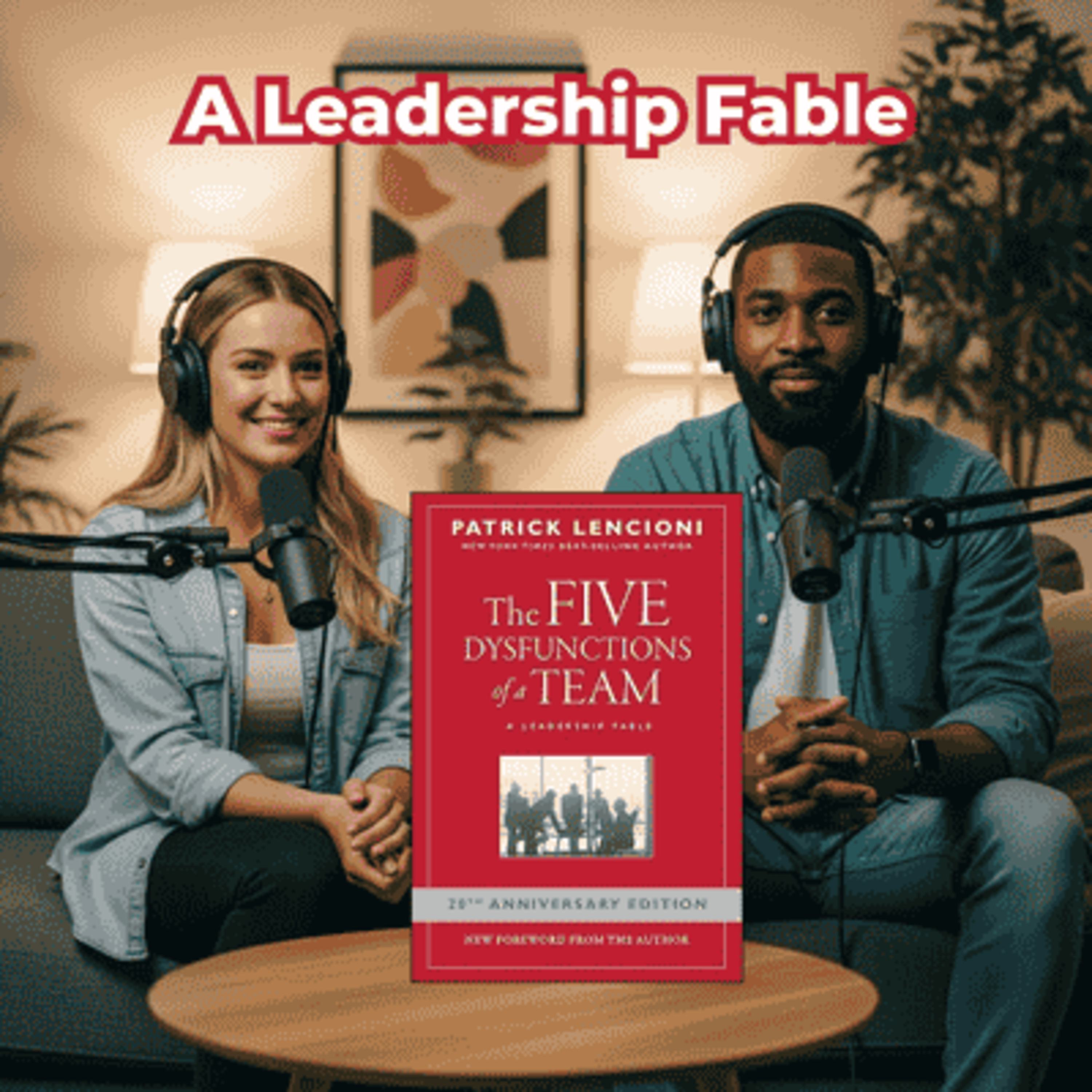
This episode provides a comprehensive breakdown of Patrick Lencioni’s leadership framework, focusing on the five core obstacles that prevent groups from functioning effectively. The material emphasizes that a foundation of vulnerability-based trust is essential for members to engage in honest, productive conflict and reach true consensus. Without this clarity, teams suffer from a lack of commitment and a tendency to evade individual accountability, which ultimately lowers performance standards. By addressing these behavioral gaps, leaders can shift the group's focus away from personal ego and status toward achieving collective results. The overview concludes that fostering an environment of transparency and mutual responsibility is the key to transforming dysfunctional dynamics into sustained organizational success.
The New York Times best-selling team leadership handbook for modern executives, managers, and organizations
After her first two weeks observing the problems at DecisionTech, Kathryn Petersen, its new CEO, had more than a few moments when she wondered if she should have taken the job. But Kathryn knew there was little chance she would have turned it down. After all, retirement had made her antsy, and nothing excited her more than a challenge. What she could not have known when she accepted the job, however, was just how dysfunctional her team was, and how team members would challenge her in ways that no one ever had before.
For twenty years, The Five Dysfunctions of a Team has been engaging audiences with a page-turning, realistic fable that follows the travails of Kathryn Petersen, DecisionTech’s CEO, as she faces the ultimate leadership crisis. She must unite a team in such disarray that it threatens to derail the entire company.
Equal parts leadership fable and business handbook, this definitive source on teamwork by Patrick Lencioni reveals the five behavioral tendencies that go to the heart of why even the best teams struggle. He offers a powerful model and step-by-step guide for overcoming those dysfunctions and getting every one rowing in the same direction.
Today, the lessons in The Five Dysfunctions of a Team are more relevant than ever. This special anniversary edition celebrates one of the best-selling business books of all time with a new foreword from the author that reflects on its legacy and lessons.
#productivityhacks #personaldevelopment #successstrategies #businessinsights #leadershipskills #leadership #ambitiousprofessionals #businesstips #self help #scaling business #businesstactics #professionaldevelopment #startupgrowth #entrepreneurship #businessmindset #growthstrategies
Ever been part of a team where everything just felt, well, sticky? Sticky is a good word. For it, you know the meetings are polite, but nothing ever actually gets decided. Right. Or deadlines just sort of quietly get missed. Yes, and there's all that unspoken tension. Everyone's got their professional smile on, but you can feel this massive dysfunction just under the surface. We've all been there and honestly, it's exhausting. It is. And the good news, the really great news is that most of the time this isn't about bad people.
It's a structural flaw. Exactly. It's a problem with the system. Which is why we're doing this deep dive into Patrick Lancione's classic book, The Five Dysfunctions of a Team. It's less of a self help guide and more of a diagnostic manual. A road map, really. He takes the whole messy world of office politics and just boils it down into this clean hierarchical model. It's so clear. It is, and our mission here is to unpack this five step pyramid for you, step by step. Think of this as your shortcut to turning what the book calls those office nightmares into success stories.
And what's so compelling, and I think what people often miss at first is where it all starts. It's not with strategy or erformance reviews. No, it all starts at the very bottom of that Yramid with something that feels almost soft. It starts with trust. OK, let's get into it. The Foundation. Let's start right at the bottom. The first, most critical dysfunction, and the one everything else is built on, is the absence of trust. Right now, Lencioni is very specific about this. This is not, you know, predictive trust.
It's not about I trust you to get the code done on time. It's not about competence, no. It's vulnerability based trust. It's the feeling, the assurance that your teammates mean well and aren't out to get you. It's what allows you to actually lower your guard. That distinction is so important. It's not about what you can do. It's about your intent. Yeah, but why is that so hard to get in a professional setting? I mean, shouldn't adults be able to just, you know, trust each other at work? You'd think so, but most corporate cultures, they're built on competition, on individual merit, and in that kind of environment, vulnerability just feels like a weakness.
A liability, even. Right. And Lencioni's point is that this kind of trust is what creates psychological safety. Without it, why on earth would I expose myself? Why would I say, hey, I don't know the answer or I really messed that up if I think it's going to be held against me in my next performance review? You just wouldn't. The natural defense mechanism kicks in. Instead of asking for help, you hide things. Yeah, you keep your cards close to your chest. Your whole focus shifts. Yeah, you stop worrying about doing good work and start about looking good.
Exactly. And that has an immediate impact on the quality of the work. Let's take that marketing team example from our source material. If you have real trust, someone can throw out a half baked idea, even a kind of silly idea, knowing the team will play with it, not judge them for it. Or someone can say hey I'm really struggling with these social media metrics can someone help me? Yes, but if that trust is gone, what happens? The opposite, the person with the risky but maybe brilliant idea just keeps it to themselves.
They don't want to get laughed at. And the other person, the one who needs help, they pretend they're an expert, and then they go off and produce subpar work because they were just too afraid to admit they needed a hand. So that lack of vulnerability, it's not a soft problem. It directly suppresses the best ideas and stops the team from fixing small problems before they become big ones. That's Lencioni score insight right there. You cannot move forward until this trust is established. It is the absolute, absolute, absolute foundation for everything else.
Open dialogue, commitment, accountability, and finally results. If you skip this step, the whole pyramid is built on sand. OK, so once that vulnerability is off the table and everyone's got their armor on, what happens next? Where does that lead us? It leads directly and inevitably into dysfunction to fear of conflict because there's no trust. Team members are terrified of engaging in any kind of passionate ideological debate. They avoid the real discussions. And they retreat into what Lencione calls artificial harmony.
That's the one. Everybody is just pretending everything is fine to avoid any kind of friction. Now this is where it gets really counterintuitive, right? Because we're all taught that workplace conflict is bad, it's toxic. We are. But Lencione says the opposite. He says avoiding healthy conflict is what's truly toxic because it leads to terrible decisions. Air. So how do we tell the difference? That's the key question. He makes a really vital distinction between ideological conflict and personal conflict.
OK, Ideological conflict is passionate, unfiltered debate about ideas, about strategies, about the facts. It's not personal. It's not about ego or attacks. So it's fighting for the best answer, not fighting with a person across the table. Perfectly put in a high trust room. You can passionately disagree with my idea and I know it's not an attack on me personally. We're both just trying to get to the best possible outcome. Let's go back to that project meeting example. Yeah, everyone sitting around the table, they're discussing the new timeline, right?
And everyone is not thing smiling. Yep looks great. But inside half of them are thinking this is completely insane, we'll never hit this. But nobody says anything. Nobody says a word because they're prioritizing that artificial harmony over the truth. They're avoiding the necessary conflict. And what happens? The project is doomed before it even starts. The critical risks were never talked about when they were cheap and easy to fix, all because they chose politeness over rigor. And that avoidance spirals directly into the next level of failure, doesn't it?
It has to. It takes us right to the strategic problem. Dysfunction 3. Lack of commitment. We avoided the difficult conversation and now we have a decision that nobody actually believes in. Exactly. Lack of commitment is when team members don't truly buy into a decision, or sometimes they even leave the meeting confused about what was decided in the first place. And that link back to conflict is so important. If I never got to voice my concerns, if I didn't feel like I was heard, why would I be committed to the?
Plan you wouldn't. I see this as the difference between compliance and commitment. That's good. Explain that. Compliance is, you know, nodding along in the meeting, doing the bare minimum because the boss said so, right? Checking the box. But commitment is true buy in. It's emotional ownership. It's when you can say, OK, that wasn't my idea, but I was heard. I understand the decision and now I'm going to do everything I can to make it work. And Lencioni points out that commitment doesn't come from consensus, does it?
It's not about everyone agreeing. No, not at all. It comes from clarity and closure after a good, healthy debate, even if your idea loses, you feel heard. You understand the why behind the final decision and that allows you to get on board. I've seen this go so wrong at the leadership level. We call it organizational whiplash. The executive team leave the room without genuine commitment. And they all have their own secret reservations. Exactly. And they go back to their departments and send these conflicting messages down the chain.
Let's use our marketing strategy team example. The leadership team agrees officially to put all the resources behind Product A for the quarter. But one leader secretly thought they should have gone with Product B. So what do they do? They don't openly rebel, but they subtly steer resources away from A. They give lukewarm support. Maybe they even start a little side project for B. And the team below them gets totally mixed signals. They spend a month just trying to figure out what the real priority is.
The whole plan is sabotaged by that one leaders lack of commitment. It creates chaos, all because of a secret disagreement at the top. So we've moved from trust up to conflict and commitment. Now we're getting to the operational level. When commitment is weak, what happens to the standards of the work itself? Well, they fall apart, and that brings us to dysfunction for avoidance of accountability. OK, when that commitment is fuzzy, people start avoiding the tough conversations about performance and behavior.
For Lincione, accountability isn't about the boss punishing someone. It's about peers holding each other to a standard. Yes, it's peer pressure, but used in a respectful, positive way. The source material says that calling someone out on a problem is actually a sign of respect. It means I care enough about you and this team not to let you fail in silence. I think we see this so clearly in that Sarah example from the book. Oh yeah, that one's classic. So you have a team, they're all friends, they have great social cohesion, they all agreed to a project milestone.
A clear commitment was made right? But when the deadline hits, Sarah's part of the project, project is well, it's late and it's not good enough. And what does the team do? Nothing. Nobody says a word because they don't want to upset her. They don't want to jeopardize the friendship. They're prioritizing their temporary social comfort over the permanent standard of quality for the team. Exactly. Yeah. So maybe another team member just quietly stays late and redoes her work, which builds up this secret resentment.
And the whole situation just gets worse. On a healthy team, the feedback is immediate and non judgmental. It's hey, we agreed on X and this isn't why. What do you need to get it there? But you can't have that conversation if you can't handle healthy conflict. They're all connected. It all stacks. OK, so now we're the very top of the pyramid. The final dysfunction. Let's say a team has somehow managed the other four steps. They trust each other, they debate, they commit, they even hold each other accountable.
They can still fail. They can still fail and this is because of dysfunction 5 inattention to results. This is where ego comes in. This is where ego, status, and self preservation can completely derail A-Team from its actual collective goals. Lencione identifies 2 really sneaky types of status distractions here. The first one is interesting. He calls it team status. Yeah, this one is more insidious. It's when the team becomes happy, just belonging to the group. The identity of being on the cool team or the elite team becomes the reward itself.
So they're patting themselves on the back for being the best, even when their actual results their metrics. Are flat. They're substituting the feeling of being special for the hard work of achieving something special. The second kind is much more familiar. It's individual status. Right. This is where a team member prioritizes their own career, their promotion, their visibility over the success of the team. And Lencioni makes a great point that focusing on results isn't just about the big final number, it's about being obsessed with the smaller, tangible goals along the way.
The guideposts. If you lose sight of those, you'll never reach the destination. Let's use the software development team example for this. Perfect, so you have 1 developer who is just constantly pushing their own pet solution, not because it's the best, but because it's their idea. That's ego. And maybe you have another developer who hoards critical information to make themselves seem indispensable. That's individual status. They're trying to get ahead personally, but because of that lack of cooperation, because knowledge isn't being shared, what happens to the final product?
The code gets messy. The app takes way longer to build. It launches with bugs. The quality is lower. The team's individual priorities actively sabotage the collective result they were supposed to be focused on. So the lesson is that collective success has to come before any personal recognition or comfort. Every single step from trust all the way up has to be pointed toward achieving that external result. That's the whole framework in a nutshell. So we've walked through the whole hierarchy from that foundation of vulnerability based trust up through the healthy conflict that builds real commitment which allows for peer accountability, all leading to that final sharp focus on collective results.
And when a team gets all five of these things right, it's like they've built this structural immune system against dysfunction. Just it works. It's such a powerful way to diagnose where things are going wrong. We've given you the structure. Lencioni designed a really clear road map to start looking at any team you're on or any team you lead. And as we reflect on this whole pyramid, you know that trust at the bottom is maybe the hardest thing to build, and that focus on results at the top is the easiest thing to lose.
We want to leave you with this to think about. Which do you think is a greater sign of a team's future failure? The total absence of trust right at the bottom, or the successful presence of the first four steps, only to be completely ruined by that inattention to results at the very top. It's a great question. Is it a failure to launch or a failure to finish? That's definitely something worth mulling over.
 Apple Podcasts
 Castbox
 Castro
 Goodpods
 Moon FM
 Overcast
 Pocket Casts
 Podbean
 Podcast Addict
 Podcast Republic
 Spotify