The Ascent of Money by Niall Ferguson | A Financial History of the World
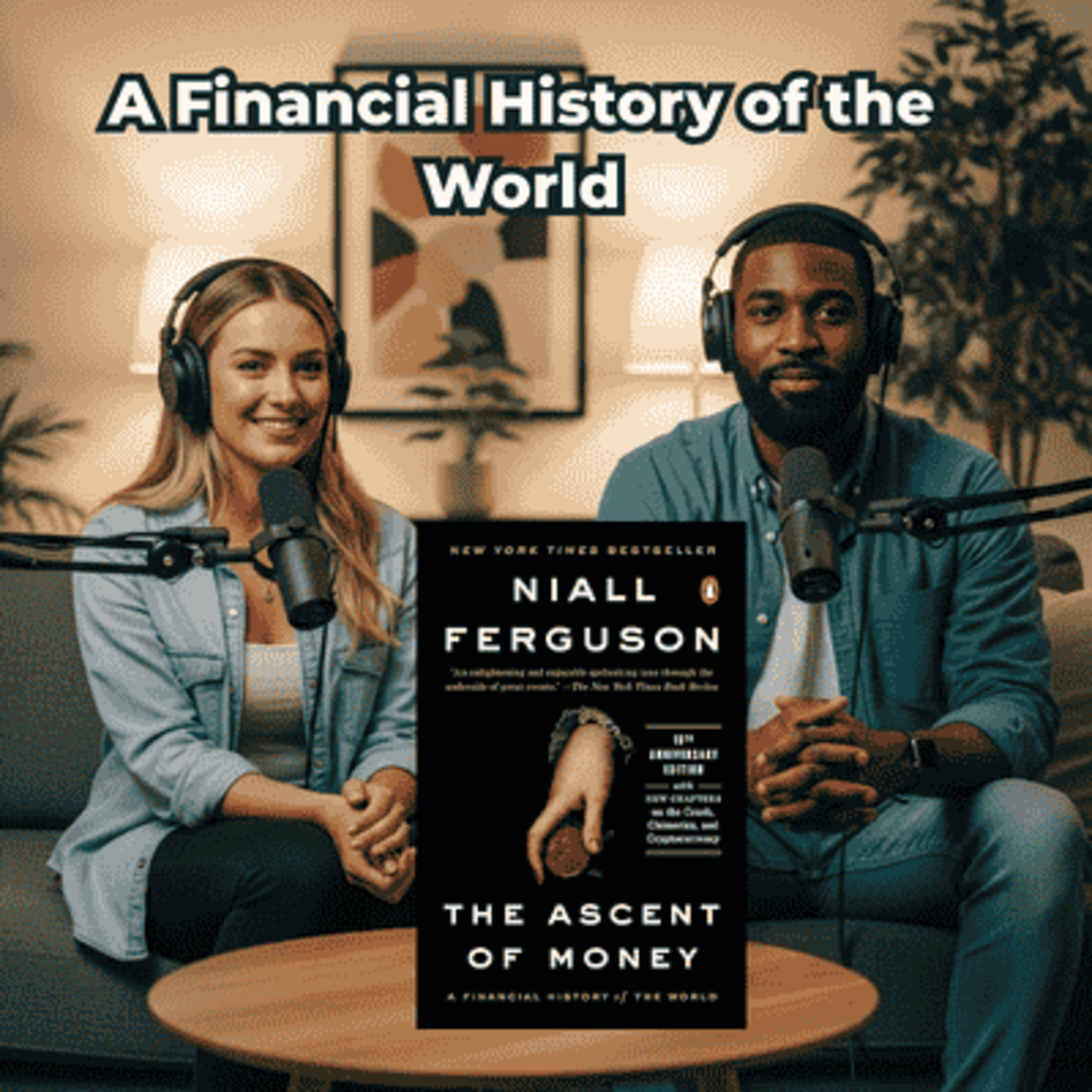
The provided text outlines essential financial concepts derived from Niall Ferguson’s work, The Ascent of Money, to help individuals navigate the complex world of finance. It highlights the vital role of banking institutions in circulating capital through loans, while explaining how credit can be a useful tool for immediate purchases if managed with caution. The source also emphasizes the importance of evaluating risk and balancing potential rewards with the security of one's assets. By examining historical economic patterns, readers are encouraged to make better-informed predictions regarding modern market fluctuations. Finally, the text explores financial globalisation, illustrating how international interconnectedness requires investors to diversify their portfolios to mitigate global instability.
#productivityhacks #personaldevelopment #successstrategies #businessinsights #leadershipskills #leadership #ambitiousprofessionals #businesstips #self help #scaling business #businesstactics #professionaldevelopment #startupgrowth #entrepreneurship #businessmindset #growthstrategies
Welcome back to The Deep Dive. Today we're tackling something that can feel, well, a little daunting. Global Finance. It definitely can. It feels like this huge complex system that just happens to us. Exactly. Something you only really notice when you know the numbers on your bank statement change. Right? But the architecture of that whole system, why banks work the way they do, why credit is everywhere. It's all rooted in history, and that's what we're digging into today. We are. We're doing a deep dive into Niall Ferguson's big work, The Ascent of Money.
He basically strips away all that complexity to show that financial history is, at its heart, just human history. So our mission is to pull out five key historical lessons from his work and connect them right to, well, your financial life today. OK, let's unpack this. And that's the real value here for you. It's the connection between that huge macro history and the small micro decisions you make everyday. It's a shortcut. It's not about memorizing dates then. Not at all. It's about understanding why these institutions exist.
Once you see the patterns, you know the cycles of risk of human behavior. You just gain this massive advantage in making your own informed choices. OK, so let's start at the very foundation, the engine room, really. Lesson 1, the importance of financial institutions. We're talking about banks. Right banks. And it's so easy to just think of them as places to, you know, save or borrow money. But their evolution is the key part. That's it. Yeah, they're real genius. The thing that let them build the modern world is their ability to gather up and deploy capital.
Your money doesn't just sit there when you deposit it. It's mobilized. It's mobilized. It enters this high velocity system. And that's so crucial because it solves this huge historical problem, right? How do you take 1000 people's small savings and turn them into one giant pool of money for something huge like a factory or a railroad? And Ferguson frames this as a win win, which is why the system is, for the most part, stable. OK, explain that the win, win. Well, for you, the depositor, your savings are secure and they're earning interest a return.
But at the same time, the bank can use most of that money to give out loans. Fueling businesses. Fueling businesses, creating jobs, boosting productivity. It creates this this economic growth that in theory, benefits everybody. So let's make that concrete. An entrepreneur wants to start a new cafe, right? They get a loan from the bank, a loan made-up of capital from hundreds of savers like you, and they turn it into well into real economic activity. Exactly. They're buying coffee machines, they're hiring baristas, they're paying rent.
The bank was the go between that turned all that passive saving into an active investment. So where you choose to bank or even just keeping money in a bank account is an active decision. You're deciding to let your money participate in that bigger system. You. Absolutely are. OK. So that role of the bank, it leads us straight into our second lesson, the idea that I mean, it basically revolutionized how we buy things, the function of credit. Credit. It's fundamentally about two things, time and trust.
Time and trust. Yeah, it's a tool that lets you borrow against your future self, your future earnings. Yeah, you need a laptop for school now, but you don't have the cash right now. Credit lets you pull that purchase from the future and today. Precisely, You're pulling consumption forward in time. The mechanism is that you're making a promise, a promise to pay it back later, usually with interest. And Ferguson points out that this is a huge financial innovation, but it's also a balancing act. It's this contrast between leverage and, well, liability.
A very fine balancing act for a business credit is leverage. It's a tool to expand and invest. But for the average person, it can become a trap, a liability. It can. Now, on the good side, if you use credit responsibly, you build a positive credit history. Your financial resume. Your financial resume, Perfect. And that's what gets you a low rate mortgage or a business loan down the line. It opens doors. But the danger is that instant purchasing power. I know Ferguson talks a lot about how fast consumer debt can spiral out of control.
It's the inherent risk in a system built for speed. Think about it. You buy a new phone on your credit card, an immediate need, OK, But then you add a few streaming services, some dinners out, little things, but they stack up and they compound it, you know, 20% interest. And that convenience becomes a huge. Weight It becomes paralyzing debt. And what's fascinating here is that credit is essential for a dynamic economy, but the system provides the rope. And it's up to you to decide whether you're going to climb with it or not.
Or not. The user has to apply relentless critical thinking that. Need for critical thinking. It takes us right to our third big insight, understanding risk. Absolutely, because every single financial decision from a savings account to a startup investment is an evaluation of risk. It's not just asking will I make money? No, it's asking how many ways can I lose money and am I OK with? That so how do we get beyond just high risk and low risk? How do we apply that in a, you know, smarter way? We have to differentiate the types of risk.
So something like a volatile stock that's primarily market risk, the whole market could go down and take your stock with it. Higher potential reward, but higher chance of losing your capital. Right now, on the other hand, something low risk like a government bond, it minimizes that market risk. Your capital is pretty safe. But there's still risk. There is you have inflation risk. Your money might not grow fast enough to keep up with the cost of living, so stability has an opportunity cost. So it's not about avoiding risk, it's about balancing these different types across your portfolio.
It's an active process. It's a very active process. And here's where it gets really interesting, I think. Let's say you're looking at shares in some hot new app, OK, you see the potential, but you also see the risk. Maybe it's success depends on one single product launch, so you're informed decision using risk analysis isn't to go all in. Yeah, of course not. It's to invest only a small amount, an amount you're prepared to lose completely, and you keep the rest of your savings in something more reliable.
That is the very definition of a calculated gamble, and that kind of cold, hard assessment of failure is key, but to do that well we have to look backwards. Which brings us to Lesson 4. Historical context matters. Yes, Ferguson's whole argument is that trying to understand today's economy without its history is like trying to solve a puzzle with half the piece is gone. We think our crises are new and unique. But they're not. We see these deep, repeating patterns of human behavior again and again.
You look at things like the 17th century Tulip mania, and you see the same irrational exuberance we see today. The problems aren't new. They're just, you know, wearing new clothes. Let's. Use the 2008 financial crisis as an example. People plus their shirts not just because of bad loans, but because of these incredibly leveraged investment. Leverage. Yeah, borrowing huge amounts of money to make even bigger bets. Basically betting with $10.00 for every $1.00 they actually had. And history shows us time and again that excessive leverage is always the flashpoint.
It's the trigger for a crisis. So knowing that as a modern learner changes how you act. You know how fast things fell apart in 2008. So today, when you look at an investment, you investigate its debt, you hesitate before jumping into some highly leveraged crypto asset because you recognize the historical pattern, you see the fragility it's. Like a financial defense mechanism? It's the ultimate defense mechanism. Yeah, because finance is driven by fear and greed, and those two emotions haven't changed in centuries.
And the complexity now combined with technology leads us perfectly into our final lesson. The globalization of finance. A web. The web? Exactly. It's the fact that capital now has wings. Money doesn't just cross state lines, it crosses international borders instantly. It connects markets worldwide in a way that was unthinkable even 50 years ago. So what's the practical implication of that for someone just trying to manage their retirement account? The biggest one is risk interdependence. An event in one country can directly hit markets in another within minutes.
So a crisis in Asia could affect MY4O1K here. It could affect your 4-O1K before you finished your morning coffee. So if you're only looking at your own country's economy, you're missing huge systemic risks brewing on the other side of the planet. And understanding that drives smarter investing. It drives diversification. Let's say you realize your domestic investments are all tied up in one industry. OK, because you understand global finance, you might decide to diversify by looking at foreign stocks, maybe investing in infrastructure in a stable emerging market.
You're insulating your assets from a purely local shock. A way of safeguarding your money. Exactly. Wow. OK, so that really wraps up our deep dive into these five foundational lessons from Ferguson's work. It does a lot to cover. Just to quickly recap, right, we looked at financial institutions and how they deploy capital. Right then, the dual nature of credit, both a tool and a trap. Then the importance of truly understanding standing risk, not just labeling it. The critical role of historical context to see patterns.
And finally, the interconnected reality of the globalization of finance. And if you tie all of that together, the repeating patterns from history and the instantaneous speed of today's global markets, it leaves us with one final provocative thought for you. OK Historically, financial crises were slow. They took time to spread like an illness, moving from town to town. Now everything is immediate. So the big question isn't just about identifying the next risk. It's about figuring out if globalization makes new crises fundamentally faster and more contagious, or if our instant information just makes us aware of their speed in a way past generations never were.
Something to think about as you watch the markets today.
 Apple Podcasts
 Castbox
 Castro
 Goodpods
 Moon FM
 Overcast
 Pocket Casts
 Podbean
 Podcast Addict
 Podcast Republic
 Spotify