Peak by Anders Ericsson | How to Master Almost Anything
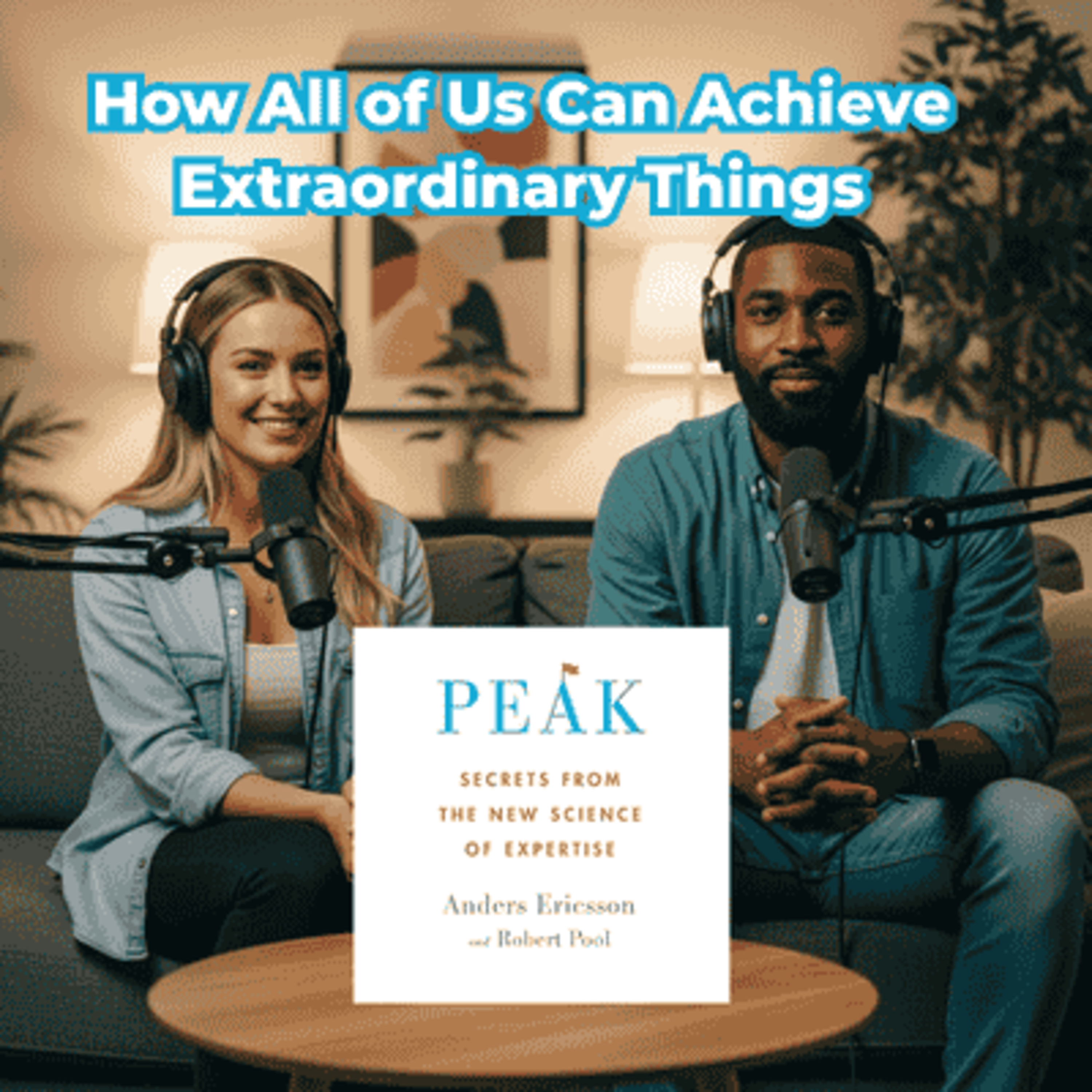
This an episode of the book Peak by Anders Ericsson and Robert Pool explores the science of high-level expertise and how individuals can reach their full potential. The text argues that innate talent is secondary to a specific, structured methodology known as purposeful practice, which involves setting clear goals and pushing beyond one's comfort zone. By developing sophisticated mental representations and seeking constant feedback, learners can effectively adapt their skills in professional environments and daily life. The chapters highlight that consistency, resilience, and a growth mindset are the true foundations of mastery rather than natural-born gifts. Ultimately, the source provides a comprehensive framework for anyone looking to refine their abilities through intentional effort and lifelong learning.For the first time in decades of groundbreaking research, the inventor of the 10,000-hour rule explains his techniques for developing mastery of any skill
We live in a world full of people with extraordinary abilities. Consider what Roger Federer can do with a tennis ball, or Connor McDavid with a puck. There are chess grandmasters who can play several dozen different games simultaneously--while blindfolded--and a seemingly unending supply of young musical prodigies who would have astonished aficionados a century ago. We are dramatically better at just about everything than we were just a generation ago.
We assume, though, that these peak performers are the lucky ones, the ones with a gift. That's only partly true. The fact is we are all lucky. We all have that gift. As Ericsson's whole career has shown, with the proper practice, we are all capable of extraordinary feats.
On the surface, the techniques that chess players use to develop their skills seem quite different from the methods soccer players use to perfect their games, which in turn seem quite different from how pianists improve their playing. But at a deeper level, they are all variations on a single fundamental approach to learning, what Ericsson, a world-renowned researcher, has named "deliberate practice": a simple, yet powerful system for enhancing learning.
This approach to expertise has the potential to revolutionize how we think about every sort of education and training. We are not limited by an endowment of natural talent. We create our own limits.
Whether you want to step up your game at work or on the weekend, or help your kid achieve athletic or academic goals, Ericsson's revolutionary methods will show you how to master almost anything.
#productivityhacks #personaldevelopment #successstrategies #businessinsights #leadershipskills #leadership #ambitiousprofessionals #businesstips #self help #scaling business #businesstactics #professionaldevelopment #startupgrowth #entrepreneurship #businessmindset #growthstrategies
Welcome back to the Deep Dive. You know, I think we've all looked at people who are operating at the absolute peak of their field. Oh, absolutely. You see a world class surgeon, a championship golfer, maybe that genius coder at work, and you just have to wonder, how do they do that? Is it just some freak of nature or is it something I could learn? Well, that's the debate we are settling today. This deep dive is all based on the the groundbreaking science compiled in Peak Secrets from the News Science of Expertise.
The authors, led by a doctor, Andrews Erickson, they spent decades just dissecting how mastery is actually built. And what they found is well, it's not about magic. It's a measurable process. So this isn't just about us sitting here and admiring top performers, it's about actually pulling out the blueprints. Exactly. You've taken the core findings from this research, which is, and this is the amazing part, it's surprisingly universal across every field you can imagine, and we are giving you the fast track to understanding the science behind competence.
So our mission today is pretty simple. We want to pull out the concrete steps and the, you know, the practical knowledge you need to stop just messing around with a skill and start intentionally advancing it. Moving beyond just passive repetition. Right. Moving you into intentional focused growth. OK, so let's start with a claim that for me, hits the hardest. It's the one that just completely challenges that old narrative we all grew up with. You know, the idea that success is built on innate ability.
The sources they just stated plainly, talent isn't everything. And what's fascinating here is the your weight of evidence they put behind this. I mean, it's all synthesized to argue against the idea that natural talent is the sole determinant of success, right? We love the story of, like, the Mozart prodigy who just woke up. Brilliant. But the research shows something different. It shows that while sure, natural talent might give someone an initial advantage. Like they pick it up a little faster at the start.
Exactly. Maybe they grasp a melody or a math concept quicker than appear, but that initial edge is it's highly perishable. So if I start out with a higher aptitude than my neighbor, I might race ahead for the first month or so, but that gap could close really quickly if they're working harder than I am. That is the critical comparison the research makes. It's that in the long run, effort Trump's talent. Every. Time, pretty much. If you look at people who start with high natural talent but approach learning passively, you know they just rely on their gifts.
They invariably hit a ceiling. And then what happens? Then you see these other individuals who might have started further back, but they dedicate themselves to consistent, focused, and frankly uncomfortable effort. They surpassed the naturally gifted every single time. That's AI mean that's a fundamentally democratic idea. It is. It means the only real limitation is the one you place on yourself. Precisely. And that requires a a fundamental shift in your perspective. The sources really emphasize how necessary it is to adopt A growth mindset.
The belief that you can actually change your abilities. Yes, the belief that abilities are malleable and can be developed through dedication. Because if you believe your skill ceiling is fixed, you won't even try the demanding type of practice that's necessary for mastery. It all falls apart before it even begins. Exactly. You have to believe improvement is possible. OK, let's unpack this then. If talent isn't the key and just showing up and practicing for two hours isn't enough, what exactly is this purposeful practice?
What's the real difference between a master's training and, you know, a hobbyists routine? This is where we need to get specific. The concept is called purposeful practice and it's defined by 4 let's call them non negotiable requirements that lift it way beyond just casual interaction or rote repetition. OK, what's the first requirement? 1st, the efforts must be intensely focused, structured and goal oriented. You can't just noodle around. Think of it like a personal training session where the trainer knows exactly which muscle groups need work that day.
I get the goal oriented part, but why is the structure so critical? Because the next requirement is the hardest one. You have to be consistently pushing yourself beyond your comfort zone. If you were just doing what you already know how to do and it feels easy, your brain isn't changing. If your practice session feels comfortable, you are just maintaining. You're not improving. OK, but wait, how do you know if you're stretching yourself enough without, you know, hitting a wall and just getting completely demoralized?
That's a great question. If I try something that's way too hard, I might just give up. And that's why the third requirement is so essential. You must be receiving accurate feedback. The guiding light, yes. It tells you exactly where you failed and why, so you can adjust your next attempt. Without feedback, you might spend hours just reinforcing a bad habit. So I need an external set of eyes or maybe some kind of measurable result to tell me if I'm failing productively or just spinning my wheels.
Absolutely. And the fourth core element is that you have to be continuously refining your skills based on that feedback. It's not passive, it's an active loop. Assess. Adjust, Refine. Repeat. So if we package those four things together, the goal setting, the discomfort, the feedback, and the refinement, that gets us to what the sources call the gold standard. Yes, the gold standard. It just summarizes what sets effective practice apart. To maximize your time, the practice has to 1st focus on specific goals.
OK, give me a real world example. Let's say an accountant learning new tax software. Perfect. Instead of saying I'll learn the tax software, they would say something like I will master the specific process of inputting quarterly adjustments using the new software as batch function. Oh, that's specific. Aiming for 100% accuracy within a 20 minute time block. It's measurable. It's targeted. You're systematically eliminating one specific weakness. That's a world away from how most of us approach skill development, which is really just broad exposure.
It is Secondly, the practice has to challenge and stretch. This means consistently engaging with tasks that are slightly beyond your current ability. That sweet spot? That sweet spot. If you're a coder and you already know Python practice shouldn't be just writing the same basic functions over and over. It should be tackling a project that forces you to integrate a new complex library you've never used before. Uncomfortable, but still doable. And finally, that continuous feedback loop we mentioned, whether it's an online dashboard, a mentor, or some kind of a simulated environment, you have to actively seek out data that tells you where you are relative to your goal.
So a high level musician doesn't just play a piece. No, they record themselves and they analyze every single micro error. OK, this is where it gets really interesting for me. How does the brain actually change during all this, this relentless, demanding practice? What's going on under the hood that lets a person go from novice to extraordinary? The sources outline 2 key myanisms. The first is what we can call harnessing adaptability. When experts face difficulties, their brains show this immense flexibility.
They don't just, you know, brute force their way through a problem. So what does that flexibility look like in a complex skill like, say, learning a foreign language? It's all about strategic decomposition. So when you're facing a complex task, like conducting a full business negotiation in that new language, the tactic is to break the complex task down. Into smaller chunks. Smaller, manageable, incremental components. You don't try to master the whole negotiation at once. You might dedicate a week just to perfecting the vocabulary and cadence of the opening pleasantries.
The next week is only focused on reframing objections. So you're attacking weak points one by one. You're creating these small, short term practice targets that all funnel back into the bigger skill. That's the most effective path to adaptation, keep you from getting overwhelmed, and it ensures the feedback you get could be applied surgically. You're building the skill piece by piece, not just performing a bad routine over and over. And the second mechanism is even more fascinating to me. It's the development of mental representations.
This, you're saying, is where the true difference lies between an expert and a novice. Absolutely. Think of mental representations as extremely clear, detailed and efficient mental models or frameworks. They let an expert process immense amounts of information almost instantaneously. So they're seeing things we're not seeing. They are directing their comprehension and guiding decisions in complex fast moving situations. OK. Can you give us a really tangible example? Because mental models can sound a little abstract.
Of course. Consider a fighter pilot. When a novice looks at their instrument panel, they see dozens of separate gauges, numbers, warnings. It's overwhelming. Just a wall of data. A wall of data. An expert pilot, through years of this kind of practice, doesn't see individual gauges anymore. They see an instantaneous, holistic state of the aircraft. Their mental representation integrates all those inputs into one coherent predictive model that tells them what's going to happen next. And this model enhances their performance under pressure because they are recognizing patterns, not calculating every single variable from scratch.
So it's the difference between seeing a list of ingredients for a recipe and just seeing the finished dish and knowing exactly how to get there. That's a perfect analogy, and the sources emphasize a really powerful technique for strengthening these representations, visualization. Just thinking about. It a simple act of mentally rehearsing a task, vividly imagining yourself performing the skill perfectly, identifying potential problems, correcting them in your mind. That reinforces the neural pathways.
So an athlete isn't just practicing on the field, they're getting reps in their own head, strengthening that mental blueprint before they even make a physical move. It's free, unlimited practice, and the goal of all this effort has to be a deep understanding of the underlying principles, not just simple repetition. If you build strong mental models, you become adaptable. If you just rely on memorization, you break the second the situation changes. Now if we connect this to the bigger picture, I bet the listener is thinking that sounds like a full time job.
Yeah, exactly. How do we integrate this demanding, purposeful practice into my already busy life? That is the $1,000,000 question, and this is where we need to review the practical applications, the sources layout for you. We have to stop seeing professional development as something that happens at a seminar once a year. And start viewing it as a daily intentional effort. Right, so let's start with the application in the workplace. OK, the first step is to actively prioritize the practice. You have to carve out specific time for it, treating skill development as a mission critical part of your routine, not something you do if you get to inbox 0.
And crucially, you have to seek out growth opportunities. That means actively raising your hand for that challenging project, the one that kind of makes your stomach turn a bit because it requires a skill you haven't mastered yet. Avoiding those tasks because they might expose A weakness just guarantees you're going to plateau. Which ties back to the feedback loop. In a, you know, a knowledge work environment, you have to be actively soliciting feedback from your supervisors, your mentors, your colleagues.
Don't wait for the annual review to find out where you're falling short. Treat every presentation, every document you write as a chance to ask for specific critical critique. Not just was this good, but where did I fall short in the data visualization? That takes a lot of ego management. You have to literally invite the negative feedback. You do, because that negative feedback is the fuel for purposeful practice. Now, moving to everyday life, the approach is still highly structured. First, you need structure.
Set clear, specific, achievable goals for every single practice session, whether you're learning to bake or improving your budgeting skills. Right, we need to move past. I will try to cook better to something more like I will master the specific technique of tempering chocolate this weekend. Watching 3 different instructional videos. And doing it until the finished product is glossy and firm. Precisely. And second, practice with intention. If you're reading for professional development, read actively.
Take notes, summarize chapters, stop and test your comprehension. If you're learning a physical skill, focus intently on your form, not just on completing the session. But mastery requires more than just good technique and a schedule, right? The sources also detail the traits of the extraordinary. It takes certain character traits to sustain this for years. It absolutely does. First, unwavering commitment and dedication. We're talking about prioritizing your goals, even when it means sacrificing immediate comfort or leisure.
The extraordinary Commit countless hours, often in solitude. And maybe the most defining trait of all, resilience and perseverance. Yes, since purposeful practice means you're always operating outside your comfort zone. Failure is just. It's part of the process. You will fail. You will fail publicly. You will fail privately. You'll face setbacks, the ability to bounce back with determination to analyze that failure and adjust your strategy. That is the ultimate discriminator between those who quit and those who master.
It's a relentless pursuit of continuous improvement. Yes, exceptional performers never decide they're finished. They're always striving to refine their skills, always seeking out the next challenge, always pushing their own boundaries. It is a commitment to getting just a little bit better every single day, year after year, and to address the final ramifications here. The good news is that this rigorous framework, this deliberate practice, it fundamentally supports lifelong learning. The methodology is completely scalable if it works for a musician, works for an engineer, a teacher, a retiree learning woodworking.
That's empowering. It means the tools are universal. You can apply them to any goal you set for yourself. They are. And one final, often overlooked point. The source has really emphasized the value of seeking out community and support. You can't do it all alone. No. Mentors provide that necessary accurate feedback. Peers provide motivation and, you know, comparison points. Collaboration can enrich the learning process and accelerate skill development. It just makes that difficult, demanding process a little more bearable.
O When we boil it all down, what does this all mean? The core message for you is, I think, profoundly encouraging. Mastery is a direct product of intentional effort and perseverance, not some magic genetic watery. While some initial talent might give you a nice little head start, it's the dedication to disciplined, focused, and uncomfortable practice, that commitment to living just outside your comfort zone, that separates those who plateau from those who achieved truly extraordinary results. The principles we've discussed today, breaking down tasks, prioritizing accurate feedback, leveraging visualization to build mental models.
These are universal tools. They are available to you right now. Regardless of where you're starting from. The most important choice you have to make is where to apply that consistent, intentional effort first. The road to extraordinary begins the moment you move past comfortable repetition and commit to focused, uncomfortable goal setting. Now go find your next challenge.
 Apple Podcasts
 Castbox
 Castro
 Goodpods
 Moon FM
 Overcast
 Pocket Casts
 Podbean
 Podcast Addict
 Podcast Republic
 Spotify