SPIN Selling by Neil Rackham | Mastering the Art High-Value Sales
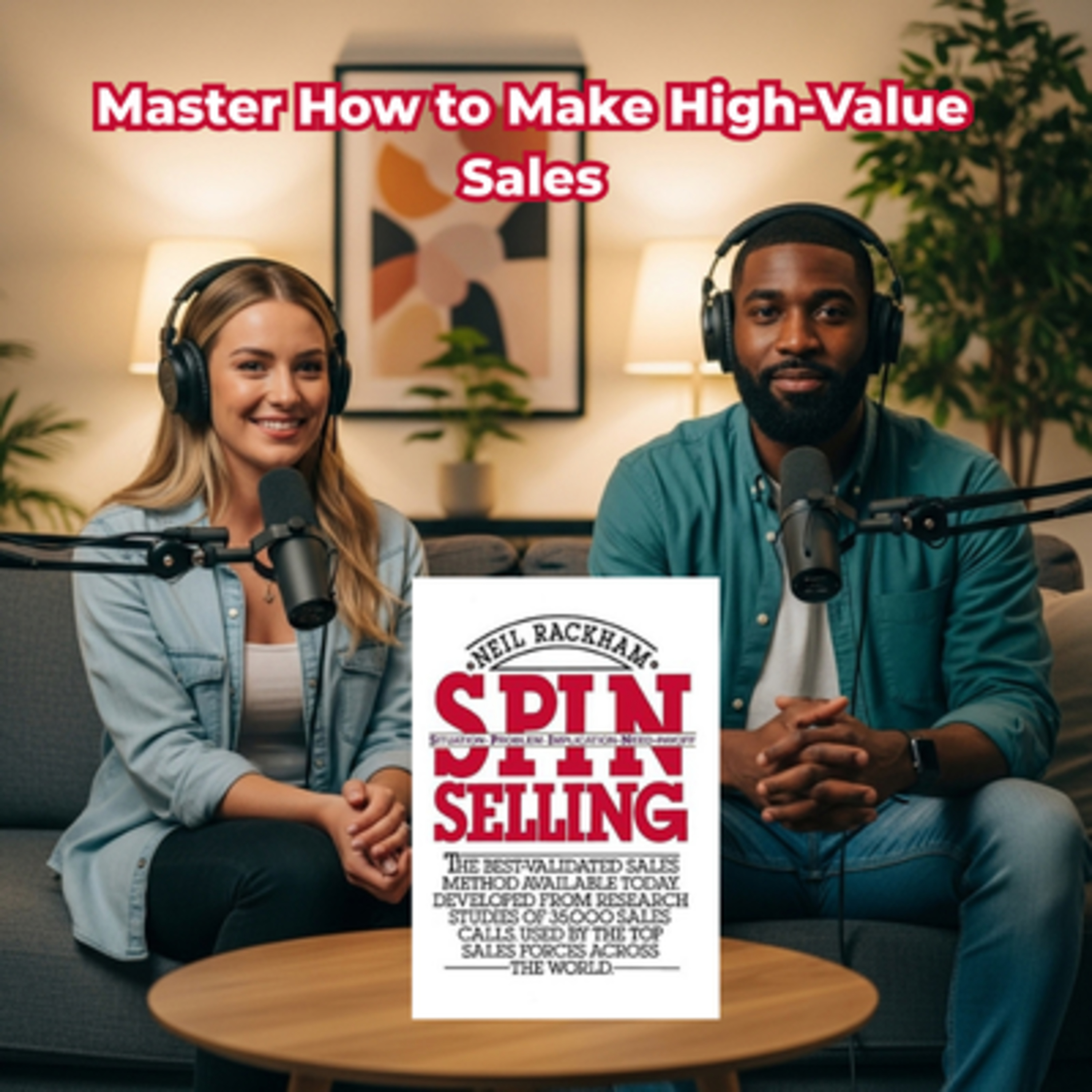
This episode summarizes Neil Rackham’s SPIN Selling, a research-based framework designed to improve success in high-value transactions. The material outlines a systematic approach to sales that prioritizes deep customer understanding over aggressive closing tactics. By utilizing the SPIN acronym—Situation, Problem, Implication, and Need-payoff—salespeople can transition from basic information gathering to uncovering the complex needs of major clients. The chapters detailed in the source provide a roadmap for establishing rapport, handling objections proactively, and demonstrating tailored value to stakeholders. Ultimately, the guide transforms theoretical questioning strategies into practical applications for securing long-term business commitments.
Written by Neil Rackham, former president and founder of Huthwaite corporation, SPIN Selling is essential reading for anyone involved in selling or managing a sales force. Unquestionably the best documented account of sales success ever collected and the result of the Huthwaite corporation's massive 12 year, $1 million dollar research into effective sales performance, this groundbreaking resource details the revolutionary SPIN (Situation, Problem, Implication, Need payoff) strategy. In SPIN Selling, Rackham, who has advised leading companies such as IBM and Honeywell delivers the first book to specifically examine selling high value product and services. By following the simple, practical, and easy to apply techniques of SPIN, readers will be able to dramatically increase their sales volume from major accounts. Rackham answers key questions such as “What makes success in major sales” and “Why do techniques like closing work in small sales but fail in larger ones?” You will learn why traditional sales methods which were developed for small consumer sales, just won't work for large sales and why conventional selling methods are doomed to fail in major sales. Packed with real world examples, illuminating graphics, and informative case studies and backed by hard research data SPIN Selling is the million dollar key to understanding and producing record breaking high end sales performance. Sales Behavior and Sales Success. Obtaining Commitment: Closing the Sale. Customer Needs in the Major Sale. The SPIN Strategy. Giving Benefits in Major Sales. Preventing Objections. Preliminaries: Opening the Call. Turning Theory into Practice.#productivityhacks #personaldevelopment #successstrategies #businessinsights #leadershipskills #leadership #ambitiousprofessionals #businesstips #self help #scaling business #businesstactics #professionaldevelopment #startupgrowth #entrepreneurship #businessmindset #growthstrategies
Imagine you spent weeks preparing the absolute perfect pitch. You know, like without a shadow of a doubt, that the client desperately needs what you are offering. Oh yeah, you've got all the data lined up. You've anticipated their needs, you've polished your presentation, and you step into the room totally confident, but like 5 minutes into the meeting they are shifting in their chairs. Checking their watches, Yeah, yeah. Exactly. They're glancing at their phones. They're completely, fundamentally checked out.
It's the worst feeling. It really is. So why does this happen? Welcome to today's deep dive. Today is Friday, April 17th, 2026 and we are looking at the hidden psychology of human persuasion. Because that feeling, that awful sinking realization that you are losing the room, it happens to literally everyone. Oh, absolutely. Whether you are presenting to a corporate boardroom, trying to win over a really skeptical new client, or frankly just trying to convince your partner to help you reorganize the garage this weekend.
I mean, that last one is the real challenge, right? But exactly our mission today for you the listener, is to extract the fundamental aha moments of high value deal making. We are drawing from the legendary concepts in an executive summary of Neil Rackham's highly influential methodology Stim and selling it's. Just such a classic. It really is. We are skipping past the slightly cringy, outdated stereotype of the, you know, sleazy salesman who refuses to take no for an answer. Yeah, the foot and the door.
Guy. Yeah, that guy. Instead, we are looking at the actual science of uncovering what people actually need. And doing that requires a massive shift in how we think about communication. It's about moving away from aggressively pushing an idea and towards a research backed framework that helps us understand demands. Which is so much more effective. It really is. It helps you forge stronger professional bonds and reach genuinely mutually beneficial agreements without, you know, just forcing the issue.
OK, let's unpack this, because before we can dive into the really complex questioning techniques, yeah, we have to start where literally every interaction begins. The initial contact. Exactly. There is a massive behavioral difference between your average communicator and a truly top tier persuader. Yeah. So to set the stage, let's go back to that scenario you just opened with. You've done hours, maybe days of homework. Just grinding away. Right, you step into the room to pitch this massive software solution.
The average communicator in that scenario steps in and immediately starts pushing the product. Just firing off features. Yeah, they fire up A50 slide deck. They they want to show how smart they are and how great their idea. Is right the classic show up and throw up method? Is it completely overwhelming? Precisely. It's just too much. Successful professionals, the top performers, they do something radically different. What's their secret? They focus entirely on deeply understanding the customer's situation and adapting to it in real time.
This preliminary phase isn't about selling your idea at. All. Wait, really? Not at all. Not at all. It is crucial for establishing rapport, navigating that initial skepticism everyone brings to a meeting, and setting clear objectives. Like what kind of objectives? Well, like just gathering critical information or scheduling a follow up rather than trying to force a final decision right then and there. You know, hearing that, it makes me think of an analogy that average behavior is basically like a terrible Doctor Who walks into the exam room, doesn't even look look at your chart, and just immediately prescribes you a heavy, expensive medication.
Before even asking you where it hurts. Exactly. That is a perfect way to visualize it. It's malpractice in medicine, and it's practically malpractice in persuasion. I mean, if a doctor did that to me, I'd walk out, right? If you prescribe before diagnosing, the patient or the client will immediately distrust you. It doesn't matter how genuinely good the medicine or the solution is. They feel like a target, not a priority. But let me push back on one thing here, because the concept of building rapport gets thrown around a lot during this preliminary opening phase.
Oh. It sure does. Does establishing rapport just mean making awkward small talk about the weather or like asking about their golf game? Because I know you, and I know you hate small talk as much as I do. I really do. Is there an actual strategic angle here, or are we just pretending to be their best friend to grease the wheels? I truly do despise forced small talk, and what's fascinating here is that in high value interactions, true rapport is absolutely not about making chitchat. Really. Yeah, the research shows that trying to bond over sports or the weather can actually backfire in complex professional settings because it just wastes valuable time.
True rapport is about building immediate professional trust. OK, so how do you do that without sounding like a robot reading a script? It is about demonstrating to the other person from the very first minute that you are there to diagnose a problem, not just to talk at them. Make them feel heard right away. Exactly. You build rapport by showing competence. You ask a highly relevant opening question about their business or their workflow. You prove that their time is safe with you. You're aligning with them professionally, signaling you know I am an expert and I am here to understand your world.
That makes a lot more sense. It's professional alignment. So because true rapport relies on diagnosing rather than just talking, you obviously need a systematic road map to uncover those deep seated needs. You definitely do. You can't just randomly guess where the pain points are, especially in complex situations. Exactly. When we talk about pitching a complex idea or making a major sale, we are usually dealing with the situation that involves multiple decision makers. Which is always a nightmare.
Oh, totally. You've got the CEO who cares about the big picture, the CFO who only cares about the budget, the IT director who cares about implementation. Pulling in different directions. They all have entirely different priorities and just guessing will get you absolutely nowhere. Here's where it gets really interesting to navigate that maze of different priorities. The framework introduces the Sam PINE acronym SPIN. Yes, the core of it all. And I really want us to take our time here because this seems like the absolute core of the whole strategy.
It is the engine of the methodology. You start with situation questions, understanding their current circumstances. Like what you might ask? What software are you currently using or how is your team currently handling this workflow? OK, establishing the baseline. Right. Once you understand the landscape, you move to problem questions determining the issues they have with that existing setup. So finding the cracks in the foundation. Exactly. Are you experiencing any bottlenecks with that software?
This is the problem centric approach. Right, because human beings are incredibly resistant to change unless they feel some level of discomfort. Absolutely. We are creatures of habit. If everything is perfectly fine, why buy anything? Why change the workflow at all? Exactly. We need a catalyst for change. But here is the critical part. You don't stop at the problem. Which is what most people. Do yeah, most average persuaders find a single problem and immediately pounce on it with their solution. The magic, the real psychological leverage, happens in the the implication.
Stage the implication. OK this. Is where you explore the ripple effects of the problem. Give me an example of how that works in practice, because I think it's easy to just say, explore the effects. What does an implication question actually sound like? Let's say the problem they identified is a software bottleneck. An implication question doesn't just say, oh, I can fix that bottleneck. It asks how is that bottleneck impacting your team's weekly overtime? Or if this bottleneck causes a delay in your quarterly reporting, how does that affect your budget forecasting?
Oh, I see. You are transitioning the conversation from a minor, manageable annoyance, a bottleneck, into a critical challenge that is actively hurting their budget. Yes, or burning out their team. Right. And it needs solving right now. Yes, you are deliberately magnifying the problem because human nature requires us to feel the acute pain of a problem before we truly value a solution. That makes so much sense. If I just tell you I have a cure for a headache, you don't care at all unless your head is currently throbbing.
Implication quadrants make the headache throb. I was thinking about this earlier and using spin is really like untangling A delicate knotted necklace. Oh, I like that you. Can't just grab the chain and pull or you'll break the whole thing. You have to 1st locate the exact knot. That's the problem. Then you have to gently examine how that one knot is snagging the rest of the chain, preventing the class from closing and basically ruining the whole piece of jewelry. That's the implication. Showing them the whole mess.
Right. You're showing them the full extent of the mess, and then finally you demonstrate how smooth and beautiful it'll look once it's fixed before you even offer to fix it. That's the need payoff. That is a brilliant visual. You are guiding their attention to the true cost of the knot, not forcing your fingers in there and ripping it apart. But I'm still a little hung up on that last letter. N need payoff. So what does this all mean for the listener who isn't selling enterprise software? Good question.
Let's say they're just pitching a new workflow to their marketing team. Or, you know, trying to negotiate chores with a roommate. How does a need payoff actually create value instead of you just standing there listing the great features of your idea? This is where the psychology gets really profound. A need payoff question flips the script entirely. It asks the other person to explain the value to you. Wait, really? Yeah. Instead of you saying my new workflow will save us 10 hours, you ask if we could completely eliminate that bottleneck we just talked about, how much time would that free up for your team to focus on the big Q4 campaign?
Wait, so you are making them say the benefit out loud? Isn't that a bit transparent? It might feel that way at first, but if we connect this to the bigger picture, it is incredibly effective. How so? When the customer or your colleague or your roommate articulates the need payoff, they are essentially selling themselves on the value of your solution. Wow, they might respond. Wow, that would save us 10 hours a week and massively reduce our stress. When they say it, they own the conclusion. Because it came from their own mouth.
Exactly, it's infinitely more powerful than you just handing them a list of features. Because people inherently believe what they say, not what they are told by someone else. That is wild. You are leading them to the water, but you're making them verbalize how thirsty they are before they drink. Precisely. OK, so we've diagnosed the knot, we've shown them how much it's ruining the necklace, and we've got them imagining how great it would be to have it fixed. We've done the heavy lifting, right? Once you've successfully walked through that SESPN framework, the other person fully recognizes the deep implications of their problem.
The next step isn't just throwing a generic solution at them, right? No, definitely not. That would ruin all the meticulous diagnostic work you just did. This is where we bridge the gap. Bridging the gap? You have to present your solution in a way that maps perfectly to the specific problems you just uncovered. Let's talk about delivering these tailored benefits because that seems crucial. The absolute critical necessity here is tailoring. You must link your product or your idea directly to the specific challenges identified in that CEF being diagnostic.
Give me an example. Let's go back to our marketing team example. If the team leader said their biggest implication was wasted time leading to burnout, your benefit presentation needs to be hyper focused on how your workflow saves time and reduces stress. Just zooming in on that one thing, yes. You completely ignore the other flashy features. Maybe your workflow also saves a little money or looks prettier on a dashboard if they didn't identify those as problems. Because if you start listing off a dozen random features, you dilute the main point.
Exactly. It gets lost in the noise. It's like pitching generic, untailored benefits to someone is like buying your friend a birthday present that you want, completely ignoring the wish list they just spent an hour explicitly telling you about. Exactly. And think about how that makes the friend feel. Right. The psychological friction there is huge. It's not just that they don't want the present, it's the profound feeling of being unheard. Yes. If I tell you I want a book on gardening and you buy me a video game because you think it's cool, my immediate reaction is you weren't listening to me at all.
Trust is instantly broken. That is the exact psychological mechanism at play. When people feel unheard, friction inevitably arises. They put their walls up. Which brings us to the next massive hurdle, right? Yes, preventing objections. Let's dive into this, because objections always feel like sudden, terrifying roadblocks. They do, They really do. Picture this. You are nearing the end of that big software pitch. You've done this Beyond framework. Things are going smoothly, but suddenly the client crosses their arms and raises major concerns about implementation costs and how long it's going to take to install the system.
And average communicators panic when this happens. Sweating bullets. Yeah, they get incredibly defensive, but what we learn from elite persuaders is that objections shouldn't be a surprise at all. Really, you can see them coming. Oh, definitely. By anticipating objections based on customer profiles and understanding the root causes of those hesitations early, you can turn them into opportunities. You handle them skillfully to keep the momentum going. OK, I'm tracking with you. In fact, the most effective strategy is to proactively bring them up before the client even has the chance.
OK, I have to stop and question the logic here. I really don't buy this all. Right. Hit me. If you proactively bring up things like high implementation costs or lengthy timelines before they do, aren't you just planting negative thoughts in their head? It's a common fear. If they weren't thinking about the cost and you bring it up, doesn't that make you sound defensive right out of the gate? It feels like shooting yourself in the foot. It's a very common fear, and it feels entirely counterintuitive to human nature.
Why bring up a flaw if you don't have to? Exactly. But if we connect this to the bigger picture, proactive objection handling does the exact opposite of planting negative seeds. Think about it from their perspective, OK, when you say, now looking at this, your next question is probably going to be about implementation time. And I want to be upfront that it does take a full month to integrate. What is that signal to the client? I guess I mean it signals that I'm not hiding anything. Exactly. It proves your expertise.
It shows you understand the world and their anxiety so well that you've already identified the problems they're about to worry about. And you've already formulated a plan to solve them. Yes. It transforms you from an adversary trying to hide the fine print into a trusted advisor who is actively looking out for their blind spots. It strengthens your credibility immensely because you are confidently owning the narrative. Wow, OK I stand corrected. It completely shifts the dynamic of the relationship.
It really does. You aren't avoiding the elephant in the room. You are walking right up to it and addressing it. You're saying, I know this is a concern. Here's exactly how we handle. It taking the power back. That takes a lot of confidence, but I can see how it builds massive trust. So by tailoring your benefits like that perfect birthday gift and seamlessly turning those potential objections into pillars of trust, you've effectively cleared the runway. The hardest part is over. Now it's time for the final critical phase, getting them to actually say yes and turning all this incredible theory into real world muscle memory.
This is the finish line. Let's look at obtaining commitment first. The expert advice here completely shatters the old Hollywood idea of sales. Oh, thank goodness. Closing a deal is not just about repeatedly asking for the signature or using aggressive high pressure tactics. Right. No more always be closing, No more forcing them into a corner until they surrender. Exactly. It is about ensuring the client is genuinely ready and willing to make a decision. How do you gauge that? You do this by summarizing those perfectly tailored benefits we just discussed and providing reassurance you are looking for a natural progression and agreement to move forward.
Keeping it low pressure. Right, You might just say, based on how this solves the overtime issue, does it make sense to proceed to the next step? You shouldn't feel like a trap. It really makes me think of proposing marriage. Oh, that's a good one. You wouldn't just randomly ask someone to marry you on a first date, right? You wouldn't ask unless you had already done all the groundwork, built the trust, had the serious conversations about your future, and already knew they were completely ready to say yes.
Absolutely. If you are sweating and terrified when you ask for the commitment, you probably skipped a few crucial steps in this egg pine process. That is a phenomenal analogy. The clothes should be the most natural, stress free part of the entire conversation. It's just the logical next step. That's a relief to hear. But to get to that point of effortless mastery where you aren't sweating the clothes, you have to turn the theory into practice. And this is where the really hard work comes in. Here it is.
Transitioning from reading about this framework to real world application requires adapting to different profiles, creating continuous feedback loops, measuring your success, and engaging in role-playing exercises. Oh man, role-playing. I am going to playfully groan here on behalf of everyone listening because role-playing always feels so incredibly awkward and forced. You're sitting in a fluorescent lit conference room pretending your manager Bob is an angry client. It just feels silly. Is it really, truly necessary to master this?
Can our listener just keep the SKIN acronym in the back of their head during their next meeting and be totally fine? I know almost everyone hates it initially, but this raises an important question about how human performance actually works. Think about an athlete. They don't just read a playbook and then walk onto the field for the championship game. Fairpoint they practice. Because SP requires active real time adaptation. You are asking complex diagnostic questions. You are reading subtle body language cues.
Right, you have to be present. You are formulating implication questions on the fly based on answers you just heard seconds ago. You cannot just rely on memorizing an acronym. That makes sense. It's too much to juggle mentally. Exactly. The reason, and that awkward role play is so essential, is exactly because it prevents you from freezing up when a real client throws A curveball. It builds the neural pathways. It turns theory into instinct. So you're saying the awkwardness is the point you stumble in the conference room so you don't stumble in the boardroom?
Exactly. If you practice navigating those conversational roadblocks in a safe environment, the actual high stakes meeting feels like a breeze. You've already built the muscle memory. OK OK I can see the point. The temporary embarrassment of role-playing with a Co worker is vastly superior to blowing $1,000,000 deal or fumbling a major presentation that could have gotten you a promotion. Exactly. It's all about preparation, meeting opportunity. Well, as we look to wrap up this deep dive, I think it's worth summarizing the incredible journey we've just taken.
We started by ditching the generic aggressive pitch and learning how to build real diagnostic professional rapport. Setting that baseline of trust. Right. We learned how to find the knot in the necklace using the SPIN framework, moving from understanding the situation to exploring the problem and, crucially, highlighting the true implication of that problem. And from there, we explored how to get them to our articulate the need payoff themselves. Which is so powerful. It is we learned to tailor the exact benefits to their specific pain points, proving that we truly listen and owning the narrative by proactively handling objections before they even become a roadblock.
And finally, we saw that closing isn't a high pressure cinematic event. But a mutual readiness built on trust and a whole lot of behind the scenes role-playing practice. Even if it involves Bob in the conference room. Even Bob. Truly, whether you are prepping for a boardroom presentation, interviewing for a job, or just trying to navigate a complex negotiation with a contractor at your house, these tools elevate you from being a mere pusher of ideas to a genuine solver of problems. They absolutely do.
And as we leave you today, I want to offer a final lingering thought that builds on what we've discussed. Let's hear it. We've spent a lot of time looking at how remarkably powerful it is to use the implication stage to magnify a customer's problem, to make them feel the acute urgency to solve it. Right, making the headache throb. Exactly. But this raises an important question to ponder on your own. At what point does expertly magnifying a problem cross the ethical line from being a helpful, necessary diagnosis into becoming psychological manipulation?
Oh wow, that is a heavy and genuinely fascinating question to leave. Everyone with. Where is that line between guiding someone and manipulating them? Thank you so much for joining us on this deep dive. Everyone keep analyzing, keep asking the right questions, and we warmly invite you back for our next exploration. Until then, take care.
 Apple Podcasts
 Castbox
 Castro
 Goodpods
 Moon FM
 Overcast
 Pocket Casts
 Podbean
 Podcast Addict
 Podcast Republic
 Spotify