Slow Productivity by Cal Newport | The Lost Art of Accomplishment Without Burnout
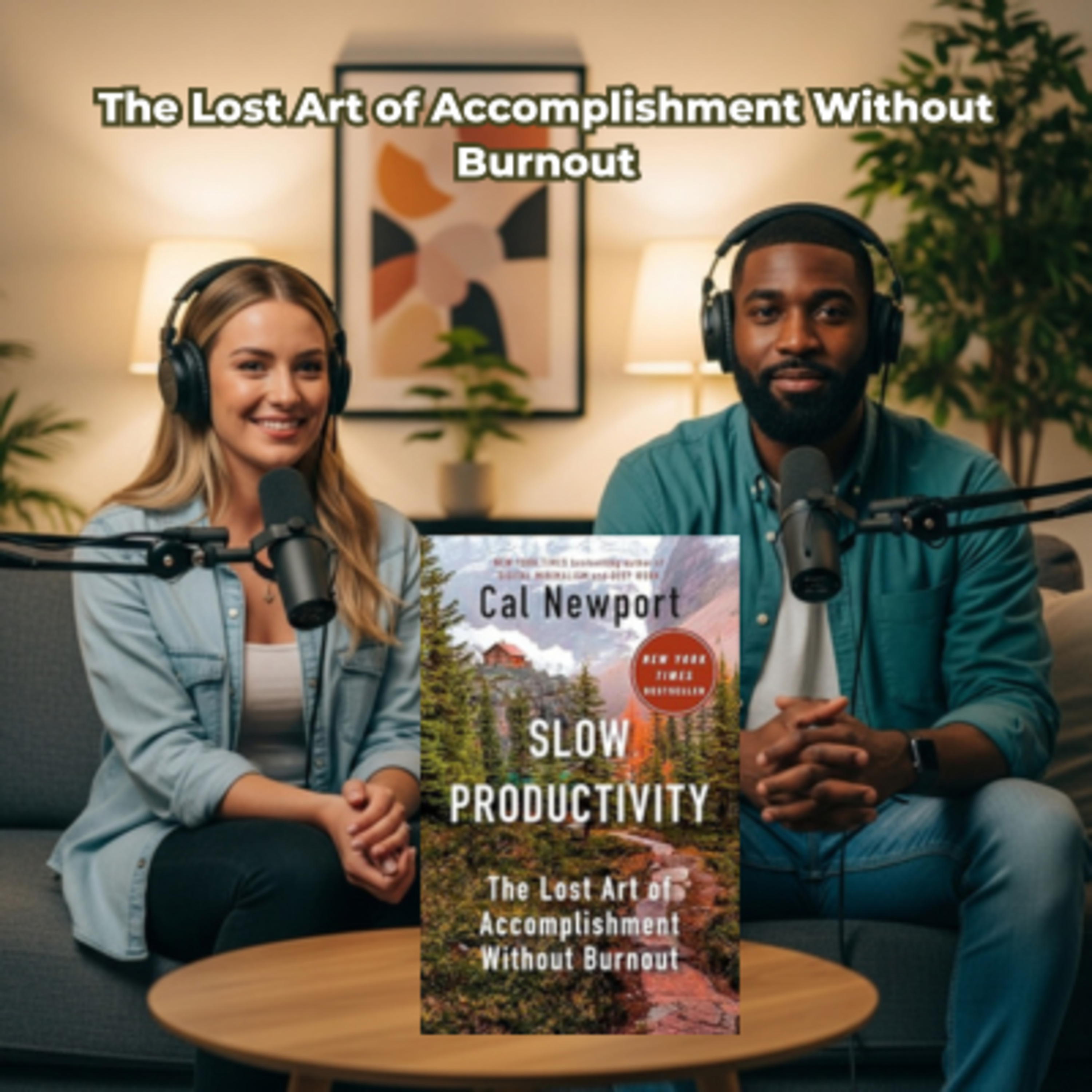
Cal Newport’s philosophy of slow productivity offers a sustainable alternative to the modern cycle of constant busyness and burnout. Instead of measuring success through a high volume of small tasks, this approach emphasizes prioritizing high-impact work and maintaining a deliberate, intentional pace. The text outlines essential strategies such as limiting daily goals, eliminating digital distractions, and aligning difficult projects with one's natural energy cycles. By learning to say no to low-value commitments, individuals can protect their time for deep, meaningful efforts that produce superior results. Ultimately, the source argues that choosing quality over quantity leads to greater professional fulfillment and long-term mental well-being. This framework encourages a shift toward continuous improvement and purposeful action rather than frantic activity.Our current definition of “productivity” is broken. It pushes us to treat busyness as a proxy for useful effort, leading to impossibly lengthy task lists and ceaseless meetings. We’re overwhelmed by all we have to do and on the edge of burnout, left to decide between giving into soul-sapping hustle culture or rejecting ambition altogether. But are these really our only choices?
Long before the arrival of pinging inboxes and clogged schedules, history’s most creative and impactful philosophers, scientists, artists, and writers mastered the art of producing valuable work with staying power. In this timely and provocative book, Cal Newport harnesses the wisdom of these traditional knowledge workers to radically transform our modern jobs. Drawing from deep research on the habits and mindsets of a varied cast of storied thinkers – from Galileo and Isaac Newton, to Jane Austen and Georgia O’Keefe – Newport lays out the key principles of “slow productivity,” a more sustainable alternative to the aimless overwhelm that defines our current moment. Combining cultural criticism with systematic pragmatism, Newport deconstructs the absurdities inherent in standard notions of productivity, and then provides step-by-step advice for cultivating a slower, more humane alternative.
From the aggressive rethinking of workload management, to introducing seasonal variation, to shifting your performance toward long-term quality, Slow Productivity provides a roadmap for escaping overload and arriving instead at a more timeless approach to pursuing meaningful accomplishment. The world of work is due for a new revolution. Slow productivity is exactly what we need.#SlowProductivity
#CalNewport
#Productivity
#DeepWork
#TimeManagement
#FocusedWork
#MeaningfulWork
#WorkSmarter
#ProductivityTips
#KnowledgeWork#productivityhacks #personaldevelopment #successstrategies #businessinsights #leadershipskills #leadership #ambitiousprofessionals #businesstips #self help #scaling business #businesstactics #professionaldevelopment #startupgrowth #entrepreneurship #businessmindset #growthstrategies
Think about the absolute most exhausted you've been after a work day this past month. Oh man, that's not hard to imagine. Right. Like, I want you to really visualize that specific evening you log off, your eyes are burning and your brain is just, well, completely fried. Totally just running on empty, yeah. Now ask yourself, what did you actually accomplish that day? That is the dangerous question. It really is, because if your answer is you know, I have absolutely no idea, but I definitely answered 100 emails and sat through 6 meetings, then today's deep dive is built specifically for you.
Yeah, we are really getting into the weeds on this one today. We are We're looking at a stack of notes today sourced from a book Tunez summary of Cal Newport's concept, which is called Slow Productivity. The subtitle is The Lost Art of Accomplishment Without Burnout. Which is such a massive promise. Accomplishment without burnout. Exactly. And our mission here is highly tactical for anyone out there listening who is feeling constantly overwhelmed. Or, you know, if you're just insanely curious about how to engineer a work day that actually matters, we are going to dissect how to escape the exhaustion trap.
Yeah, it's about redefining what the word productive even means. Right. And doing it without losing our Peace of Mind or, frankly, our careers in the process. Which is a very real fear for people. Totally. So to ground this, there's a scenario in these notes that is it's painfully relatable. There's a person, let's call her Sarah. OK, poor Sarah, I feel like I know where this is going. You definitely do. Sarah is a highly competent professional and she is always, always busy. Like her day is just a relentless barrage of back-to-back calendar blocks.
Right, the classic corporate marathon. Exactly, her slat channel looks like a slot machine just constantly pinging and she has this To Do List that functions like a hydra. You know, she crosses one thing off and three more appear. That sounds like an actual nightmare. It is, and by 6:00 PM she is utterly depleted. But as she closes her laptop, there's a there's zero sense of actual forward momentum. She's just surviving. She isn't advancing precisely. OK, let's unpack this. Because modern corporate culture has it essentially drilled it into our neurobiology that being productive means doing as much as humanly possible at maximum velocity.
Yeah, we glorify the hustle. We really do. We do. But if we are so highly optimized, and if we have all these incredible tools for efficiency, why does Sarah's brand of busyness feel so incredibly hollow? That is the core issue right there, like. Why are we peaking in exhaustion but flatlining in satisfaction? Because we have fundamentally confused the friction of movement with actual momentum friction versus. Momentum. I like that. Yeah, I mean, we look at someone who is highly active, you know, typing furiously, rapid firing responses, jumping between video calls, and our brains misinterpret that sheer volume of activity as value.
So we see the sweat and just assume something got built. But movement does not inherently equal progress. Like a hamster on a wheel is moving incredibly fast, but it's it's not actually going anywhere. Right, it's just burning calories. Yes, the exhaustion Sarah feels is entirely real. Her brain is burning massive amounts of glucose to manage all that context switching, but the progress is an illusion. Wow, so the exhaustion is real but the progress is fake? Yeah, she, like so many of us, is measuring her professional worth by the sheer quantity of her actions rather than the significance of her outcomes.
True productivity, the kind that actually moves industries forward, is about impact. So we're basically tricking our own dopamine systems. We've established that Sarah's rapid fire approach is leading her into a wall. A very solid brick wall, yeah. But we need to figure out why those specific daily actions are failing her so catastrophically. The foundational lesson here from the notes is separating the noise from the signal. Or is the concept outlines busy doesn't mean productive? Right, and they use the standard 20 item To Do List to illustrate this.
Oh yeah, let's talk about the 20 item list because it's usually packed with administrative debris. Debris is the perfect word for it. Yeah, like updating a status tracker, clearing out the inbox, adjusting the the formatting on a slide deck. Just tiny shallow tasks. Exactly, it generates a ton of cognitive noise but the actual return on investment is near 0. None of that actually moves the needle, no. The alternative presented in the framework is well, it's almost jarring. You pick just two or three massive high impact tasks each morning that actually push you toward your core goals, and you let the rest burn.
Letting the rest burn, that is tough for people to swallow. It is, but look at the examples in the notes. Like a university student shouldn't juggle a dozen minor reading assignments just to feel productive. They need to isolate and study for the one exam that dictates 80% of their grade. Right, you have to find the leverage point. Exactly. Or an entrepreneur, instead of agonizing over the hex code for their startups logo, they need to lock in on product development and client acquisition. Because a pretty logo doesn't matter if the product doesn't work.
Precisely. To me, checking off those 20 tiny tasks is a lot like a computer's RAM. Oh, I like where this is going, Yeah. Like every open loop, you know, an e-mail, a slack ping, a tiny formatting task. It eats up your background processing power. Just constantly draining your battery. Right. And by the time you try to boot up the heavy software, which is your deep, meaningful work, your brain literally crashes. What's fascinating here is this psychological defense mechanism behind why we willingly open all those browser tabs in the first place.
Wait, defense mechanism? What do you mean? Well, we actively gravitate toward the noise because it is cognitively safe. Safe. How is being overwhelmed safe? Because doing deep high impact work like writing a complex strategy, coding a difficult architecture, designing a new product that requires a massive amount of mental strain. Oh. Right, it actually requires you to think. Yes, and it requires vulnerability because you might fail or it might just be really difficult to figure out. It is infinitely safer to spend 3 hours clearing out your inbox.
Because you can't really fail at sorting e-mail. Exactly, you get an immediate low stakes dopamine hit every time you archive a message. You feel productive without having to do anything genuinely difficult. Well, that is a little too real. It is, but the underlying argument of slow productivity is that intentionally delaying or even dropping those less important tasks is a required strategic maneuver. So it's not being lazy, it's being tactical, yes. It requires A tremendous amount of discipline to look at a noisy, urgent feeling task and say I am choosing to let this fire burn so I can focus on building the fire station I. Think that's where people freeze though, letting the fire burn feel so unnatural.
It goes against every corporate instinct we have. Right. But if you accept that, if you make that mental shift to ruthlessly pair down to two or three big tasks, the immediate logistical nightmare is how do you carve out the actual time? Which brings us to the mechanics of slowing down. Yes, and fiercely defending your calendar. The framework emphasizes working with deliberate intention rather than speed. And they use that brilliant culinary comparison for this. Oh, the cooking analogy, yes. So if you're cooking a complex reduction sauce and you just crank the heat to maximum because you want it done faster, you don't get a faster sauce.
No, you get a burnt ruined mess. Exactly. The chemical reaction requires time. The deliberate pacing is what actually creates the value. You can't rush chemistry. You really can't. And in the workplace, applying that deliberate pacing means weaponizing the word. No, I love that. Yeah, the classic scenario in the notes is being asked to join a tangential work committee. Agreeing to that doesn't just fill an hour on your calendar, it steals the cognitive energy required for your main responsibility.
Right, you're giving away the ingredients for your sauce. Exactly. Politely declining is the only way to protect the ingredients of your deep work. But here's where it gets really interesting. OK, lay it on me. Because I love the chemistry, the cooking analogy, I really do. But I have to push back on how the survives first contact with the corporate hierarchy. The reality check? Right. What if your boss is the one demanding the meal right now? That does complicate things it. Completely changes things in the real world.
Saying no to a committee or telling a manager you're slowing down sounds like a pretty great way to get fired. Are we just protecting our time at the expense of our reputation? Well, you're assuming that the boss's timeline is actually tied to an unchangeable business reality. Which it usually feels like it. Is it? Feels like it, but it's rarely the case. Most urgent deadlines in a corporate environment are entirely arbitrary. Really. You think they're mostly made-up? I do, they are driven by anxiety, not necessity.
The skill isn't in telling your boss no. I refuse to work quickly. Because that would definitely get you fired. Right. The skill is in negotiation, the timeline by exposing the invisible trade-offs. Exposing the trade-offs, how does that sound in practice? Well, yes, the boss wants the project now, but they also needed to be accurate. When you rush a high impact task, you introduce technical debt. You make mistakes. Exactly. You make analytical errors, you miss strategic nuances, and ultimately you end up having to do it over, which cost the company far more time and money.
So how do you actually push back? When you push back, you don't say no. You say I can deliver this by Friday with complete accuracy, or I can give you a rush draft by Tuesday that will likely need significant revisions. Which approach serves our goal better? Precisely setting aside extra time for those key tasks isn't about moving at a snail's pace for your own leisure. It is about allocating the necessary cognitive bandwidth to execute smoothly. Intention replaces chaotic speed with precision. That is a critical distinction exposing the trade-offs.
You aren't refusing the work, you are forcing the organization to acknowledge the cost of rushing. You make the invisible costs visible. OK, so let's think you successfully negotiated the deadline, you have your schedule protected, and you've locked in your two or three massive tasks. The Holy Grail, right? Now we have to figure out how you physically and mentally execute. We are moving from calendar management to environment and energy architecture. This is where it gets really biological. It does.
The concept comes with a pretty severe warning. Deep work doesn't just happen because you have a free hour. It absolutely requires engineered concentration, yes. You have to actively build a fortress against distraction. Right, because human attention isn't just easily distracted, it suffers from something called attention residue. Attention residue. It's such a visceral term. Exactly. Even a momentary distraction leaves a stain on your focus. Like, think about trying to read a highly complex, dense textbook in a loud coffee shop.
Oh, that's impossible. Right. It's not just that the espresso machine is noisy, it's that every time a barista shouts a name, your brain breaks its connection to the material. You lose your place in the mental map. And even when you look back at the page, part of your processing power is still lingering on the interruption. That's the residue. To actually absorb the material, you have to change context and go to a quiet library. You have to physically remove the triggers, yes. But it goes way deeper than just moving to a quieter room.
It's about honoring your internal biological rhythms. The chronotypes. Exactly. The notes highlight the classic night owl scenario. We all know someone whose brain simply doesn't boot up until noon. I might be one of those people, honestly. Well, there you go. If that person tries to force their most demanding analytical work into an 8:00 AM time block just because that's when the business day starts, what happens? They stare at a blank screen and hate their lives. Yes, they are going to produce incredibly mediocre work and bring themselves out in the process, but if they shift those heavy lifting tasks to their natural late night energy peak, the friction disappears.
It becomes effortless, or at least much easier. Right. The results are dramatically better and the effort required is actually lower. But let me challenge the reality of that for you, the listener. Push back time again. Always. If I am that night owl, but I am locked into a highly synchronous traditional 9 to 5 office job, how do I actually deploy this? That is the ultimate constraint, right? Yeah, I can't do my best work at midnight if the deliverable is due at 4:00 PM. Do I just buy expensive noise cancelling headphones?
Hide in the metaphorical library of my cubicle and just hope my brain cooperates. If we connect this to the bigger picture, the goal isn't necessarily to achieve perfect biological alignment. It's not, no. It is about ruthless optimization within your specific constraints. Even in the most rigid 9 to 5 environment, your energy is not a flat line, it is a wave. OK, a wave I'm tracking. Maybe as a night owl, 9:00 AM is your absolute through, but by 2:00 PM you begin your upward surge. Right after lunch, you finally start waking up.
Exactly. The application here is a concept called chronotype mapping. You monitor your own energy for a week and identify when you naturally feel most capable of handling complex thought during your work day. You find your personal peak within the office hours. Yes. Then you fiercely guard that specific window. You intentionally schedule your low value, low energy administrative debris. You know the e-mail sorting the expense reports for 9:00 AM. Because your prefrontal cortex is basically offline anyway.
Exactly. You use your worst hours for your worst tasks. Then at 2:00 PM, you build that metaphorical library. You block your calendar, you silence your notifications, you put on the headphones, and you execute the high value work when your internal tide is finally rising. So you stop fighting a losing battle against your own biology. You start using it as leverage. Using your worst hours for your worst tasks? That is so incredibly practical. You just map the terrain and maneuver accordingly. It's working smarter, literally.
So we've covered isolating the right tasks, defending the timeline, and engineering the environment to match our biology. We've built the system. Right now we need to look at the end game, what is the actual outcome of the slow productivity methodology and how do we sustain it because. Consistency is the hardest part. Exactly. Because if we just do this for a week and then slip right back into Sarah's exhaustion trap, it's totally useless. We. Just end up burnt out again. Right. So a massive emphasis is placed on the rule of choosing quality over quantity, and it's illustrated with the tension and artist faces.
The artist analogy is so good here. It really is. An artist can panic, rush around, and quickly turn out five mediocre, forgettable sketches just to say they produce something today. Which is what a lot of us do at work. We totally do. Or the artist can sit down, ignore the pressure of volume, and pour all their technical skill into one highly detailed, masterful painting. One masterpiece versus 5 doodles. Exactly. Producing fewer things at a significantly higher caliber is what actually drives a career forward.
But the process doesn't end when the painting is done. No, the masterpiece is just step one. Right. The crucial mechanism for sustaining this routine is continuous iteration, and the notes use a master chef to explain this. Yes, the feedback loop. Right. A master chef doesn't just send a dish into the dining room and forget about it. They actively seed feedback. They want to know how it landed. Exactly. They asked the diners what worked. They adjust the acidity. They tweaked the plating. The journey of improvement is a continuous loop.
The actionable advice here is to implement a strict review protocol. Yes, at the end of each week, sit down and autopsy your work. What deep work sessions succeeded? Where did the friction come from? You have to study your own process. You do. So what does this all mean? When I look at the artist and the chef, they are essentially running the exact same algorithm they are. They are actively trading the metric of volume for the metric of resonance. It is no longer about how many plates leave the kitchen or how many canvases get filled.
It's about impact. Yes, it is entirely about how deeply the final product impacts the end user. And that shift in metrics, you know, from volume to resonance is precisely the antidote to professional burnout. Really. That's the cure. It is. We often misunderstand. Burnout is simply working too many hours. But neurologically, burnout is the chronic experience of expending immense effort without a corresponding sense of meaning or impact. You're just spinning your wheels in the mud. Exactly. When you are just churning out 50 low value tasks a day, you are operating as a piece of machinery, and machinery inevitably degrades from friction.
It just wears out. But when you implement that feedback loop, when you pause to reflect and prioritize the exceptional quality of a single strategy or a single piece of code, you shift from being a machine to being a Craftsman. Oh, I love that. A machine to a Craftsman. Yeah, you are engaging in the practice of mastery. Those small weekly adjustments you make based on feedback? They compound over time. So you actually see yourself improving. Exactly that tangible, undeniable evidence that you're getting fundamentally better at something difficult that generates the dopamine needed to sustain long term effort.
It feeds you. Yes, it completely replaces the hollow, anxious exhaustion of busyness with a profound sense of psychological nourishment. Psychological nourishment That hits the nail on the head. That is exactly what Sarah was starving for at the beginning of our scenario. She was starving while eating constantly. Yes, she was gorging herself on the empty calories of busyness, and she was still malnourished. Precisely right? So to synthesize all of this for you, listening, escaping the trap that Sarah is caught in is not some idealistic fantasy.
It's totally achievable. It is a series of mechanical, deliberate choices in how you architect your work day by ruthlessly paring your focus down to just two or three high impact tasks by mapping those tasks to your natural biological peaks. And shutting out the noise. Right, by actively blocking out the attention shattering noise of the modern office, and by valuing the resonance of your work over the sheer volume of it. If you do that, you can achieve genuine accomplishment. You can actually move the needle.
You can move the needle without burning yourself to the ground. And the most empowering part of this entire framework is that you do not need an organizational mandate to begin. You don't need permission. No. You can start this tomorrow morning by simply looking at your massive list, isolating the signal from the noise, and letting the fires burn. Tomorrow morning, it's completely within your locus of control. You just wake up and decide to stop running on the hamster wheel. You do. But as we close this out, this raises an important question, and it's something I want you to really Mull over as you transition back into your day.
Final thought for the road. Yes, we've established the mechanics. The framework clearly demonstrates that slowing down and focusing creates higher caliber work, and it preserves our sanity. The evidence is all there. It is, but we operate in a macro culture that obsessively rewards instant replies, performative busyness and constant availability. We really do. So what happens to our own internal sense of identity when we finally step off that treadmill? To actually achieve slow productivity? Will we have to actively learn to sit with the extreme discomfort of feeling unproductive?
Oh wow. Are we prepared to sit alone with the anxiety of the unread e-mail and the judgement of our peers before we can finally reach that deep satisfaction of true mastery? Wow. That is an incredibly uncomfortable yet necessary truth to confront the growing pains of slowing down. It's not going to be easy. No, you are stripping away the armor of looking busy and that is going to feel terrifying before it feels liberating. Well, to you listening as you scare down your own hydra of A to do list today, I want to encourage you to take a breath.
Just breathe. Think about Sarah's exhaustion and choose not to inherit it today. Find your critical tasks, negotiate your time, protect your cognitive energy, and let the rest of the noise fade out. Enjoy the rest of your day. We'll catch you on the next deep dive.
 Apple Podcasts
 Castbox
 Castro
 Goodpods
 Moon FM
 Overcast
 Pocket Casts
 Podbean
 Podcast Addict
 Podcast Republic
 Spotify