Remote Not Distant | Your Hybrid Work Culture Reset
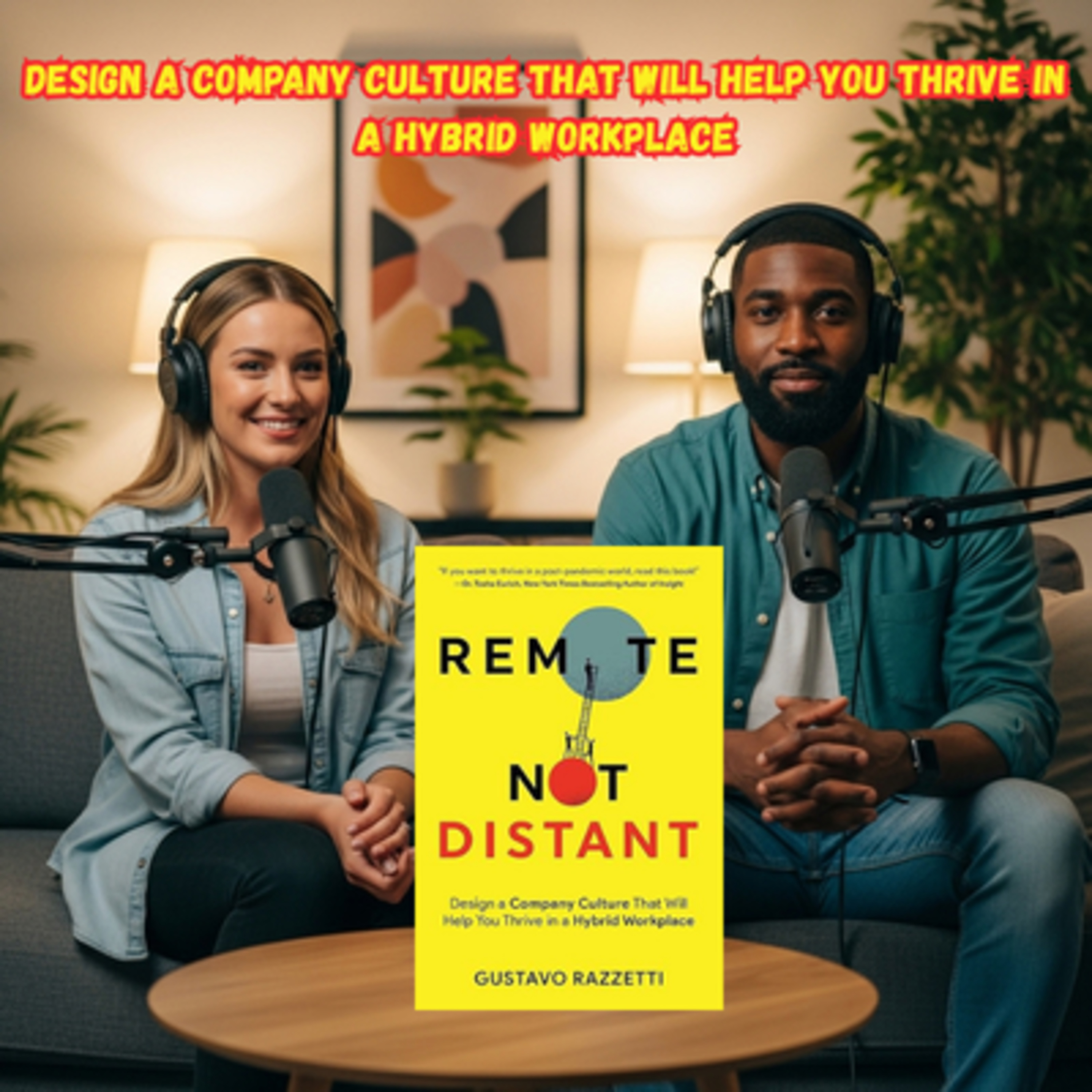
In his book Remote Not Distant, Gustavo Razzetti provides a blueprint for reconstructing corporate culture to thrive within a hybrid professional landscape. The text emphasizes that leaders must intentionally reset their mindsets by moving away from traditional office-centric habits and embracing a shared mission that unites employees regardless of their physical location. A significant portion of the work focuses on fostering psychological safety, ensuring that team members feel secure enough to contribute ideas without fear of repercussions. Furthermore, Razzetti advocates for a strategic balance between real-time meetings and asynchronous communication to prevent burnout and boost efficiency. By granting staff greater autonomy and moving away from micromanagement, organisations can drive engagement and maintain agility in a changing world. Ultimately, the source serves as a guide for building a connected and high-performing workforce in a remote-first environment.
Rethink everything you know about office culture, hybrid work, and remote teams with this game-changing book by acclaimed business culture design consultant Gustavo Razzetti, CEO of Fearless Culture - Featured in Forbes, Blue Ink Review, and FlexOS.
"Gustavo Razzetti captures the return to the office/remote debate so well and enables us to understand how we can utilize the benefits of remote working without compromising on having a great company culture. A great read!"
--Liz Rider, Global Head of Leadership and Culture, Volvo
⭐️ ⭐️ ⭐️ ⭐️ ⭐️
Hybrid and remote work is here to stay. But what will it take for your company to succeed in the new normal?
The pandemic taught many businesses a very valuable lesson — those who don’t adapt will get left behind. Some businesses managed to not only survive but actually thrive in a remote and hybrid work model.
What’s their secret?
Remote, Not Distant unveils the secrets behind successful remote workplace cultures and provides actionable tools for senior leaders, managers, team members, and consultants. Authored by top culture thought leader Gustavo Razzetti, this book provides a clear roadmap to understanding, adapting to, and succeeding in a hybrid workplace.
After spending years studying businesses like Amazon, Volvo, and Microsoft, Razzetti meticulously addresses the multiple areas that are crucial to effective remote and hybrid work today, such as culture, keeping your team connected, asynchronous communication, facilitating courageous conversations, and defining the right hybrid model for your organization.
Here’s exactly what this book will show you:
- What successful remote leaders do differently and how you can do the same
- How to implement the 5 key mindset shifts to reset your workplace culture
- Why your office was never your culture and what to do about it
- How to build company culture remotely
- How to build psychological safety – one step at a time
- How to incorporate the six modes of collaboration for hybrid teams
- How you can build a successful culture by design, and not chance
- And so much more!
Simply put: In Remote, Not Distant, you will learn how to design a company culture that will help you thrive in a hybrid workplace.
"The future of work isn't fixed; it's waiting to be built. Remote, Not Distant offers a tactical blueprint to building a better future for all."
--Darren Murph, Head of Remote, GitLab
⭐️ ⭐️ ⭐️ ⭐️ ⭐️
The future of work is here. Will you adapt or be left in the dust?
Free Bonuses: Access to download dozens of exclusive tools and templates to design your hybrid work culture (upon book purchase - add to cart now).
"If you want to thrive in a post-pandemic world, read this book!"
--Dr. Tasha Eurich, New York Times Bestselling Author of Insight
⭐️ ⭐️ ⭐️ ⭐️ ⭐️
If you're part of the working world right now, you know this. It's just a reality. That hybrid structure, you know, that mix of remote work and some office time, it's here to stay. This isn't some temporary fix anymore. It's just, it's the new normal. And yet so many companies are, well, they're still struggling with it, aren't they? They sort of assume you can take the old in office culture, the way things work and. Just drop it onto. Zoom. Exactly. Just move it onto zoom or Slack. But that kind of passive approach it, it leads straight to burnout, cultural erosion, and just that that feeling of disconnected frustration that I think we're all sensing.
That's it exactly. It's not a scheduling problem. People think it is, but it's not. It's a deep foundational challenge to how we even think about work culture. So our mission today is a deep dive into the framework from Gustavo Rizzetti. He really offers one of the clearest paths I've seen for building solid, resilient hybrid workplace. Right. And what we're going to do is extract 5 really crucial shifts, you know, the Nuggets of knowledge that redefined everything from how a leader defines purpose all the way to how teams collaborate and find autonomy in this new distributed world.
So this framework, it's really for you if you're trying to cut through all the noise and build habits that actually work no matter where your two members are sitting. OK, let's unpack this. Rosetti's starting point is well, it's a tough pill for a lot of executives to swallow. The culture that made you successful when everyone was in one building. It's just not enough anymore. So the first critical shift is what he calls the intentional culture reset. Think about it, when everyone was physically together, culture sort of happened organically.
It was all driven by that daily face to face cooperation. The coffee machine chats, the spontaneous whiteboard sessions. Exactly. All those little things created this really powerful social capital. And now all that spontaneity is just gone. You can't really recreate an open office layout virtually. I mean, we see companies trying, right? They have all these eight hour virtual summits to try and replace that collaboration and it just, it doesn't work. The very ties that held teams together are eroding.
Precisely, Rosetti points out. You can't just hope that the few in person moments you have will be enough to sustain the remote work. That's why so many organizations are seeing these huge problems with engagement and communication. They never updated the underlying operating system, the culture itself. And the knee jerk reaction is to panic and, you know, mandate five days a week back in the office. So why does Rosetti say this intentional resetting is a better solution? Because forcing people back doesn't fix a real problem.
The problem is that the habits are obsolete. The key lesson is that culture has to be rethought and reconfigured for the reality we're in now, and that needs a real mindset adjustment from leadership. So what does a concrete intentional reset actually look like? It means you're replacing old spontaneous habits with new structured rituals. So for example, instead of just hoping for an impromptu chat, a company might design something like a deep or cuddle a mandatory structured session maybe once a week where everyone checks in on priorities.
But here's the key. You are explicitly forbidden from tactical updates. The focus is purely on high level alignment, removing roadblocks. You're replacing accidental connection with deliberate connection. I see. So you're not just accepting the hybrid reality, you're actively designing your culture around it. OK, so once you've done that really hard work of resetting the culture, a new challenge comes up. Alignment. How do you keep everyone you know rowing in the same direction when they're all spread out?
And this brings us to the second shift. Reimagine a shared future. This is where Rosetti says you have to elevate the company's purpose statement, its mission. It can't just be some idealistic marketing copy on a wall. In a hybrid world, the mission becomes a crucial, practical tool. It has to be specific enough to actually direct judgment calls and create unity. So it becomes a kind of decision making compass for every single employee. If I'm working from home and I need to make a quick choice, I don't necessarily have to call my manager.
I check the purpose. Does this decision move us toward that future? That is the goal. Rosetti shares this anecdote about a company that was just dealing with massive silos, disorganized efforts everywhere, different departments are all optimizing for different things, and their mission statement goes just too vague. So what was the practical change they made? The reframing. Well, they shifted their objective. Instead of focusing internally on revenues on quarterly deadlines, they reframe the entire conversation to focus on how their work positively impacts customers lives and when that why is that clear?
And it's shared by everyone. It guides everything. The big long term plans and the small daily decisions people make alone. It just drives dedication. That makes so much sense. Clarity of purpose gives direction. But direction only really works if people feel emotionally invested, right? That sense of isolation, of feeling disconnected from the team, it's lethal for productivity. Which brings us to the third big shift, Reignite belonging. Yes, and this is where psychological safety stops being this academic theory and becomes an absolute operational necessity.
Morale and innovation, they just tank when people feel alienated. In a hybrid setting, you have to create an environment where people feel free to speak up, to share ideas, even to make mistakes without fearing they'll be judged or misinterpreted. And that's the danger in hybrid work, isn't it? The lack of nonverbal cues, a quick Slack message just asking for a clarification can so easily be read as criticism. And if people are afraid of that, they just they stop speaking up. That's the core vulnerability.
Rossetti highlights this case study of a remote team that was actively reluctant to raise technical concerns in meetings. They knew a failure had occurred, but the personal risk of being blamed just felt higher than the risk of letting the problem get worse. Wow, so the lack of psychological safety was literally stopping them from doing their jobs correctly? Yes. And the organization, they had to implement really tangible structured steps to fix it. They introduced frequent low stakes virtual check ins team building that focused on personal sharing and an open feedback culture with really explicit rules.
It took time, but you know, eventually people felt safe enough to speak their minds, even with bad news. So it sounds like the key isn't just saying, oh, it's safe to speak up, but actually demonstrating it. Rosetti calls this climbing the safety ladder. What's the hardest step? On that ladder, it's the leader taking that first visible step of vulnerability. It's not something you can delegate to HR. It requires the leader to go first, to admit a mistake they made, or ask for help on a tough problem, or to publicly own a failure.
That one small, visible active vulnerability is what makes the whole process feel real for the rest of the team. Right. That shifts the culture from blame to learning. OK, so once the culture is reset, the purpose is clear and the team feels safe. Now you can look at the actual mechanics of work. And that's the 4th shift, operational shift. Rethink collaboration. We've kind of established that traditional collaboration, that impromptu brainstorm, the long meeting, it's just inefficient and draining in a hybrid model.
And if you try to replicate it with endless video calls, you just get Zoom fatigue. Rossetti's solution is finding that right balance between synchronous real time scheduled work and asynchronous at your own pace. More documentation based work. It's not about doing less, it's about designing a system that actually respects people's time to focus. Absolutely. Think about that group in the book that was dealing with these draining in person meetings, most of which were just status updates, and they had the extra problem of coordinating across different time zones, which led to constant delays.
They were fighting their distributed nature, not using it. Their big mistake was making synchronous real time communication the default for everything. Right? Exactly. So their solution was to pivot. They moved major decisions and all status updates to asynchronous methods. They use tools like Message Fours and shared documents where complex ideas could be debated over, say, a 24 hour period. That's so smart because if I need deep focus, I can contribute my best ideas at 10:00 AM, but if you're in a different time zone, you can add your thoughts at 6:00 PM your time.
The async system respects my focus and lets me contribute when I'm at my sharpest. And the insight here is so crucial. Asynchronous communication lessens the need for everyone to constantly be on. It's a tool to protect deep work. You're making distributed time and advantage, not a point of friction. Which brings us perfectly to our fifth and final shift, which really builds on that trust, the empowerment principle. Rossetti's big assertion here is that in a hybrid world, autonomy is the new engagement.
This is all about giving teams the independence they need to act fast to adjust without being held back by old inflexible procedures. I mean, this is where we clear up some confusion about agility. Rosetti is basically telling leaders to let go of that need for control that some of those old rigid structures imposed. The moment you grant that trust, you shift accountability. It moves from the manager supervising the input to the employee truly owning the output. But that shift so often gets derailed by the classic micromanagement.
Trap. Oh yeah, the source material has this vivid example of a business that was just completely choked by micromanagement. People were stuck in this endless loop of multi tiered approvals. They couldn't move anything forward without getting sign offs from multiple layers of management. That is creativity being killed by procedure and morale being killed by a total lack of trust. Exactly. So the practical solution was to empower teams by giving them significantly greater autonomy. But, and this is critical, they also set precise published parameters for decision making authority.
They were told you have the authority to spend up to X dollars or make Y process change without talking to a manager. That's the key distinction, isn't it? You can't just grant autonomy in a vacuum. You have to be crystal clear on the guardrails. Otherwise it's just chaos. And that clarity is what makes it work. By defining the hybrid structure, including how and when decisions get made, they let projects move faster and employees felt more invested, more accountable for what happened. OK, so to synthesize this whole deep dive into Rossetti's five step framework, these are really the necessary cultural shifts for any modern workplace.
One, the intentional culture reset, You have to consciously design new rituals. 2 Reimagine a shared purpose so the mission becomes a practical compass for everyday judgment calls. 3 Reignite belonging through psychological safety, led by vulnerable leaders. 4 Rethink collaboration, striking that balance between synchronous and asynchronous work to protect focus. And finally, 5 recognizing that autonomy is the new engagement, which means leaders have to step back, trust their teams, and grant real decision making authority.
These are the shifts that value both community and speed. This isn't just about managing where people sit, it's about designing a whole new operating system built on trust and clarity. Which leaves us with a final thought for you to consider today. Rosetti suggests that purpose drives motivation, but autonomy drives engagement. So if your team had absolute clarity on its purpose and you trusted them completely over how to achieve it, what slow, obsolete approval process could you eliminate today?
What specific sign off could you just scratch off your list to foster that trust and ultimately accelerate your results? That's where the reset truly begins.
 Apple Podcasts
 Castbox
 Castro
 Goodpods
 Moon FM
 Overcast
 Pocket Casts
 Podbean
 Podcast Addict
 Podcast Republic
 Spotify