Find Your Why | A Practical Guide for Discovering Purpose for You and Your Team
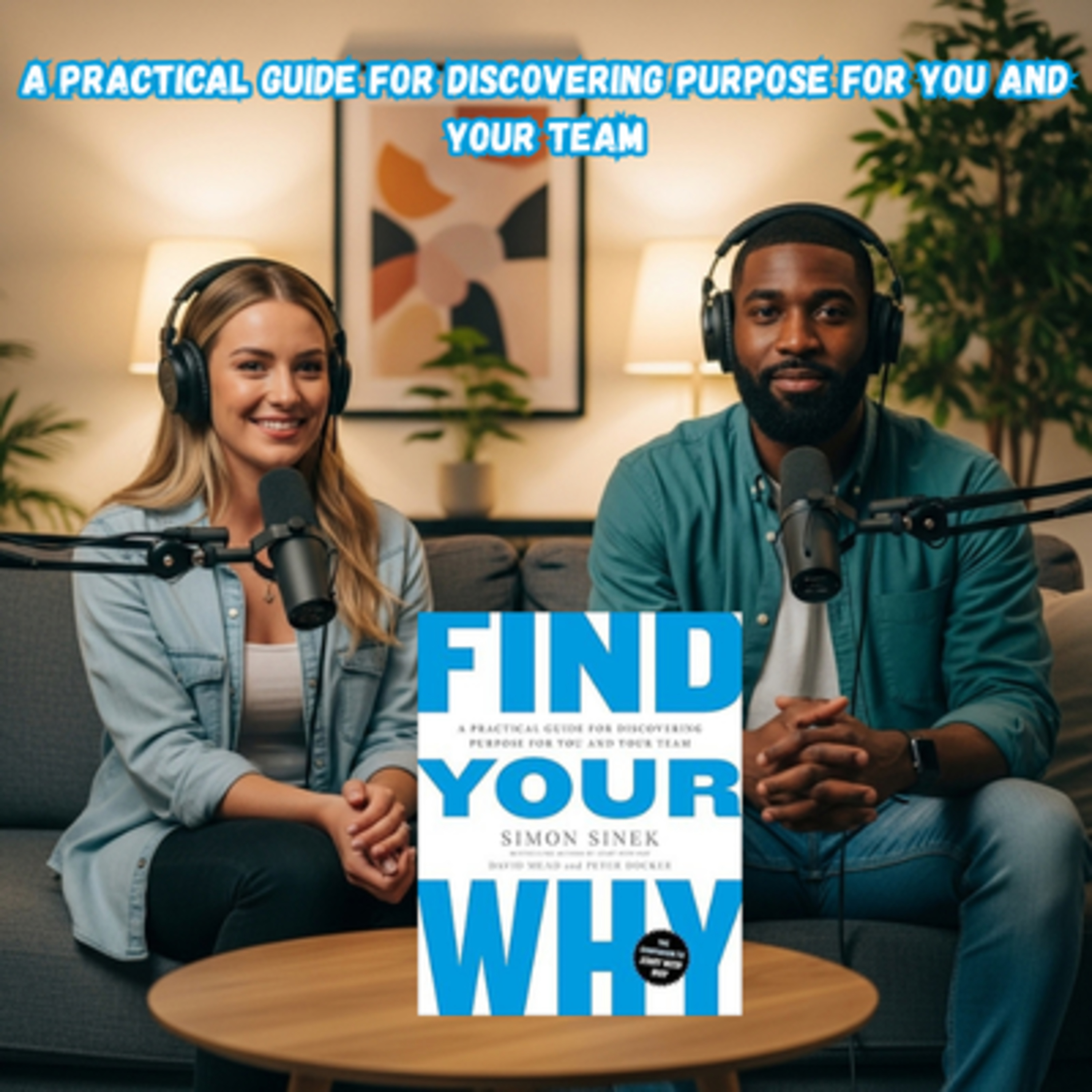
The provided text outlines the core principles of the book Find Your Why, a practical manual designed to help individuals and organizations pinpoint their fundamental motivations. It explores a systematic journey of self-reflection that transitions from identifying a core purpose to establishing the specific actions and behaviors necessary to manifest that vision. The chapters detail specialized strategies for personal discovery as well as collaborative techniques for teams to align their collective values. By differentiating between the "Why" and the "How," the authors provide a framework for making authentic decisions and fostering deeper connections with others. Ultimately, the source emphasizes that living a life of meaning and impact requires a clear understanding of one's driving force.
Start With Why has led millions of readers to rethink everything they do – in their personal lives, their careers and their organizations.Now Find Your Why picks up where Start With Why left off. It shows you how to apply Simon Sinek’s powerful insights so that you can find more inspiration at work -- and in turn inspire those around you.
I believe fulfillment is a right and not a privilege. We are all entitled to wake up in the morning inspired to go to work, feel safe when we’re there and return home fulfilled at the end of the day. Achieving that fulfillment starts with understanding exactly WHY we do what we do.
As Start With Why has spread around the world, countless readers have asked me the same question: How can I apply Start With Why to my career, team, company or nonprofit? Along with two of my colleagues, Peter Docker and David Mead, I created this hands-on, step-by-step guide to help you find your WHY.
With detailed exercises, illustrations, and action steps for every stage of the process, Find Your Why can help you address many important concerns, including:
* What if my WHY sounds just like my competitor’s?
* Can I have more than one WHY?
* If my work doesn’t match my WHY, what should I do?
* What if my team can’t agree on our WHY?
Whether you've just started your first job, are leading a team, or are CEO of your own company, the exercises in this book will help guide you on a path to long-term success and fulfillment, for both you and your colleagues.
Thank you for joining us as we work together to build a world in which more people start with WHY.
Inspire on!
-- Simon
Welcome back to The Deep Dive. Today we are shortcutting your path to an informed perspective on one of the most foundational ideas in modern leadership and really in self help. We're diving into the architecture of purpose. We're pulling out the critical insights from Simon Sinek, David Meade, and Peter Docker's work The Compass of Purpose, a guide to find your why and our mission here. It isn't just to summarize the book. I mean, anyone can read a dust jacket. We're extracting the actionable. McKenna, How to.
Exactly The specific steps and frameworks the authors propose for discovering that core, authentic Why? It's all about transforming, you know, this vague motivational theory into a structured process for living and leading. That's a great way to put it. We're really moving beyond just the inspirational quote and getting into the the engineering and fulfillment. The core idea behind all of this is that golden circle, Why, how, what? And the promise is that if you reverse how usually think, if you start with why, that's the path to well, to sustain success and real satisfaction for individuals and for big organizations.
It's the engine really. It generates lasting loyalty, genuine influence, all because it shifts the conversation from the what the features and functions to the why to belief and identity. OK, so let's unpack that. Right at the start, the sources really emphasize that almost everyone knows their what you know, their job title, what they sell. And many know their how the process. Right, the process they use, but very, very few can actually articulate their why. Now, this might sound a bit like just, you know, a mission statement.
It's deeper than. That the source makes this really important distinction. The what is rational, it's concrete, it's external, but the why? That's the fundamental belief or 'cause that drives everything. It's the reason you exist beyond just making money. And what's so fascinating is the neurobiological angle they bring in. Yeah, they suggest that when people communicate from the outside in, starting with the what, you're talking to the analytical part of the brain. So you understand the facts, but it doesn't really move you.
Exactly. You get the information, but it doesn't compel to act. But when leaders communicate, starting with AY with a belief, they tap right into the limbic brain. Which is responsible for feelings trust? And crucially, decision making. That is the transformational power. Leaders who can articulate their purpose don't just give you information. They forge these deep emotional connections. They inspire people who already believe what they believe. So it's not about selling something to everybody, it's about finding people who are already kind of walking in the same direction and just giving them a vehicle to get there.
It's like a filter for alignment. Precisely. And if you connect that to the big picture, having a clear why is the ultimate tool for influence. It ensures every activity, every strategic decision, it all gets checked against that core belief it. Prevents that drift. It prevents drift and it ensures long term consistency, and that consistency is what builds trust. So if the why is the compass, then the immediate question for probably everyone listening is OK. How do you actually find it? How do we get past the theory and into the, you know, the messy process of personal discovery?
The road map suggests that finding your why is less about invention and more more like an archaeological dig. Chapter 2 really stresses this. The why is already there. It's an unchangeable truth about you. Exactly. But you have to unearth it. It takes some diligent self reflection, some research, some inspiration. And this is where the sources get really concrete, which I appreciate. They offer a structured approach, not just some vague, you know, journal about it prompts Chapter 3 details this why discovery for individuals, right?
And it focuses on finding the patterns that define your highest moments, the times you felt real joy and contribution. The core method is all about reflecting on what they call your stories and moments. And you're not just looking at your whole life story, no. Not at all. You're pinpointing maybe 3 or 4 specific significant experiences. These could be work achievements, personal challenges, even small quiet moments where you felt truly alive. So you're basically gathering evidence of your purpose in action, finding the times you were operating at your absolute authentic best.
Exactly And once you have these really vivid stories, the method says you need to share them with a trusted partner or a facilitator, and this is vital. Because someone else can see the patterns better than you can. Yes, other people are often much better at spotting the consistent themes that tie all your different experiences together. You might get stuck on the what of the story, but the listener, they'll hear the why, the motive underneath it all. So what kind of themes are we actually looking for?
Is it something broad? Like I enjoy helping people. No, it has to be much more specific and active than that. You're looking for recurring objectives, patterns of behavior, and most importantly, the contribution you made in those peak moments. For example. Well, did you consistently challenge assumptions or did you bring order to chaos? Maybe you help marginalized voices feel heard? It's about the action, and once you have these distinct themes, the source suggests you synthesize them into a single why statement and has a very specific structure.
Right, it's a two-part structure. It is to contribution, so that impact has to be simple, it has to be timeless and it has to be phrased positively, so, for example, to empower others with knowledge so that they can live independent, informed lives. That structure really makes it practical. It forces you to define not just what you do for others, but the ultimate positive effect of that action. It takes all the guesswork out of that general advice. Just find your passion. And they do stress that this isn't A1 and done thing.
It's a lifelong process, not something you just take off a list. That's right. It's an ongoing conversation with yourself acting as a concert reference point to make sure you're still aligned. And that's really the key transition. Once an individual understands their purpose, the next layer of complexity kicks in. How do you scale that? What happens when you go from one person to a whole team or a company? How does an entire organization find a shared? Why? And that takes us right into chapter 4, which details what the authors call the tribe approach.
This is the method for when an organization is large or maybe when the founders original why has gotten a little diluted over time. Due to growth or new leadership maybe? Exactly, and they highlight this critical need to involve a representative group, the tribe from inside the firm. This ensures the collective purpose is inclusive and reflects all the different views. So it's not just coming down from the executive suite. Right. It moves the purpose from just, you know, aspirational marketing copy to an internal authentic truth.
And the tribe approach isn't about inventing a new goal. It's more like retrieving the organization's soul. It works by having this diverse group of employees share their own stories, their own moments when the organization made them feel the proudest. Or when they felt they were at their best working for the company. Right. And in Chapter 5, the mechanics of these group sessions become so important. This isn't just a casual brainstorming session, it requires real discipline. And the number one prerequisite is psychological safety.
Absolutely. Creating a safe environment for open communication where everyone participates and people feel OK being a little vulnerable. I totally agree safety is non negotiable, but in a real corporate setting, how do you deal with stories that seem to conflict? You know, one person's best moment might be about ruthless efficiency and another's is about slow, deliberate creativity. That's where the analysis comes in. You have designated roles, A facilitator and often a challenger, and their job is to listen to every point of view, encourage participation and then synthesize the common emotional threads, not the surface level actions.
So you're looking for the pattern underneath, yes? The goal isn't uniformity, it's finding the robust pattern that supports all those positive experiences. For instance, if one story is about a fast product launch and another is about meticulous customer service, the shared why might be something like to earn customer trust through relentless quality and responsiveness. That purpose is broad enough to value both speed and care, but specific enough to unite everyone toward one goal. It's the collective understanding of the group's highest ideal.
So we spent all this time defining the ultimate goal, the why. We found our individual compass and our group's guiding star. But clarity? I mean it's useless without execution. The rubber has to meet the road. Exactly. So now we have to move from belief to concrete action. The natural next question is how. And this brings us to Chapter 6. State your House. These are the specific actionable steps or behaviors you adopt to make the why a tangible reality. They're like behavioral guardrails. The Hows are absolutely critical.
They're the bridge between that you know ethereal belief and the measurable behavior. If your why is to foster fearless exploration, your house might be things like embrace constructive failure or ask 3 naive questions per meeting. So how do? You find them. You have to reflect again, but this time you're not looking for peak emotional moments. You're looking at your natural behaviors when you are fulfilling your purpose. How did you act when you felt most aligned? Those actions, when you generalize them into principles, they become your house.
That makes a lot of sense. They're your operating values, but they're defined by actions, not just, you know, words on a poster. Exactly right, and the principles for stating your house are pretty rigid. They must be simple, clear and authentic. A great how should be a verifiable instruction. Be honest, is weak. What's a strong one? Always admit mistakes immediately. That's a strong how you could see if you're doing it or not. So how does is an organization or an individual actually use these as filters day-to-day?
This is the application that I think people really need. The most important function of the house, according to the sources, is as behavioral filters for decision making. They become the benchmark. Think about hiring. If one of your house is challenge the status quo, you don't just hire the candlelate with the best resume. You hire the one who asked the most provocative question. You got it. Or if a team's house is prioritize learning over profit, that filter helps them decide between a quick, cheap solution and a complex, innovative one that requires new training.
They have to be communicated constantly so everyone understands how you operate. So the house make sure everyone is walking the same way down the path. That's it. And Chapter 7, take a stand. Do the things you say you believe. It just drives that point home. It links belief to accountability. It's the constant integrity check. It makes it clear that finding and living by these principles provides the road map for realizing your purpose and everything you do. Right when you define your house, you create this non negotiable road map for fulfilling your goal.
By understanding your natural habits and defining your values, you ensure there's zero daylight between what you believe and how you actually operate. This really has given us a complete, actionable road map. The source material doesn't just ask us to think differently, it defines the entire process. Figuring out your why, defining your house, and then identifying your who's the people you serve. That synergy gives you undeniable clarity. And direction and meaning. The ultimate take away seems to be empowerment through authenticity.
By accepting your true purpose and then deliberately putting it into measurable action with your house, you ensure a positive impact. And you lead a life of fulfillment and integrity. It is the framework for achieving real, meaningful, sustained success. And building on that idea of the house as filters, we want to leave you with one final thought to Mull over as you go about your day. The entire discovery process hinges on reflecting on past behaviors to define your principles. So think about your life right now.
What is 1 routine professional or personal decision you currently make without applying a purpose filter? Maybe you're just relying on inertia or or what's easiest? It could be how you handle e-mail or how you decide to staff a certain project. How would that one specific decision change if you just paused today and actively applied one of your courthouse, that simple guiding principle to that choice? That shift from automatic action to purposeful, disciplined action, that's the entire point of this journey.
 Apple Podcasts
 Castbox
 Castro
 Goodpods
 Moon FM
 Overcast
 Pocket Casts
 Podbean
 Podcast Addict
 Podcast Republic
 Spotify