Playing to Win by A.G. Lafley & Roger L. Martin | How Strategy Really Works
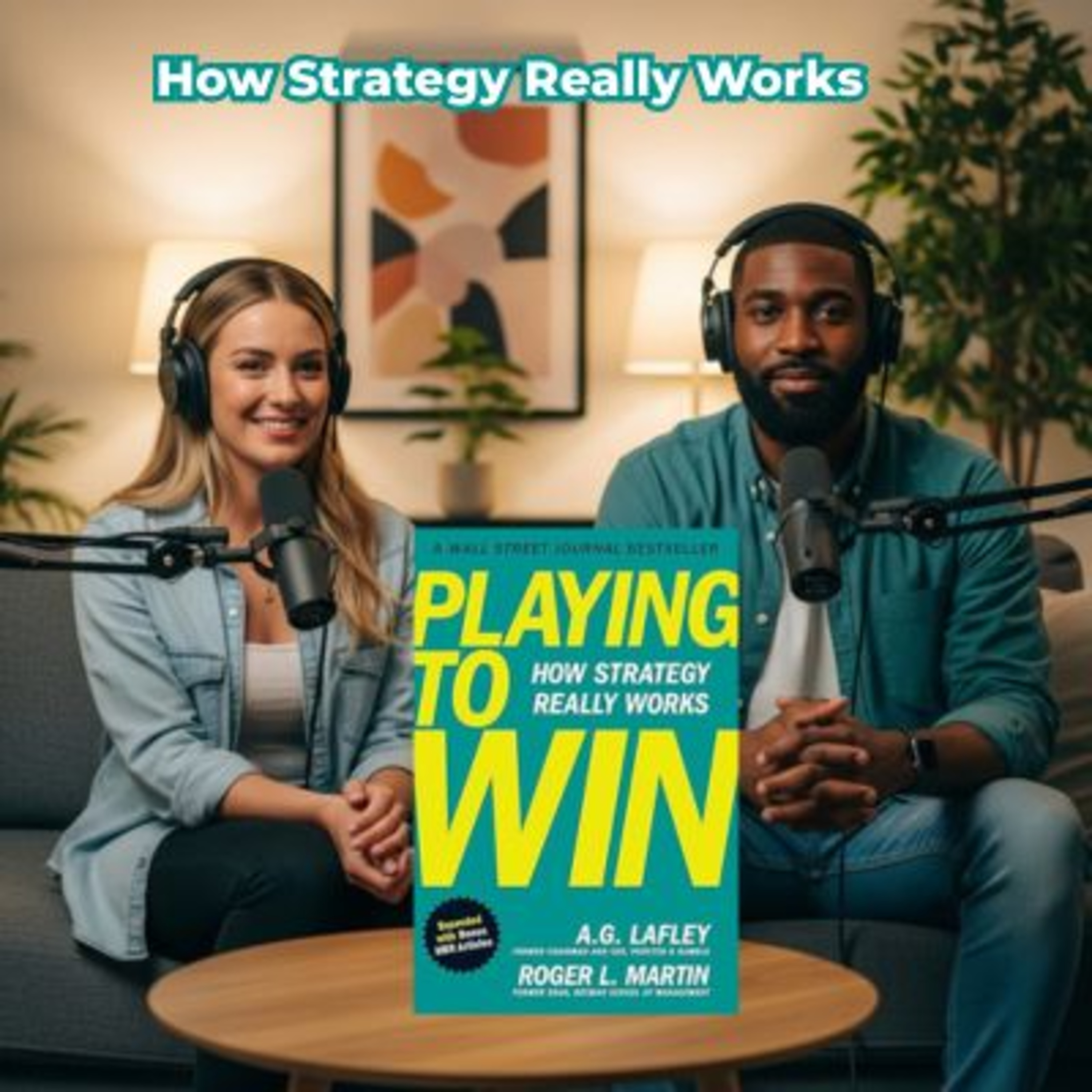
This episode outlines the core principles of strategic decision-making based on the business philosophy of A.G. Lafley and Roger Martin. It emphasizes that strategy is a deliberate choice rather than a vague ambition, requiring organizations to define clear winning aspirations and specific markets where they can thrive. By identifying unique strengths and making necessary trade-offs, leaders can concentrate limited resources on the activities that provide the highest impact. The source also highlights the importance of effective execution and alignment, urging companies to remain agile through continuous learning and disciplined management. Ultimately, the guide serves as a practical framework for shortening the odds of success by transforming complex theories into actionable, informed business moves.
Strategy is not complex. But it is hard. It's hard because it forces people and organizations to make specific choices about their future—something few companies do well.
In this contemporary business classic, now with a foreword by former Harvard Business Review editor in chief Adi Ignatius and insightful articles from HBR, two of today's most respected business thinkers explain what strategy is for, how to think about it, and how to get it done. And they use one of the most successful corporate turnarounds of the past century, which they achieved together, to prove their point.
A.G. Lafley, former CEO of Procter & Gamble, in close partnership with strategic adviser Roger Martin, doubled P&G's sales, quadrupled its profits, and increased its market value by more than $100 billion in just ten years. Drawing from their experiences, they explain how leaders in any organization can guide everyday actions with strategic goals built around the essential elements that determine business success—where to play and how to win.
The result is a playbook for winning. At its core is a set of five integrated and essential strategic choices:
- What is our winning aspiration?
- Where will we play?
- How will we win?
- What capabilities must we have in place to win?
- What management systems are required to support our choices?
The authors tell rich stories of iconic P&G brands, such as Olay, Bounty, Gillette, and more, to clearly illustrate how deciding on a strategic approach—and then making the right choices to support it—can make the difference between just playing the game and actually winning.
#BusinessStrategy #PlayingToWin #Leadership #Entrepreneurship #StrategicThinking #BusinessGrowth #CEOmindset #Management #CompetitiveAdvantage #StartupStrategy #BusinessPodcast #LeadershipDevelopment #GrowthStrategy #DecisionMaking #BookSummary
Imagine working like 80 hours a week and you are perfectly executing every single task on your To Do List, crushing every meeting and still slowly steering your business straight off a Cliff. Oh yeah, it happens all the time. Right, because activity is not strategy. But the two are just incredibly easy to confuse. They really are. I mean, we assume that because we are moving aggressively, we must be moving purposefully. Exactly how often do you find yourself caught in that illusion of momentum? You know you were spinning your wheels mistaking a high heart rate for actual forward progress.
And without a deliberate framework that actually forces us to make difficult, sometimes really painful decisions, all that kinetic energy just dissipates into nothing. Today's deep dive is designed specifically to dismantle that trap. OK, let's unpack this. We are looking at a brilliant summary guide today titled Winning through Strategy, A Guide to Informed Choices. Right, which breaks down the core concepts from AG Lafley and Roger L Martin's really influential book Playing to Win, How strategy works.
And the mission today is to prove a very specific point. Strategy isn't some mystical art reserved for, you know, top ranking leaders in corporate boardroom. No, not at. All it is a highly practical, manageable manual for absolutely everyone, including you, to force the tough choices necessary to succeed. What's fascinating here is how the source material dissects why really smart people consistently fail at strategy. It almost always comes down to the fear of making a choice. Which is so human, right?
Absolutely. Because strategy is entirely about making intentional, restrictive choices to succeed in a given space. Every single thing an entity does, where it competes, what it ignores, how it outwits rivals, it's a choice that shapes its trajectory. So the guide sets up this fantastic scenario. To visualize the trap, consider yourself the CEO of a modest tech company. You have a groundbreaking product but you're facing down these massive, well established rivals. Right, the classic David and Goliath setup.
Yeah, and the reality check the guy delivers is that having a fantastic product is simply the entry ticket doesn't win the game. No, a great product without a strategy is just a very expensive hobby. Wow, that's a great way to put it. An expensive hobby. And the mechanism of failure in that scenario is almost always the refusal to make a trade off. The source outlines 3 core tenets. Here we have clarity of choice, trade-offs and commitment. OK, so break those down for us. Well, leaders of that modest tech company often look at the market, and they just want to capture all of it.
They suffer from an intense fear of missing out. The corporate FOMO. Exactly. But you literally cannot be everything to everyone. You will not excel at everything. So you have to prioritize. And the act of prioritizing naturally means leaving money on the table in the short term, right? Just to secure dominance in the long term. Strategy is basically like packing a suitcase for a long trip. You have limited space. Oh, I like that. Right. Those are your trade-offs. If you try to pack absolutely everything in your closet because you're terrified you might need like, a tuxedo on a hiking trip, the bag just bursts.
Yeah, and you go nowhere. Exactly, you have to choose the right outfits for the actual destination you are going to. And that destination is what the guy calls your winning aspiration. It acts as a filter for every single subsequent choice you make. So how does that play out in the real world? Well, the source contrasts the tech company with the founder of an eco friendly clothing brand. For this founder, the winning aspiration isn't a generic you know, increase profits by 10%. Right, because profit is just a byproduct.
Precisely the aspiration is becoming the absolute leading sustainable fashion choice for conscious consumers worldwide. And having that specific aspiration forces the mechanics of the entire business to align. It dictates your product design, your supply chain, your marketing, you. Can't secretly use cheap polluting dyes to save a buck. If you're winning, aspiration is to be the leading sustainable choice. You just can't do it. The overarching goal demands goals, differentiation and a long term perspective.
But I do have to ask about that third tenet you mentioned earlier commitment. OK, what about it? The guide says you have to commit wholeheartedly and that flip flopping undermines efforts. But if you're David facing Goliath, isn't hesitating just a natural healthy survival instinct? I mean, you don't want to make the wrong move and get crushed. Well, fear is a survival instinct, sure, but hesitation in your strategy is blood in the water. Think about the underlying mechanics of an organization. It relies on a network of people executing a shared vision.
When leadership hesitates or flip flops on the core strategy because they are afraid of a competitor, it creates a massive cascade of confusion down the entire organizational chart. Oh, I see. So the marketing team suddenly doesn't know who to target, the product team pauses their development, and the sales reps just stumble on their pitches. Exactly. Flip flopping completely paralyzes the entire operation, and This is why the winning aspiration is so critical. Because it keeps everyone anchored.
Right. Without it acting as a fixed, immovable guiding star, your choices have no framework. You just end up reacting to the market instead of actively shaping it. But I mean, an aspiration is useless if you don't know where the battlefield is. Knowing what you want to be naturally forces the question of where you are going to fight for it, deciding where to play and how to win. Yeah, and the guide uses the example of a software company CEO producing Productivity Tools. You have the software, but you must make a definitive choice.
Are you serving individual consumers, small businesses, or massive enterprise corporations? Because the underlying logic is that you literally cannot build one piece of software that serves all three perfectly without alienating someone. Right, because the features inherently contradict each other. An individual consumer wants a low price point and absolute simplicity. Yeah, and a major corporation demands enterprise grade security, complex integrations and like a dedicated account manager. Exactly.
If you try to build for both, you end up with a bloated, expensive product that the individual hates and a dangerously simplified product that gets the enterprise user fired. Which is the worst case scenario? And that is the mechanism of segmentation. You must select your market, recognize that not all customers are the same, and maintain intense focus so you don't dilute your value proposition. So that covers the where to play, Yeah aspect, but the theoretical map isn't the actual territory we have to move to the execution phase, right?
How to win? Translating strategic choices into systemic action. Yes, and here's where it gets really interesting. The source uses the analogy of a sports coach preparing A-Team for a championship match. OK, I love a good sports analogy. A game strategy is just one part. The players have to know their duties, practice constantly and give maximum effort. It highlights 3 necessities, alignment from top leadership to the frontline, capabilities meaning actual investments in tech and training and adaptability.
But let's look at the reality of that coach analogy for a 2nd A sports game has a final whistle, right? You play your heart out for a few hours, and then you go home and rest. True business doesn't have a final whistle. So how do you maintain that intense championship match energy without completely burning out your frontline employees? If we connect this to the bigger picture, the trap most leaders fall into is thinking that alignment means grinding gears harder and running faster. Hustle culture, basically.
Exactly. But true alignment actually reduces friction. The coach analogy isn't about endless, breathless sprinting. It is fundamentally about building those capabilities. Oh, I get it. So it's about giving them better running shoes, not just yelling at them to run faster. Precisely, Strategy is an ongoing process. When frontline employees are completely aligned with the top leadership and they have the technological tools and training they actually need, execution becomes a sustainable habit, not a daily panic attack.
The strategy carries the momentum. Right, They don't have to burn mental energy constantly trying to figure out what they're supposed to be doing or fighting against broken internal processes. That makes perfect sense. Maximum effort is about maximum precision, not just an 80 hour work week. But, you know, deciding where to play and refining that execution is impossible if you haven't taken a hard look at the actual weapons you're bringing to the field. You really? Have to look inward. Which requires an incredibly honest assessment of your internal mechanics.
The guide shifts focus to playing to your strengths and managing what truly matters. And we see a powerful example here, a leader of a manufacturing company known specifically for precision engineering. The prevailing corporate temptation is almost always to chase growth by diversifying into unrelated booming industries. Right, the classic we do precision engineering. But hey, let's also launch a software startup trap. Yeah, but the strategy here dictates the exact opposite. Instead of diluting their expertise, the most potent move is to double down on their existing engineering prowess.
They identify their core strength, focus their efforts entirely on activities that align with it, and invest in continuous improvement so that specific strength stays lethal over time. It's all about focus. It makes me think of a magnifying glass. If you take sunlight, which represents your energy, your capital, your workforce, and let it scatter naturally across a piece of paper, you just make the paper slightly warm. That's a diversified, unfocused company. Exactly. But if you use the discipline of a magnifying glass to focus all of that exact same energy onto 1 tiny specific point, it starts a fire.
It becomes completely disruptive force. That focus beam is the essence of resource allocation. The guide provides another great scenario, a retail chain manager. Rather than spreading resources incredibly thin across a dozen shiny new initiatives, this manager prioritizes the core activities that actually drive the profit engine. So optimizing the existing store layouts, ruthlessly streamlining the supply chains, enhancing the frontline customer service. Right. And the linchpin holding all of this together is discipline.
You know, think about the last time you were at work and someone asked you to take on a quick side project. Oh, they always sound so appealing. Right. It sounded fun. It was flattering to be asked, but it had absolutely nothing to do with your main quarterly goals. The discipline we were talking about here is basically walking past the buffet. OK, I'm listening. The discipline isn't in filling your plate as high as possible with every single dish offered. The discipline is walking past the mediocre pasta because you know you came for the prime rib.
That quick side project is the mediocre pasta. That is a brilliant way to phrase it, and the corporate world serves A staggering amount of mediocre pasta. Shiny, new, but ultimately unrelated opportunities cross a leader's desk every single day. All the time. The underlying psychology of discipline is having the fortitude to say no to a good idea just to save room for a great one. Continuous improvement and brilliant resource allocation completely collapse if a leader lacks the discipline to resist those distractions.
Because if you eat the pasta, you have no room for the prime rib. Exactly. If you chase the unrelated opportunity, you drain the exact resources you needed to dominate your core market. It completely reframe strategy. It shifts it from being a list of what you will do to being almost entirely defined by what you aggressively refuse to do. But intense discipline on internal strengths creates a new vulnerability. Blind spots. Yeah. If you're perfectly optimized for today's market, using that magnifying glass to start a fire right now, how do you keep from being wiped out by a massive environmental shift tomorrow?
Which brings us to the final hurdle. Future proofing, thinking through your strategy, and shortening your odds. The guide dives into strategic thinking as the absolute foundation of decision making. You really have to step back from the daily grind. The example provided is a marketing agency leader tasked with creating a massive new campaign. So they don't just sit down and start designing graphics immediately. No, they step all the way back to adopt A holistic perspective. They conduct comprehensive market research, evaluate competitor tactics, and brainstorm to ensure maximum impact.
This requires critical thinking, right? Actively challenging the conventional wisdom that made them successful in the past. Because what worked yesterday might just be a massive liability tomorrow. Crucially, it requires scenario planning, anticipating diverse future scenarios, and developing contingencies. You aren't just planning the perfect sunny day picnic, you are building the umbrella for the unexpected rainstorm too. Yes, and that directly ties into what the guide calls shortening your odds, reducing your risk in a highly competitive setting.
An example here is a startup CEO launching a new product. Instead of staking everything on one massive high risk plan and betting the whole farm on a single idea, they take an iterative approach. Right. They run small scale experiments, they gather real world feedback, and they maintain the agility to pivot quickly when the data tells them to. So they are actively practicing risk management by diversifying their alternatives rather than making a single catastrophic gamble. Wait, I'm getting whiplash here.
What do you mean? Well, earlier we agreed that flip flopping is a death sentence. We talked about how the David versus Goliath tech company had to make a choice and commit wholeheartedly. Now we're praising a startup CEO for hedging bets, experimenting, and pivoting. I mean, that sounds exactly like flip flopping. Where is the line between agility and just failing to commit? This raises an important question, and honestly, it is precisely where the majority of leaders stumble when trying to apply these frameworks in real life.
But the apparent contradiction completely disappears when you separate the goal from the tactics. OK, separate goal from tactics, yes. Your commitment, that wholehearted, unwavering, absolute dedication, is to your winning aspiration. The destination is fixed on the map. You do not compromise on that. But the agility, the iterative approach, the small scale experiments, those apply strictly to the tactics you use to reach that destination. Oh wow, OK, let's map that back to the eco friendly clothing brand.
Let's do it. They are absolutely committed to their winning aspiration being the leading sustainable fashion choice. That is the fixed destination. They don't wake up one day and decide to pivot to fast fashion. Never. But they might run a small scale experiment on whether their audience responds better to a marketing campaign focused on organic cotton versus 1 focused on recycled polyester. Exactly. And if the recycled polyester campaign completely fails, they haven't flip-flopped on their strategy, they haven't abandoned their goal.
They have iteratively learned what tactical vehicles don't work on the road to their destination. That is such a crucial distinction. It is about balancing immense rigid ambition regarding your final destination with deep, flexible prudence regarding the path you take to navigate uncertain terrain. You commit obsessively to the what's and the why, but you remain highly agile and experimental about the how. So what does this all mean? If we bring this entire framework down to the ground level, we see that strategy is absolutely not some theoretical textbook exercise.
Far from It is a vital mechanism for making hard choices. It starts with defining and uncompromising winning aspiration that forces you to make painful trade-offs. And it requires understanding the specific battlefield you were playing on, realizing you can't build for everyone, and aligning your team to reduce friction. It demands the ruthless discipline to focus your internal strengths like a magnifying glass walking past the buffet of distractions. And finally, it requires the wisdom to lock in your final destination while remaining agile enough to experiment with the tactics that will actually get you there.
The overarching truth to all of this is that knowledge is most valuable when it is actually understood and practically applied. Absolutely. Whether you are launching a brand new corporate initiative, organizing a community project, or trying to fix an existing process where you feel like you were just spinning your wheels, this framework is your toolkit. Making deliberate, restrictive, informed choices is the only reliable mechanism for moving from merely being active to actually being effective.
It really requires a complete shift in how we view our daily work. We started this deep dive talking about that frustrating feeling of executing perfectly but going nowhere. Yeah, mistaking activity for progress. We've learned that strategy is fundamentally about trade-offs. It is defined by what you aggressively refuse to do. So I want to leave you with a final lingering thought to explore on your own today. It's a tough question, but a necessary one. Look closely at your own life, your current projects, or your career trajectory right now.
What is the one good opportunity? That shiny side project, that perfectly mediocre pasta that you need to abandon today so that you finally have the focused resources to achieve your true winning aspiration tomorrow.
 Apple Podcasts
 Castbox
 Castro
 Goodpods
 Moon FM
 Overcast
 Pocket Casts
 Podbean
 Podcast Addict
 Podcast Republic
 Spotify