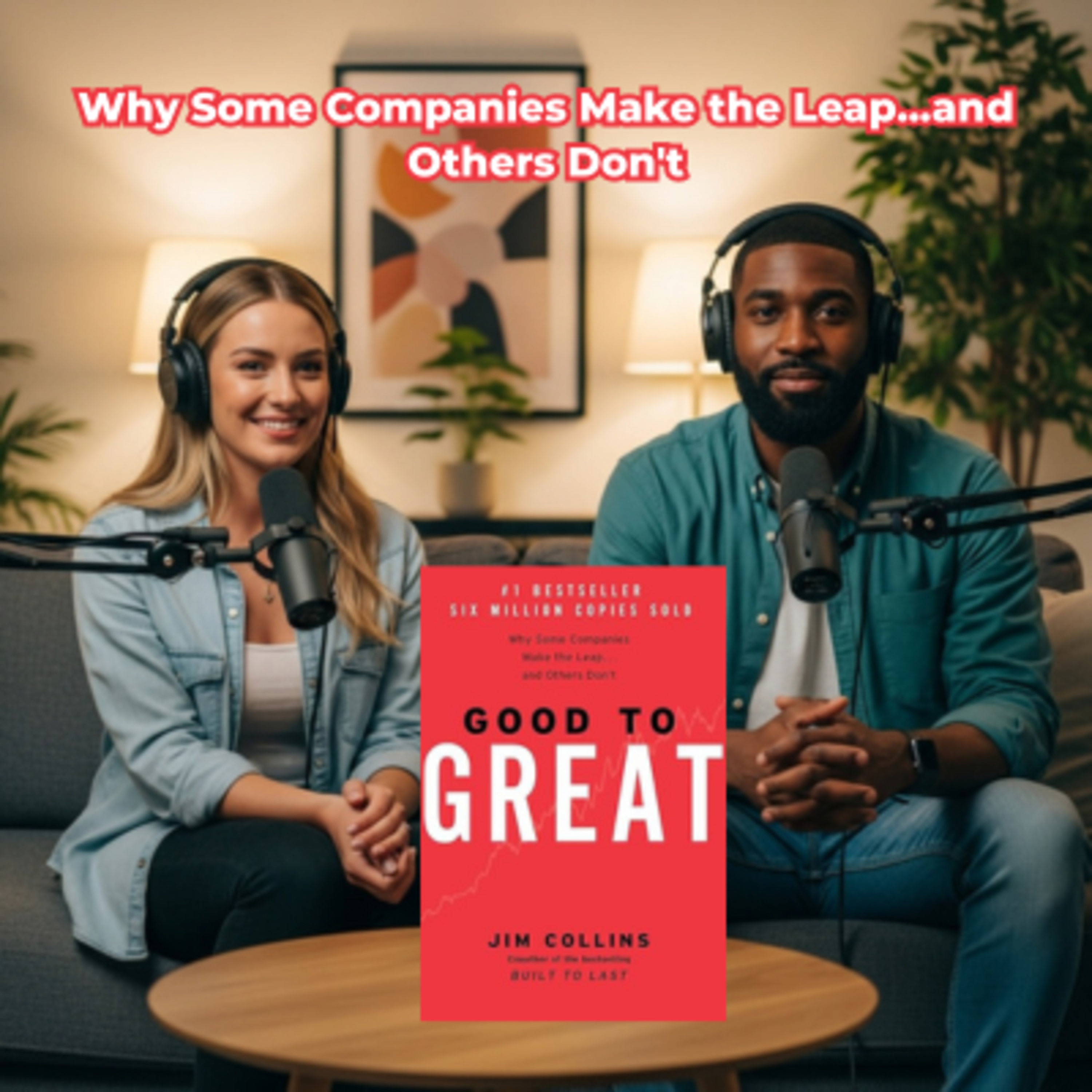
Good to Great by Jim Collins | Why Some Companies Make the Leap...and Others Don't
The Challenge:
Built to Last, the defining management study of the nineties, showed how great companies triumph over time and how long-term sustained performance can be engineered into the DNA of an enterprise from the verybeginning.
But what about the company that is not born with great DNA? How can good companies, mediocre companies, even bad companies achieve enduring greatness?
The Study:
For years, this question preyed on the mind of Jim Collins. Are there companies that defy gravity and convert long-term mediocrity or worse into long-term superiority? And if so, what are the universal distinguishing characteristics that cause a company to go from good to great?
The Standards:
Using tough benchmarks, Collins and his research team identified a set of elite companies that made the leap to great results and sustained those results for at least fifteen years. How great? After the leap, the good-to-great companies generated cumulative stock returns that beat the general stock market by an average of seven times in fifteen years, better than twice the results delivered by a composite index of the world's greatest companies, including Coca-Cola, Intel, General Electric, and Merck.
The Comparisons:The research team contrasted the good-to-great companies with a carefully selected set of comparison companies that failed to make the leap from good to great. What was different? Why did one set of companies become truly great performers while the other set remained only good?
Over five years, the team analyzed the histories of all twenty-eight companies in the study. After sifting through mountains of data and thousands of pages of interviews, Collins and his crew discovered the key determinants of greatness -- why some companies make the leap and others don't.
The Findings:
The findings of the Good to Great study will surprise many readers and shed light on virtually every area of management strategy and practice. The findings include:
- Level 5 Leaders: The research team was shocked to discover the type of leadership required to achieve greatness.
- The Hedgehog Concept: (Simplicity within the Three Circles): To go from good to great requires transcending the curse of competence.
- A Culture of Discipline: When you combine a culture of discipline with an ethic of entrepreneurship, you get the magical alchemy of great results. Technology Accelerators: Good-to-great companies think differently about the role of technology.
- The Flywheel and the Doom Loop: Those who launch radical change programs and wrenching restructurings will almost certainly fail to make the leap.
“Some of the key concepts discerned in the study,” comments Jim Collins, "fly in the face of our modern business culture and will, quite frankly, upset some people.”
Perhaps, but who can afford to ignore these findings?
#GoodToGreat #JimCollins #Leadership #BusinessStrategy #LeadershipDevelopment #BusinessGrowth #Management #CompanyCulture #OrganizationalSuccess #LeadershipSkills #BusinessLeadership #BookSummary #SuccessPrinciples #HighPerformance #BusinessExcellence#productivityhacks #personaldevelopment #successstrategies #businessinsights #leadershipskills #leadership #ambitiousprofessionals #businesstips
You know, usually when we think about failure, we picture something really dramatic, like a company just going completely bankrupt overnight or a massive project crashing and burning. Just some some giant explosion of terrible decisions that everyone can see from a mile away. Yeah, exactly. I mean, we are totally wired to look for the spectacular disaster because that, well, it makes the news, it's visible. It's a really clear warning sign for the rest of. Us exactly but today we aren't just giving opinions on failure or success.
We're looking at a massive stack of data five years of deep dive research tracking companies over a 15 year period to see what actually makes them tick. Distilling Jim Collins landmark findings and when you look at that data, the biggest threat to an organization or honestly even to a person isn't some catastrophic failure at all. The biggest threat is actually, well, it's comfort. It's being just fine. Right. It's this invisible trap of good enough. Yeah. And it is incredibly seductive, largely because, you know, doesn't feel like a trap when you're in it.
Yeah, It feels like success. You're doing well. You're comfortable. Which brings us to our mission. For this deep dive, we are decoding the specific data backed road map that separates ordinary companies and ordinary individuals from the truly extraordinary ones. Because whether you are building a business, managing A-Team, or just, you know, looking to level up your own life, these insights are designed to be entirely practical for you. So OK, let's unpack this. And I think the most fascinating part of this data is that greatness isn't born from luck, right?
It's not a lightning strike, and it's certainly not a happy accident. It is born from highly specific, repeatable patterns of discipline and focus. Right, and that starts with a concept that is honestly a bit of a tough pill to swallow. Which is good is the enemy of grade, yes. Like settling for good is the exact thing that prevents greatness. Think about it like a student who is naturally pretty smart, right? They can put in like minimal effort and easily get AB grade on every test. So they just decide, hey, AB is good enough, they get comfortable.
And they coast. Exactly. And because they are so comfortable with that B, they never actually push themselves to see if they could get an A. They never uncover their true potential because the B is just a perfectly cozy place to hide. And if we connect this to the bigger picture, you see this exact same B student behavior in massive multibillion dollar corporations. Oh, for sure. Just look at the data on the classic showdown between Blockbuster and Netflix. Oh man, the ultimate cautionary tale. Exactly.
But let's look at why it actually happened. Because at one point, Blockbuster was the absolute undisputed king of movie rentals. Yeah, they were everywhere. Right. They had thousands of stores. They were literally printing money, but they got comfortable with what was good for them. I mean, they had a model that relied incredibly heavily on late fees. Oh, I remember those. Brutal. Yeah, they were basically punishing their customers, but it made them a total fortune so they stuck with it. Netflix, on the other hand, started small but wasn't satisfied.
Right, they kept pushing. Exactly. They adapted to DVD delivery, then to streaming. They pushed for greatness. Blockbuster stayed comfortable with their good late fee model. And today, well, Netflix is thriving while Blockbuster is basically a relic. Just a nostalgic T-shirt at this point. Yeah, it just shows that the refusal to abandon a good legacy system can completely erase you from the map. It really makes you look at your own life and ask, you know, where am I just good when I could be striving for greatness.
But OK, let's say you recognize the trap. You realize you're stuck and good. You want to get out. The data outlines the very first step, and it's called first who, then what? Meaning you focus on getting the right people on board before you decide on your ultimate direction. That's right, the team comes before the strategy. No, wait, I got to say, this feels incredibly backwards to me. How so? Well, if I'm planning a road trip, I don't just grab a bunch of my friends, shove them in my car, lock the doors and say, all right, where are we going?
I map out the route to the Grand Canyon first, and then I ask who wants to go to the Grand Canyon? Shouldn't I know exactly where I'm driving before I invite people along? Well, it does feel counterintuitive, especially in traditional business planning where the vision is supposed to come first. Everyone tells you to set the vision right, but think about the mechanics of your road trip. If you pick people who only want to go to the Grand Canyon, what happens when the highway is completely washed out?
Oh, I see. Or what happens if you realize halfway there that there's a massive snowstorm and heading to the beach is actually a much better opportunity? If you hire exclusively for the destination, Your team falls apart the second the destination has to change. Because they only signed up for the Canyon. Exactly. And in reality, the destination always changes. Always. OK, I see the vulnerability there. So how do you actually hire without a destination? What does that look like? Look at how Southwest Airlines did it during their massive growth phase.
They didn't just hire people who are obsessed with a specific route or a specific type of plane. They focused heavily on filtering for people who matched their core culture and values first. The utilized group interviews not just to, you know, test hard skills, but to see how candidates interacted under stress. Oh, that's smart. Yeah, they look for humor, empathy, and adaptability. Because if you pick the right people, people who are adaptable and driven by shared values rather than just a specific skill set, they will actually help you figure out the best place to go when the road is closed.
They don't just sit in the back seat complaining. They become the compass. So you aren't just hiring passengers, you're hiring navigators? Exactly. OK, So you have this adaptable value driven crew in the car, but who's driving and how do they handle the inevitable potholes along the way? Well, this brings us to what the research classifieds as Level 5 leadership. Right. And it's crucial to point out that these are not the flashy, ego driven celebrity CE OS we constantly see on TV or on social media.
The ones taking all the credit for every win and going viral. Not at all. The defining characteristics of a Level 5 leader are a deep, almost quiet personal humility combined with a terrifyingly intense professional will. Terrifyingly intense. I like that. Yeah, they aren't in it for the magazine covers. Yeah, they are quietly getting things done and focusing entirely on the team's success over their own ego. Right. Think about the late Sam Walton, the founder of Walmart. Yes, perfect example. You'd think the guy who built the biggest retailer in the world would be flying around in private jets from day one, demanding absolute royal treatment wherever he goes.
You assume so. Yeah, but instead he famously drove an old beat up a pickup truck. He stood completely grounded and spent massive amounts of time just walking the floors of his stores, connecting directly with his employees. And let's breakdown exactly why that behavior is so effective mechanically. It's not just APR stunt. It creates psychological safety when a leader focuses on the success of the team, takes the blame when things go wrong, but looks out the window to assign credit to everyone else.
When things go right, the team notices. They feel valued. Exactly, and it destroys internal politics when people see that you are genuinely invested in the collective wind. They stop protecting their own egos and start giving their absolute best to the. Mission because they know you have their back. But, and this is a big but, even with a humble leader and a brilliant, adaptable team, reality can be harsh. Disasters happen. Oh, absolutely. Markets crash. Products completely fail. Which leads us to the next vital concept, confronting the brutal facts without losing faith.
It's like a doctor giving a patient an honest, painful diagnosis. You cannot start a treatment plan, you cannot start healing until you know the absolute truth of what's wrong with you. You have to look at the X-ray. Right. You have to look reality right in the eye without flinching or trigger coating it. But I have. To ask, how do you do that? I mean, how do you look at a truly brutal reality, a terrible quarter, a failing project, a massive existential set back without just getting incredibly depressed and throwing in the towel?
What's fascinating here is how the data addresses that exact psychological tension to the story of Admiral Jim Stockdale. He was the highest ranking military officer in the Hanoi Hilton prisoner of war camp during the Vietnam War. He survived 8 years in just unimaginable torturous conditions. Eight years. I mean, I can't even fathom that level of hardship. Exactly. It's horrific, and Stockdale survived while many others unfortunately didn't because of a very specific cognitive framework that we now call the Stockdale Paradox.
He realized that the prisoners who died of broken hearts were actually the optimists. Wait, the optimist? Yes, but that goes against every self help book ever written. You're supposed to stay positive. It really does. But the optimist would say we're going to be out by Christmas and Christmas would come and go. Oh, I see. Then they. 'D say we'll be out by Easter. Easter would come and go eventually, the repeated disappointment just completely crushed. Them. That's devastating. It is, but Stockdale survived because he separated the timeline from the ultimate outcome.
He fully accepted how terrible his daily situation was. He didn't pretend the torture wasn't happening. But at the exact same time, he never, ever lost faith that he would eventually prevail and make it home. So he held two totally conflicting ideas in his head at once, like absolute pessimism of the immediate reality and unwavering optimism of the ultimate outcome. Precisely. It's a dual mindset. You have to aggressively address what is broken or failing. You confront the brutal facts while staying completely steadfast about your end goal.
You acknowledge the immediate pain, but you remind yourself that you will engineer a way through it. OK, so we have a resilient team facing reality, but reality is chaotic. There are 1,000,000 different fires to put out, a million different opportunities to chase. Shiny object syndrome. Exactly how do they avoid spreading themselves too thin trying to fix everything at once? Well, this leads us to the idea of radical simplification. Finding your hedgehog concept. Right. Think of a musician who is pretty talented.
They can play the piano, the drums, the bass and the guitar decently well. They gig around, but they're just OK at everything. But then they decide to drop the piano, drop the drums, drop the bass, and focus absolutely entirely on mastering just the guitar. By focusing all their energy on that one single instrument, they go from being a decent generalist to a world class virtuoso. They build a massive reputation. And when we look at the corporate data, the perfect example of this is Walgreens. OK, Walgreens.
Yeah, back in the day, Walgreens was experimenting with all sorts of things. They actually owned restaurants. Wait, really? Walgreens restaurants? They. Were trying to be a grocery store, a general retailer, and a pharmacy all at once. They were basically playing all the instruments. Just a giant mashup. Exactly. But then they look at the data and realize they needed to simplify. They decided to focus purely on becoming the most convenient pharmacy in the world. But how? Did they actually measure that?
Because, you know, convenience is kind of a vague corporate buzzword. Every company says they're convenient. Well, they shifted their entire metric of success. Most retailers focus on profit per store. Walgreens changed their primary metric to profit per customer visit. Oh, that's totally. Different. It changes everything. It meant they needed high volume, high frequency and incredible ease of access. So they pioneer the drive through pharmacy. Makes sense they. Put stores on prominent St. corners so people could easily pull in and out.
They stop trying to be a restaurant and just focused relentlessly on that one clear, simple intersection of value. And if we apply that to you, the listener, it's really about finding your personal sweet spot. Yes. It's finding the exact intersection of three things. What you are deeply, intrinsically passionate about, what you are genetically or naturally capable of being the best in the world at, and what actually drives your economic or practical engine. Basically, what brings value. Exactly.
Once you find the overlapping center of those three circles, that becomes your entire focus. You stop playing the drums and the piano, but. And this is key. Maintaining that level of intense, singular focus requires a specific environment. You need what the data calls a culture of discipline. Which means no micromanaging, right? Yeah, because micromanaging seems like the opposite of a high functioning team. Exactly. Micromanaging is what happens when you have the wrong people or unclear goals, right?
If you have the right people, remember 1st 2:00, then what? And you have a crystal clear hedgehog concept. You don't need to hover over everyone's shoulder. They just get it done right. Look at companies like Amazon. They operate with incredible discipline, often utilizing concepts like the two Pizza rule, where teams are small enough to be fed by two pizzas. I love that. Rule. It's great. It creates a culture of immense clarity. Everyone knows exactly what their boundaries are, what their responsibilities are, and they are trusted to execute within that framework.
It's freedom within boundaries. OK, Speaking of execution and efficiency, technology is everywhere right now. I mean AI automation, a new productivity software launching every 3 seconds. Oh yeah, it's overwhelming. And here's where it gets really interesting, because the data on technology accelerators kind of goes against the grain of our tech obsessed culture. It's like being a chef. Technology is just a high quality, state-of-the-art oven. The oven does not make the food taste great. The chef's skill, the recipe, the quality of the ingredients, that's what makes the food great.
The fancy oven just cooks it faster and more evenly. That is a brilliant way to look at it. Technology is a support system. It is not the foundation of greatness. It is an accelerator of momentum, not the creator of it. So buying the most expensive enterprise software or adopting the latest AI tool isn't going to somehow magically save my disorganized, unfocused business. Not at all. In fact, if you have a flawed system, technology will just help you execute those flaws at lightning speed. Yeah, it'll help you make mistakes faster.
The research points back to Walgreens. They didn't lead with technologyduringthe.com Boom. When everyone was panicking and throwing money, any of the websites Walgreens paused they. Didn't just jump in. No, they only utilize new computer systems and Internet infrastructure to improve efficiency after they have their core strategy locked. In the convenience strategy. Exactly. They knew their strategy was convenience, so they use tech specifically to link their satellite systems so a customer could refill a prescription at any store nationwide.
They use technology to improve what they were already doing perfectly. Wow, That is discipline. So let's take a breath and look at where we are. We've avoided the trap of good enough. We've got the adaptable crew. We have a humble, driven leader. We're facing the brutal facts without losing hope. We have a singular focus, a culture of discipline, and we're using tools the right way. It's a solid foundation. It is. So why does it still feel like it takes forever to see any real results? Because greatness is a long game and this is where we have to talk about the flywheel.
Now I know everyone loves to throw around the phrase flywheel effect in business meetings these days like it's some magic spell. Right, it's definitely become a buzzword. But it's basically about building slow, steady momentum. You start pushing a massive heavy metal wheel. At first you push with all your might and it barely moves an inch. You keep pushing. It takes a monumental effort just to get it to complete one single rotation. And that's the part people skip over the boring, unglamorous, grueling effort of the first hundred turns because.
It's not sexy. Exactly. They want the wheel to spin at 1000 miles an hour on day 2. But the data shows that the companies that achieved greatness did it through consistent, relentless pushing in One Direction. It's compounding effort. But I have to push back here because the modern mantra is move fast and break things. You need to be agile. You need to pivot quickly or you'll be left behind, I hear. That all the time. Right. And the data warns against the opposite of the flywheel, which it calls the doom loop, constantly changing strategies.
I hear that, but practically speaking, how do you know if you're abandoning your core focus too early or if you're just stubbornly pushing a snowball that's never going to roll? It's tricky. Where's the line between having grit and just being delusional? Doesn't the doom loop just sound like modern agile? Advice. Well, that is the $1,000,000 question, and it's a vital distinction. There is a massive difference between changing your tactics and changing your core identity. OK, explain that. Being agile means you are adjusting how you execute your hedgehog concept based on new data.
That's totally fine. The doom loop is when you completely abandoned your hedgehog concept because pushing the wheel got hard and you go looking for a completely new, lighter wheel. You launch a new initiative, it doesn't yield immediate results, so you panic, scrap it, and pivot to a completely new industry. You never get the compounding effect of momentum because you keep resetting to 0. Greatness comes from committing to a core vision and taking consistent steps every single day, even when progress feels agonizingly slow.
I love that distinction, changing the tactics versus changing the core. So if the listener wants to start pushing their own flywheel today, what are the practical everyday action items? How do we actually do this? The research highlights a few key behaviors. First, establish rigid daily routines. Develop simple, repeatable habits that keep your focus locked in, like you know, time blocking your most important strategic work. Before checking a single e-mail, protect the time you spend on your hedgehog concept.
Consistency over intensity. Got it. What else? 2nd, and this is perhaps the most powerful tool, make a stop doing list A. Stop doing list. That sounds incredibly liberating. It really is. We always make to do lists, constantly adding to our plate, but greatness is often an act of subtraction. You need to look brutally at your calendar and actively decide which activities, meetings, or obligations do not serve your core focus and mercilessly eliminate them. Less distraction means more energy for the flywheel.
I'm literally going to make one of those as soon as we finish recording. Highly recommend it. And 3rd, make sure you celebrate the progress, not just the comfort. Reward yourself and your team for facing the brutal facts, for maintaining discipline, and for making those tiny incremental improvements that eventually lead to breakthrough momentum. So what does this all mean? When we zoom out and look at all this exhaustive data, the overriding message is clear and honestly pretty empowering. Greatness is not reserved for the lucky.
It is a result of disciplined, focused effort over a long period of time. It's about who you let in the car with you, how honestly you view the potholes in the road, and your absolute refusal to change your destination every time a shiny new trend pops up on the horizon. Exactly. And I I want to leave you with a final thought to ponder, building on this idea of the stop doing list and the very real danger of good enough. OK, we've talked extensively about tasks and strategies holding you back. But consider this.
What if the good thing that is preventing your greatness isn't a task at all? What if it's an environment or even a relationship? Oh wow, that changes the lens completely. Think about the people in your car right now. Are you surrounded by colleagues or peers who are actively pushing you toward greatness? Or are you sitting next to people who are perfectly comfortable settling for AB? That's a tough question to ask yourself. It is, but sometimes the most important thing you need to put on your stop doing list is spending your time in comfortable rooms where mediocrity is the accepted standard.
Because your environment dictates your standards, and if you want to be great, you simply can't afford to be anchored by the comfortably good. What an amazing place to leave it. Thank you so much for joining us on this deep dive. Keep asking the hard questions, keep pushing that flywheel, and most importantly, keep striving for your own greatness. We'll catch you next time.
 Apple Podcasts
 Castbox
 Castro
 Goodpods
 Moon FM
 Overcast
 Pocket Casts
 Podbean
 Podcast Addict
 Podcast Republic
 Spotify