An Ex-FBI Agent's Guide to Speed-Reading People | What Every Body Is Saying by Joe Navarro & Marvin Karlins
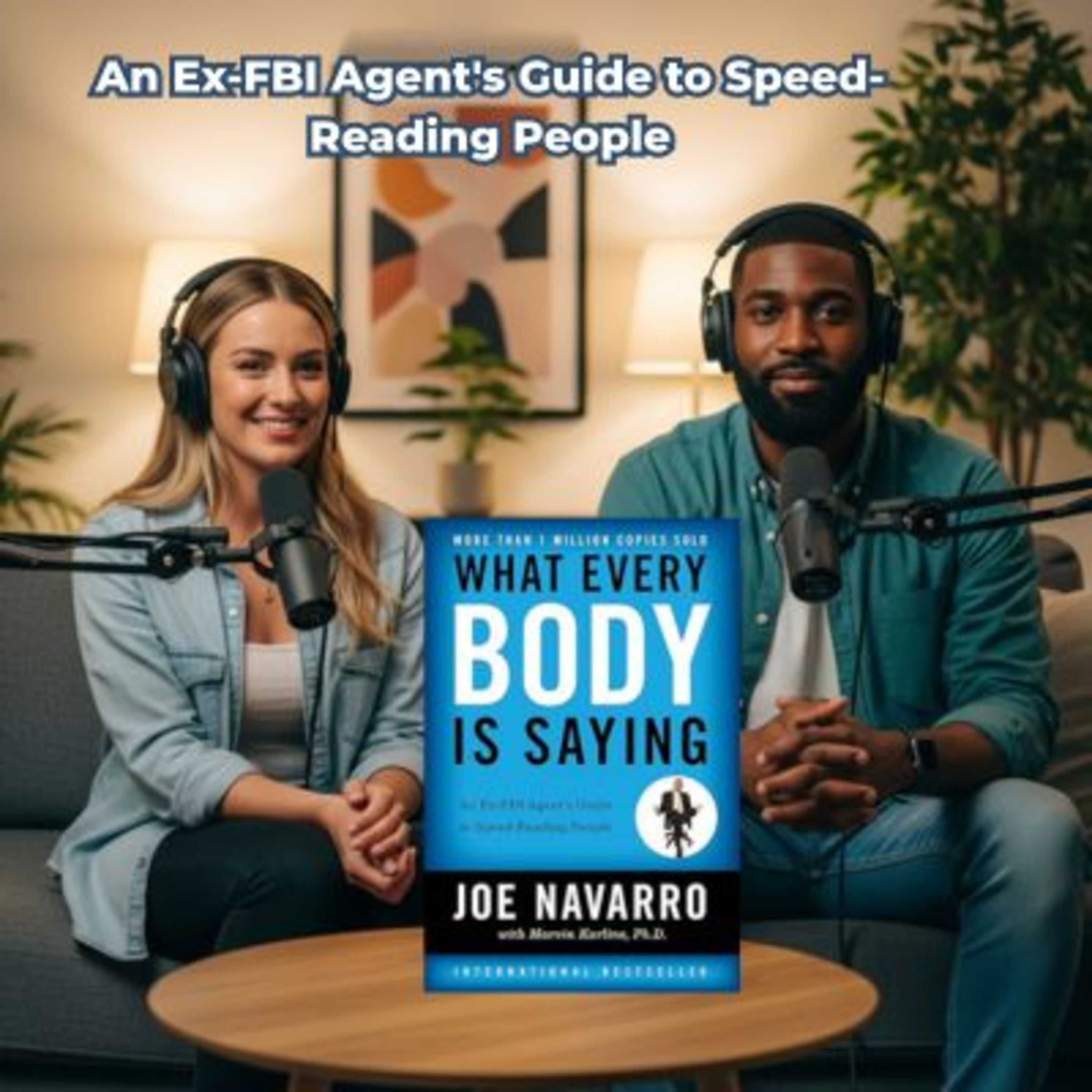
This episode outlines the fundamental principles of nonverbal communication as taught by former FBI agent Joe Navarro. It emphasizes the importance of establishing a baseline behavior for individuals to accurately detect shifts in their emotional state. Readers are encouraged to observe the limbic system’s automatic responses, which manifest through physical cues of comfort or discomfort. Specific focus is placed on the feet and torso, as these areas often reveal a person's genuine intentions or desire to leave a conversation. Finally, the guide highlights how arm gestures and posture provide critical context for understanding confidence and defensiveness. Mastering these techniques allows for enhanced relationship building and a more sophisticated interpretation of hidden social signals.Joe Navarro, a former FBI counterintelligence officer and a recognized expert on nonverbal behavior, explains how to "speed-read" people: decode sentiments and behaviors, avoid hidden pitfalls, and look for deceptive behaviors. You'll also learn how your body language can influence what your boss, family, friends, and strangers think of you. You will discover:
- The ancient survival instincts that drive body language
- Why the face is the least likely place to gauge a person's true feelings
- What thumbs, feet, and eyelids reveal about moods and motives
- The most powerful behaviors that reveal our confidence and true sentiments
- Simple nonverbals that instantly establish trust
- Simple nonverbals that instantly communicate authority
Filled with examples from Navarro's professional experience, this definitive book offers a powerful new way to navigate your world...
He says that's his best offer. Is it? She says she agrees. Does she? The interview went great—or did it? He said he'd never do it again. But he did.
#BodyLanguage #Psychology #CommunicationSkills #HumanBehavior #PeopleSkills #NonverbalCommunication #SocialSkills #EmotionalIntelligence #Confidence #Persuasion #SelfImprovement #BehavioralPsychology #LeadershipSkills #BookSummary #MindsetShift
Right now, I mean, someone in your life is probably lying to you and they don't even know that their own feet are giving them away. Yeah, it sounds a bit dramatic, but it is actually entirely true. I want you to picture this. You are sitting in a bustling coffee shop. The espresso machine is hissing, people are shuffling past your table, and you just take a moment to really observe the individual surrounding you. Which, you know, most of us rarely do these. Days, right? Exactly. But let's say you do.
Over in the corner you see someone leaning all the way forward over their table, arms extended, chatting eagerly. OK, very engaged. Yeah, then 2 tables down there is someone else aggressively tapping their foot, looking just completely impatient. And then, right by the counter, you spot a third person. Their arms are folded firmly across their chest and they just look incredibly stressed. You see these postures every single day, just everywhere. What if you could read their minds just by looking at those movements?
It's a really profound question because we usually just process all that is like background noise, but they are anything but random. Exactly. And this deep dive is dedicated to unpacking exactly that. We are looking at the insights of Joe Navarro, who is a former FBI agent. He spent his entire career. They're unlocking the hidden realm of nonverbal communication. Which is such a fascinating field. It really is. And our goal today is to give you the tools to identify hidden emotions, build much stronger relationships, and even, you know, guard yourself against deceit.
So OK, let's untack this because the idea of having this real life superpower to read the people around you, it just radiates this incredible appeal. It'll be like unlocking a secret level of human interaction. Right. It does sound like a superpower, I agree. But what's fascinating here is that this isn't some sort of parlor trick or, you know, psychic ability. It is actually deeply grounded in biology and critical observation. So it's not magic, no. Not at all. These movements, the tapping foot, the folded arms, the leaning torso, they are part of a deeply wired biological language that we all speak.
We are broadcasting our internal state constantly and mostly without even realizing it. But to actually read these signals, the source material makes a really interesting .1 that I think completely upends how most of us approach body language. Oh, the baseline concept. Yes. Like we can't just walk into a room and start aggressively analyzing everyone's crossed arms or tapping feet. If we just memorize a Dictionary of gestures, we are going to get it completely wrong. Oh 100% you will completely misread the situation.
Navarro insists we have to establish a baseline first. And that is really the absolute foundation of nonverbal intelligence. Before you can read someones nonverbal cues, you have to know what their normal actually looks like. Right, because everyone is different. Exactly. The fundamental truth is that people behave very differently based on their surroundings or just their inherent personality. You cannot possibly spot a meaningful deviation in someone's behavior if you don't have a starting point.
It's basically like calibrating a scale before you weigh something. You have to know what absolute 0 looks like on that specific scale. That's a great way to put it. Because otherwise every measurement you take afterward is going to be completely flawed. The source material actually gives this highly relatable first date scenario to illustrate this. Oh, the coffee date. Yeah, so imagine you sit down for coffee on a first date. Initially, the other person grins a lot. They lean in and they're quite talkative.
You have to mentally love that. That grinning, talkative state is their starting point. It's their baseline. Right, you're calibrating the scale. Exactly. But then an hour later you bring up a specific topic, maybe a past relationship or a career change or something, and suddenly they are only giving you these brief one word responses and they've crossed their arms tightly across their chest. Now, if you hadn't paid attention to the beginning of the date, you might just assume they are naturally a quiet, reserved person.
You just chalk it up to their personality. Exactly. But because you established the baseline of them being chatty and open, that sudden change is a glaring indicator. It tells you that something in the environment or something you just said has triggered A biological reaction. So is it a common mistake for people to just jump to conclusions without calibrating that scale first? Because, I mean, it feels like human nature to just walk around assigning meaning to gestures. Oh, we do it all the time.
We see crossed arms and immediately assume oh they are angry with me and we do it without doing any of the baseline work. It is the single most common and and I'd argue the most destructive mistake people make. We really love cognitive shortcuts. We want the cheat codes. Right. We want to generalize and say, you know, crossed arms always means anger, or avoiding eye contact always means deception. But skipping the baseline moves us into reckless speculation. Which is dangerous for a relationship it.
Was very dangerous. When you take the time to learn someone's unique baseline, like how much they naturally fidget or how they sit when they're relaxed, you move from speculating to actual comprehension. It radically improves your relationships because you are responding to their actual emotional shifts, avoiding disastrous misreadings that can really damage trust. OK. So once we have that baseline and we notice the sudden deviation, the obvious question for me is what is actually driving that physical shift?
Right, the mechanics behind. It yeah because if my date suddenly crosses their arms or my Co worker suddenly leans away they aren't consciously thinking OK I am uncomfortable therefore I will now cross my arms. No, the body just does it. Exactly. Navarro points straight to the biological engine driving this, which is the limbic system. Yes, and this is where the science gets just incredibly elegant. Our most honest nonverbal reactions are not controlled by the neocortex. And the neocortex is the logical part.
Exactly the logical thinking, higher order part of our brain. These reactions are driven by the limbic system, which is our brains emotional and survival center. The limbic system evolved to keep us alive. It processes sensory information and reacts to it milliseconds before the logical brain even has a chance to catch up. Wow, milliseconds. So the limbic system is basically the evolutionary first responder pulling the strings behind the scenes. Precisely. It operates entirely unbeknownst to us.
When we encounter a stressor, the limbic system triggers the classic survival responses. You know, freeze, flight, or fight without us making a conscious choice. The limbic system commands the body. It forces us to hold perfectly still. That's the freeze response to avoid detection. Or it forces us to lean away and create distance, which is the flight response. Oh, OK, that makes sense. These physical indicators are the limbic systems rapid fire way of protecting us when we feel endangered or conversely, relaxing our posture when we feel safe.
OK, let's bring this out of the evolutionary wild and into like the modern workplace because the source notes provide a perfect meeting scenario for this. Let's hear it. So you are standing at the front of the room presenting a new idea to your team. You look at one individual and they are leaning forward in their chair. They're grinning and they are nodding along. Which means the limbic system is broadcasting comfort and involvement. Exactly. But then you look at another person in the room, they are actively avoiding eye contact, their arms are crossed and they are leaning back as far as their chair will go.
Which is the limbic system executing A modified flight response. It is broadcasting discomfort and a feeling of being threatened by the situation. Wait, wait. So when I'm just standing there giving a PowerPoint presentation on quarterly metrics, my Co worker's brain is essentially reacting like they're out in the wild spotting a predator. I know it's hilarious to picture, but yeah, absolutely it's brilliant. The limbic system is ancient. It does not differentiate between a literal physical threat like a predator in the brush and a social or intellectual threat in a boardroom.
To the primitive brain, stress is just stress. If your new idea threatens a Co worker's status or makes them anxious about their workload, their limbic system reacts instantly to protect them. The leaning away is an attempt to escape, and the crossed arms act as a physical barrier against the perceived threat of your presentation. That is wild, but knowing that completely changes the dynamic of a room. How so? Well, if I see that biological flight response happening in real time, I can actually adapt.
If I see the leaning away and the crossed arms, I shouldn't just keep plowing forward with the same aggressive pitch. No, definitely not. Right. I can pause, I can adjust my tone and maybe ask them a collaborative question. Understanding these automatic limbic cues allows you to actively ease tension and foster trust, rather than just talking at someone whose biology is desperately trying to escape the room. Exactly. You stop fighting their logic and you start soothing their limbic system. That's a great way to put it.
So if the limbic system is reacting instantly, constantly trying to either protect us or signal safety, where does it leak this information most honestly? Because, I mean, we all have pretty good control over our facial expressions. Oh, very much so. Right from the time we are toddlers, we are expertly trained to lie with our faces. We are told to smile for the camera or look happy to see your relatives. Yeah, we are exceptional at facial deception, but the truth, according to Navarro's research, is revealed by the furthest point from our conscious control, and that is the feat.
OK, here's where it gets really interesting, because nobody is actively thinking about what their feet are doing during a conversation. Almost never. We put all our cognitive energy into managing our face and our voice. Which leaves the feet entirely under the jurisdiction of the limbic system. From an evolutionary standpoint, your feet are your primary means of escape. If a thread appears, the brain has to prepare the feet to move instantly. So they're like the getaway driver? Exactly. Gravity, balance, locomotion, it it all starts there.
Consequently, our feet frequently point in the precise direction of our desires, and they point away from our dislikes. They are incredibly honest indicators of where our brain actually wants to be. That is so revealing. They also exhibit signs of anxiousness much quicker than the rest of the body, like suddenly tapping toes or bouncing legs, which is essentially kinetic energy building up for a flight response. The text uses a party conversation to illustrate this, and it is a brilliant visual.
Imagine you are at a party and you are trapped in a conversation. You are looking at the other person's face and they are nodding, smiling and maintaining eye contact. Sure. They're being polite. Right on the surface, they look totally engaged, but then you glance down. Their torso is facing you, but their feet are pointed completely away, aimed straight toward the nearest exit. Or perhaps another group of people. That is a subliminal, unfiltered indication that their limbic system wants to leave.
It has already commanded the feet to prepare for departure, even while the socially conditioned neocortex is forcing the face to maintain polite eye contact. It is exactly like a car's turn signal. Oh, I like that. Yeah, like the face might be honking the horn making a lot of polite noise and keeping up appearances, but the feet are the actual turn signal, showing exactly where the driver really wants to go. That's a perfect analogy. So let's say I see the turn signal pointing to the door. My instinct would be to feel a bit insulted, but what is the actual strategic play here?
Well, the advantage here is having a covert understanding of their actual emotions. When you spot these subliminal indications, it enables you to modify your strategy seamlessly without making them defensive. So you don't call them out on it. No, never. You don't say hey your feet are pointing away. Instead you graciously say well I know you want to mingle. It was so great catching up and you just wrap it up nicely. Ah OK. You've given them an out before they even had to ask for one. And they will subconsciously appreciate your social grace.
Or if you want to save the interaction, you pivot the subject to something you know they actually care about and wants to see if their feet turn back towards you. Wow, so you just save everyone the awkward just by listening to the biology? Exactly. OK, moving up the body from the feet, we hit the core, the torso. How does the limbic system manipulate the center of our mass? Well, the torso houses the heart, the lungs, the vital organs. It is our most vulnerable real estate, so when the limbic system perceives danger, the torso responds dramatically to act as a shield.
Makes total sense, right? When a person is at ease and senses safety, they will stand tall, exposing their ventral side, their chest and stomach. It is a posture of absolute comfort. Open and relaxed. But if they're under stress or feel threatened, the biology of the freeze and hide response takes over. They will instinctively lean down, sag their shoulders to protect the vulnerable jugular of the neck, or cross their arms to put a physical barrier of flesh and bone over their heart and lungs. The source notes use a tough workplace scenario for this.
You are providing a teammate with feedback at the start of the meeting. They sit up straight, completely open and at ease. So that's our baseline. That's the baseline exactly, but the second you bring up a specific area where they underperformed, they immediately sagged their shoulders, slumped down and crossed their arms tightly. A huge shift. Right, and the text says this is blatantly defensive, but I want to push back on something here because this gets to the heart of how we interpret these signals.
OK, go ahead. The text explicitly says deception is hard to spot, but if I ask a pointed question and someone immediately throws up that physical shield, sagging and crossing their arms, doesn't that mean they are hiding the truth? Isn't hiding your true emotions a literal form of deception? This raises an important question, and it is a philosophical and biological distinction we really have to navigate carefully. What the torso is showing you is not a cognitive lie, it is showing you limbic stress and discomfort.
OK, stress not lies. Right. Deception is a high level cognitive process. It requires the neocortex to invent a false reality. The limbic system doesn't invent lies, it only reacts to stress. So their physical reaction isn't them lying to me, it's just them trying to survive the discomfort of the moment. Exactly. They might be sagging and crossing their arms because your feedback made them feel insecure or misunderstood or simply terrified about their job security. Spotting these thoracic hues isn't about playing interrogator and yelling aha, you're lying.
Right, which would be terrible for a team dynamic. If you accuse someone of deception every time they show discomfort, you will destroy your relationships. It is about having the empathy to know you've hit a nerve. When you see that physical shield go up, you know it is time to stop your current line of feedback. You inquire gently. You alter your strategy to manage their stress and bring their limbic system back to a state of safety. That reframing is so vital, it stops us from assuming malicious intent whenever someone is just biologically overwhelmed.
Precisely. But reading body language isn't just about isolating the torso or the feet in a vacuum, right? We can't just diagnose someone based on one body part. No, definitely not. The whole picture has to come together, especially when we look at highly expressive parts of the body like the arms. Right. And this leads us to the final and perhaps most critical lesson of Navarro's work. Context is crucial. Our motions are incredibly dynamic. They can be used to broadcast welcoming openness, aggressive defensiveness, or overwhelming confidence.
But the meaning of those gestures depends entirely on the surrounding circumstances. You cannot read a single gesture accurately without factoring in the environment. The general rule of thumb from the text seems to be about how much physical space the arms are claiming. Like broad, open arm gestures frequently convey assurance and zeal. Because you're claiming territory, which signals confidence. Conversely, tight, limited movements where the arms are pinned rigidly close to the body indicate holding back discomfort or anxiety.
You're making yourself a smaller target. Correct. Broad gestures indicate the limbic system feels safe enough to expand. Tight movements indicate it feels the need to protect and withdraw. The text gives us a great example of a job interview. If the candidate have loose arms and uses open hand motions while talking, they are likely at ease and confident in their answers. A. Good sign. But if they keep their arms rigidly close to their body, their limbic system is signaling severe anxiety or that they are holding something back.
But wait, let's complicate this. OK, let's do it. What if the interview room has the air conditioning turned up to the absolute maximum? If a candidate is sitting there with their arms crossed tightly over their chest, are they defensive and hiding something, or are they just freezing cold? Right, the environment. If we just look at the arms, we might assume they are a terrible defensive candidate. How much does context dictate the actual read here? If we connect this to the bigger picture, your question highlights exactly why context is the lynchpin of everything we've discussed today.
The context dictates everything. If the room is freezing, a crossed arm is not a psychological shield against your interview questions. It is a biological attempt to retain body heat. So if I ignore the ACI failed the baseline test and the context test, I'm reading a survival response to temperature as a personality flaw. Absolutely. You must account for environmental variables first. Is it cold? Is the chair painfully uncomfortable? Are there loud construction noises outside making them tense their shoulders?
Right, you have to rule all that out. Exactly. Once you factor those out, then and only then, can you interpret the arm motions as insight into their mental state. And the benefit of getting that right is immense. How so? Well, if you realize an interviewee is keeping their arms tight because they are genuinely anxious about the questions and not just physically cold, you can modify your behavior. You could smile more, offer a glass of water, and provide a moment of consolation to soothe their limbic system, helping them open up and show their true potential.
So what does this all mean? We have journeyed through the necessity of baselines, the evolutionary survival instincts of the limbic system, the brutal honesty of our feet, the protective shielding of our torsos, and the absolute demand for context. It's a lot to take in. It is, but when I look at all these pieces together, the ultimate take away here isn't about becoming some sort of hyper vigilant mind reading interrogator trying to catch people in lies. No, not at. All it is actually about navigating the world with significantly more empathy.
By understanding the mechanics behind these subtle cues. You can handle difficult situations with grace because you are actually listening to what the other person's biology is trying to tell you, even when their words are saying something completely different. That is the perfect synthesis. The core message of Navarro's work is that our bodies are constantly striving for safety in connection, and actions truly do speak louder than words. But accumulating this knowledge about the limbic system is completely useless if it just sits in your head is interesting trivia.
It is only valuable when you actively apply it. Use it to observe more deeply, to respond more compassionately, and to forge closer, more authentic bonds with the people you interact with every single day. It really does change the way you see every interaction. You know, we have spent this entire deep dive talking about how you can decode the hidden signals of everyone around you. But think about the wait. No, I shouldn't say it like that. Think about this instead as you go to your next meeting or as you sit down at a coffee shop later today.
You know what to look for in others now. But what unconscious secrets is your limbic system screaming to the rest of the room right now?
 Apple Podcasts
 Castbox
 Castro
 Goodpods
 Moon FM
 Overcast
 Pocket Casts
 Podbean
 Podcast Addict
 Podcast Republic
 Spotify